


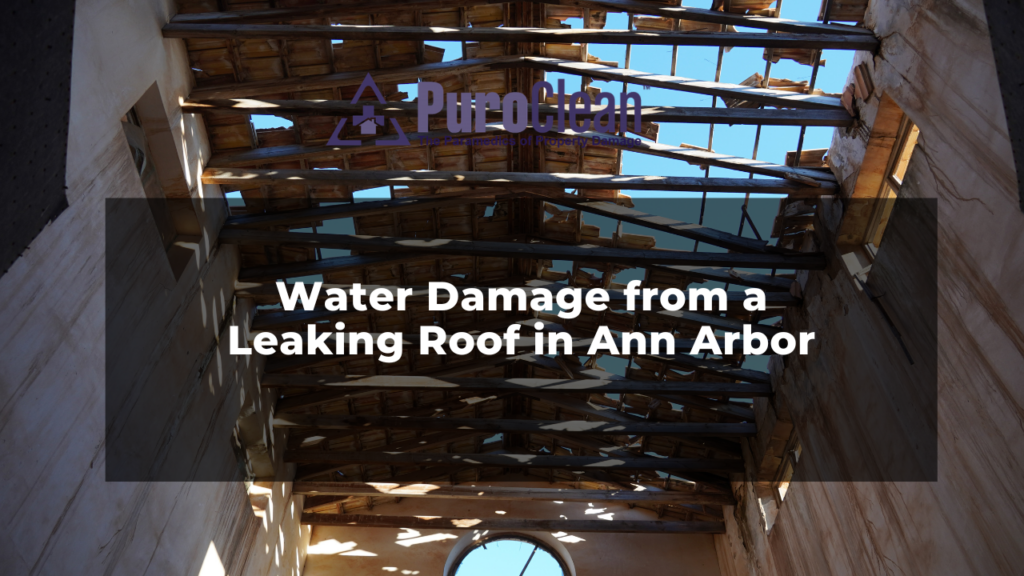
What Is Roof Leak Water Damage?
Roof leak water damage occurs when compromised roofing materials allow water to penetrate the building envelope and enter the home’s interior — soaking insulation, saturating drywall, weakening structural framing, and creating conditions where mold can establish and spread within 24 to 48 hours.
In Ann Arbor, roof leaks are a year-round risk. Spring and summer bring heavy thunderstorms with high rainfall intensity. Fall delivers sustained rainfall combined with wind-driven debris. Winter introduces ice dams — one of the most destructive and misunderstood causes of roof leak water damage in Michigan — along with the freeze-thaw cycles that accelerate the deterioration of roofing materials.
What makes roof leak water damage particularly damaging is how quietly and quickly it spreads. Water entering through a small breach in the roofing system does not stay at the point of entry. It travels along rafters, saturates insulation, migrates through wall cavities, and can appear as a ceiling stain or wet wall in a room far removed from the actual leak. By the time a homeowner notices any visible sign, water has typically been moving through the structure for longer than they realize.
According to the Insurance Information Institute, wind and hail — the most common triggers of roof damage — account for the largest share of homeowner insurance claims in the United States. A significant portion of those claims involve resulting interior water damage.
Understanding what causes roof leaks, how to recognize damage early, and what steps to take before and after a storm can protect your Ann Arbor home from the full extent of roof leak water damage.
What Causes Roof Leak Water Damage in Ann Arbor?
Roof leaks in Ann Arbor homes develop from a range of causes — some sudden and storm-related, others the result of gradual deterioration that goes unnoticed until a storm exposes the vulnerability.
1. Storm Damage to Roofing Materials
High winds during Ann Arbor thunderstorms can lift, crack, or completely remove shingles — leaving the underlayment and roof deck exposed to rainfall. Even shingles that remain in place can be compromised by wind uplift that breaks the adhesive seal between courses, allowing water to drive underneath during subsequent rain events.
Hail impact causes a different type of damage — granule loss from asphalt shingles that accelerates UV deterioration and reduces the shingle’s ability to shed water effectively. Hail damage is often invisible from the ground and requires a professional roof inspection to identify.
2. Ice Dams
Ice dams are one of the most destructive — and distinctly Michigan — causes of roof leak water damage. They form when heat escaping from the living space warms the upper sections of the roof, melting snow accumulation. That meltwater flows down toward the eaves, where the roof surface is colder, and refreezes — forming a ridge of ice that blocks drainage.
As the dam grows, water backs up behind it and has nowhere to drain. It sits on the roof surface, eventually finding its way under shingles, through the underlayment, and into the home. Ice dam water damage frequently affects ceilings, upper wall sections, and insulation directly beneath the roofline — and because it occurs gradually over days or weeks, the volume of water that enters can be substantial.
The University of Minnesota Extension identifies inadequate attic insulation and ventilation as the primary drivers of ice dam formation — making this a building performance issue as much as a weather event.
3. Damaged or Failing Flashing
Flashing is the metal material installed at roof transitions — around chimneys, skylights, dormers, vent pipes, and where the roof meets a vertical wall. It is designed to create a watertight seal at these vulnerable junctions. When flashing corrodes, pulls away from the surface, or was improperly installed, it becomes a primary entry point for water — even when the shingles themselves are in good condition.
Flashing failures are among the most common causes of roof leaks in Ann Arbor’s older housing stock, where original flashing materials may be decades old and well past their service life.
4. Deteriorated or Missing Shingles
Asphalt shingles have a finite service life — typically 20 to 30 years depending on material quality and installation. As shingles age, they become brittle, lose granule coverage, curl at the edges, and develop cracks that compromise their ability to shed water. In Ann Arbor, the freeze-thaw cycle accelerates this deterioration by repeatedly expanding and contracting roofing materials.
Missing shingles — from wind events or physical damage — leave the roof deck directly exposed. Even a single missing shingle represents a significant vulnerability during a heavy rainstorm.
5. Clogged or Damaged Gutters
While gutters are not part of the roof itself, their failure directly contributes to roof leak water damage. When gutters are clogged with debris, water backs up along the roof edge and saturates the fascia board and soffit. In winter, clogged gutters accelerate ice dam formation by preventing meltwater from draining away from the roof.
Gutters that have pulled away from the fascia allow water to run behind the gutter and directly down the exterior wall — another pathway for water to enter the building envelope.
6. Skylight and Vent Pipe Seal Failures
Skylights and roof penetrations for plumbing vents, exhaust fans, and HVAC equipment are sealed with flashing and caulking that degrades over time. As sealants shrink, crack, and separate, water finds a direct path into the home through what should be a watertight penetration. Skylight leaks are particularly common in Ann Arbor homes after the freeze-thaw cycles of late winter and early spring.
What Are the Signs of Roof Leak Water Damage?
Roof leak water damage often hides behind finished surfaces long before it becomes visible. Knowing what to look for — both inside and outside the home — allows Ann Arbor homeowners to catch problems before they escalate into major structural repairs.
Inside the home:
- Water stains or discoloration on ceilings, particularly brown or yellow rings
- Peeling, bubbling, or sagging paint on ceilings or upper walls
- Damp, soft, or bowing drywall — particularly near the roofline
- Musty or earthy odors in upper-floor rooms or the attic
- Visible mold growth on ceilings, attic framing, or insulation
- Daylight visible through the attic roof deck
- Wet or compressed insulation in the attic
Outside the home:
- Missing, cracked, curling, or visibly worn shingles
- Granule accumulation in gutters — a sign of advanced shingle wear
- Damaged, lifted, or corroded flashing at chimneys, skylights, or dormers
- Sagging gutters or sections that have pulled away from the fascia
- Ice buildup along the eave line in winter
Catching even one or two of these signs warrants a professional roof inspection — and if interior signs are present, a water damage assessment as well.
What to Do Before a Storm to Prevent Roof Leak Water Damage
Proactive maintenance before storm season is the most cost-effective way to protect your Ann Arbor home from roof leak water damage. These are the highest-impact steps to take:
Schedule a professional roof inspection annually: Have your roof professionally inspected at least once a year — ideally in early spring before heavy rain season and again in late fall before winter weather arrives. A qualified inspector can identify failing shingles, deteriorated flashing, and vulnerable penetrations before they become active leaks.
Clean and secure gutters before storm season: Remove all debris from gutters and downspouts in spring and fall. Ensure gutters are properly fastened to the fascia and correctly sloped for drainage. Extend downspouts at least 3 to 6 feet from the foundation to prevent ground-level water intrusion.
Inspect and reseal flashing: Visually inspect flashing around all chimneys, skylights, and roof penetrations for signs of lifting, corrosion, or separation. Have deteriorated flashing repaired or replaced before storm season — it is far less expensive to address proactively than after water has entered the home.
Improve attic insulation and ventilation: Proper attic insulation and ventilation are the most effective defenses against ice dam formation. Ensuring your attic is adequately insulated and that soffit and ridge vents are clear and properly functioning reduces the heat differential that causes snow to melt unevenly on the roof surface.
Trim overhanging tree branches: Branches over your roof are a significant hazard during Ann Arbor storms. High winds can bring branches down on the roof, causing immediate structural damage. Overhanging branches also deposit debris into gutters and create ongoing abrasion against roofing materials.
Know where your water main shutoff is located: If a storm causes significant roof damage and water begins entering the home rapidly, knowing how to quickly shut off the water supply prevents compounding damage from plumbing systems affected by structural movement.
What to Do After a Storm If You Suspect a Roof Leak
If your Ann Arbor home has been through a significant storm event, take these steps immediately — even if you don’t yet see obvious signs of damage:
Step 1: Conduct a safe interior inspection. Before going on the roof, inspect your attic and upper-floor ceilings for any signs of water entry. Look for wet insulation, water dripping from the roof deck, staining on ceiling drywall, or daylight visible through the roof structure. The attic will show damage before it appears on finished ceilings below.
Step 2: Document all visible damage. Photograph every area of suspected or visible damage thoroughly — both interior and exterior — before beginning any cleanup or temporary repairs. Comprehensive photo documentation is critical for insurance claims and professional damage assessments.
Step 3: Apply temporary protective measures safely. If you can safely access the roof, placing a waterproof tarp over damaged sections prevents additional water entry while permanent repairs are arranged. Do not attempt to access a wet, steep, or structurally compromised roof. Safety takes absolute priority over temporary damage mitigation.
Step 4: Contact your insurance company promptly. Report the damage to your homeowner’s insurance carrier as soon as possible. Most policies require prompt notification after a storm event. Provide your photo documentation and avoid making permanent repairs before an adjuster has inspected the damage.
Step 5: Begin interior water removal and drying immediately. If water has entered the home, begin extraction and drying without delay. Remove standing water, place fans and dehumidifiers in affected areas, and increase ventilation. Every hour that moisture remains in building materials increases the risk of mold growth and structural deterioration.
Step 6 : Call a professional water damage restoration company. Surface drying is not sufficient when water has penetrated into wall cavities, insulation, or structural framing. Professional restoration requires moisture detection equipment, structural drying systems, and in many cases, controlled demolition to access and fully dry affected materials.
How Far Can Roof Leak Water Damage Spread?
The distance roof leak water damage travels from its point of entry surprises most homeowners. Water entering through a roofing defect does not pool neatly below the breach. It flows along rafters and roof sheathing, saturates attic insulation, and migrates through ceiling drywall — often appearing as a ceiling stain in a room that has no roof directly above it.
In multi-story homes, water that enters through the roof can travel through the attic floor, saturate the ceiling of the upper floor, migrate through wall cavities, and ultimately affect the floor below. A single roof leak — left unaddressed through multiple rain events — can result in damage spanning multiple rooms, multiple floors, and multiple building systems.
The Federal Emergency Management Agency (FEMA) notes that water intrusion through the building envelope — including roof systems — is a leading cause of progressive structural deterioration in residential properties, particularly when initial entry points go undetected.
This is precisely why professional moisture detection is essential after any suspected roof leak. Thermal imaging cameras and calibrated moisture meters can identify water migration pathways and hidden moisture pockets that are completely invisible to the naked eye — ensuring that drying is complete and that no moisture is left behind to promote mold growth or continue degrading structural materials.
What Is the Mold Risk After a Roof Leak?
Any roof leak that introduces moisture into insulation, drywall, or wooden framing creates immediate mold risk. Mold requires only three conditions to establish and spread: moisture, a food source (organic building materials), and time. In the warm, enclosed environment of a wall cavity or attic space, all three conditions are present.
The Centers for Disease Control and Prevention (CDC) recommends that water-damaged materials be dried within 24 to 48 hours to prevent mold growth. After that window, remediation becomes significantly more complex and expensive.
Mold following a roof leak most commonly appears in the attic — where insulation and wooden framing provide abundant organic material — and in ceiling and upper wall cavities directly below the leak. Left unaddressed, attic mold can spread to the entire roof structure and eventually compromise the integrity of the sheathing and framing that supports the roof itself.
When Should You Call a Professional Restoration Company in Ann Arbor?
Contact a professional water damage restoration company immediately if:
- Water is actively entering your home through the ceiling or walls
- You find wet or water-stained drywall, insulation, or framing in your attic
- Ceiling drywall is sagging, soft, or visibly bowing with retained water
- You detect musty odors in upper-floor rooms or the attic after a storm
- You find visible mold on attic framing, insulation, or ceiling surfaces
- Water stains appear on ceilings or upper walls following a rain event
- Your home has experienced repeated roof leaks over multiple storm events
PuroClean of Ann Arbor provides 24/7 emergency response for roof leak water damage throughout Ann Arbor and surrounding communities. Our certified technicians use thermal imaging and professional moisture detection equipment to locate all water migration pathways — including hidden moisture inside walls, ceilings, and attic spaces. We provide complete structural drying, content protection, and certified mold remediation to restore your home fully and safely.
Frequently Asked Questions About Roof Leak Water Damage in Ann Arbor
How quickly does roof leak water damage become serious? Roof leak water damage can become serious within hours of a significant rain event. Water entering through a roof breach saturates insulation rapidly, and mold growth can begin within 24 to 48 hours of moisture exposure. Prompt action — beginning interior drying immediately and calling a restoration professional — is the most effective way to limit damage and costs.
Can a small roof leak cause significant damage? Yes. Small, slow roof leaks are often more damaging than sudden large leaks precisely because they go unnoticed for longer. A minor leak that persists through several rain events can saturate insulation, rot framing, and establish mold colonies long before any visible sign appears inside the home.
Does homeowner’s insurance cover roof leak water damage in Ann Arbor? Most standard homeowner’s insurance policies cover sudden and accidental water damage resulting from storm-related roof damage — such as wind-removed shingles or hail impact. Damage resulting from gradual deterioration or deferred roof maintenance is typically excluded. Document all damage thoroughly, report promptly to your insurer, and avoid making permanent repairs before an adjuster inspects.
What is an ice dam and how does it cause roof leaks? An ice dam forms when heat from the home’s interior warms the upper roof surface, melting snow accumulation. The meltwater flows toward the colder eaves and refreezes, forming a ridge of ice that blocks drainage. Water backs up behind the dam and eventually penetrates under shingles and into the home. Proper attic insulation and ventilation are the most effective preventative measures.
How do I know if water has gotten into my walls from a roof leak? Signs that water has migrated into wall cavities from a roof leak include soft or bowing drywall on upper walls, paint that is peeling or bubbling near the ceiling, musty odors that persist despite ventilation, and mold appearing on wall surfaces in upper rooms. A professional restoration company can use thermal imaging and moisture meters to confirm hidden moisture without destructive investigation.
How long does roof leak water damage restoration take? Restoration timelines depend on the extent of damage, the materials affected, and whether mold remediation is required. Structural drying of affected building materials typically takes 3 to 5 days with professional equipment. If mold remediation, drywall replacement, or structural repairs are required, the full restoration process may take one to several weeks.
PuroClean of Ann Arbor provides 24/7 emergency water damage restoration, roof leak damage repair, structural drying, and mold remediation services throughout Ann Arbor and surrounding communities. When a leaking roof threatens your home, we respond fast — any time, day or night.