


For commercial property owners, corporate facility managers, and real estate developers in New York, a sudden water intrusion event is not just an inconvenience, it is an absolute operational emergency. Every hour that standing water remains in a commercial building translates directly to thousands of dollars in lost revenue, disrupted supply chains, displaced tenants, and severe structural risk. Unlike residential water mitigation, handling large scale disasters in retail plazas, high rise office towers, industrial warehouses, and medical clinics requires a completely different echelon of expertise, heavy industrial machinery, and regulatory compliance.
When search metrics indicate a surge in business queries for commercial water damage restoration ny, stakeholders are looking for immediate solutions that prioritize business continuity, mitigate structural liability, and ensure rapid, lawful restoration. PuroClean of Baldwin stands at the forefront of this critical industry, offering round the clock emergency dispatch via our dedicated commercial response line at (516) 200-1416.
Navigating the dense regulatory landscape of New York State while managing a physical structural crisis is incredibly complex. Commercial buildings feature complex mechanical systems, dense structural materials, multi floor layouts, and strict indoor air quality mandates that must be respected during any restoration project.
This deep dive industry guide explores the unique challenges of commercial water damage, the engineering protocols behind large scale drying, the financial realities of business interruption insurance, and how a proactive partnership with a local Nassau County mitigation leader protects your bottom line.
The Financial and Operational Realities of Commercial Water Incidents
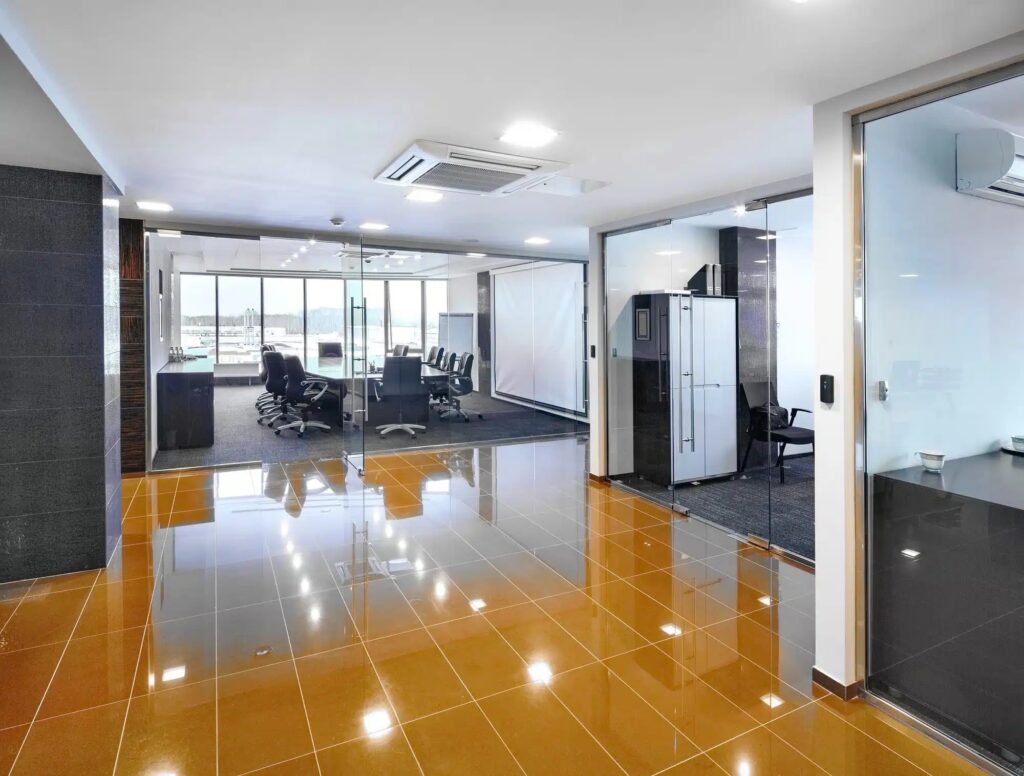
The primary differentiator between residential and commercial water damage is the scale of financial exposure. In a single family home, a burst pipe destroys finishes and personal property. In a commercial office complex or manufacturing hub, that same burst pipe can halt manufacturing lines, ruin millions of dollars in electronic data infrastructure, trigger steep tenant lease penalties, and create a massive public relations problem.
The Real Cost of Operational Downtime
Business interruption is often the most expensive component of a commercial water disaster. If a multi story office building in Baldwin experiences a plumbing failure on an upper floor, the cascading water can force the temporary closure of dozens of independent businesses. Employees cannot work, retail operations cease, and customer transactions drop to zero. Statistical data indicates that a significant percentage of businesses that experience a catastrophic disaster without a swift mitigation plan never fully reopen their doors. This highlights why speed is the single most critical factor when selecting a New York commercial restoration company.
Structural Liability and Tenant Relations
Commercial property managers owe a strict duty of care to their tenants and employees. If water damage is handled improperly, or if drying is delayed, the indoor environment can become compromised by toxic mold growth and degraded indoor air quality. This creates an environment ripe for tenant litigation, worker compensation claims, and local health department code violations. By choosing a highly certified restoration partner, you secure documented proof that the property has been restored to safe, healthy building standards, successfully insulating your corporation from future structural liability.
Common Catalysts for Commercial Water Damage in New York Buildings
The architectural landscape of New York, ranging from historic brick buildings to modern glass curtain wall high rises, presents unique vulnerabilities to water intrusion. Understanding these catalysts helps facility engineers implement better preventative maintenance plans.
High Pressure Commercial Plumbing and Pipe Bursts
Commercial plumbing systems operate under significantly higher pressure than residential networks to distribute water across massive footprints and vertical stories. When a main supply line, a commercial water heater, or a major valve fails, thousands of gallons of water can flood a building within minutes. We frequently see extensive damage caused by a second floor pipe burst that completely saturates the floor assembly, destroying the ceiling tile grid systems and office cubicle infrastructure on the floor below.
Fire Sprinkler System Malfunctions
While fire sprinkler systems are vital life safety assets, accidental activation or line ruptures due to freezing temperatures can cause staggering property damage. A single open sprinkler head releases a continuous blast of pressurized water that can inundate an entire floor in a matter of minutes. Because sprinkler lines often hold stagnant water, the initial discharge can carry heavy rust and organic sediment, requiring intensive cleaning and sanitization of all affected surfaces.
Commercial Roof Failures and Severe Weather Events
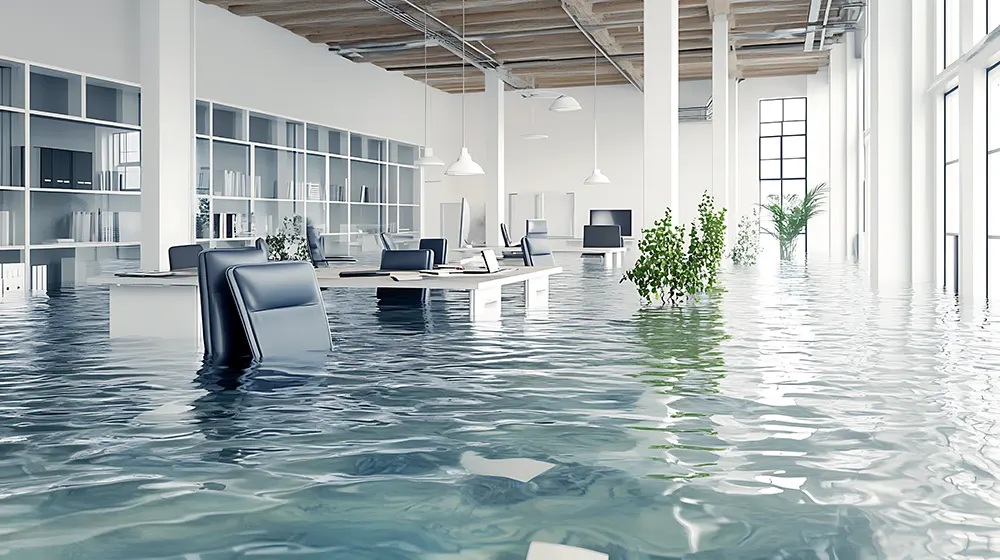
Flat commercial roof systems require constant maintenance. Clogged roof drains, deteriorated flashing, or membrane punctures during heavy Long Island storms can trap water on the roof, eventually forcing it through the decking and down into the building envelope. During winter months, ice dams along commercial roof lines can back up water beneath the roofing material, leading to widespread ceiling saturation in top floor office suites and retail showrooms.
HVAC Condensate Line Overflows
Massive commercial HVAC rooftop units and interior air handlers generate immense volumes of condensate water, especially during hot, humid New York summers. If condensate drain lines become blocked by algae, rust, or debris, the collection pans overflow directly into the building’s ceiling cavities. This slow, hidden water damage can go unnoticed for weeks, quietly destroying drywall, warping structural wood framing, and fostering widespread mold colonies behind commercial wallpaper.
The Scientific Protocol for Industrial Scale Water Mitigation
Restoring a commercial facility requires a precise, engineered approach based on the laws of thermodynamics and psychrometrics. PuroClean of Baldwin adheres strictly to the IICRC S500 standard for professional water damage restoration, executing a multi stage protocol to stabilize the building envelope rapidly.
Advanced Moisture Mapping and Thermal Imaging
You cannot dry what you cannot see. Because water travels along the path of least resistance, it often migrates deep inside commercial wall cavities, elevator shafts, subfloor systems, and concrete structural slabs. Our technicians utilize state of the art FLIR thermal imaging cameras and non invasive moisture meters to map out the exact boundary of the moisture migration. This allows us to pinpoint hidden water pockets without needlessly demolishing sound building materials.
High Volume Commercial Water Extraction
Physical extraction is infinitely faster and more cost effective than relying entirely on dehumidification. PuroClean deploys heavy duty, truck mounted extraction units and heavy duty industrial submersible pumps to pull standing water out of carpets, concrete subfloors, and basement levels. Our specialized weighted extraction tools, such as the Rover water extractor, apply hundreds of pounds of targeted compression to squeeze subsurface water out of commercial carpet tiles and dense padding, drastically accelerating the overall drying timeline.
Industrial Dehumidification: Desiccant vs LGR Technology
Drying massive commercial spaces requires specialized equipment capable of removing hundreds of pints of moisture from the air every day. We utilize a strategic combination of Low Grain Refrigerant (LGR) dehumidifiers and massive desiccant drying wheels. LGR dehumidifiers are exceptionally efficient in standard commercial conditions, lowering grain weight and pulling moisture out of standard building materials. For complex, deep structural drying, or when dealing with highly porous materials in cold environments, we deploy large desiccant trailers. Desiccant dehumidifiers utilize chemical attraction to create ultra dry processed air, driving moisture out of dense materials like plaster, brick, and thick structural concrete slabs.
Precision Air Management and Evaporation
To facilitate rapid evaporation, industrial axial air movers are arranged in a precise aerodynamic pattern throughout the affected space. These fans break the boundary layer of saturated air directly above wet surfaces, allowing the dry air generated by our dehumidifiers to continuously absorb structural moisture. Our project managers continuously monitor temperature, relative humidity, and grains per pound to adjust the drying configuration daily, ensuring the fastest path to pre loss condition.
Prioritizing Business Continuity: Strategic Incident Management
A major challenge in commercial restoration is executing the cleanup without completely shutting down client operations. As professional digital marketers and operations specialists, we know that communication and strategic logistics are what separate an excellent restoration company from an average one.
Phased Containment and Zoning
PuroClean can isolate wet areas using heavy duty, flame retardant plastic sheeting walls and negative pressure air systems. By creating a sealed containment zone, we can run loud industrial equipment, perform necessary demolition, and apply sanitizing agents in one sector of the building while employees safely continue their work on the other side of the barrier. HEPA air scrubbers run continuously inside the containment zone to ensure that no dust, mold spores, or odors escape into active public spaces.
Flexible Off Hours Scheduling
We recognize that certain high traffic environments, such as retail stores, medical centers, and schools, cannot have technicians running around during standard business hours. PuroClean of Baldwin provides full 24/7 flexibility, deploying large crews during night shifts and weekends to handle the loudest extraction and demolition work. By the time your staff arrives the following morning, the site is stabilized, safe, and whisper quiet dehumidifiers are tucked away discreetly out of the main foot traffic zones.
Navigating Commercial Claims with Industry Standard Software
Commercial water damage insurance claims are inherently complex, involving property damage, asset loss, and extensive business interruption computations. To secure proper coverage and quick funding, your restoration company must provide immaculate documentation.
PuroClean of Baldwin utilizes Xactimate, the universally accepted estimating software platform used by major commercial insurance carriers across New York. Our project managers document every single line item of labor, material, and equipment usage in strict accordance with insurance company guidelines. We capture high resolution digital photographs of every affected asset, track daily atmospheric drying logs, and compile comprehensive structural moisture readouts. This transparent, data driven reporting package gives your insurance adjuster exactly what they need to approve and settle your claim rapidly, preventing costly disputes and communication delays.
Frequently Asked Questions About Commercial Water Restoration
How does commercial water damage restoration differ from residential?
Commercial restoration involves vastly larger physical footprints, unique structural components like steel framing and concrete decks, complex commercial code compliance, and intense business continuity demands. It requires industrial scale drying equipment, specialized commercial insurance knowledge, and the ability to work around active employees or tenants without disrupting business operations.
What is the difference between Category 1, 2, and 3 water?
Category 1 water originates from a clean source, such as a broken supply line, and poses minimal health risks if handled quickly. Category 2 water, often called gray water, contains significant contamination, such as washing machine discharge or punctured waterbeds, and can cause sickness if ingested. Category 3 water, or black water, is grossly contaminated and highly dangerous, originating from sewage backups, seawater intrusion, or river flooding. Category 3 scenarios require aggressive structural demolition, specialized personal protective gear, and heavy sanitization protocols.
How long will it take for our commercial facility to dry completely?
Most commercial properties can be thoroughly dried within three to five days under optimal conditions. However, if water has deeply penetrated heavy structural concrete floors, multiple layers of drywall, or intricate hardwood assemblies, the process can take longer. Using desiccant dehumidification trailers can significantly accelerate this timeline for large commercial spaces.
Can our employees remain in the building during the drying process?
Yes, in many scenarios, business operations can continue seamlessly. By setting up rigid physical containment barriers, utilizing negative air pressure machines, and planning disruptive work for evening shifts, we can ensure active zones remain safe, clean, and quiet for your staff.
How do you prevent mold from developing after a commercial flood?
The absolute key to mold prevention is rapid response and thorough structural drying. Mold spores germinate within 24 to 48 hours in the presence of moisture. By deploying high volume extraction units and heavy dehumidification immediately, we pull moisture levels down below the threshold required for mold to grow, followed by the application of EPA registered antimicrobials for long term protection.
What should a facility manager do while waiting for the restoration team?
If safe, locate and close the main water control valve immediately to stop the flooding. Isolate power to the affected sectors at the breaker panel to prevent electrical shock hazards. Move vulnerable electronics, high value inventory, and essential business documents out of the flood zone, and clear a path for emergency restoration vehicles.
Are your restoration technicians fully certified in New York State?
Yes, all PuroClean of Baldwin technicians undergo rigorous training and hold full certifications from the IICRC. We maintain comprehensive liability insurance policies tailored for commercial environments and strictly follow all state and federal OSHA safety mandates.
Secure Your Business Resilience with PuroClean of Baldwin
When a water disaster threatens your commercial property in New York, hesitation is your costliest mistake. Partnering with a proven, local restoration leader ensures that your building is stabilized rapidly, your financial exposure is controlled, and your operations resume with minimal friction.
Do not let a plumbing failure or an unexpected storm disrupt your business success. For elite, scientifically backed commercial water damage restoration ny, contact the experienced professionals at PuroClean of Baldwin immediately at (516) 200-1416. Our emergency commercial response teams are fully mobilized and standing by 24/7 to defend your property, your people, and your bottom line.
Call PuroClean of Baldwin any time, 24 hours a day, 7 days a week. We serve Baldwin, Freeport, Rockville Centre, Merrick, Bellmore, Oceanside, Valley Stream, Lynbrook, and all of Nassau County with immediate emergency fire damage restoration response.
Connect With Us on Social Media!
Facebook | Instagram | Twitter | NextDoor | Pinterest | Google Reviews | LinkedIn | Tiktok | YouTube


