


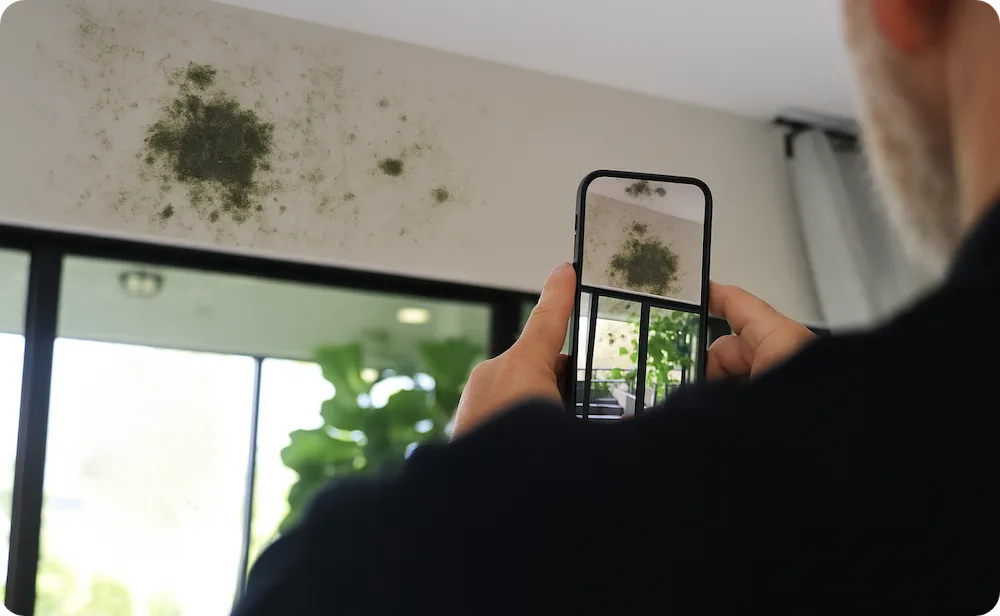
Mold can begin growing on wet materials in as little as 24 to 48 hours. This is the single most important fact for any Nassau County homeowner dealing with water damage to understand, because it transforms water damage from a cleanup task into a race against a biological clock.
That 24 to 48 hour window is not a worst-case scenario or a scare tactic used by restoration companies. It is the documented timeframe in which mold spores, which are present in virtually all indoor and outdoor air, can germinate and begin colonizing a wet surface when conditions are favorable. Once that colonization begins, the situation changes fundamentally. What was a water damage problem, solvable through extraction and drying, becomes a water damage problem plus a mold problem, which requires an entirely different and more involved remediation process.
For homeowners across Baldwin, Freeport, Rockville Centre, and the rest of Nassau County, where coastal humidity already creates favorable conditions for mold growth even without an active water event, this timeline is especially critical to understand. This guide breaks down exactly how the mold growth timeline works, what factors accelerate or slow it down, and why the speed of your response to water damage is the single biggest factor in whether your home develops a mold problem.
The Mold Growth Timeline: Hour by Hour and Day by Day
Mold growth is not an instantaneous event, but it is also not a slow, gradual process that gives homeowners weeks to respond. Understanding the actual timeline helps explain why restoration professionals talk about response time in hours, not days.
| Time After Water Exposure | What Is Happening |
| 0 to 1 hour | Water spreads and is absorbed into porous materials including drywall, carpet, upholstery, and wood. No mold growth has begun. This is the optimal window for extraction and drying. |
| 1 to 24 hours | Materials continue to absorb moisture. Wood begins to swell. Drywall begins to wick moisture upward from the base. Mold spores present on the surface have access to moisture but have not yet germinated. Professional response in this window typically prevents mold entirely. |
| 24 to 48 hours | This is the critical threshold. Under favorable conditions, mold spores begin to germinate on wet organic materials. Germination is the first stage of mold colonization and is generally not visible to the naked eye at this point. |
| 48 to 72 hours | Mold colonies that began germinating in the prior window continue to develop. Some visible mold growth may begin to appear on highly susceptible materials such as paper-faced drywall, particularly in warm, humid conditions. |
| 3 to 7 days | Mold colonies become more established and may become visible on a wider range of materials. Odor from mold growth, the musty smell many homeowners associate with mold, often becomes detectable during this window even before growth is visually obvious. |
| 1 to 2 weeks | Visible mold growth is common on affected porous materials if drying did not occur. Mold may begin to spread beyond the immediately wet area as spores are released and find new moisture sources nearby. |
| 2 weeks and beyond | Without intervention, mold growth continues to expand. Structural materials may begin to show signs of deterioration from sustained moisture and microbial activity. The scope of remediation required grows substantially compared to earlier intervention. |
It is important to understand that this timeline represents typical conditions, not a guarantee. The actual speed of mold development in any specific situation depends on the factors discussed in the next section, and in particularly favorable conditions, visible mold has been documented in less time than this general timeline suggests.
What Factors Affect How Quickly Mold Grows?
The 24 to 48 hour window is a general guideline, but several specific factors determine where within that range, or beyond it, a particular situation falls.
Temperature
Mold grows most actively in temperatures between 77 and 86 degrees Fahrenheit, though it can grow in a much broader range from just above freezing to over 100 degrees Fahrenheit. Indoor temperatures in occupied Nassau County homes, particularly during summer months, frequently fall within or near the optimal growth range for mold. A water damage event in a heated home during winter may see somewhat slower mold development than the same event in an air-conditioned home during a Long Island summer, though both remain within the danger window.
Humidity and Moisture Level
The more saturated a material is, and the higher the ambient relative humidity in the surrounding air, the faster mold can develop. This is where Long Island’s coastal climate becomes particularly significant. Ambient humidity in Nassau County frequently exceeds 65 to 80 percent during summer months even without any water intrusion event. When a water damage event occurs during these conditions, the baseline humidity is already closer to the threshold that supports mold growth, effectively narrowing the safe response window.
Type of Material
Different materials have different vulnerability to mold growth based on their organic content and porosity. Paper-faced drywall is highly susceptible because the paper facing provides an excellent food source for mold and the material is porous enough to hold moisture readily. Wood, particularly when it has any existing moisture content from age or prior exposure, is also highly susceptible. Carpet and carpet padding hold significant moisture and provide organic material in the form of dust, skin cells, and other debris that supports mold growth. Materials such as concrete, tile, and glass do not themselves support mold growth, but mold can grow on dust, dirt, or organic residue present on these surfaces if they remain wet.
Air Circulation
Stagnant air allows humidity to remain concentrated near wet surfaces, accelerating the conditions for mold growth. Areas with poor air circulation, including closets, areas behind furniture, inside cabinets, and enclosed wall cavities, are particularly vulnerable because moisture has no pathway to dissipate. This is part of why hidden water damage inside walls, which has essentially no air circulation, often develops mold faster and more extensively than an equivalent amount of water on an open floor with some air movement.
Water Category
Water that is already contaminated, classified as Category 2 (gray water) or Category 3 (black water), introduces additional organic material and in some cases microbial contamination directly into the affected materials. This can accelerate mold development compared to clean Category 1 water, because the food source and in some cases the microbial seed population are already present in the water itself.
Why Nassau County’s Climate Makes This Timeline Even More Critical
Long Island’s geography places homes in a uniquely challenging position when it comes to the relationship between water damage and mold development.
Year-Round Humidity Pressure
Unlike inland regions that experience genuinely dry periods during certain seasons, Nassau County’s proximity to the Atlantic Ocean, the Long Island Sound, and numerous bays and inlets means that ambient humidity rarely drops to levels that would slow mold development significantly. Even during cooler months, coastal humidity remains elevated compared to inland areas at similar latitudes. This means the mold growth timeline in Nassau County homes tends to run toward the faster end of the general range described above, rather than the slower end.
Aging Housing Stock and Hidden Cavities
The mid-century housing stock common throughout Baldwin, Merrick, Rockville Centre, and surrounding communities often has wall and floor assemblies with limited or no vapor barriers, original insulation that holds moisture readily, and construction details that create numerous hidden cavities where water can collect with minimal air circulation. When water damage affects these homes, a significant portion of the affected moisture is often located in spaces that are completely inaccessible without professional moisture detection equipment, and these hidden spaces are exactly the high-risk, low-airflow environments where mold develops fastest.
Seasonal Storm Patterns
Nassau County’s exposure to nor’easters, tropical storm remnants, and intense summer thunderstorms means that water damage events often occur during periods of already elevated regional humidity, when outdoor conditions provide no opportunity for natural drying through ventilation even if a homeowner wanted to open windows. A basement flooded during a nor’easter in October faces both the storm’s moisture and the already humid autumn conditions common on Long Island.
What Happens If Mold Has Already Started Growing?
If more than 24 to 48 hours have passed since a water damage event and professional drying has not occurred, it is reasonable to assume that mold growth has begun, even if nothing is visible yet. This does not mean the situation is unmanageable, but it does mean the appropriate response changes.
The Remediation Approach Changes
When mold has not yet developed, the appropriate response to water damage is extraction and structural drying, sometimes with antimicrobial treatment as a precaution. When mold has developed, even at an early, non-visible stage, the appropriate response becomes mold remediation, which involves a more involved process: containment to prevent spore spread, removal of materials that have been colonized and cannot be effectively cleaned, HEPA-based cleaning of remaining surfaces, antimicrobial treatment, and in many cases post-remediation clearance testing.
The cost and timeline difference between these two approaches is significant. A straightforward drying project for a Category 1 water event might take three to five days. The same event, if mold has developed due to delayed response, could require ten days to two weeks and involve substantially more material removal and replacement.
Mold Can Develop in Areas You Cannot See
One of the most important things for Nassau County homeowners to understand is that the absence of visible mold does not mean mold has not started growing. Mold frequently develops first in hidden locations, the back side of drywall, inside wall cavities, under flooring, within insulation, because these locations often retain moisture longer than visible surfaces and because they may have less air circulation, accelerating the conditions for growth even while the front-facing surface appears to be drying normally.
This is why professional water damage assessment includes moisture mapping using thermal imaging and moisture meters, not just a visual check of affected surfaces. A wall that looks dry to the eye and feels dry to the touch can have significant moisture, and potentially early mold development, inside the cavity.
Can You Stop Mold From Growing if You Act Fast Enough?
Yes. This is the encouraging side of the timeline. If professional water extraction and structural drying begins within the 24 to 48 hour window and brings affected materials to safe moisture levels before mold spores have had the opportunity to germinate, mold growth can be prevented entirely. This is the outcome PuroClean of Baldwin works to achieve on every water damage call we respond to.
The key elements of preventing mold after water damage are speed of response, completeness of extraction, and thoroughness of drying:
- Speed of response: The faster professional extraction and drying equipment is deployed after a water event, the more of the 24 to 48 hour window remains available before mold becomes a concern.
- Completeness of extraction: All standing water and as much absorbed moisture as possible must be removed promptly. Water left in carpet, padding, or pooled in low areas continues to provide the moisture mold needs.
- Thoroughness of drying: Every affected material, including those in hidden locations identified through moisture mapping, must be brought to safe moisture levels. Drying that addresses only visible, accessible surfaces while leaving wall cavities or subfloor areas wet does not prevent mold in those hidden locations.
This is precisely why professional response within hours of a water damage event, rather than days, makes such a significant difference in outcomes for Nassau County homeowners.
Signs That Mold Has Developed After a Water Event
If you experienced water damage more than 48 hours ago and are wondering whether mold has developed, watch for these indicators:
- A musty, earthy odor in the area that was affected, even if the area looks dry
- Discoloration on drywall, baseboards, or flooring that was not present before the water event
- Visible fuzzy or spotty growth in colors ranging from white and gray to green, brown, or black
- A return of dampness or staining in an area that seemed to dry out initially
- New or worsening allergy-like symptoms among household members when in the affected area
- Warping, bubbling, or soft spots in materials near the original water event
If any of these signs are present, professional mold assessment is warranted. PuroClean of Baldwin can evaluate whether mold has developed, determine the extent, and recommend the appropriate remediation approach.
The Cost Difference: Acting Within 48 Hours vs. After
To put the urgency of this timeline into concrete terms, here is a general comparison of how response timing affects the scope and cost of addressing a typical residential water damage event in Nassau County:
| Factor | Response Within 24-48 Hours | Response After 48+ Hours With Mold Present |
| Primary scope | Extraction and structural drying | Extraction, drying, plus mold remediation |
| Material removal | Minimal; drying in place often possible | Removal of colonized porous materials required |
| Containment required | Generally not required | Required to prevent spore spread |
| Typical timeline | 3 to 5 days for Category 1 events | 10 days to 2 weeks or more |
| Post-project testing | Not always necessary | Clearance testing often recommended |
| Relative cost | Baseline cost of water damage response | Significantly higher due to added remediation scope |
This comparison illustrates why restoration professionals emphasize speed so consistently. The cost of calling immediately is the cost of the water damage response itself. The cost of delay is that same cost, plus an entirely additional remediation process.
What Nassau County Homeowners Should Do Right Now
If you are currently dealing with water damage, or if you experienced water damage recently and are unsure whether the response was thorough enough, here is what to do:
- If the water event happened within the last few hours: Call PuroClean of Baldwin immediately. You are within the optimal response window, and rapid professional extraction and drying can prevent mold entirely.
- If the water event happened more than 48 hours ago and was not professionally addressed: Call PuroClean of Baldwin for an assessment. Mold may have developed, and a professional evaluation will determine the appropriate scope of work, which may include mold remediation in addition to drying.
- If a water event was addressed by drying but you are now noticing odor, discoloration, or other signs of mold: This often indicates that drying was incomplete, particularly in hidden areas. A professional mold assessment with moisture mapping can identify what was missed.
- If you are not currently dealing with water damage but want to be prepared: Save PuroClean of Baldwin’s contact information, know where your main water shutoff is located, and understand that any future water event needs a response within hours, not days.
PuroClean of Baldwin’s Response Speed: Why Hours Matter
PuroClean of Baldwin maintains 24/7 emergency response capability throughout Nassau County and Long Island specifically because of this timeline. Our team can be on-site within one to two hours of your call for most Long Island locations, bringing immediate water extraction capability and the moisture mapping tools needed to identify every affected area, including hidden moisture in wall cavities, under flooring, and in other locations that visual inspection would miss.
This rapid response is the single most effective tool against mold development after water damage. Every hour of delay narrows the window in which prevention is possible. Every hour of rapid response keeps that window open.
Frequently Asked Questions About Mold Growth After Water Damage
Does the 24 to 48 hour rule apply to all types of water damage?
The general timeline applies to most residential water damage scenarios involving clean to moderately contaminated water (Category 1 and 2) under typical indoor conditions. Category 3 water events involving sewage or significant contamination can introduce organic material and microbial content that may accelerate the timeline further. The 24 to 48 hour window should be treated as the maximum safe response time, not a target.
If I dry the area myself with fans within 48 hours, will that prevent mold?
Consumer fans and dehumidifiers may slow the process but typically cannot achieve the complete drying of structural materials, especially in hidden areas like wall cavities and subfloors, that is needed to fully prevent mold. Even if surface drying appears successful, moisture trapped in inaccessible areas can still support mold growth. Professional assessment with moisture mapping is the only reliable way to confirm that all affected areas have reached safe moisture levels.
Can mold grow in less than 24 hours?
Under unusually favorable conditions, including high temperature, high humidity, highly contaminated water, and highly organic materials, some mold growth has been documented in less than 24 hours. The 24 to 48 hour figure represents a general guideline based on typical conditions, and Nassau County’s elevated ambient humidity means situations here may trend toward the faster end of this range.
If I cannot see or smell mold, does that mean it has not started growing?
No. Early-stage mold growth, particularly in hidden locations such as inside wall cavities or under flooring, is often not visible or detectable by smell until the colony has developed further. The absence of visible or detectable mold does not confirm the absence of mold growth, particularly if more than 48 hours have passed since a water event without professional drying.
How quickly can PuroClean of Baldwin respond to a water damage call?
For most locations throughout Nassau County and Long Island, PuroClean of Baldwin can have a team on-site within one to two hours of your call, 24 hours a day, 7 days a week. This rapid response is specifically designed to keep your water damage event within the window where mold prevention is possible.
Every Hour Counts: Call PuroClean of Baldwin Now
The relationship between water damage and mold is governed by a clock that starts the moment water intrudes into your home. That clock does not pause for convenience, for business hours, or for the time it takes to research your options. The single most impactful decision you can make after water damage is how quickly you call for professional help.
Call PuroClean of Baldwin now, 24 hours a day, 7 days a week. We serve Baldwin, Freeport, Rockville Centre, Merrick, Bellmore, Oceanside, Valley Stream, Lynbrook, and all of Nassau County and Long Island with immediate emergency response designed to stop the mold clock before it runs out.
PuroClean of Baldwin | Serving Nassau County and Long Island Communities.


