Table of Contents
Industrial odor removal in commercial kitchens requires more than opening a window or spraying air freshener. Stubborn smoke and grease smells penetrate walls, ceiling tiles, ventilation ducts, and porous surfaces, and they will not leave on their own. Professional-grade solutions like thermal fogging, ozone treatment, hydroxyl generation, and HEPA air scrubbing are the only reliable methods to permanently eliminate these odors. When a kitchen fire or years of grease buildup is the source, certified restoration professionals like PuroClean of Burlington provide the comprehensive industrial odor removal services that restaurant owners, property managers, and commercial kitchen operators need to reopen safely and confidently.
If you have ever walked into a commercial kitchen a week after a grease fire and been hit by that thick, acrid stench still clinging to the walls, you already understand the problem. Cooking smoke and grease odors are not just unpleasant. They are persistent, they are deep, and they are scientifically complex to eliminate.
For restaurant owners in Burlington, Kenosha, Racine, and the surrounding Wisconsin communities, letting that smell linger is not an option. Health inspectors will notice. Customers will walk out. Staff will complain. And in some cases, lingering smoke and grease odors can signal hidden fire damage or air quality issues that put your license and your people at risk.
This guide breaks down everything you need to know about industrial odor removal for commercial kitchens: what causes those stubborn smells, why they are so hard to eliminate, the professional methods that actually work, and how PuroClean of Burlington helps commercial kitchens get back to smelling clean and operating at full capacity.
Why Smoke and Grease Smells Are So Difficult to Eliminate
Short answer: Smoke particles and grease molecules are submicron in size, meaning they penetrate deeply into porous materials drywall, insulation, wood, fabrics, and HVAC ductwork where surface cleaning cannot reach them. True industrial odor removal requires neutralizing these molecules at their source, not masking them.
When a commercial kitchen produces smoke, the particles released during combustion are extraordinarily fine, many below 1 micron in size. According to ASHRAE research, higher-temperature cooking appliances like broilers generate not only more particulate but a higher percentage of these smaller, harder-to-capture particles.
Grease presents a different challenge. The long-chain fatty acid molecules that give grease its odor are “sticky” they adhere aggressively to every surface they contact. Over time, this buildup becomes rancid, compounding the smell with every degree of heat the kitchen generates.
Standard air fresheners, surface cleaners, and even commercial-grade degreasers only address what you can see and smell at the surface. The molecules causing the odor are deeper in wall cavities, inside duct systems, under flooring, and inside the porous face of every block of drywall in the building. That is precisely why genuine industrial odor removal requires specialized equipment and trained professionals.
The 5 Most Common Sources of Persistent Odors in Commercial Kitchens
Short answer: Persistent commercial kitchen odors most commonly originate from grease-saturated exhaust systems, fire or smoke events, rancid grease buildup on surfaces, poorly maintained HVAC ducts, and sewage or drain backups. Each source requires a different industrial odor removal approach.
1. Post-Fire Smoke Penetration
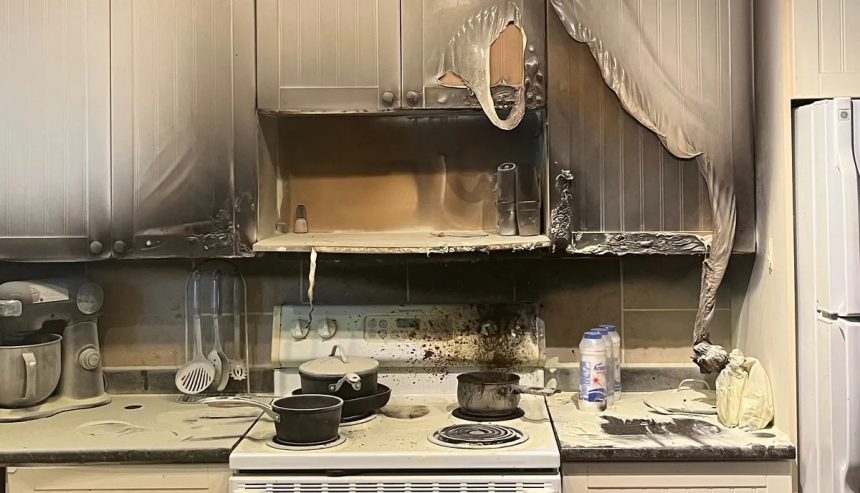
Even a small kitchen fire, a flare-up on the grill, a grease fire in the fryer sends smoke particles throughout the building within minutes. These particles travel through ventilation systems and settle into walls, ceilings, and soft furnishings. Without professional industrial odor removal, the smell will return every time the kitchen heats up, because the particles are still embedded in the structure.
2. Grease-Saturated Exhaust Ductwork
Commercial kitchen exhaust systems accumulate grease with every service. Most hood filters capture large grease particles above 8 microns, but smaller particles which make up the majority during high-heat cooking, pass right through. Over months and years, this creates thick grease deposits throughout the duct system that become increasingly malodorous as they oxidize and go rancid.
3. Surface and Wall Absorption
In a busy kitchen, grease and smoke molecules are constantly being deposited on every surface — walls, ceilings, equipment, and flooring. Porous materials like drywall, wood, and concrete absorb these molecules like a sponge. Once absorbed, they continue off-gassing odor indefinitely unless professionally treated.
4. HVAC System Contamination
When smoke or grease-laden air is circulated through your HVAC system, the entire system becomes a delivery mechanism for odor spreading the problem far beyond the kitchen itself. Dining rooms, storage areas, offices, and restrooms can all carry the smell of an uncleaned kitchen exhaust system.
5. Drain and Grease Trap Odors
Commercial grease traps that are not properly maintained generate powerful odors from decomposing organic matter. Sewage gases from floor drains can also permeate a kitchen, creating a smell that no amount of surface cleaning will eliminate. Proper drain maintenance and, when necessary, professional odor treatment are both required.
Why DIY Odor Removal Always Fails in Commercial Settings
Short answer: Consumer-grade products mask odors temporarily but cannot penetrate porous materials or reach inside ductwork and wall cavities. Without treating the molecular source of the smell, it always returns — often stronger once the kitchen heats back up.
Restaurant owners and facility managers often attempt to address kitchen odors themselves before calling professionals. The results are almost always the same: temporary relief, followed by the smell returning with the next service rush.
Here is why DIY approaches consistently fall short in commercial kitchen environments:
Odor masking vs. elimination. Air fresheners and fragrance sprays cover the smell with a different smell. They do not neutralize, absorb, or destroy the odor-causing molecules. The moment the masking agent dissipates, the original odor returns.
Surface-only cleaning. Even industrial-strength degreasers only treat visible surfaces. The smoke and grease molecules embedded inside walls, ceilings, and ductwork are completely untouched.
Inaccessible areas. Exhaust ducts, wall cavities, crawl spaces, and air handler units cannot be reached or properly treated without professional equipment and certifications.
Heat activation. Residual grease and smoke compounds in walls and surfaces are re-activated every time the kitchen heats up, continuously releasing odor into the space. Surface treatment cannot stop this cycle.
Regulatory risk. Health departments and insurance adjusters can identify insufficient odor remediation. Attempting to handle post-fire cleanup or significant odor issues without certified professionals can jeopardize your claims and your compliance status.
7 Professional Industrial Odor Removal Methods That Actually Work
Short answer: Effective industrial odor removal uses a combination of thermal fogging, ozone generation, hydroxyl technology, HEPA air scrubbing, enzymatic treatments, activated carbon filtration, and surface encapsulation to neutralize smoke and grease odors at the molecular level.
There is no single silver bullet for commercial kitchen odor elimination. Certified professionals deploy multiple technologies in sequence, because different odor compounds require different treatment approaches. Here is how each method works:
1. Thermal Fogging
Thermal fogging is one of the most powerful tools in industrial odor removal. A thermal fogger heats a specially formulated deodorizing solution into an ultra-fine fog that behaves exactly like smoke — penetrating into every crack, crevice, wall cavity, and porous surface that smoke particles originally reached.
The fog chemically pairs with odor-causing molecules and neutralizes them in place. Because it follows the same pathway as the original smoke, it treats areas that no other method can reach. It is particularly effective after kitchen fires and is a core component of professional industrial odor removal protocols.
Best for: Post-fire smoke odor, deep wall penetration, large open kitchen spaces.
2. Ozone Treatment
Ozone (O₃) is a powerful oxidizing agent that breaks down the chemical bonds of odor-causing compounds — including the complex, long-chain fatty acid molecules in grease. Industrial ozone generators flood a space with concentrated ozone, which reacts with and permanently destroys smoke and grease odor molecules rather than simply masking them.
Research from exhaust treatment specialists confirms that ozone injection into kitchen exhaust systems reduces grease buildup by making grease particles less adhesive — essentially cutting the molecular bonds that allow them to stick to duct surfaces. This dual benefit makes ozone a standout tool in commercial kitchen industrial odor removal.
Important note: Ozone treatment requires the space to be vacated during treatment and properly ventilated afterward. Always use certified professionals for ozone applications.
Best for: Grease odors, post-fire smoke, heavily contaminated ductwork, enclosed kitchen spaces.
3. Hydroxyl Generation
Hydroxyl generators produce hydroxyl radicals — the same reactive molecules the atmosphere uses to naturally clean itself — to neutralize odor compounds in the air. Unlike ozone, hydroxyl generators can operate while the building is occupied, making them ideal for kitchens that cannot close for extended treatment periods.
Hydroxyl technology works continuously over hours or days, treating both airborne odor molecules and those being off-gassed from contaminated surfaces. It is frequently used alongside other methods in a staged industrial odor removal protocol.
Best for: Ongoing odor management, occupied spaces, large commercial facilities.
4. HEPA Air Scrubbing
Industrial HEPA (High-Efficiency Particulate Air) scrubbers pull contaminated air through a series of progressively finer filters, capturing particles down to 0.3 microns with 99.97% efficiency. While HEPA filtration alone cannot eliminate embedded odors, it dramatically reduces airborne odor-carrying particles during the restoration process and improves air quality throughout the space.
In commercial kitchen industrial odor removal projects, air scrubbers run continuously throughout the remediation process, creating negative pressure that prevents odors from spreading to dining areas and other parts of the building.
Best for: Airborne particle removal, containment during remediation, post-fire air quality restoration.
5. Enzymatic and Chemical Treatments
Enzyme-based cleaners and EPA-registered disinfectants target the biological components of kitchen odors — the proteins, fats, and oils that bacteria break down into malodorous compounds. Applied directly to surfaces, grease traps, and drains, these treatments permanently neutralize odor at the source rather than masking it.
For grease trap odors and drain smells specifically, enzymatic treatments are often the most targeted and effective component of an industrial odor removal program.
Best for: Grease trap odors, drain smells, surface grease odors, biological odor sources.
6. Activated Carbon Filtration
Activated carbon filters work through adsorption — odor molecules are pulled from the air and bind to the highly porous surface of the carbon media. Unlike physical filtration, carbon filters target odor-causing vapors and gases rather than solid particles, making them effective for cooking smells that pass through standard filters.
Installed within exhaust systems or used as standalone units, activated carbon filtration provides ongoing odor control between professional industrial odor removal treatments and is especially effective for persistent cooking odors in restaurants located in mixed-use buildings.
Best for: Ongoing odor control, exhaust system treatment, mixed-use building compliance.
7. Surface Encapsulation and Sealants
When smoke or grease odors are deeply embedded in drywall, wood, or concrete, professional-grade sealants can encapsulate the odor-causing compounds within the material, preventing them from continuing to off-gas. This technique is commonly used as a final step in post-fire industrial odor removal when structural materials cannot be replaced.
Applied after thorough cleaning and chemical treatment, encapsulants form a permanent barrier that locks odors in place. They are typically followed by repainting or refinishing to restore the surface to pre-loss condition.
Best for: Post-fire wall and ceiling treatment, deeply embedded smoke odors, structural material restoration.
The Professional Industrial Odor Removal Process: Step by Step
Short answer: A professional industrial odor removal project follows a structured sequence — assessment, source removal, HEPA air scrubbing, targeted chemical treatment, thermal fogging or ozone treatment, duct cleaning, surface encapsulation, and final air quality verification.
When PuroClean of Burlington responds to a commercial kitchen odor emergency, here is what the process looks like in practice:
Step 1 — Initial Assessment and Source Identification. Technicians conduct a thorough inspection of the kitchen, exhaust systems, HVAC, walls, and adjacent spaces. Moisture meters and air quality monitors help identify where odors are concentrated and what is causing them. No treatment plan is created until the source is fully understood.
Step 2 — Source Removal. Wherever possible, the physical source of odor is removed first. This may include severely contaminated materials, unsalvageable insulation, grease-saturated duct liner, or fire-damaged structural elements. Industrial odor removal is far more effective when the primary source is gone.
Step 3 — HEPA Air Scrubbing and Containment Setup. Air scrubbers are deployed to capture airborne particles and establish containment, preventing odors from migrating to unaffected areas of the building during treatment.
Step 4 — Surface Cleaning and Chemical Treatment. All accessible surfaces are cleaned with IICRC-approved agents appropriate for the contamination type. Enzymatic treatments are applied to drains, grease traps, and organic residue sources.
Step 5 — Thermal Fogging or Ozone Treatment. Depending on the type and location of odors, thermal fogging, ozone generation, or hydroxyl treatment is deployed. This step targets embedded odor molecules in areas that surface cleaning cannot reach.
Step 6 — Duct and HVAC Cleaning. Exhaust ductwork, hoods, and HVAC components are professionally cleaned to remove grease deposits and smoke residue that would continue re-contaminating the space if left untreated.
Step 7 — Encapsulation and Final Sealing. Any remaining odor sources embedded in structural materials are sealed with professional-grade encapsulants. This is followed by repainting or surface restoration as needed.
Step 8 — Post-Treatment Air Quality Verification. Final air quality testing confirms that odor levels have been successfully eliminated before the kitchen is cleared for occupancy. Documentation is provided for insurance and regulatory purposes.
Health, Safety, and Compliance: Why Industrial Odor Removal Is Not Optional
Short answer: Persistent smoke and grease odors in commercial kitchens are not just a nuisance — they indicate air quality issues that can expose staff and customers to harmful compounds, trigger health code violations, and create fire hazards from accumulated grease deposits in exhaust systems.
There is a reason industrial odor removal is taken seriously by health departments, insurance companies, and fire marshals. The same conditions that produce persistent odors often create real safety risks:
Health risks. Smoke compounds and combustion byproducts include polycyclic aromatic hydrocarbons (PAHs) and volatile organic compounds (VOCs) associated with respiratory irritation and, with prolonged exposure, more serious health effects. Kitchen staff working in a space with unresolved smoke odor are being continuously exposed to these compounds.
Fire hazard. The same grease buildup that causes persistent odors in exhaust ducts is also a significant fire hazard. The National Fire Protection Association (NFPA 96) establishes standards for commercial kitchen ventilation cleaning specifically because grease accumulation is a leading cause of commercial kitchen fires. Ignoring odors that signal grease buildup is ignoring a fire risk.
Regulatory compliance. Health inspectors and environmental health officers have the authority to issue violations and, in severe cases, close establishments for odor and air quality issues. In cities with pollution control ordinances, commercial kitchens are required to meet specific opacity and odor emission standards.
Insurance implications. Failure to properly remediate a kitchen fire — including odor removal — can affect insurance claims and future coverage. Documented professional industrial odor removal demonstrates due diligence and supports claim validation.
Customer experience. Research consistently shows that unpleasant smells directly reduce customer spending and return visits. In the restaurant industry, ambient odor is part of the dining experience — and a kitchen smell that permeates the dining room tells customers something is wrong.
When Do You Need Professional Industrial Odor Removal Services?
Short answer: Call a professional whenever odors persist after standard cleaning, following any fire or smoke event (even small ones), when smells have spread beyond the kitchen, or when health inspectors or insurance adjusters are involved.
Not every kitchen smell requires professional intervention — but knowing when it does can save you time, money, and your business reputation. Here are the clear signs it is time for professional industrial odor removal:
- Odors persist after thorough cleaning — the smell keeps coming back despite regular professional cleaning of surfaces and equipment.
- Any fire or smoke event occurred, even a small one. A grease flare-up that self-extinguished still sends smoke throughout your ventilation system.
- The smell has migrated beyond the kitchen into dining areas, hallways, restrooms, or adjacent tenant spaces.
- Customers or staff are commenting on the smell — if it has reached their awareness, it has already reached a level that will affect your business.
- You have received a health inspection notice or complaint related to odors or air quality.
- You are reopening after an extended closure and want to ensure your kitchen is clean and compliant before customers return.
- An insurance claim is involved — professional documentation of industrial odor removal supports your claim and protects your coverage.
Frequently Asked Questions: Industrial Odor Removal for Commercial Kitchens
Q: How long does industrial odor removal take in a commercial kitchen?
A: The timeline depends on the severity and source of the odor. A straightforward post-fire smoke odor treatment in a mid-size kitchen may take 1–3 days. More extensive projects involving deeply embedded grease odors, duct cleaning, and structural treatment can take 3–7 days. PuroClean of Burlington provides a detailed timeline after the initial assessment so you can plan your kitchen closure accordingly.
Q: Will ozone treatment damage kitchen equipment?
A: When conducted by certified professionals following proper protocols, ozone treatment is safe for commercial kitchen equipment. Certain materials — including natural rubber, some plastics, and latex — are sensitive to ozone, and a qualified technician will identify and protect these items before treatment. All equipment is thoroughly ventilated before the kitchen is returned to operation.
Q: Can I stay open during industrial odor removal treatment?
A: It depends on the methods used. Hydroxyl generation can be conducted in occupied spaces. Ozone treatment and thermal fogging require the space to be vacated during treatment and properly ventilated before re-entry. A professional industrial odor removal company will schedule treatments to minimize business interruption where possible, including after-hours or overnight treatments.
Q: How do I prevent smoke and grease odors from coming back?
A: After professional industrial odor removal, maintaining a clean kitchen is your best defense. This includes scheduling regular hood and duct cleaning (quarterly for heavy-use kitchens), replacing activated carbon filters as recommended, ensuring proper exhaust system function, training staff on grease management, and arranging annual professional odor assessments for high-volume operations.
Q: Does commercial property insurance cover odor removal?
A: Industrial odor removal costs are typically covered under commercial property insurance when the odor results from a covered event — such as a fire, smoke damage, or a covered water or sewage loss. Most standard policies cover professional restoration services including odor remediation. PuroClean of Burlington works directly with your insurance company to document the loss, file the claim correctly, and ensure all covered remediation services are included.
Q: What is the difference between industrial odor removal and standard kitchen cleaning?
A: Standard kitchen cleaning addresses visible surfaces and is essential for daily hygiene. Industrial odor removal goes far beyond — it uses specialized equipment and chemicals to treat odor compounds embedded inside walls, ductwork, HVAC systems, and structural materials that standard cleaning cannot reach. The two are complementary: regular cleaning prevents buildup, while professional industrial odor removal is required when odors have already penetrated the structure.
Q: How much does industrial odor removal for a commercial kitchen cost?
A: Costs vary based on kitchen size, severity of contamination, and the methods required. A targeted post-fire odor treatment in a small kitchen may start at a few hundred dollars, while comprehensive remediation of a large facility with duct cleaning, structural treatment, and multiple technology deployments can run into several thousand dollars. The cost of professional industrial odor removal is almost always less than the cost of lost business from customers deterred by persistent odors — or a health inspection violation.
PuroClean of Burlington: Industrial Odor Removal Services for Commercial Kitchens in Burlington, Kenosha, Racine & Beyond
When the smell just will not go away, when you have cleaned every surface, replaced every filter, and the kitchen still carries that stubborn smoke and grease odor — it is time to call the professionals who have the training, equipment, and experience to solve it permanently.
PuroClean of Burlington is a veteran-owned, IICRC-certified property restoration company serving commercial kitchen operators throughout Burlington, Kenosha County, Racine County, Walworth County, and Lake County, IL. Our industrial odor removal services are designed specifically for the unique challenges of commercial kitchen environments — the deep grease penetration, the post-fire smoke damage, the contaminated exhaust systems that require more than a standard cleaning crew.
Our Commercial Kitchen Industrial Odor Removal Services Include:
- 24/7 emergency response — we respond immediately after kitchen fires and smoke events
- Thermal fogging for deep structural smoke odor penetration
- Industrial ozone and hydroxyl generation treatment
- HEPA air scrubbing and air quality restoration
- Commercial exhaust duct and hood cleaning coordination
- Enzymatic treatment for grease traps and drain odors
- Surface encapsulation and sealant application
- Post-treatment air quality verification and documentation
- Direct insurance claim coordination and billing
- Complete fire and smoke damage restoration services
Our founder, Jennifer Wine, built PuroClean of Burlington with a clear mission: to provide the kind of honest, thorough, professional restoration service that she wished had been available when her own family faced fire damage. That commitment shows up every day in how our team approaches industrial odor removal — we do not leave until the job is done right.
We work directly with your insurance company, provide full documentation for regulatory and compliance purposes, and stand behind our work. Whether you are dealing with the aftermath of a kitchen fire, years of accumulated grease odor, or a persistent smell that no one else has been able to resolve — we have the tools and expertise to eliminate it permanently.
Don’t let odors cost you business. Call PuroClean of Burlington 24/7 at (262) 342-2226 Serving Burlington, Kenosha, Racine, Walworth County & Lake County, IL www.puroclean.com/burlington-wi-puroclean-burlington
Summary
Stubborn smoke and grease smells in commercial kitchens are not cosmetic problems, they are signals of deep contamination that has penetrated into walls, ductwork, and structural materials. No consumer-grade product can reach those molecules. Only professional industrial odor removal using thermal fogging, ozone treatment, hydroxyl generation, HEPA air scrubbing, and enzymatic treatments can permanently neutralize them.
For commercial kitchen operators in Burlington, Kenosha, Racine, and surrounding Wisconsin communities, the health, safety, regulatory, and business reputation stakes are too high to settle for surface-level solutions. Professional industrial odor removal restores your kitchen to a clean, compliant, customer-ready environment and it gets done right the first time.
If your commercial kitchen is carrying a smell that just will not leave, PuroClean of Burlington is available 24/7 to assess the situation and deploy the right industrial odor removal solution.
PuroClean of Burlington 📞 Call Now: (262) 342-2226 🕒 Available 24/7 — Because disasters don’t wait.
🔗 Quick Links: Instagram | Google Reviews & Directions | Facebook | Pinterest