 PuroClean of Burlington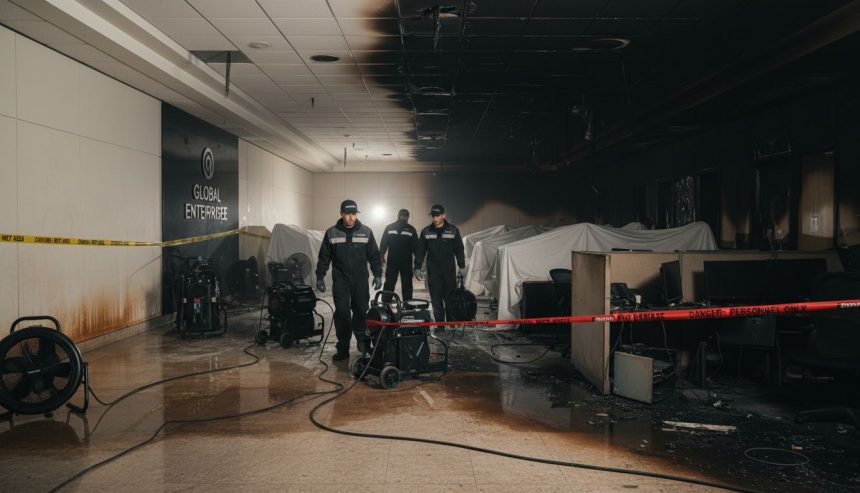
Table of Contents

Commercial water damage requires immediate professional response to minimize business downtime. Unlike residential water losses, commercial water damage involves complex HVAC systems, multi-tenant coordination, legal liability concerns, and the urgent need to maintain business operations. Property managers in Burlington, Kenosha, and Racine minimize business downtime by partnering with licensed, IICRC-certified restoration companies that provide 24/7 emergency response, industrial-scale equipment, strategic drying plans prioritizing critical business areas, and comprehensive insurance documentation. Every hour of delay increases revenue loss, tenant dissatisfaction, and potential code violations.
When a burst pipe floods your Burlington commercial building at 2 AM, your first thought is not about drying equipment or moisture meters. It is about how many tenants will be affected, how long the business will be closed, and how much revenue you are losing every hour.
Commercial water damage is fundamentally different from residential water loss. You are not just protecting a home, you are protecting livelihoods, business operations, tenant relationships, and significant financial investments. For property managers overseeing office buildings, retail centers, industrial parks, and mixed-use developments in Burlington, Kenosha, Racine, and throughout southeastern Wisconsin, minimizing business downtime after commercial water damage is not just a goal, it is a necessity.
This guide explains exactly how professional commercial water damage restoration minimizes business interruption, what equipment and certifications actually matter, how to prioritize critical business areas during restoration, and why the restoration company you choose directly impacts how fast your tenants get back to business.
Why Commercial Water Damage Demands Different Response Than Residential
Short answer: Commercial water damage involves larger square footage, complex building systems (HVAC, elevators, fire suppression), multiple stakeholders (tenants, owners, insurers), strict building codes and ADA compliance, and the financial pressure of lost business revenue. Residential techniques do not scale to commercial environments and will extend your business downtime unnecessarily.
The restoration industry categorizes water damage into residential and commercial for good reason. Here is what makes commercial water damage uniquely challenging:
Scale and Complexity
A 2,000-square-foot home has maybe 3-4 rooms affected by water damage. A commercial building might have 50,000+ square feet across multiple floors with interconnected HVAC systems that spread moisture throughout the entire structure. Commercial water damage restoration requires industrial equipment that residential companies simply do not own.
Business Continuity Requirements
Homeowners can temporarily relocate during restoration. Businesses cannot. A restaurant closed for a week loses far more than the cost of repairs—it loses customers to competitors, staff to other jobs, and momentum that takes months to rebuild. Minimizing business downtime means strategic phased restoration that keeps at least part of the operation functional.
Multi-Stakeholder Coordination
Commercial water damage involves property managers, building owners, multiple tenants, commercial insurance adjusters, municipal building inspectors, and often franchise corporate offices. Everyone needs updates, documentation, and proof of compliance. Professional commercial restoration companies manage this coordination so property managers do not have to.
Liability and Code Compliance
Commercial buildings must meet stricter building codes, fire codes, ADA accessibility standards, and OSHA workplace safety requirements. Improper commercial water damage restoration can create liability exposure that residential shortcuts never face. Licensed contractors ensure compliance from day one.
Documentation Requirements
Commercial insurance policies require detailed documentation that residential claims do not. Your commercial water damage restoration company must provide moisture logs, thermal imaging reports, equipment deployment records, and scientific drying documentation that proves compliance with IICRC S500 standards.
The 5 Biggest Causes of Commercial Water Damage in Burlington
Short answer: The most common commercial water damage sources in Burlington are: aging plumbing systems in older industrial buildings, sprinkler system malfunctions, roof leaks in flat commercial roofs, HVAC condensate line failures, and winter freeze-related pipe bursts. Understanding these risks helps property managers implement prevention strategies.
1. Aging Plumbing Infrastructure
Many of Burlington’s commercial buildings were constructed 30-50+ years ago with original plumbing. Cast iron pipes corrode, galvanized steel pipes deteriorate, and supply lines fail without warning. Commercial water damage from plumbing failures often goes undetected for hours or days because it occurs in wall cavities, under slab foundations, or in mechanical rooms.
2. Fire Sprinkler System Issues
Commercial fire suppression systems are required by code but create significant commercial water damage risk. Sprinkler head malfunctions, frozen pipes in unheated areas, and accidental activation from construction work can discharge hundreds of gallons per minute. Unlike residential water damage, sprinkler activation affects entire floors simultaneously.
3. Flat Roof Membrane Failures
Wisconsin’s freeze-thaw cycles are brutal on flat commercial roofs common in Burlington industrial parks and strip malls. Ponding water, membrane cracks, and failed flashing create slow leaks that cause extensive hidden commercial water damage before property managers even realize there is a problem.
4. HVAC Condensate Problems
Commercial HVAC systems produce significant condensate during cooling season. When drain lines clog or condensate pumps fail, water backs up into ceiling spaces and wall cavities. This commercial water damage often manifests as ceiling tile staining or musty odors before the actual water source is discovered.
5. Winter Freeze Events
Burlington winters regularly drop below zero. Unheated warehouses, inadequately insulated exterior walls, and thermostats set too low during closed periods create perfect conditions for frozen pipe bursts. When temperatures rise, these pipes rupture—often flooding entire commercial spaces before anyone arrives for work.
How Licensed Restoration Teams Minimize Business Downtime: The Critical Difference
Short answer: Licensed commercial water damage restoration companies minimize business downtime through immediate 24/7 response, industrial-scale equipment that dries buildings 3-5x faster than residential gear, strategic phased restoration prioritizing revenue-generating areas first, proper containment allowing partial operations to continue, and expert coordination with building inspectors ensuring fast code compliance.
Why Licensing Matters for Commercial Projects
In Wisconsin, commercial restoration work above certain dollar thresholds requires licensed contractors. Here is why this matters for minimizing business downtime:
Building Code Compliance: Licensed contractors know Wisconsin commercial building codes inside and out. They ensure all commercial water damage restoration work meets or exceeds code requirements, preventing failed inspections that extend your downtime.
Insurance Approval: Commercial insurance carriers require licensed contractors for claims above residential thresholds. Using an unlicensed provider can void your coverage—a catastrophic outcome for commercial water damage claims often exceeding $100,000.
Liability Protection: Licensed contractors carry substantial general liability and workers’ compensation insurance. If something goes wrong during commercial water damage restoration, you are protected. Unlicensed contractors create liability exposure that property managers cannot afford.
Professional Standards: Licensing demonstrates commitment to industry standards including IICRC certifications, ongoing education, and adherence to scientific drying principles. These standards directly impact how efficiently business downtime is minimized.
IICRC Certification: The Commercial Standard
The Institute of Inspection Cleaning and Restoration Certification (IICRC) sets the scientific standards for commercial water damage restoration. IICRC S500 provides the framework for proper structural drying that commercial insurance adjusters and building officials expect.
What IICRC certification means for your business downtime:
- Scientific Drying Methods: IICRC-certified technicians use psychrometric calculations and moisture mapping to create optimal drying conditions. This speeds restoration by 40-60% compared to trial-and-error approaches.
- Proper Equipment Selection: Certification teaches technicians exactly which equipment configurations work for specific commercial water damage scenarios—no guesswork extending your downtime.
- Documentation Standards: IICRC protocols produce the comprehensive documentation commercial insurance claims require, preventing claim delays that extend business interruption.
Industrial Equipment That Actually Minimizes Business Downtime
Short answer: Commercial water damage restoration requires specialized industrial equipment including large-scale desiccant dehumidifiers (removing 10-20x more moisture than residential units), trailer-mounted extraction systems, HEPA air scrubbers for occupied space filtration, thermal imaging cameras for hidden moisture detection, and moisture monitoring systems providing real-time drying data.
Residential water damage equipment works for homes. It fails miserably in commercial environments. Here is what actually minimizes business downtime:
Desiccant Dehumidification Systems
These industrial units remove moisture through chemical absorption rather than refrigeration, making them effective in large spaces and low temperatures. A single commercial desiccant dehumidifier can do the work of 15-20 residential refrigerant units—directly translating to faster drying and reduced business downtime.
Truck-Mounted Extraction
Commercial water damage often involves thousands of gallons of standing water. Portable extractors used in residential work would take days. Truck-mounted systems extract water at 10x the rate, clearing buildings in hours instead of days.
HEPA Air Scrubbing for Occupied Spaces
When businesses must stay partially open during commercial water damage restoration, air quality is critical. Industrial HEPA air scrubbers filter the air 4-6 times per hour, removing particulates, odors, and potential contaminants. This allows safe occupation of unaffected areas while restoration continues.
Thermal Imaging Technology
Hidden moisture extends business downtime because you cannot dry what you cannot see. Infrared thermal cameras reveal moisture in wall cavities, under flooring, and inside ceiling spaces—ensuring complete restoration the first time without callbacks.
Remote Moisture Monitoring
Advanced commercial water damage restoration companies deploy wireless moisture sensors throughout the affected area, providing real-time drying data accessible remotely. Property managers can see progress 24/7 without site visits, and technicians can adjust equipment remotely—maximizing efficiency and minimizing business downtime.
Strategic Business Continuity Planning: Prioritizing Critical Areas
Short answer: Professional commercial water damage restoration minimizes business downtime by identifying and prioritizing “critical zones” for immediate restoration: customer-facing areas (lobbies, retail space, dining rooms), revenue-generating equipment and systems, IT infrastructure and server rooms, essential utilities (restrooms, break rooms), and building access points. Non-critical areas are addressed later.
Not all square footage is equally important to business operations. Smart commercial water damage restoration prioritizes strategically:
Phase 1: Critical Business Operations (Days 1-3)
- Customer Access Points: Lobbies, entrances, retail frontage
- Revenue Equipment: Point-of-sale systems, production equipment, kitchen facilities
- IT Infrastructure: Server rooms, network closets, telecommunications
- Essential Utilities: Public restrooms, employee break areas
- Safety Systems: Emergency exits, fire suppression, elevators
Phase 2: Secondary Operations (Days 4-7)
- Office Space: Administrative areas, private offices
- Storage Areas: Warehouses, stock rooms
- Mechanical Rooms: HVAC, electrical (if not initially affected)
Phase 3: Non-Essential Areas (Week 2+)
- Common Areas: Hallways, non-public spaces
- Landscaping Access: Maintenance areas
- Cosmetic Repairs: Painting, trim work, final finishes
This phased approach allows businesses to reopen partially while restoration continues, dramatically reducing revenue loss and tenant impact.
Documentation That Protects Property Managers and Speeds Insurance Claims
Short answer: Professional commercial water damage restoration provides comprehensive documentation including: initial site assessment reports with photos and moisture readings, daily progress logs with moisture content tracking, equipment deployment records, IICRC-compliant drying documentation, insurance estimating software reports (Xactimate), certificate of completion with final moisture verification, and air quality clearance if required.
Commercial insurance claims move faster with proper documentation. Here is what property managers need:
Initial Assessment Report
Within 24 hours, you should receive a detailed report documenting: extent of commercial water damage, affected square footage, moisture content readings, equipment deployed, estimated drying timeframe, and preliminary scope of work.
Daily Moisture Logs
IICRC standards require daily moisture monitoring. Professional commercial water damage restoration provides logs showing moisture content dropping toward acceptable levels—proof the drying strategy is working.
Photographic Documentation
Before, during, and after photos create undeniable proof of conditions and completed work. This protects property managers from tenant disputes about pre-existing conditions.
Equipment Deployment Records
Insurance adjusters need to see that appropriate equipment was used. Detailed records of equipment type, quantity, and duration justify the restoration costs on your claim.
Final Clearance Documentation
Before restoration is considered complete, final moisture readings must prove structures have returned to dry standard (typically below 15% moisture content). This documentation protects property managers from future mold claims.
Common Mistakes That Extend Business Downtime
Short answer: The biggest mistakes extending business downtime after commercial water damage are: delaying initial response “to get quotes” (every hour multiplies damage), hiring residential contractors for commercial work, attempting DIY extraction to “save money,” failing to document pre-loss conditions, and not implementing emergency business continuity plans before disaster strikes.
Avoid these critical errors:
Delayed Response: Every hour of delay allows water to penetrate deeper into building materials, extending drying time exponentially. A 2-hour response might require 3 days of drying. A 24-hour response might require 10+ days.
Wrong Contractor: Residential contractors lack commercial equipment, commercial insurance requirements knowledge, and multi-tenant coordination experience. They extend business downtime through trial and error.
Inadequate Extraction: Leaving standing water “to save on extraction costs” is false economy. Water remaining after initial extraction takes 3-5x longer to remove through evaporation.
Poor Communication: Tenants, owners, and insurers need regular updates. Professional commercial water damage restoration companies provide daily communication, preventing the confusion that extends perceived downtime.
What is the most common cause of commercial water loss in Burlington?
In our area, sprinkler head malfunctions and aging plumbing in industrial parks are the leading causes. Regularly scheduled inspections are a vital part of your home emergency preparedness (or business preparedness) strategy.
Are your technicians background-checked?
Yes. We understand that our staff is entering sensitive business environments. Every member of our team undergoes a rigorous background check to ensure the security of your property and your tenants’ assets.
Can my tenants stay in the building during restoration?
In many cases, yes. Our professional staff uses containment barriers and air scrubbers to isolate the affected area, allowing the rest of the building to function normally.
How long does commercial water damage restoration take?
Timeline depends on building size, water category, and affected materials. Small office suite: 3-5 days. Multi-tenant retail center: 1-3 weeks. Large warehouse: 2-4 weeks. Licensed contractors provide accurate timelines after initial assessment.
What is the most common cause of commercial water damage in Burlington?
Aging plumbing in older commercial buildings and sprinkler system malfunctions are tied for most common. Regular preventive maintenance significantly reduces these risks.
How do you prevent mold after commercial water damage?
Professional restoration following IICRC standards prevents mold by: extracting water within 24 hours, drying affected materials to below 15% moisture content within 3-5 days, applying EPA-registered antimicrobials to affected surfaces, and verifying complete drying before reconstruction.
What makes commercial water damage more expensive than residential?
Commercial projects involve: larger square footage, industrial equipment, 24/7 operations to minimize business downtime, multiple stakeholders requiring coordination, stricter code compliance, and more extensive documentation requirements.
Does commercial insurance cover business interruption during water damage?
Many commercial policies include business interruption coverage that compensates for lost revenue during forced closures. Proper documentation from licensed restoration contractors is required to support these claims.
PuroClean of Burlington: Licensed Experts Minimizing Commercial Business Downtime
When commercial water damage threatens your Burlington property, every minute counts. PuroClean of Burlington is a veteran-owned, IICRC-certified restoration company specializing in commercial water damage with the licensing, equipment, and expertise that property managers depend on to minimize business downtime.
Our Commercial Water Damage Services:
✅ 24/7 emergency response—we arrive within 1-2 hours in Burlington, Kenosha, Racine ✅ Licensed Wisconsin contractors meeting all commercial building codes ✅ IICRC-certified technicians trained in commercial restoration ✅ Industrial desiccant dehumidification and truck-mounted extraction ✅ Strategic business continuity planning prioritizing critical areas ✅ Complete insurance documentation with Xactimate estimates ✅ Background-checked technicians for secure commercial environments ✅ Multi-tenant coordination and daily stakeholder communication ✅ Full reconstruction services restoring properties to pre-loss condition
We understand that for property managers, commercial water damage is not just about restoration, it is about protecting tenant relationships, minimizing revenue loss, and maintaining property value.
Commercial Water Damage Emergency? Minimize Downtime Now. PuroClean of Burlington — 24/7 Commercial Response (262) 342-2226 Licensed | IICRC Certified | Veteran Owned
Summary: Protecting Your Commercial Investment
Commercial water damage requires immediate professional response from licensed, IICRC-certified restoration contractors with commercial-grade equipment and expertise. Unlike residential water loss, commercial water damage involves complex building systems, multi-stakeholder coordination, strict code compliance, and urgent business continuity requirements.
Property managers minimize business downtime by partnering with restoration companies that provide: 24/7 emergency response, industrial-scale drying equipment, strategic phased restoration prioritizing critical business areas, comprehensive insurance documentation, and expert coordination with building officials and insurance adjusters.
The restoration company you choose directly determines how quickly your tenants return to normal operations and how much revenue loss your property experiences. Licensed professionals like PuroClean of Burlington provide the expertise, equipment, and efficiency that commercial properties demand.
Don’t let water damage shut down your business. Minimize your downtime today.
PuroClean of Burlington 📞 Call Now: (262) 342-2226 🕒 Available 24/7 — Because disasters don’t wait.
🔗 Quick Links: Instagram | Google Reviews & Directions | Facebook | Pinterest


 PuroClean of Burlington