


You had a pipe burst. Or maybe your dishwasher leaked overnight. The visible water is cleaned up, and everything looksdry. But here’s what most North Metro Atlanta homeowners don’t realize — water travels. It wicks into drywall, seeps under flooring, and migrates through wall cavities in ways you can’t see with the naked eye.
That hidden moisture is where the real damage happens. Left undetected, it leads to mold growth within 24 to 48 hours, weakens structural materials, and can turn a manageable water event into a major restoration project.
This is exactly why moisture mapping exists — and why our team at PuroClean North Metro Atlanta uses it on every single water damage job we respond to in Canton, Roswell, Alpharetta, Woodstock, and Johns Creek.
What Is Moisture Mapping?
Moisture mapping is the process of identifying exactly where water has traveled in your property and how severe the saturation is. Think of it as creating a detailed “weather map” of your home — but instead of showing rain patterns, it shows where moisture is hiding inside your walls, floors, ceilings, and crawl spaces.
The result is a visual document — your moisture map — that shows the boundary between wet zones and dry zones throughout the affected area. This map becomes the blueprint for everything that follows: what needs to be dried, what equipment goes where, and how long the restoration process will take.
Without moisture mapping, restoration work is essentially guesswork. Technicians might dry the areas they can see while missing moisture trapped behind a bathroom wall or under hardwood flooring two rooms away from where the leak started. Whether it’s a burst pipe in a Woodstock townhome or a dishwasher leak in an Alpharetta kitchen, the water almost always travels further than homeowners expect.
How We Perform Moisture Mapping at PuroClean North Metro Atlanta
When our IICRC-certified technicians arrive at your property, moisture mapping is one of the first things we do. Here’s what that process looks like:
Step 1: Visual Inspection
We walk the entire affected area looking for visible signs of water intrusion — stains on ceilings, warped baseboards, discoloration on walls, bubbling paint, or damp carpet. In many of the older homes we service in Roswell and Alpharetta, water often follows unexpected paths through plaster walls and settled foundations. Newer construction in Johns Creek and Canton presents different challenges, with open floor plans that allow water to spread quickly across large areas before it’s noticed.
Step 2: Infrared Thermal Imaging
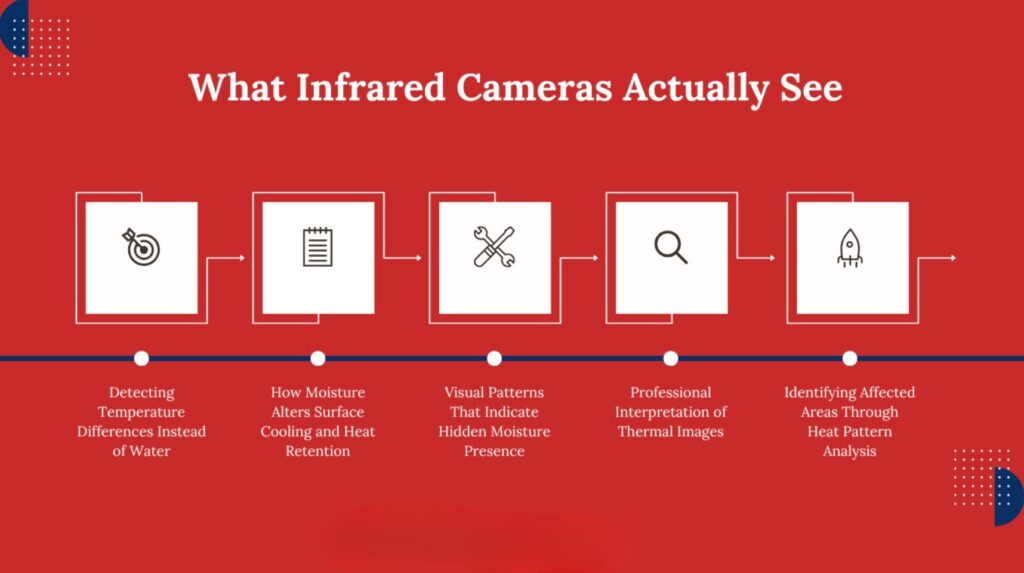
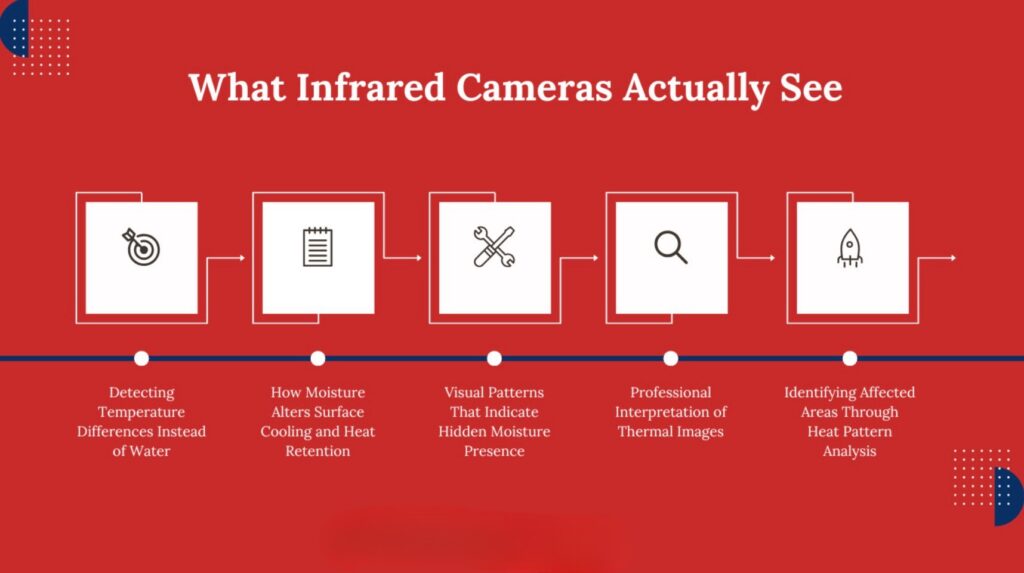
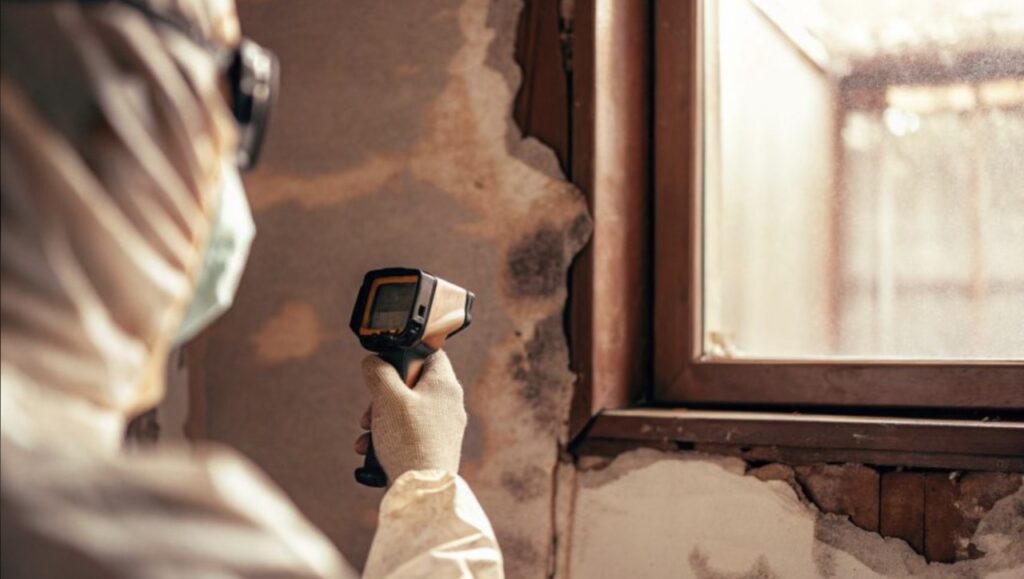
Our technicians use infrared cameras to scan walls, floors, and ceilings. Thermal imaging detects temperature variations — wet materials show up cooler than dry ones, creating a heat map that reveals moisture hiding behind surfaces. This is completely non-invasive, meaning we don’t need to cut into your walls just to find out where the water went.
Step 3: Moisture Meter Readings
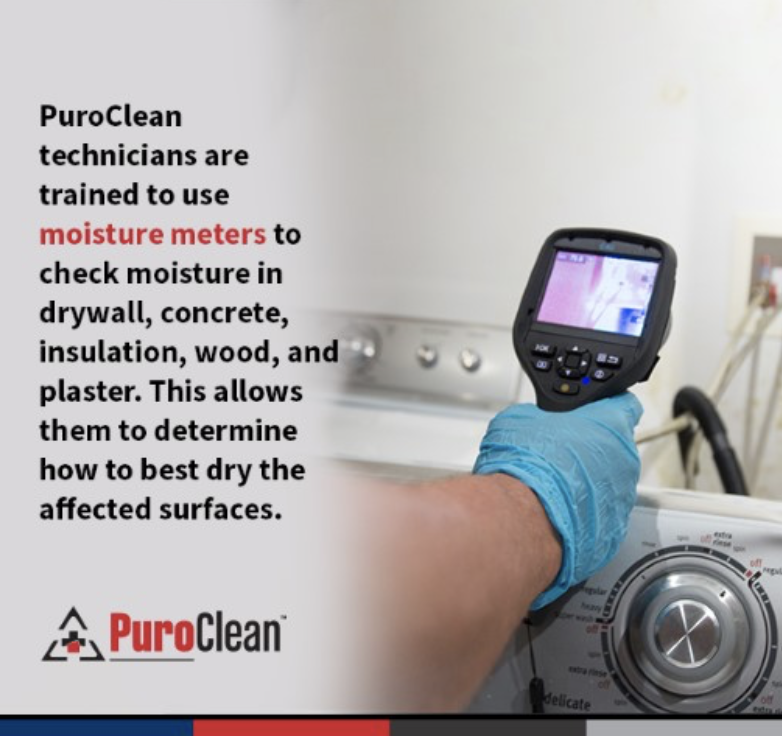
We take precise moisture content readings using professional-grade pin and pinless moisture meters on different building materials — drywall, wood framing, subfloor, carpet padding, and insulation. We measure both the affected areas and unaffected areas to establish a baseline “dry standard” for your specific property.
Step 4: Atmospheric Readings
Using hygrometers, we measure relative humidity and temperature in each room and area. High humidity levels indicate ongoing moisture evaporation from materials — even when surfaces feel dry to the touch.
Step 5: Creating the Moisture Map
All readings are documented and compiled into a comprehensive moisture map that shows the exact locations, extent, and severity of moisture damage in your property. This map details where the wet zones are, where the dry zones begin, and how saturated each affected material is.
Why Moisture Mapping Matters for Your Insurance Claim
If you’re filing an insurance claim for water damage — and most homeowners in North Metro Atlanta do — your moisture map is one of the most important documents you’ll have.
Insurance adjusters need objective evidence of the damage scope to approve restoration work. A detailed moisture map provides exactly that: documented proof of where water penetrated, which materials are affected, and why specific restoration steps are necessary. Without it, disputes over the scope of work (and what the insurance company will pay for) become much more likely.
At PuroClean North Metro Atlanta, we work with insurance companies regularly — from national carriers to local Georgia agencies — and know what documentation they need. Our moisture mapping reports include all readings, thermal images, and a clear visual representation of the affected areas — everything your adjuster needs to process your claim efficiently. Homeowners in Alpharetta, Roswell, Johns Creek, Canton, and Woodstock can count on us to provide the thorough documentation that keeps claims moving forward without disputes.
What Happens After Moisture Mapping?
The moisture map drives every restoration decision:
Equipment placement. Based on the map, we strategically position commercial dehumidifiers, HEPA air movers, and drying equipment where they’ll be most effective — not just scattered around the room. A Canton ranch home with a crawl space needs a completely different drying setup than a two-story Johns Creek colonial.
Daily monitoring. Our technicians return daily (at minimum) to take updated moisture readings, following the ANSI/IICRC S500 Standard for water damage restoration. We update the moisture map as drying progresses, tracking each area’s progress toward its drying goal.
Targeted remediation. If the map reveals that moisture has reached materials beyond what’s visible — say, water has wicked up inside a wall cavity or saturated subfloor in an adjacent room — we address those areas before they become mold problems. In Woodstock and Canton homes with hardwood flooring, this is especially critical because moisture trapped under hardwood can cause buckling and permanent damage if not caught early.
Dry-out verification. When we believe drying is complete, we perform a final round of moisture mapping to confirm that all affected areas have returned to their pre-loss moisture levels. This verified completion protects you from future issues and gives your insurance company clear documentation that the job was done thoroughly.
Common Moisture Mapping Scenarios We See in North Metro Atlanta
Georgia’s climate and the variety of home construction across our service area create some unique water damage patterns:
Crawl space moisture in Canton and Woodstock. Many homes in these areas have crawl space foundations where moisture can accumulate and go unnoticed for weeks. Moisture mapping helps us identify when water from an interior leak has migrated down into the crawl space.
Slab foundation issues in newer Alpharetta and Johns Creek subdivisions. In slab-on-grade homes, water from a kitchen or bathroom leak can travel under flooring across large areas before any surface damage appears. Infrared imaging is especially valuable here because the concrete slab retains moisture differently than wood structures.
Multi-story water migration in Roswell homes. A leak on an upper floor can cause water to travel down through wall cavities, pooling on lower levels or in areas far from the original source. Without thorough moisture mapping, these secondary damage areas often get missed.
Storm and rainwater intrusion. North Metro Atlanta’s severe spring and summer storms can drive water into attics, around windows, and through compromised roofing. Moisture mapping after a storm event helps identify all entry points, not just the ones showing obvious damage.
When Should You Request Moisture Mapping?
Any time water has entered your property where it shouldn’t be. Homeowners across Roswell, Canton, Woodstock, Alpharetta, and Johns Creek call us most often for these situations:
- A pipe burst or plumbing leak
- Appliance failure (dishwasher, washing machine, water heater)
- Roof leak or storm damage
- Sewage backup
- Flooding from heavy rain
- Any time you notice a musty smell, unexplained stains, or warped materials
The sooner moisture mapping happens after a water event, the better. Water continues migrating through materials over time, so early detection limits the scope of damage and the cost of restoration.
PuroClean North Metro Atlanta: Your Local Moisture Mapping Experts
Our IICRC-certified technicians respond to moisture mapping and water damage calls 24/7 across Canton, Woodstock, Roswell, Alpharetta, and Johns Creek. We use professional-grade infrared cameras, moisture meters, and hygrometers — the same equipment and standards used by the most advanced restoration companies in the industry.
More importantly, we’re local. Our team knows the construction styles, soil conditions, climate patterns, and common water damage scenarios specific to North Metro Atlanta. That local expertise means faster, more accurate assessments and restoration plans tailored to your property.
If you’re dealing with water damage — or you suspect hidden moisture in your home — call PuroClean of North Metro Atlanta at (770) 720-2320. We’re available 24 hours a day, 7 days a week. Save our number, and let us help you protect your property before hidden moisture becomes a bigger problem.
Frequently Asked Questions About Moisture Mapping
How long does moisture mapping take? The initial assessment typically takes 1-3 hours depending on the size of the affected area. Follow-up monitoring visits during the drying process are shorter, usually 30-60 minutes.
Does moisture mapping damage my walls or floors? No. The equipment we use — infrared cameras, pinless moisture meters, and hygrometers — is non-invasive. In some cases, we may use pin-type moisture meters that create tiny pinholes in materials, but these are virtually invisible.
How much does moisture mapping cost? Moisture mapping is typically included as part of our water damage restoration service for homeowners throughout Canton, Woodstock, Roswell, Alpharetta, and Johns Creek. If you’re filing an insurance claim, the cost is generally covered as part of the restoration scope. Call us at (770) 720-2320 for specifics about your situation.
Can I do moisture mapping myself? While consumer-grade moisture meters are available at hardware stores, they don’t provide the accuracy, range, or thermal imaging capability needed for a comprehensive assessment. Professional moisture mapping uses multiple technologies together and requires training to interpret the readings correctly — especially in determining the difference between normal moisture levels and problematic ones for each specific building material.
How often do technicians check moisture levels during drying? Per the ANSI/IICRC S500 Standard, we monitor moisture levels at least once daily during the drying process. We update the moisture map at each visit and adjust equipment placement as needed based on the latest readings.
Infrared thermal imaging and moisture mapping are widely recognized as industry best practices in water damage restoration. According to the U.S. Environmental Protection Agency (EPA), hidden moisture significantly increases the risk of mold growth, which can begin developing within 24–48 hours if not properly addressed (epa.gov/mold). The ANSI/IICRC S500 Standard for Professional Water Damage Restoration establishes moisture mapping, daily monitoring, and documented drying goals as essential steps for effective restoration and insurance claim validation (iicrc.org/s500). Additionally, FEMA emphasizes that water intrusion often spreads beyond visible areas and must be thoroughly assessed to prevent long-term structural damage (fema.gov/fact-sheet/mold-cleanup). Infrared technology itself is supported by research from the National Institute of Standards and Technology (NIST), which explains how thermal imaging identifies temperature differentials associated with moisture intrusion behind walls and building materials (nist.gov/infrared-thermography). Together, these standards and guidelines reinforce why professional moisture mapping is critical for accurate water damage assessment and restoration.
PuroClean of North Metro Atlanta provides 24/7 water damage restoration, moisture mapping, mold remediation, fire and smoke damage restoration, and biohazard cleanup services to Canton, Woodstock, Roswell, Alpharetta, Johns Creek, and surrounding communities. Call (770) 720-2320 for emergency service.
Explore more: