 PuroClean Disaster Restoration of West Fort Wayne
 Key Takeaways for Homeowners
- Fort Wayne’s freeze-thaw cycles and humid continental climate create unique water damage risks that DIY cleanup cannot address.
- Delayed water extraction allows Category 1 water to degrade into Category 3 contamination within 72 hours.
- Bleach and household disinfectants fail on porous materials and actually increase moisture content, accelerating mold growth.
- Fans without professional dehumidification redistribute moisture rather than remove it, triggering secondary damage.
- Hidden moisture in wall cavities, crawl spaces, and insulation requires thermal imaging and invasive inspection to detect.
- IICRC S500 and S520 certified restoration is the only scientifically validated approach to structural drying and mold prevention.
Why Fort Wayne’s Climate Makes Flood Damage Especially Dangerous
Fort Wayne, Indiana sits at the confluence of three rivers: the St. Marys, the St. Joseph, and the Maumee. This geography, combined with a humid continental climate characterized by hot, humid summers and cold winters with repeated freeze-thaw cycles, creates a perfect storm for water damage vulnerability. When spring storms, summer downpours, or winter ice dams cause flooding in Fort Wayne homes, the damage is rarely limited to what homeowners can see.
The local housing stock in Fort Wayne includes a significant number of older homes, particularly in established neighborhoods near downtown and along the river corridors. These properties often feature basements with aging foundation walls, clay tile sewer lines, and minimal waterproofing. Newer developments in areas such as southwest Fort Wayne and Aboite Township may have better construction, but they are not immune to the soil saturation and hydrostatic pressure that drive water intrusion during heavy rainfall events.
Fort Wayne’s routine freeze-thaw cycles are a particularly insidious factor. Water that seeps into foundation cracks during winter thaws expands when temperatures drop again, widening cracks and creating new pathways for future water entry. By the time a homeowner notices water in the basement, the structural damage may already be extensive. This is why professional moisture mapping and structural assessment are non-negotiable after any significant water event.
Mistake 1: Delaying Professional Water Extraction and Mitigation
The Critical Window: Why Every Hour Counts in Northeast Indiana
The IICRC S500 standard establishes clear timelines for water damage progression. Within the first 24 hours, water begins wicking into drywall, carpet fibers, and wood framing. Between 24 and 48 hours, microbial activity accelerates exponentially. By 72 hours, even initially clean water from a supply line break has likely become Category 2 (gray water), contaminated with bacteria and organic matter from building materials and soil contact.
Fort Wayne homeowners who attempt to manage flood cleanup independently often lose critical time sourcing equipment, researching techniques, or waiting for insurance pre-authorization. During this delay, water migrates into wall cavities, beneath flooring, and into HVAC ductwork. The cost of restoration compounds with every passing hour.
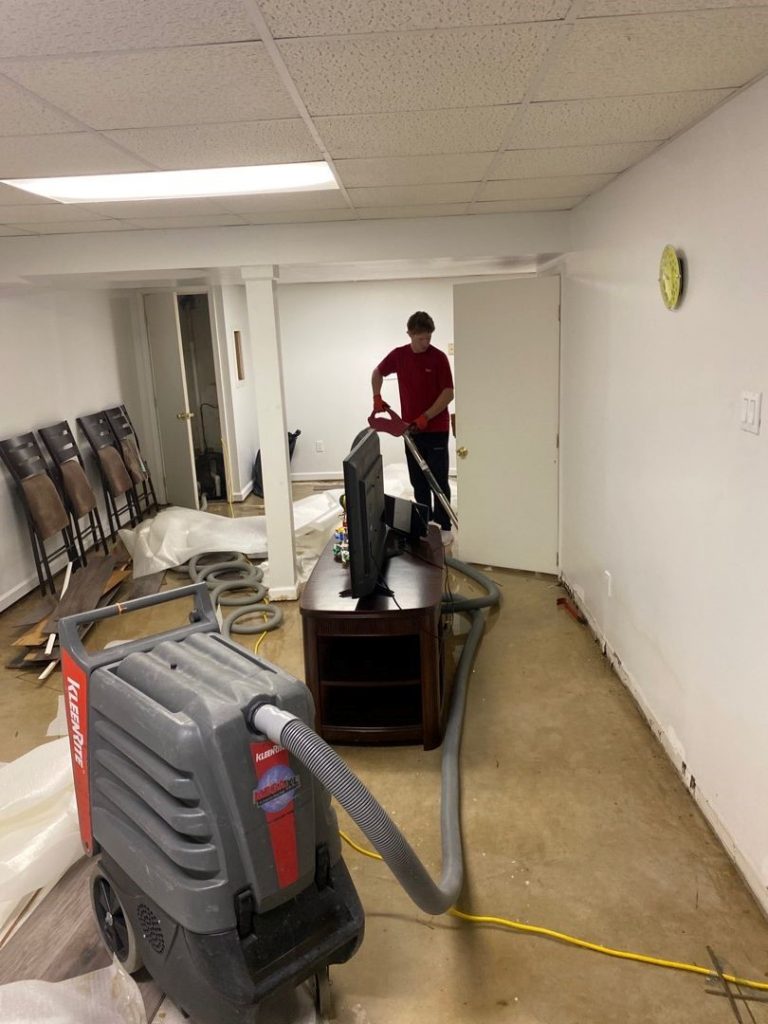
Professional restoration companies in Fort Wayne deploy truck-mounted extraction systems capable of removing thousands of gallons of water per hour. They conduct comprehensive moisture mapping using thermal imaging cameras to identify water migration patterns invisible to the naked eye. This technology is essential in Fort Wayne’s older homes, where water frequently travels along foundation perimeters, through sill plates, and into crawl space environments where it remains hidden for weeks or months.
Mistake 2: Applying Bleach or Household Disinfectants to Flood-Damaged Surfaces
The Dangerous Myth of Bleach as a Mold Solution
Bleach is one of the most misunderstood tools in home maintenance. While it effectively disinfects non-porous surfaces such as tile and glass, it is fundamentally unsuited for mold remediation on porous materials like drywall, wood, and carpet backing. The chemistry is straightforward: bleach is approximately 90 percent water. When applied to porous flood-damaged materials, the chlorine evaporates rapidly, but the water soaks into the material, providing additional moisture for fungal colonization.
The IICRC S520 standard for mold remediation requires physical removal of contaminated porous materials, followed by HEPA vacuuming, negative air pressure containment to prevent cross-contamination, and the application of EPA-registered antimicrobial biocides specifically formulated for restoration environments. Bleach accomplishes none of these objectives.
In Fort Wayne, where summer humidity routinely climbs above 70 percent and basements are naturally damp environments, using bleach on flood damage is particularly dangerous. Homeowners smell the chlorine and believe the problem is solved. Meanwhile, toxigenic molds such as Stachybotrys chartarum, Aspergillus fumigatus, and Penicillium species continue growing within wall cavities, releasing mycotoxins and microbial volatile organic compounds (MVOCs) that degrade indoor air quality. Long-term exposure to these contaminants has been associated with respiratory illness, allergic reactions, and neurological symptoms in sensitive individuals.
Mistake 3: Attempting to Dry Structures with Consumer-Grade Fans and Dehumidifiers
Why Psychrometric Drying Requires Professional Equipment and Expertise
Psychrometrics is the engineering discipline that governs how air, temperature, and moisture interact during the drying process. Professional structural drying is not simply about moving air across wet surfaces. It requires precise control of temperature, relative humidity, and vapor pressure to force moisture out of materials and into the air, then remove that moisture from the environment before it can redeposit elsewhere.
Consumer-grade box fans and small dehumidifiers are incapable of achieving the air exchange rates and grain depression (the measure of moisture removal efficiency) required for structural drying. In Fort Wayne’s humid summer climate, where outdoor dew points frequently exceed 65 degrees Fahrenheit, running fans without adequate dehumidification actually increases indoor humidity. The moisture evaporating from wet surfaces has nowhere to go. It condenses on cooler surfaces such as ductwork, window frames, and the back sides of walls, creating new pockets of moisture damage.
Professional restoration technicians use low-grain refrigerant (LGR) dehumidifiers and desiccant dehumidifiers capable of achieving specific humidity levels below 40 grains per pound. They position high-velocity axial air movers to create controlled airflow patterns across wet surfaces. Daily monitoring with thermo-hygrometers and moisture meters allows technicians to adjust equipment placement and calculate drying progress. This scientific approach reduces drying time from weeks to days and prevents the secondary damage that plagues DIY cleanup attempts.
Mistake 4: Failing to Identify and Address Hidden Moisture
The Invisible Reservoirs That Destroy Fort Wayne Homes From Within
Water is deceptive. What appears dry on the surface often conceals significant moisture within building assemblies. In Fort Wayne homes, common hidden moisture reservoirs include:
- Wall cavities behind baseboards: Water wicks upward through drywall and into insulation batts, where it remains trapped.
- Subfloor assemblies: Water seeps beneath vinyl, laminate, and hardwood flooring, saturating OSB or plywood subflooring.
- Crawl spaces: Floodwater and groundwater intrusion create persistently damp environments beneath the main living area.
- HVAC ductwork: Metal ducts in basements and crawl spaces condense moisture, distributing humidity throughout the home.
The IICRC S500 standard mandates invasive inspection when moisture detection tools indicate elevated readings. This may include removing baseboards, drilling small inspection holes in drywall, or cutting controlled flood cuts to expose wall cavities. While homeowners often resist this level of intrusion, it is the only way to ensure complete drying and prevent progressive structural damage.
Fort Wayne’s older homes are especially vulnerable to hidden moisture damage. Clay tile sewer lines, common in pre-1970s construction, can crack and leak beneath basement slabs, creating chronic moisture conditions that support wood rot, termite infestation, and mold growth. Foundation walls in historic neighborhoods may lack modern waterproofing membranes, allowing groundwater to penetrate through mortar joints and weep holes.
The Certified Restoration Process: What Sets Professionals Apart
Step-by-Step IICRC S500 and S520 Protocol for Fort Wayne Properties
- Step 1: Emergency Response. Certified restoration companies provide 24/7 dispatch. In Fort Wayne, where summer storms and winter thaws can strike without warning, rapid response is essential to limit damage scope.
- Step 2: Comprehensive Assessment. Technicians use thermal imaging, borescopes, penetrating moisture meters, and non-penetrating scanners to map the full extent of water migration, including hidden reservoirs.
- Step 3: Water Extraction. Truck-mounted and portable extraction systems remove standing water. In flooded basements, submersible pumps may be required for significant water volumes.
- Step 4: Controlled Demolition. Flood cuts, carpet and pad removal, and contaminated insulation disposal expose wet structural materials to drying airflow.
- Step 5: Psychrometric Drying. LGR dehumidifiers, desiccant units, and high-velocity air movers are positioned based on daily moisture readings. Technicians calculate grain depression and adjust equipment to achieve target equilibrium moisture content.
- Step 6: Antimicrobial Application. EPA-registered biocides are applied to prevent microbial growth on treated surfaces. In mold-contaminated areas, negative air pressure containment and HEPA air scrubbers protect unaffected areas from cross-contamination.
- Step 7: HEPA Filtration and Odor Control. Air scrubbers with HEPA filtration remove airborne mold spores, particulates, and odors. Activated carbon filters address persistent musty smells.
- Step 8: Verification and Documentation. Final moisture readings, thermal imaging confirmation, and detailed photographic documentation provide the evidence base for insurance claims and certify that the property is ready for reconstruction.
FAQ:
Does home insurance cover mold caused by high humidity in Fort Wayne?
Homeowners insurance policies in Indiana generally distinguish between mold caused by a covered sudden and accidental event and mold resulting from long-term maintenance issues. If mold develops as a direct consequence of a covered water damage event, such as a burst pipe or storm damage that enters through a compromised roof, your policy may cover remediation up to specified limits. However, mold caused by chronic humidity, poor ventilation, or gradual seepage is typically excluded as a maintenance responsibility. Fort Wayne homeowners should review their policy’s mold endorsement carefully and document all water damage with professional moisture readings and photographs to support potential claims.
How do Fort Wayne’s freeze-thaw cycles affect foundation water damage?
Fort Wayne’s climate produces repeated freeze-thaw cycles throughout winter and early spring. Water that enters foundation cracks during thaw periods expands when temperatures drop below freezing, exerting pressure that widens cracks and creates new pathways for water entry. Over time, this process compromises foundation integrity, increases basement leakage, and can lead to bowed or settled walls. Professional restoration includes foundation assessment and referral to qualified foundation repair specialists when structural damage is identified.
Are Fort Wayne homes with basements more vulnerable to long-term flood damage?
Yes. Basements are inherently vulnerable to water intrusion due to their below-grade position and exposure to hydrostatic pressure from surrounding soil. In Fort Wayne, where the water table fluctuates seasonally and clay soils retain moisture, basements face continuous pressure from groundwater. Older homes with clay tile sewers, deteriorated waterproofing, or inadequate sump pump systems are at elevated risk. Professional moisture mapping and preventive waterproofing recommendations are essential components of comprehensive restoration.
How long does professional flood restoration take in Fort Wayne?
For a typical residential water mitigation project with prompt professional intervention, drying takes 3 to 5 days. Projects involving Category 3 contamination, extensive mold remediation, or structural reconstruction may require 2 to 4 weeks. The single most important factor in timeline is the speed of initial response. Homes where water extraction begins within hours of the event experience significantly shorter restoration periods and lower overall costs than properties where cleanup is delayed by days.
Do Not Let Flood Damage Destroy Your Fort Wayne Property
The four cleaning mistakes detailed in this guide are not theoretical risks. They are the exact errors that transform manageable water damage into catastrophic property loss. Every day, homeowners in Fort Wayne, Aboite, New Haven, and surrounding Allen County communities discover that DIY cleanup has left their homes structurally compromised, contaminated with mold, and unsafe for occupancy.
PuroClean Disaster Restoration of West Fort Wayne is IICRC certified in water damage restoration (S500) and mold remediation (S520). Our technicians understand the unique challenges of Northeast Indiana’s climate, the construction characteristics of Fort Wayne’s diverse housing stock, and the scientific principles that govern successful structural drying. We deploy industrial-grade extraction equipment, thermal imaging moisture mapping, LGR dehumidification, HEPA air filtration, and negative air pressure containment to restore your property safely and completely.
If your Fort Wayne area home or business has experienced flooding, water intrusion, or storm damage, do not risk your property’s future with incomplete cleanup. Call PuroClean Disaster Restoration of West Fort Wayne now at (260) 263-9788 for immediate 24/7 emergency response. Our certified team will stop the damage, protect your health, and guide you through every step of the restoration process.
 PuroClean Disaster Restoration of West Fort Wayne