


Key Takeaways for Homeowners
- Allen County’s freeze-thaw cycle and clay soil composition make Fort Wayne basements uniquely vulnerable to foundation seepage
- The IICRC S500 standard mandates that water damage mitigation begin within 24 hours to prevent secondary damage
- Category 2 and 3 water losses require antimicrobial biocide application and HEPA filtration for safe remediation
- Mold colonization begins in 24-48 hours and produces mycotoxins that threaten respiratory health
- Professional moisture mapping prevents hidden damage that can cost tens of thousands in future repairs
- Your insurance claim success depends on proper documentation and hiring IICRC-certified contractors
- Calling PuroClean Disaster Restoration of West Fort Wayne at (260) 263-9788 within the first hour can cut total restoration costs by up to 40%
What Is Water Damage Restoration and Why Fort Wayne Homeowners Cannot Afford to Get It Wrong?
Water damage restoration is the professional science of returning a water-impacted structure to its pre-loss condition, governed by the Institute of Inspection, Cleaning and Restoration Certification (IICRC) S500 Standard and Reference Guide for Professional Water Damage Restoration. This standard is not a suggestion. It is the authoritative framework that separates professional mitigation from dangerous guesswork.
For property owners in Fort Wayne, Indiana, and throughout Allen County, water damage represents a persistent and escalating threat. The National Weather Service reports that northeastern Indiana averages 35-40 inches of precipitation annually, with spring thunderstorms, summer humidity spikes, and winter freeze-thaw events creating year-round water intrusion risks. Fort Wayne’s location along the St. Joseph, St. Marys, and Maumee Rivers means localized flooding is a recurring reality for neighborhoods near these waterways.
PuroClean Disaster Restoration of West Fort Wayne operates under full IICRC S500 and S520 certification, deploying psychrometric science, commercial-grade dehumidification, negative air pressure containment, and moisture mapping technology to protect your property and your family. When water strikes, speed is everything. Call (260) 263-9788 for immediate emergency response.
Mistake 1: Delaying Professional Response Beyond the Critical First Hour
The IICRC S500 standard establishes a clear hierarchy of damage escalation. Water damage is not static. It is a dynamic chemical and biological process that accelerates with every passing minute.
- Minutes 1-60: Water spreads across floors, wicks up walls through capillary action, and saturates porous materials. This is your window of maximum control.
- Hours 2-12: Drywall swells and disintegrates, wood flooring cups and buckles, furniture finishes bleed and stain, and metal surfaces begin oxidizing.
- Hours 12-24: Mold spores activate on organic substrates. Bacterial growth accelerates in Category 2 water. Odor compounds begin forming.
- Days 2-7: Mold colonization becomes visible. Structural materials may require replacement rather than restoration. Insurance claim complexity increases.
- Beyond 7 days: Long-term structural damage, persistent microbial contamination, and significantly higher restoration costs become inevitable.
Many Fort Wayne homeowners attempt initial water removal with consumer shop vacuums and household fans. This is a costly error. Consumer equipment typically delivers 60-100 CFM of airflow and minimal water lift. Professional air movers deliver 2,000-3,000 CFM with precision positioning. The difference is not incremental. It is the difference between restoration and reconstruction.
What to do instead:
- Call an IICRC-certified restoration company immediately upon discovering water damage
- Shut off the water source at the main valve if safe to do so
- Turn off electrical power to affected areas at the breaker panel
- Remove small valuables, electronics, and important documents from the water zone
- Take comprehensive photographs and video for insurance documentation before any cleanup
Mistake 2: Misidentifying Water Category and Contamination Level
The IICRC S500 standard classifies all water damage into three categories. Misidentification leads to inadequate safety protocols, incomplete remediation, and serious health consequences.
Category 1 (Clean Water): Originates from a sanitary source. Examples include broken water supply lines, overflowing sinks or bathtubs with no contaminants, and melting snow or ice. Category 1 water poses minimal immediate health risk but degrades to Category 2 within 48-72 hours of contact with building surfaces.
Category 2 (Gray Water): Contains significant contamination and has the potential to cause discomfort or sickness if contacted or consumed. Sources include dishwasher discharge, washing machine overflow, toilet overflow with urine but no feces, and sump pump failures. Gray water may contain chemicals, microorganisms, and nutrients that support bacterial and fungal proliferation.
Category 3 (Black Water): Grossly unsanitary water containing pathogens, toxins, and harmful agents. Sources include sewage backups, flooding from rivers and streams, and stagnant water that has supported bacterial growth. Black water requires full PPE, antimicrobial biocide application, and often requires disposal of all porous materials.
Fort Wayne’s combined sewer system, particularly in older neighborhoods near downtown and along the river corridors, is susceptible to backups during heavy rainfall events. A basement flooded with sewage is a Category 3 emergency that demands immediate professional response. Homeowners who attempt DIY cleanup risk exposure to E. coli, Salmonella, hepatitis viruses, and parasitic organisms.
What to do instead:
- Never assume water is clean based on appearance alone
- Wear full PPE including nitrile gloves, N95 or P100 respirators, and eye protection before entering any water-damaged area
- Isolate the affected zone to prevent cross-contamination to clean areas
- Deploy negative air pressure containment when Category 2 or 3 water is present
- Apply EPA-registered antimicrobial biocides per manufacturer specifications and dwell time requirements
- Dispose of carpet pad, insulation, and other porous materials saturated with Category 3 water
Mistake 3: Failing to Detect and Map Hidden Moisture
Water is insidious. It travels horizontally across subfloors, vertically inside wall cavities through wicking, and into concealed spaces through vapor diffusion. Surface dryness is meaningless if concealed moisture remains trapped.
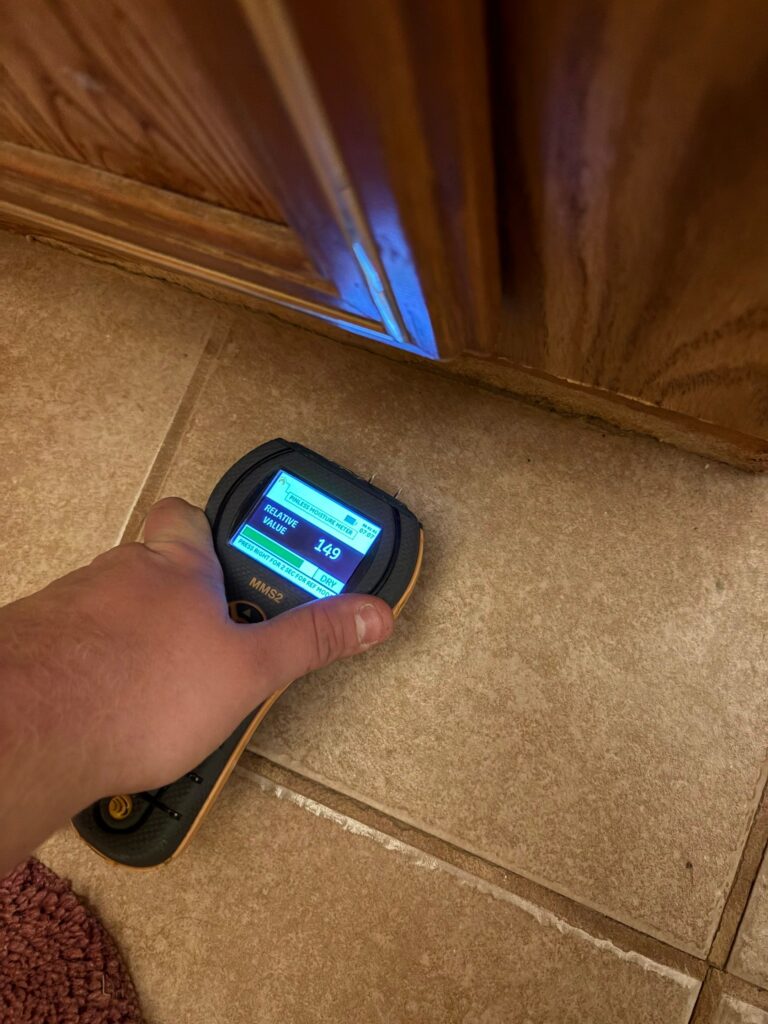
Professional moisture mapping is a non-negotiable component of IICRC S500-compliant restoration. Certified technicians employ multiple detection technologies:
- Thermal imaging cameras (infrared thermography): Detect temperature differentials as small as 0.1 degrees Celsius, revealing moisture patterns invisible to the eye
- Pin-type moisture meters: Measure actual moisture content percentage in wood, drywall, and other building materials by penetrating the surface
- Pinless moisture meters: Use electromagnetic signals to detect moisture behind surfaces without penetration
- Hygrometers and thermo-hygrometers: Measure relative humidity, temperature, and dew point to assess the drying environment
- Borescopes: Allow visual inspection inside wall cavities, ductwork, and other confined spaces
Fort Wayne’s housing stock includes a significant percentage of homes built between 1950 and 1980 with unique moisture behavior characteristics. These homes often feature plaster and lath construction, balloon framing, and minimal vapor barriers compared to modern building standards. The clay-heavy soils common in Allen County also create hydrostatic pressure against basement walls, driving moisture through foundation cracks that may not be visible from the interior.
What to do instead:
- Demand comprehensive moisture mapping from your restoration contractor before drying begins
- Establish drying goals based on dry standard readings from unaffected areas of the same structure
- Create inspection ports in walls and remove baseboards when moisture is suspected behind finishes
- Monitor moisture content daily using calibrated instruments until equilibrium is achieved
- Document all readings in a written drying log for insurance claim support
Mistake 4: Allowing Mold to Colonize Beyond the 24-48 Hour Window
Mold is not a cosmetic problem. It is a biological hazard. The IICRC S520 Standard and Reference Guide for Professional Mold Remediation establishes that mold colonization begins within 24 to 48 hours of moisture intrusion on organic substrates. Once established, mold produces mycotoxins and volatile organic compounds that can trigger asthma, allergic rhinitis, hypersensitivity pneumonitis, and other respiratory conditions.
Common indoor molds of concern include:
- Stachybotrys chartarum (black mold): Produces trichothecene mycotoxins; thrives on cellulose-rich materials like drywall paper
- Aspergillus species: Produce aflatoxins and gliotoxin; particularly dangerous for immunocompromised individuals
- Penicillium species: Produce penicillic acid and other mycotoxins; common in water-damaged building materials
- Chaetomium: Produces chaetoglobosins; indicator of chronic moisture problems
HEPA filtration is mandatory during any mold remediation activity. HEPA filters rated at 99.97% efficiency at 0.3 microns capture mold spores and prevent their migration to unaffected areas. Air scrubbers equipped with HEPA filtration and negative air machines create controlled airflow that protects both workers and occupants.
Fort Wayne’s humid continental climate means summer relative humidity frequently exceeds 75%, creating ideal conditions for mold proliferation in water-damaged structures. Homes near the rivers or in low-lying areas of Allen County face elevated risk due to persistent groundwater and soil moisture.
What to do instead:
- Begin professional drying operations within 24 hours of water intrusion
- Maintain indoor relative humidity below 60% during the drying process using commercial dehumidification
- Apply antimicrobial biocides to affected surfaces following S520 protocols
- Install HEPA air scrubbers in contained work areas with sealed polyethylene barriers
- Conduct post-remediation verification including air sampling and surface sampling by an independent third party when health concerns exist
Mistake 5: Deploying Inadequate Drying Equipment and Ignoring Psychrometrics
Structural drying is governed by psychrometrics, the science of air and moisture relationships. Effective drying requires precise control of temperature, humidity, and airflow. Guessing is not a strategy.
Homeowners commonly make these equipment errors:
- Using household fans that merely recirculate humid air without removing moisture from the environment
- Opening windows during humid weather, which introduces additional moisture and extends drying time
- Relying on residential air conditioning systems that are not designed for water damage drying loads
- Removing carpet and pad without addressing subfloor moisture that will destroy replacement flooring
- Failing to create airflow inside wall cavities where moisture becomes trapped
Professional restoration employs Low Grain Refrigerant (LGR) dehumidifiers, which remove moisture from air more efficiently than conventional units, particularly as humidity levels decrease during the drying process. Desiccant dehumidifiers using silica gel or lithium chloride may be required for specialty drying scenarios or when temperatures fall below optimal ranges.
Air movers are positioned to create turbulent airflow across wet surfaces, maximizing evaporation rates. The industry standard calls for one air mover per 50-70 square feet of affected floor area, with additional units for inside wall cavities and under cabinetry.
What to do instead:
- Deploy commercial LGR dehumidifiers sized to the cubic footage and moisture load of the affected space
- Calculate required air changes per hour and position air movers for optimal airflow patterns
- Use injection drying systems for hardwood floors and wall cavities
- Monitor grain depression (the difference between incoming and outgoing air moisture content) daily
- Adjust equipment based on daily moisture readings and psychrometric calculations
Mistake 6: Mishandling Insurance Documentation and Claim Requirements
Your homeowners insurance policy is a binding contract with specific conditions you must meet to secure coverage. Failure to document damage properly or hiring unqualified contractors can result in claim denial, underpayment, or policy cancellation.
In Indiana, standard HO-3 homeowners policies typically cover sudden and accidental water damage from internal sources such as burst pipes, appliance failures, and water heater ruptures. Common exclusions include:
- Gradual leaks and maintenance-related issues
- Flood damage from external rising water (requires National Flood Insurance Program coverage)
- Sewer backup without a specific rider endorsement
- Mold remediation beyond the scope of the original covered water loss
Fort Wayne property owners should be aware that Allen County participates in the National Flood Insurance Program, and homes in designated flood zones along the St. Joseph, St. Marys, and Maumee Rivers require separate flood insurance. Even homes outside designated flood zones can experience flash flooding during severe weather events.
What to do instead:
- Photograph and video all damage comprehensively before any cleanup or mitigation begins
- Maintain a detailed inventory of damaged personal property with descriptions, purchase dates, and estimated values
- Retain all receipts for emergency mitigation services, temporary repairs, and replacement purchases
- Request a written scope of work and drying log from your restoration contractor
- Obtain a certificate of completion documenting that IICRC drying standards were achieved
- Work with a restoration company experienced in direct insurance billing and claim documentation
Mistake 7: Hiring Unqualified or Uninsured Restoration Contractors
The water damage restoration industry lacks federal licensing requirements. This means anyone with a truck and a wet/dry vacuum can claim to be an expert. Hiring an unqualified contractor exposes you to incomplete remediation, health hazards, insurance claim complications, and potential liability.
IICRC certification is the recognized industry standard. Certified Water Damage Restoration Technicians (WRT) and Applied Microbial Remediation Technicians (AMRT) have completed comprehensive training programs, passed rigorous examinations, and must complete continuing education to maintain certification. This ensures they remain current with evolving standards, technologies, and safety protocols.
In Indiana, contractors performing construction work must also hold appropriate state licensing. Before hiring any restoration company, verify:
- IICRC WRT and AMRT certifications for all technicians who will work on your property
- General liability insurance with adequate coverage limits
- Workers compensation insurance protecting you from liability if workers are injured on your property
- State contractor licensing for any reconstruction work
- Local references from recent jobs in Fort Wayne and Allen County
- 24/7 emergency response capability
What to do instead:
- Verify IICRC certifications through the official IICRC online directory
- Request certificates of insurance directly from the contractor’s insurance carrier
- Ask for local references and check online reviews
- Confirm the company provides genuine 24/7 emergency response, not just voicemail
- Ensure they offer direct insurance billing and comprehensive claim documentation
- Obtain a written estimate and scope of work before authorizing any work
Fort Wayne-Specific Water Damage Risks Every Property Owner Should Know
Fort Wayne’s geography and climate create unique water damage vulnerabilities that out-of-state contractors may not understand:
Freeze-Thaw Foundation Stress: Northeastern Indiana experiences dramatic temperature swings in late winter and early spring. Repeated freeze-thaw cycles cause soil expansion and contraction that stress foundation walls, creating cracks that become water entry points during spring rains.
River Corridor Flooding: Properties near the St. Joseph, St. Marys, and Maumee Rivers face elevated flood risk during spring snowmelt and heavy rainfall events. Even properties outside FEMA flood zones can experience flash flooding from overwhelmed stormwater systems.
Aging Infrastructure: Older Fort Wayne neighborhoods, particularly those with original combined sewer systems, are susceptible to backups during intense rainfall. The city’s ongoing sewer separation projects are addressing this, but many areas remain at risk.
Basement-Heavy Housing Stock: A significant percentage of Fort Wayne homes feature full basements, which represent the lowest point of water accumulation and the most common site of water damage. Sump pump failures, foundation seepage, and sewer backups all converge in the basement.
High Summer Humidity: Allen County’s summer relative humidity regularly exceeds 70%, meaning structures that are not dried to IICRC standards will reabsorb atmospheric moisture, perpetuating damage and mold risk.
Frequently Asked Questions
Does home insurance cover mold caused by high humidity in Fort Wayne?
Standard Indiana homeowners insurance policies generally do not cover mold damage that results from chronic humidity, poor ventilation, or maintenance neglect. However, mold that develops as a direct result of a covered sudden and accidental water loss such as a burst pipe or storm damage is typically covered, subject to policy limits that commonly range from $1,000 to $10,000. Some insurers offer optional mold coverage endorsements for additional premium. The critical factor is establishing that the mold resulted from a covered peril and not from long-term maintenance issues. Work with an IICRC-certified restoration company that understands insurance documentation requirements.
How long does water damage restoration take in Fort Wayne homes?
Restoration timelines vary based on water category, the extent of affected materials, environmental conditions, and whether mold remediation is required. A contained Category 1 water loss in a single room typically achieves drying goals in 3 to 5 days. More complex Category 2 or 3 losses involving multiple rooms, wall cavities, or flooring systems may require 7 to 14 days of active drying, plus additional time for reconstruction. Fort Wayne’s summer humidity can extend drying times if not aggressively controlled with commercial dehumidification. Your restoration contractor should provide daily moisture readings and update projected completion timelines.
What are the warning signs of hidden water damage in Fort Wayne basements?
Be alert for peeling paint or efflorescence (white powdery deposits) on basement walls, warped or buckling flooring, persistent musty odors, stained ceiling tiles or drywall, sudden increases in water bills, condensation on windows or pipes, and visible mold growth on surfaces. Fort Wayne homes with full basements are particularly vulnerable to hidden moisture from foundation seepage, especially after heavy rains or snowmelt. Older homes in neighborhoods like West Central, Williams-Woodland, and parts of the Northside may have original foundation waterproofing that has degraded over decades.
Is it safe to stay in my Fort Wayne home during water damage restoration?
For minor Category 1 water losses confined to non-occupiable areas like unfinished basements or garages, you may be able to remain in the home with some lifestyle adjustments. However, for Category 2 or 3 water losses, any situation involving visible mold, or remediation requiring negative air pressure containment, temporary relocation is strongly advised. The equipment, antimicrobial applications, and containment protocols create conditions that are not suitable for occupancy, particularly for children, elderly individuals, or anyone with respiratory conditions. Your restoration contractor will assess the specific scope and advise on safety.
Do Not Let Water Damage Destroy Your Fort Wayne Property
Water damage is a time-critical emergency that demands immediate professional response. Every hour of delay allows moisture to penetrate deeper into your home’s structure, creating secondary damage that multiplies repair costs and threatens your family’s health.
PuroClean Disaster Restoration of West Fort Wayne serves all of Allen County with IICRC S500 and S520 certified emergency response. We combine scientific expertise, advanced restoration technology, and deep local knowledge of Fort Wayne’s unique water damage risks to protect your property and restore your peace of mind.
If you are facing water damage right now, do not wait another minute. Call PuroClean Disaster Restoration of West Fort Wayne at (260) 263-9788 for immediate emergency assistance. Our certified technicians are standing by 24 hours a day, 7 days a week, ready to respond to your call and begin professional mitigation before the damage escalates beyond repair.

