 PuroClean Disaster Restoration of West Fort Wayne
 Key Takeaways for Homeowners
| Fort Wayne’s location at the confluence of three rivers creates elevated spring flood and water intrusion risk for homeowners. |
| IICRC S500 and S520 certified restoration is the only industry-recognized standard for professional water damage and mold remediation. |
| Mold can colonize wet building materials in 24 to 48 hours, making rapid spring cleaning response essential. |
| Indiana’s freeze-thaw cycles and spring snowmelt add moisture load to Fort Wayne foundations and crawl spaces every year. |
| PuroClean Disaster Restoration of West Fort Wayne is ready 24/7. Call (260) 263-9788 for immediate restoration services. |
Why Fort Wayne Homes Face Unique Spring Water Damage Challenges
Fort Wayne, Indiana occupies a historically significant and geographically challenging location at the confluence of the St. Marys River, the St. Joseph River, and the Maumee River. This tri-river geography, combined with Allen County’s relatively flat glacial topography and heavy clay soils, creates conditions that make spring flooding, basement seepage, and foundation moisture intrusion an annual reality for thousands of Fort Wayne homeowners.
Beyond riverine flooding, Fort Wayne’s humid continental climate delivers significant snowfall from November through March. When rapid spring thaw occurs, the ground cannot absorb the meltwater quickly enough, and that moisture migrates toward basement walls, crawl space foundations, and low-lying slab-on-grade structures in neighborhoods throughout the city.
Older neighborhoods including West Central, Lakewood Park, and Waynedale feature housing stock from the early 1900s through the 1960s. These homes often have rubble stone or unreinforced masonry foundations, single-pane windows, and original wood framing that absorbs and retains moisture far more readily than modern construction. Newer developments in southwest Fort Wayne near Covington Road and Dupont Road include more modern construction but face similar clay soil drainage challenges.
When spring arrives, these moisture-saturated structures require a systematic, science-based deep cleaning approach grounded in IICRC standards. The following six strategies represent the most effective and professionally recognized methods for restoring water-damaged Fort Wayne homes.
Strategy 1: Perform Comprehensive Moisture Mapping Before Touching Anything
The first and most critical step in spring restoration is understanding the full extent of moisture infiltration through detailed moisture mapping. Professional restoration technicians use infrared thermal imaging cameras alongside calibrated pin-type and pinless moisture meters to create a complete moisture map of every affected structure.
This process reveals the true scope of water damage, which in Fort Wayne homes frequently extends far beyond the visible wet zone. Water travels through capillary action in concrete and masonry, migrates horizontally through floor assemblies, and wicks upward through wall framing. A visual inspection alone is insufficient.
Moisture mapping identifies:
- Elevated moisture content in wood framing, typically anything above 16 to 19 percent for high-risk materials
- Thermal cold spots indicating evaporative cooling from wet insulation or sheathing
- Relative humidity above 60 percent in enclosed spaces such as crawl spaces and mechanical rooms
- Moisture gradients that identify migration pathways and water source locations
- Hidden wet zones behind finished wall surfaces and under floor coverings
Strategy 2: Execute IICRC S500 Category-Compliant Material Removal
Effective water damage restoration in Fort Wayne requires material removal decisions based on the IICRC S500 water classification system. This standard defines three water categories that determine how aggressively porous materials must be removed and handled.
Fort Wayne homeowners are particularly at risk for Category 3 water exposure during spring flooding events near the Maumee River floodplain, Spy Run Creek, or any of the city’s numerous drainage ditches and retention basins. Category 3 water, or black water, is grossly contaminated and requires the most aggressive material removal protocol. All porous and semi-porous materials that have contacted Category 3 water, including drywall, insulation, carpeting, wood trim, and organic debris, must be removed, bagged, and disposed of according to Indiana Department of Environmental Management guidelines.
IICRC S500 material removal steps for Fort Wayne homes:
- Photograph and document all damaged materials before removal for insurance documentation
- Remove all wet or contaminated carpet, padding, and vinyl flooring
- Perform flood cuts in drywall at a minimum of 12 inches above the moisture line
- Remove all fiberglass batt or blown insulation from wet wall and floor cavities
- Evaluate and remove cabinets and millwork with evidence of particle board or MDF saturation
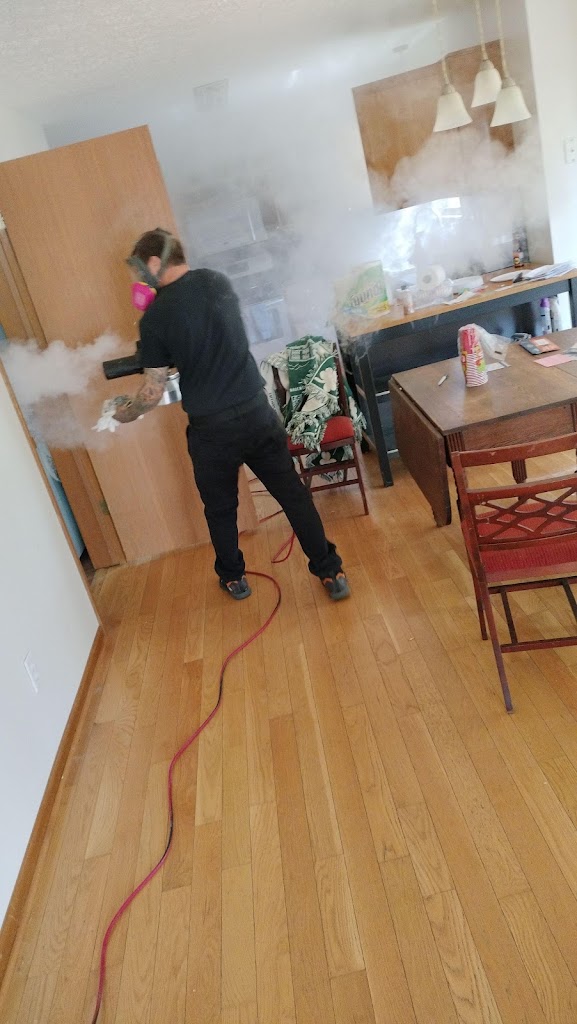
Strategy 3: Apply IICRC S520 Compliant Antimicrobial Biocide to All Structural Surfaces
After material removal, all exposed structural surfaces including wood framing, concrete block, poured concrete, and masonry must receive application of an EPA-registered antimicrobial biocide. This step eliminates mold spores, bacteria, and biofilm that have colonized structural surfaces during the period of moisture exposure.
Fort Wayne’s spring humidity levels frequently exceed 70 percent outdoors and can push indoor relative humidity well above 60 percent in affected structures without mechanical intervention. These conditions are ideal for the rapid colonization of Aspergillus, Penicillium, Cladosporium, and in cases of chronic moisture, Stachybotrys chartarum. Each of these species produces mycotoxins at varying concentrations depending on substrate type and moisture availability.
Antimicrobial biocide application must include:
- Complete surface coverage including the back sides of remaining structural members
- Appropriate product selection for each substrate type including porous wood, concrete, and metal
- Adequate dwell time as specified by the product label before mechanical disturbance
- Proper ventilation using HEPA air scrubbers to capture aerosolized spores during treatment
Strategy 4: Deploy Structural Drying Equipment Using Psychrometric Science
Structural drying is the controlled application of thermodynamic and airflow principles to remove moisture from building materials within targeted timeframes. The science of psychrometrics governs this process, providing the mathematical framework for calculating evaporation rates, dehumidifier sizing, and equipment placement.
Professional restoration teams in Fort Wayne deploy industrial-grade axial air movers that create high-velocity laminar airflow across wet surfaces. This airflow drives evaporation by continuously replacing the saturated boundary layer of air adjacent to wet materials with drier ambient air. Refrigerant dehumidifiers then extract that water vapor from the indoor environment before it can migrate into unaffected areas or be reabsorbed into drying materials.
Fort Wayne’s spring climate presents specific drying challenges. Outdoor dew points during April and May regularly range from 45 to 60 degrees Fahrenheit. Introducing outdoor air into drying zones can introduce significant moisture load that overwhelms dehumidification capacity. Professional restoration teams seal affected areas and use mechanically dried air recirculation to maintain optimal drying conditions regardless of outdoor conditions.
Structural drying targets for Fort Wayne restoration projects:
- Maintain drying zone relative humidity below 45 to 50 percent throughout the drying period
- Achieve equilibrium moisture content in structural wood at or below 16 percent
- Monitor grain depression between inlet and outlet air to confirm dehumidifier efficiency
- Adjust air mover positioning every 24 hours based on moisture meter readings
- Maintain daily psychrometric logs to document drying progress for insurance verification
Strategy 5: Establish Negative Air Pressure Containment with HEPA Filtration
When mold colonization is present or when Category 2 or 3 water contamination is involved, negative air pressure containment using HEPA filtration is a mandatory element of professional restoration under IICRC S520. This strategy prevents the spread of mold spores, mycotoxins, and contaminated particulates to unaffected areas of the home.
Containment is established using 6-mil polyethylene sheeting stretched across doorways and air passages, creating a sealed work zone. Industrial HEPA air scrubbers rated to filter particles at 0.3 microns or larger at 99.97 percent efficiency are then used to maintain negative pressure within the containment zone. This ensures that any airborne contaminants within the work zone are drawn toward the filtration units rather than escaping into clean areas of the home.
In Fort Wayne’s older West Central neighborhood homes and bungalows in the Wildwood Park area, open floor plans and interconnected basement and main floor air handling often make containment particularly complex. Professional restoration teams assess airflow patterns before establishing containment barriers.
Negative air pressure containment checklist:
- Seal all openings from the work zone to the rest of the home with 6-mil poly sheeting
- Install HEPA air scrubbers to maintain a minimum of 4 to 6 air changes per hour within the containment zone
- Verify negative pressure using a manometer or smoke test at containment barrier entry points
- Establish a decontamination anteroom for worker entry and exit to prevent cross-contamination
Strategy 6: Conduct Post-Restoration Indoor Air Quality Verification
The final strategy in your spring restoration plan is verification that all remediation objectives have been met through independent indoor air quality testing. This step is essential for confirming the safety of the home for occupancy and for providing documentation to your insurance carrier.
Post-remediation verification includes air sampling for total fungal spore counts, surface sampling of remediated areas for mold biofilm, and inspection of all structural materials for moisture content compliance with drying standards. Results are compared to baseline outdoor air samples to determine whether indoor fungal levels are elevated above normal outdoor concentrations.
Fort Wayne homeowners should request clearance testing from a certified industrial hygienist independent of the restoration contractor. This third-party verification provides objective confirmation that remediation has been completed successfully and that the home meets the occupancy standards established in IICRC S520.
Frequently Asked Questions: Water Damage Spring Cleaning in Fort Wayne
Does home insurance cover mold caused by high humidity in Fort Wayne?
Indiana homeowner’s insurance policies generally cover mold remediation when it arises directly and exclusively from a sudden, accidental covered peril such as a burst pipe, appliance overflow, or storm-related water intrusion. Mold attributed to ongoing elevated humidity, condensation from inadequate ventilation, or long-term deferred maintenance is almost universally excluded. Allen County homeowners in flood-prone areas near the Maumee or St. Marys Rivers may also need separate flood insurance through the National Flood Insurance Program to cover riverine flooding losses.
How quickly does mold grow after water damage in a Fort Wayne home?
Under conditions common to Fort Wayne’s spring climate, including temperatures between 60 and 80 degrees Fahrenheit and relative humidity above 70 percent, mold spore germination can begin within 24 hours of initial material saturation. Visible mold growth on wood framing and drywall typically appears within 48 to 72 hours. This is why professional extraction and drying must begin immediately after any water intrusion event.
Are Fort Wayne homes near the rivers at higher risk for Category 3 water damage?
Yes. Homes within the Maumee River, St. Marys River, and St. Joseph River floodplains in Fort Wayne are at elevated risk for Category 3 water intrusion during spring flood events. Category 3 water is grossly contaminated and requires the most aggressive material removal and antimicrobial treatment protocols under IICRC S500. Allen County Emergency Management publishes updated flood risk maps that homeowners can consult to assess their specific property’s flood exposure.
Can I use bleach to clean up mold after water damage in my Fort Wayne home?
Diluted sodium hypochlorite, commonly known as household bleach, is sometimes used as a surface disinfectant on non-porous materials but it is not an acceptable substitute for professional IICRC S520 compliant mold remediation. Bleach does not penetrate porous materials such as wood framing, does not eliminate mycotoxins, and does not address the underlying moisture conditions that support mold growth. Additionally, mixing bleach with other cleaning agents can produce toxic chlorine gas. Professional restoration using EPA-registered antimicrobial biocides and proper structural drying is the only evidence-based approach to effective mold remediation.
How do I choose a qualified water damage restoration company in Fort Wayne?
Look for IICRC certification, specifically the Water Damage Restoration Technician (WRT), Applied Structural Drying Technician (ASD), and Applied Microbial Remediation Technician (AMRT) credentials. These certifications confirm training in the S500 and S520 standards. Verify that the company carries general liability and contractor’s pollution liability insurance. PuroClean Disaster Restoration of West Fort Wayne holds these certifications and serves the entire Fort Wayne metro area with 24-hour emergency response.
Call PuroClean Disaster Restoration of West Fort Wayne Today
Fort Wayne homeowners in Waynedale, Aboite Township, New Haven, Huntertown, and throughout Allen County deserve fast, expert, and compassionate water damage restoration this spring. Whether your home experienced river flooding, a burst pipe, a failed sump pump, or a slow roof leak over the winter, the time to act is now.
Every day of delay means deeper moisture infiltration, greater mold risk, and higher restoration costs. PuroClean Disaster Restoration of West Fort Wayne brings IICRC-certified technicians, industrial drying equipment, and complete insurance claims support to every project.
Call (260) 263-9788 now for immediate emergency water damage assessment and spring restoration services throughout the Fort Wayne area.


 PuroClean Disaster Restoration of West Fort Wayne