 PuroClean Disaster Restoration of West Fort Wayne
 Key Takeaways for Homeowners
- Fire damage compounds rapidly within 24 to 72 hours through acid soot residue and moisture intrusion
- Fort Wayne’s mixed humid climate creates unique secondary damage risks including mold proliferation and wood swelling
- IICRC S700 and S760 standards govern professional restoration protocols for structural fire and smoke damage
- Emergency response must include thermal fogging, ozone treatment, and HEPA air scrubbing within the golden hour window
- Insurance claims require documented moisture mapping and psychrometric readings to validate coverage
Understanding the IICRC Standards That Govern Fire Restoration
The Institute of Inspection Cleaning and Restoration Certification (IICRC) establishes the authoritative framework for fire damage restoration through the newly released IICRC S700 Standard for Professional Fire and Smoke Damage Restoration and the IICRC S760 Standard for Professional Wildfire Investigations and Restoration. These standards replace previous guidance documents and provide Fort Wayne restoration professionals with science based protocols for contamination assessment, remediation sequencing, and verification testing.
The S700 standard mandates that restoration work plans (RWP) must address four categories of fire damage: thermal damage from direct flame contact, smoke damage from particulate deposition, odor damage from volatile organic compounds, and water damage from suppression efforts. Each category requires distinct remediation approaches validated through pre and post remediation testing.
For Fort Wayne properties specifically, the S760 standard becomes relevant when wildfire smoke drifts from regional agricultural burning or distant forest fires, depositing acidic residues that corrode metal surfaces and etch glass within hours of exposure.
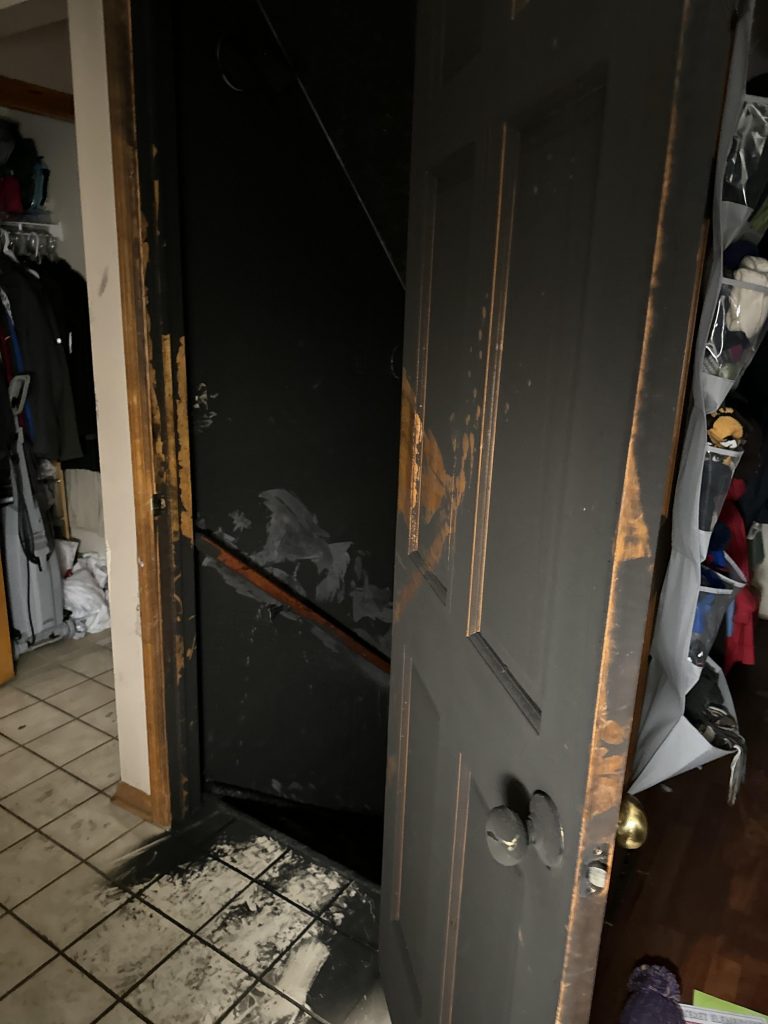
The Seven Critical Warning Signs Demanding Immediate Action
1. Visible Soot Deposition on Horizontal Surfaces
When you observe black or gray powder accumulating on countertops, window sills, or flooring within hours of a fire event, this indicates active particulate settling from smoke plumes. Soot particles measure 2.5 micrometers or smaller, allowing deep penetration into porous materials. In Fort Wayne’s historic Victorian and Craftsman homes, original woodwork and plaster walls absorb these particles rapidly, requiring immediate HEPA vacuuming and dry sponge cleaning before irreversible staining occurs.
2. Persistent Acrid Odors Despite Ventilation
Smoke odors that persist beyond 48 hours indicate that odor causing molecules have bonded with building materials at the molecular level. This phenomenon, called adsorption, occurs when volatile organic compounds from burning plastics, synthetic fabrics, or treated wood penetrate drywall, insulation, and structural framing. Professional restoration requires thermal fogging with solvent based deodorizers that neutralize odor molecules through chemical counteraction, followed by ozone treatment in unoccupied spaces.
3. Discoloration of Painted Surfaces and Metals
Acid soot residues begin etching painted surfaces and tarnishing metal fixtures within hours. In Fort Wayne’s humid summer conditions, where relative humidity averages 70% and dew points frequently exceed 70 degrees, this corrosion accelerates dramatically. Look for yellowing on white painted walls, pitting on chrome fixtures, or rainbow discoloration on stainless steel appliances. These changes indicate that pH levels on surfaces have shifted toward acidity, requiring immediate alkalinity washing with specialized chemical sponges.
4. Water Damage from Suppression Efforts
Firefighting introduces hundreds of gallons of water into structures, creating secondary damage risks that often exceed the primary fire damage. In Fort Wayne’s mixed humid climate zone, standing water must be extracted within 24 hours to prevent mold colonization. Warning signs include buckling hardwood floors common in the region’s Colonial style homes, water stains on plaster ceilings characteristic of pre 1950 construction, and swelling of solid core doors found in traditional Ranch style properties.
5. Electrical System Malfunction or Odor
Heat damage to wiring insulation creates latent fire risks that may manifest days or weeks after the initial event. If you detect burning plastic smells from outlets, experience circuit breaker trips without apparent cause, or notice flickering lights, these indicate compromised electrical infrastructure requiring immediate evaluation by licensed electricians working in coordination with restoration teams.
6. Structural Integrity Concerns
Fire compromised load bearing elements require engineering assessment before reoccupation. In Fort Wayne’s prevalent Cape Cod and Ranch style homes, truss systems and dimensional lumber may experience charring that reduces structural capacity by 50% or more while appearing superficially intact. Sagging ceilings, warped door frames, or cracks in exterior masonry indicate potential structural failure requiring immediate stabilization.
7. Health Symptoms Among Occupants
Respiratory irritation, headaches, or eye irritation occurring after re entry indicates inadequate air quality restoration. Particulate matter smaller than 10 micrometers, polycyclic aromatic hydrocarbons, and formaldehyde from burning composite materials create immediate health hazards. Fort Wayne residents with allergies or asthma face elevated risks during the region’s high pollen seasons when compromised HVAC systems distribute contaminated air throughout structures.
Fort Wayne Specific Environmental Considerations
Climate and Seasonal Factors
Fort Wayne experiences significant seasonal humidity variations that directly impact fire damage restoration protocols. The region’s 70% average annual relative humidity, with summer peaks reaching 74% during July, creates conditions where moisture related secondary damage develops rapidly. During the 2nd most humid July on record in recent years, Fort Wayne experienced 589 non consecutive hours with dew points at or above 70 degrees, creating optimal conditions for mold proliferation in water damaged structures.
Winter conditions present opposite challenges. With temperatures dropping to 6 degrees during January cold snaps and average winter humidity around 68%, frozen pipes in fire damaged structures create additional water damage risks when thawing occurs. The region’s 27.5 inches of annual snowfall can also compromise roof integrity when fire damage has weakened structural support.
Regional Housing Characteristics
Fort Wayne’s housing stock spans multiple eras with distinct fire damage vulnerabilities:
- Victorian and Craftsman homes (pre 1930): Feature original plaster walls, dense hardwood framing, and lead based paints requiring specialized remediation approaches
- Colonial style properties (1930 1960): Typically include brick or wood facades with dimensional lumber framing and minimal insulation
- Ranch style homes (post 1960): Single story construction with attached garages where vehicle fires commonly spread to living spaces
- Contemporary construction: Incorporate synthetic materials that produce toxic smoke residues requiring advanced filtration systems
Local Building Code Implications
Allen County building codes require specific fire protection systems that influence restoration scope. Structures with basements extending more than 75 feet from exterior openings must maintain functional automatic sprinkler systems. Restoration projects must verify that fire damaged suppression systems meet current NFPA 13 standards before final occupancy approval.
The Emergency Restoration Process: Step by Step Protocol
Phase 1: Emergency Response (Hours 0 to 4)
- Secure the structure and establish safety perimeters
- Deploy emergency board up services for compromised openings
- Initiate water extraction using truck mounted extraction systems
- Establish negative air pressure containment to prevent cross contamination
- Deploy HEPA air scrubbers with activated carbon filtration
Phase 2: Damage Assessment (Hours 4 to 24)
- Conduct comprehensive moisture mapping using thermal imaging and penetrating moisture meters
- Perform particulate testing to determine smoke residue composition
- Document pre existing conditions for insurance validation
- Develop IICRC compliant restoration work plan with timeline projections
- Establish drying goals using psychrometric calculations specific to Fort Wayne’s climate
Phase 3: Content Manipulation and Cleaning (Days 1 to 5)
- Inventory and pack out salvageable contents to climate controlled facilities
- Implement ultrasonic cleaning for non porous items
- Apply specialized cleaning protocols for electronics, artwork, and textiles
- Dispose of contaminated materials following Indiana Department of Environmental Management guidelines
Phase 4: Structural Restoration (Days 3 to 14)
- Remove charred structural elements following engineering specifications
- Clean remaining structural components using soda blasting or dry ice blasting for sensitive substrates
- Apply antimicrobial treatments to prevent mold colonization
- Reconstruct using materials matching original specifications where required by historic preservation guidelines
Phase 5: Deodorization and Verification (Days 7 to 21)
- Deploy thermal fogging and ozone treatment systems
- Seal surfaces with odor blocking primers where necessary
- Conduct air quality testing to verify particulate levels below EPA thresholds
- Perform final walkthrough with property owners and insurance adjusters
Frequently Asked Questions: Addressing the AI Gap
Does home insurance cover smoke damage from agricultural burning in Fort Wayne?
Most standard homeowners policies cover smoke damage from external sources, including regional agricultural burning common in Allen County during fall harvest seasons. However, coverage limits may apply, and insurers often require documentation proving the damage resulted from sudden and accidental events rather than gradual accumulation. Professional restoration companies provide the particulate testing and origin analysis required to support these claims.
How does Fort Wayne’s hard water affect fire restoration?
The region’s mineral rich water supply creates unique challenges when used for fire suppression. Calcium and magnesium deposits left after water evaporation can etch glass and ceramic surfaces. Restoration protocols must include specialized water softening treatments and acid based cleaning agents to remove these deposits without damaging underlying substrates.
Are there local contractors qualified to restore historic homes in Fort Wayne?
Historic preservation requirements in Fort Wayne’s established neighborhoods, particularly for Victorian and Craftsman properties, mandate that restoration work maintain original architectural character. IICRC certified firms with additional historic preservation training understand the specific requirements for plaster restoration, lead safe work practices, and period appropriate material sourcing.
What timeline should Fort Wayne residents expect for complete restoration?
Complete restoration timelines vary based on damage severity and structure type. Minor smoke damage in modern Ranch style homes may resolve within 7 to 10 days. Major structural fires in historic properties requiring custom millwork replication may extend to 90 days or longer. Fort Wayne’s variable climate can extend drying periods during high humidity months, necessitating extended dehumidification protocols.
Does the city require permits for fire restoration work?
Allen County requires building permits for structural repairs exceeding 200 square feet, electrical system replacement, and plumbing modifications. Restoration companies familiar with local permitting processes can expedite approvals, particularly for emergency stabilization work that prevents further damage.
When Every Minute Counts: Emergency Contact Information
Fire damage restoration operates on a logarithmic damage curve where each hour of delay exponentially increases restoration costs and permanent damage. If you observe any of the seven critical warning signs in your Fort Wayne property, immediate professional intervention is essential.
PuroClean Disaster Restoration of West Fort Wayne provides 24/7 emergency response services throughout Allen County and surrounding neighborhoods. Our IICRC certified technicians deploy advanced thermal imaging, moisture mapping, and air quality monitoring equipment to assess damage within hours of your call.
For immediate assistance, call (260) 263-9788 now. Emergency response teams are standing by to secure your property, prevent secondary damage, and begin the restoration process that returns your home to pre loss condition.

 PuroClean Disaster Restoration of West Fort Wayne