


Reviewed for technical accuracy by PuroClean Disaster Restoration of West Fort Wayne’s IICRC-certified restoration team.
Every hour that water sits in a home increases the risk of mold and material loss. If you are dealing with flooding right now, call PuroClean Disaster Restoration of West Fort Wayne at (260) 263-9788 for 24/7 emergency dispatch.
What Does Flood Cleanup Involve, and Which Standard Applies?
Flood cleanup means stopping water entry, removing contaminated water and materials, drying the structure, and sanitizing what remains. Professionals follow the ANSI/IICRC S500 Standard for Professional Water Damage Restoration, which defines water categories and drying classes so that the response matches the real hazard in your home.
Fort Wayne homeowners face a mix of flood types, and S500 helps sort them out. A clean supply-line leak, a river-driven basement seep, and a sewer backup each call for different protocols. FEMA flood guidance supports the same sequence: safety, documentation, fast water removal, then thorough drying.
Takeaway: Identify what kind of water you have before you decide how to clean it.
Why Is Fort Wayne So Prone to Flooding?
Fort Wayne floods because the St. Marys and St. Joseph Rivers meet to form the Maumee, which drains the largest watershed of any Great Lakes tributary, over 6,600 square miles. Add clay-rich soil that holds water against foundations and older combined sewers that overflow in heavy rain, and basements take the hit.
The city’s flood history, including 1913 and the 1982 flood that earned Fort Wayne the name “The City That Saved Itself,” is a reminder that this is a river city. Roughly 38 inches of precipitation falls in an average year. Rapid snowmelt over still-frozen, saturated ground is a documented spring trigger, because water has nowhere to go but sideways into foundations. Summer thunderstorms bring a second peak, when intense rain overloads storm and sanitary lines in a short window.
Soil and housing age change the risk from block to block. Clay-heavy soils in neighborhoods like Lakeside and Bloomingdale trap water against foundation walls and raise hydrostatic pressure. Mid-century homes in Waynedale, the South Side, and Foster Park, and historic homes near downtown, often sit on older sewer infrastructure where combined systems can back up through floor drains and sanitary laterals. Newer Aboite and southwest Fort Wayne developments generally have more modern drainage, though no home is immune.
Takeaway: Know your home’s weak points, whether that is a floor drain, a window well, or a foundation crack, before the next storm.
What Should You Do First After a Flood?
First, make the home safe. Turn off power to flooded areas only if you can reach the panel dry, avoid standing water, and leave if you smell gas. Then stop the water source if possible and document everything with photos and video before anything is moved.
- Cut electrical power to the affected area. If the panel is in water or you cannot reach it safely, call your utility company and a licensed electrician. Do not wade into water that may touch outlets or appliances.
- Leave immediately if you smell gas. Do not light flames or operate switches.
- Stop the source when possible. Close the main valve for a burst pipe or failed appliance line. River or groundwater flooding cannot be stopped from inside, so focus on safety and protecting what you can lift.
- Identify the water category. Clean supply water is Category 1. Slightly contaminated water is Category 2. River water, groundwater, and any sewer backup is Category 3, or black water. IDEM combined sewer overflow policy exists because overflow water carries sewage, so treat any backup through a floor drain as Category 3 and do not touch it without protection.
- Photograph and video the damage. Capture the waterline, affected belongings, and the likely source before moving anything.
Takeaway: Safety and documentation take ten minutes and protect your health and your claim.
Who Should You Call After a Flood in Fort Wayne?
Call your insurance company first to report the loss, then a certified restoration company. Ask your insurer whether your policy includes water backup coverage, because flood and sewer backup are often excluded unless you added a rider or carry a separate flood policy.
- Report the loss the same day. Describe the damage, ask about backup and flood coverage, and keep a written log of every call and the name of each representative.
- Call a restoration professional while you wait for the adjuster. Mitigation can start immediately. Delaying drying while you wait for approval lets damage spread to materials that could have been saved.
Stop and call a professional right away if you see any of these: water that rose through a floor drain or toilet, a sewage smell, water deeper than a few inches, or wet drywall that has been damp for more than a day. These point to Category 3 contamination or hidden moisture. PuroClean Disaster Restoration of West Fort Wayne is available at (260) 263-9788.
Takeaway: Start the claim and the mitigation at the same time.
How Do You Safely Remove Floodwater From a Basement?
Remove floodwater slowly and while wearing protective gear. Rubber boots, nitrile gloves, eye protection, and a respirator are the minimum. Pump basement water in stages rather than all at once, because a fast drawdown can let soil pressure outside damage walls and floors.
- Put on protective equipment before touching anything. Floodwater from a river or sewer can carry bacteria and other contaminants.
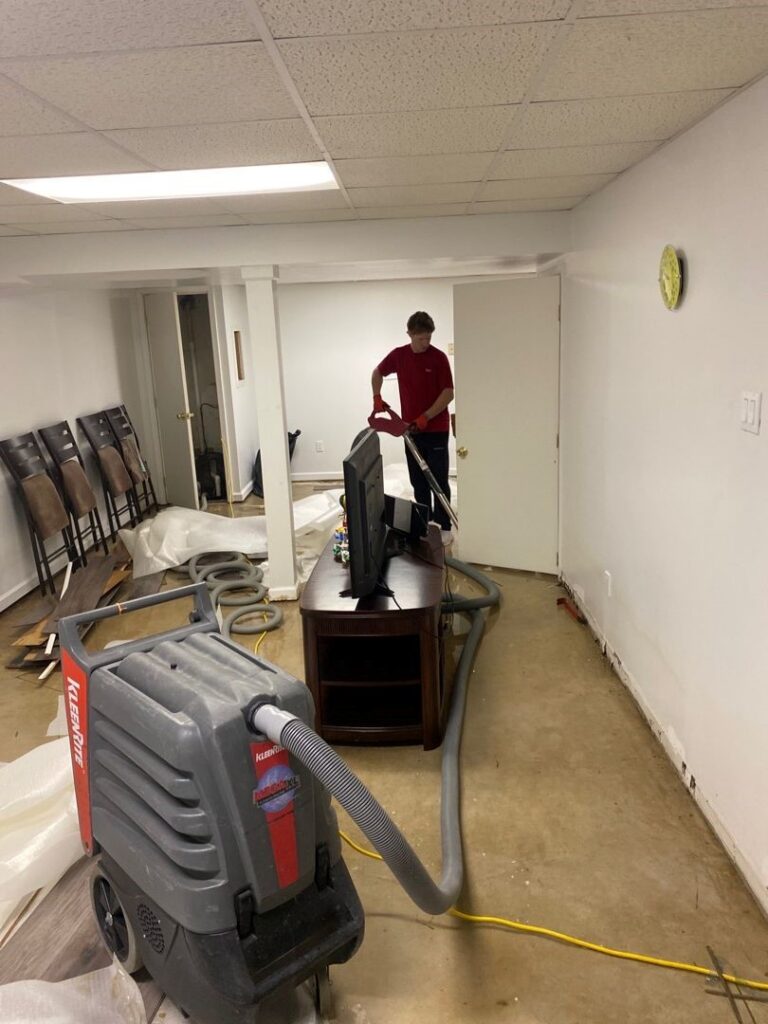
- Pump out standing water gradually. FEMA guidance recommends removing water in stages, roughly a third at a time over several days when the ground outside is saturated. Submersible pumps and wet vacuums work for shallow water. Technicians use portable and truck-mounted extractors for carpet and deeper loss.
- Move salvageable contents to a clean, dry space. Lift furniture off wet floors, bag soaked textiles, and set electronics aside for evaluation. Never plug in anything that was submerged.
Takeaway: Patience during pumping prevents structural damage that no insurance claim wants to explain.
Which Materials Have to Be Removed After a Flood?
Porous materials that contacted contaminated water must be removed. That includes carpet, carpet pad, insulation, and drywall. Nonporous materials like metal, glass, and sealed hard plastic can often be cleaned and disinfected. Wood and subfloors need a professional evaluation.
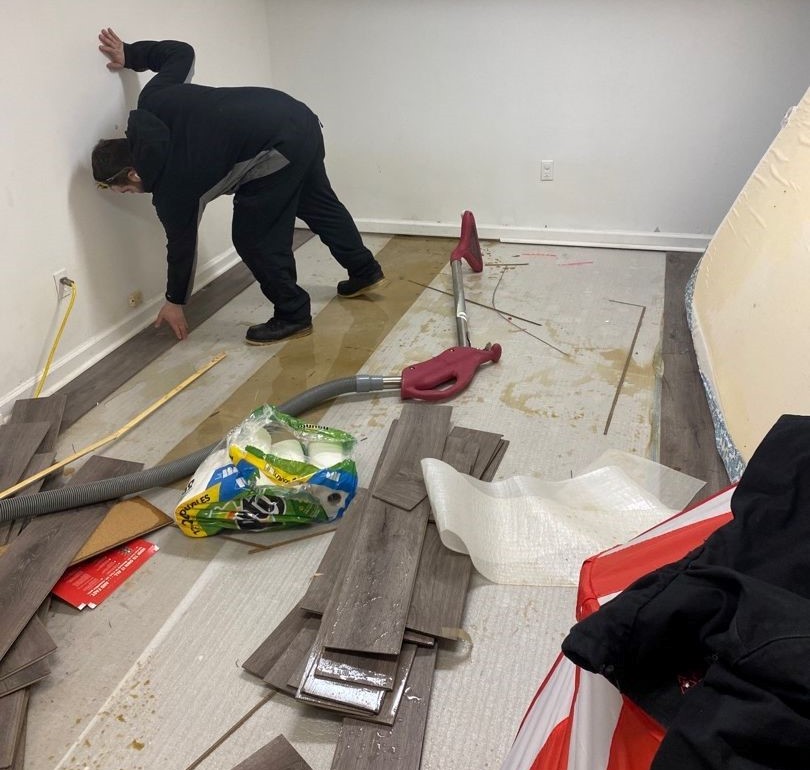
- Remove wet carpet and pad. Cut into strips and bag. Carpet and pad exposed to Category 3 water are not salvageable.
- Cut out wet drywall and insulation. Technicians typically make a flood cut above the visible waterline, then check readings above the cut to confirm moisture is not still wicking upward. Wet insulation holds water against framing and must come out.
- Inspect the subfloor and framing. Extended soaking can cause subfloor delamination, where layers of plywood or OSB separate and lose strength. Thermal imaging helps locate moisture inside walls and under floors, which keeps demolition limited to what is truly necessary.
Takeaway: If a material cannot be cleaned and fully dried within roughly two days, replace it.
How Do Professionals Dry and Disinfect a Flooded Home?
Professionals dry a flooded home by finding all the moisture, setting equipment to remove it, and tracking daily readings until the structure reaches its dry standard. They then apply antimicrobial biocide to cleaned surfaces. This approach, called structural drying, relies on psychrometrics, the science of air, temperature, and humidity.
The sequence goes in order. Technicians begin with moisture mapping, using meters and thermal imaging to locate every wet area, including those hidden behind finished walls. They then place low-grain-refrigerant (LGR) dehumidifiers and air movers sized to the space. Each day they log hygrometer readings, temperature, and moisture content and adjust equipment as conditions change. Basements saturated for days with groundwater can reach Class 4 water damage, which involves deep moisture trapped in dense materials such as concrete, plaster, and hardwood and requires specialty drying.
For sewer-related or river flooding, technicians separate clean and contaminated zones and use dedicated tools in each to prevent cross-contamination. Surfaces are cleaned of debris first, then disinfected.
Takeaway: Ask for daily moisture logs. Drying is a measured process, not a guess.
How Do You Prevent Mold After a Flood?
Prevent mold by drying the structure within 24 to 48 hours, controlling humidity, and inspecting for hidden growth. The EPA states that moisture control is the key to controlling mold. If growth is already present, professional containment is safer than DIY scrubbing.
If mold has formed, technicians set up a containment barrier of poly sheeting and create negative air pressure so air flows toward filtered exhaust and not into clean rooms. HEPA filtration and air scrubbers capture airborne spores. Because some molds can produce mycotoxins, avoid brushing dry growth or blowing fans over it, since that spreads spores through the house. A hygrometer in the basement gives you an early warning when humidity creeps up.
Fix the cause as well. Extend downspouts away from the foundation, regrade soil so it slopes away from the house, seal visible foundation cracks, and test your sump pump before every spring thaw. In older neighborhoods on combined sewers, ask a plumber about a backwater valve that blocks sewer backup through floor drains.
Takeaway: A dry basement today does not stay dry unless the entry point is fixed.
Why Choose a Local Fort Wayne Restoration Team?
PuroClean Disaster Restoration of West Fort Wayne provides 24/7 emergency dispatch, IICRC-certified technicians, and direct insurance billing, so you are not waiting on a claim to start work. Our crews know Fort Wayne’s older basements, clay soils, and river-corridor neighborhoods, and can reach Aboite, Waynedale, and the South Side quickly.
Frequently Asked Questions About Flood Cleanup in Fort Wayne
Does homeowners insurance cover flood damage in Fort Wayne? Standard homeowners policies typically exclude flood from rising rivers or surface water. Sudden pipe failures are often covered, and sewer or drain backup may require an added endorsement. Flood coverage usually requires a separate policy, such as one through the National Flood Insurance Program. Confirm your coverage with your agent before filing.
How much does flood cleanup cost? Cost depends on the water category, the area affected, the materials involved, and how long drying takes. Category 3 sewer or river water costs more because more material must be removed and disinfected. A professional provides a written estimate after moisture mapping, and many companies bill your insurer directly.
How long does it take to dry a flooded home? Water removal takes hours, and structural drying typically takes three to five days. Dense materials or Class 4 water damage can extend that. Daily moisture readings determine when drying is complete, not a set calendar. Rebuilding and repairs begin only after the structure reaches its drying goal.
When can I handle flood cleanup myself? A small, clean-water spill caught within hours may be manageable with a wet vacuum and fans. Call a professional if the water is more than a few inches deep, came from a floor drain, toilet, or river, soaked drywall or insulation, or has been present more than a day. Hidden moisture and contamination require trained handling.
Can flood mold make my family sick? It can. Mold may trigger allergy and asthma symptoms, and children, older adults, and people with respiratory conditions can be more sensitive. After a Fort Wayne flood, a persistent musty smell or visible growth warrants professional inspection. Painting over it or running a fan across it does not solve the problem.
What flood risks are specific to Fort Wayne in spring? Spring snowmelt over frozen, saturated ground is a documented trigger, raising groundwater and straining sump pumps. In clay-heavy areas like Lakeside and Bloomingdale, water also builds pressure against foundation walls. Test your sump pump, clear gutters, and extend downspouts before the thaw begins each year.
Need Help Now? Call PuroClean Disaster Restoration of West Fort Wayne
If your Fort Wayne home has flooded, you do not have to handle it alone. PuroClean Disaster Restoration of West Fort Wayne serves Fort Wayne, Aboite Township, and surrounding Allen County neighborhoods. Call (260) 263-9788 any time, day or night. Our IICRC-certified technicians are on call 24/7 and can bill your insurance company directly.

