


Key Takeaways for Homeowners
- Columbus, Ohio’s humid climate and variable spring weather create rapid humidity fluctuations that catch homeowners unprepared for mold risks.
- IICRC S500 and S520 standards provide the only scientifically validated protocols for water damage restoration and mold remediation.
- Franklin County and Columbus building codes require flood-resistant construction, but many older homes in German Village, Victorian Village, and the Near East Side predate modern moisture control standards.
- Spring humidity averages 65 to 72 percent in Columbus, creating a narrow window for effective post-flood drying.
- Professional moisture mapping, HEPA filtration, and antimicrobial biocide treatment are essential for preventing mold regrowth.
If your Columbus home has suffered flood damage, immediate action is non-negotiable. Call PuroClean Home Savers at (614) 689-0012 for 24/7 emergency water extraction, structural drying, and certified mold prevention services in Columbus and surrounding neighborhoods.
Columbus Climate and Housing: A Mold Risk Profile
Columbus, Ohio sits in the humid continental climate zone, characterized by hot, humid summers and cold, snowy winters. Spring brings the most volatile conditions, with rapid temperature swings and humidity fluctuations between 65 and 72 percent. These spring moisture surges, combined with snowmelt runoff and seasonal thunderstorms, create the perfect storm for basement flooding and hidden moisture intrusion.
The local housing stock in Columbus presents unique challenges. Historic neighborhoods like German Village, Victorian Village, and the Near East Side feature 19th and early 20th century brick homes with limestone foundations, balloon framing, and minimal modern waterproofing. These homes were built before current Franklin County flood damage prevention regulations and Columbus building codes required vapor barriers, sump pumps, or backflow prevention. When these properties flood, water penetrates deep into masonry walls and wood framing, creating moisture reservoirs that consumer-grade equipment cannot address.
Newer suburban developments in Dublin, Westerville, and Grove City benefit from modern construction standards, but they are not immune. The Big Walnut Creek, Scioto River, and Olentangy River watersheds all pose flood risks during heavy rainfall events. Combined sewer overflows, though less severe than in older Midwestern cities, still affect portions of Columbus during intense storms. The Franklin County flood damage prevention regulations require new construction to elevate lowest floors above base flood elevation and use flood-resistant materials, but existing homes remain governed by the standards in place at the time of construction.
Columbus spring humidity is particularly problematic because it coincides with the highest flood risk period. When outdoor humidity already exceeds 65 percent, the air cannot absorb additional moisture from wet building materials. This means evaporation slows dramatically, and the 24-to-48-hour mold colonization window shrinks even further. Homeowners who rely on opening windows or running standard fans during humid spring weather may actually make the problem worse by introducing more moisture into the home.
The IICRC S500/S520 Framework: Science, Not Guesswork
The Institute of Inspection, Cleaning and Restoration Certification (IICRC) is the globally recognized authority on water damage restoration and mold remediation. The S500 standard establishes the scientific principles of water damage restoration, including water classification, structural drying, and equipment deployment. The S520 standard governs professional mold remediation, covering containment, air filtration, cleaning protocols, and clearance testing.
When you choose an IICRC-certified restoration company, you are choosing a contractor who has demonstrated competency in psychrometrics, moisture mapping, microbial contamination control, and post-remediation verification. This certification is not a marketing badge. It is a professional credential backed by continuing education, examination, and adherence to evolving industry standards.
12 Smart Strategies to Stop Mold After Flood Damage
1. Extract All Standing Water Immediately
The IICRC S500 timeline is unforgiving. Category 1 clean water becomes Category 2 gray water within 24 hours as microbial activity increases. By 48 hours, it degrades to Category 3 black water, carrying bacteria, viruses, and other pathogens. In Columbus, where spring temperatures accelerate microbial growth, this timeline compresses even further.
- Deploy truck-mounted extraction units for large volumes.
- Use portable extraction tools for confined spaces and multi-story homes.
- Remove and dispose of saturated carpet pad without exception.
2. Deploy LGR Dehumidifiers and Axial Air Movers
Low-Grain Refrigerant dehumidifiers are essential for Columbus flood recovery because they maintain drying efficiency even when relative humidity drops below 40 percent. Consumer dehumidifiers lose effectiveness rapidly in this range and cannot dry dense structural materials like hardwood, plaster, or concrete foundations.
- Calculate equipment needs based on Class of water loss and cubic footage.
- Position air movers to create continuous airflow across all wet surfaces.
- Monitor grain depression daily to verify moisture removal rates.
3. Conduct Infrared Moisture Mapping
Columbus’s historic homes with plaster and lath, multiple flooring layers, and balloon framing create complex moisture migration pathways. Infrared thermal imaging detects evaporative cooling patterns that reveal water trapped behind walls, under floors, and inside ceiling cavities.
- Scan the entire flood zone plus adjacent rooms for migration.
- Use pinless moisture meters for rapid area scanning.
- Verify suspicious readings with penetrating probe meters.
4. Remove Contaminated Porous Materials
IICRC S520 mandates removal of porous materials saturated with Category 2 or 3 water. This is not negotiable. Attempting to dry drywall, insulation, or carpet pad in place traps moisture and creates permanent mold reservoirs that will reactivate with future humidity spikes.
- Cut drywall 12 to 24 inches above the visible water line.
- Remove all wet fiberglass or cellulose insulation from wall cavities.
- Dispose of contaminated materials following EPA and local biohazard guidelines.
5. Build Containment with Negative Air Pressure
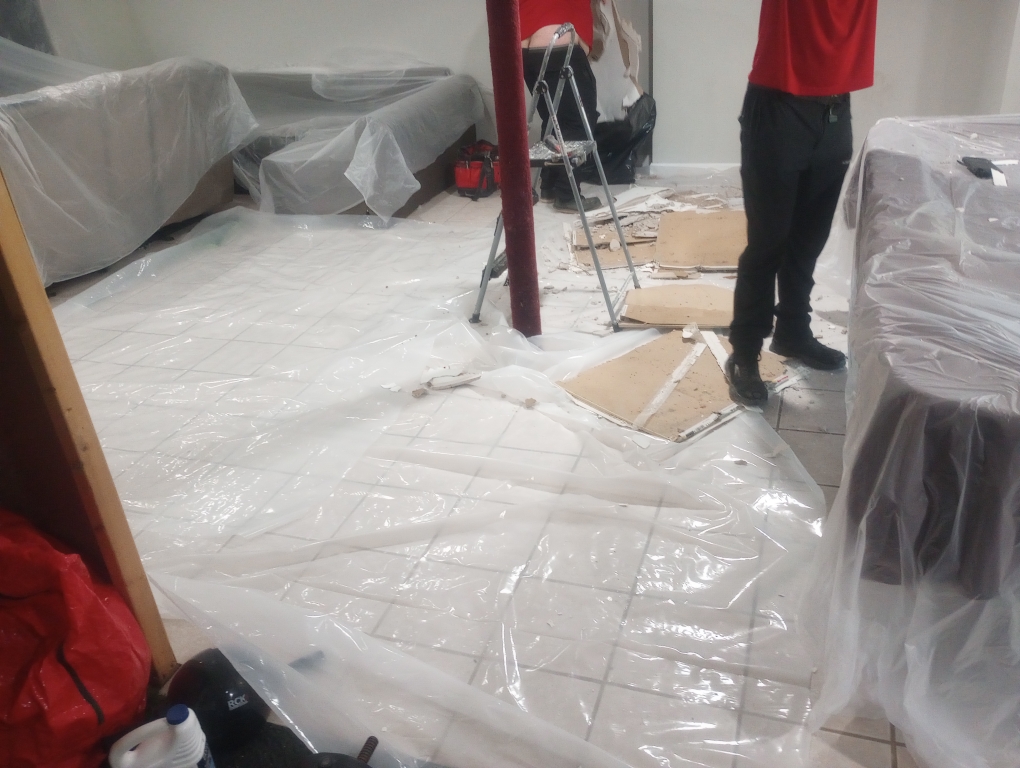
Before demolition or cleaning begins, the affected area must be physically isolated from clean zones. Negative air pressure machines draw air out of the containment zone, filter it through HEPA media, and exhaust it outdoors. This prevents cross-contamination of unaffected areas and protects occupants.
- Construct containment with 6-mil polyethylene sheeting.
- Maintain continuous negative pressure during all work phases.
- Seal HVAC registers in the containment zone immediately.
6. Run HEPA Air Scrubbers Continuously
High-Efficiency Particulate Air filtration captures 99.97 percent of particles at 0.3 microns, including mold spores, mycotoxins, and demolition dust. During flood recovery demolition, airborne spore counts can increase by orders of magnitude. Continuous air scrubbing protects workers and prevents contamination spread.
- Size units to achieve minimum 4 air changes per hour.
- Position for circular airflow within the containment zone.
- Replace pre-filters regularly to maintain airflow and efficiency.
7. Apply EPA-Registered Antimicrobial Biocides
After cleaning and drying, antimicrobial treatments provide a chemical barrier against mold spore germination. These products are not a replacement for moisture control, but they are a critical secondary defense in flood-affected environments with elevated future moisture risk.
- Apply only to clean, visibly dry surfaces.
- Follow manufacturer dwell times for effective microbial kill.
- Select formulations appropriate for the surface type and occupant sensitivities.
8. Monitor Psychrometrics Until Equilibrium
Psychrometrics is the science of moisture and air relationships. True drying is complete only when building materials reach equilibrium moisture content (EMC) with the ambient environment. Surface dryness is deceptive and dangerous if wall cavities remain damp.
- Record daily temperature, relative humidity, and specific humidity.
- Calculate vapor pressure and dew point to assess condensation risk.
- Do not approve reconstruction until EMC stabilizes for 48 consecutive hours.
9. Inspect and Remediate HVAC Contamination
Columbus homes rely heavily on HVAC systems for both heating and cooling across extreme seasonal ranges. Floodwater and mold spores can infiltrate ductwork, coils, drain pans, and air handlers. Once inside, the HVAC system becomes a distribution network for contamination throughout the home.
- Inspect ductwork with borescope cameras for visible growth.
- Clean coils and condensate pans with antimicrobial solutions.
- Replace filters and seal duct leaks to prevent future infiltration.
10. Address Foundation and Crawl Space Vulnerabilities
Columbus’s variable spring climate creates rapid humidity fluctuations that stress building envelopes. Historic homes with dirt crawl spaces, unsealed rim joists, and deteriorating foundation waterproofing are especially vulnerable. Franklin County regulations require flood-resistant materials and elevation for new construction, but retrofitting older homes is the homeowner’s responsibility.
- Install vapor barriers in dirt crawl spaces.
- Seal rim joists and foundation penetrations with closed-cell foam.
- Ensure sump pumps discharge well away from the foundation perimeter.
11. Test for Mycotoxins and Airborne Spores
Mold contamination is not always visible. Mycotoxins produced by toxigenic species like Stachybotrys chartarum, Aspergillus, and Penicillium can persist in dust and on surfaces after visible growth is removed. Objective air and dust sampling validates that remediation has achieved safe conditions.
- Collect pre-remediation and post-remediation air samples.
- Use ERMI or HERSTMI dust analysis for comprehensive contamination profiling.
- Compare indoor results to same-day outdoor baseline samples.
12. Document for Insurance, Compliance, and Resale
Mold history can reduce property values by 20 to 37 percent if poorly documented. Maintain comprehensive records of moisture readings, photos, disposal receipts, lab results, and certification documents. Columbus building officials may require permits for structural repairs in flood-damaged properties, and thorough documentation supports both insurance claims and future property transactions.
Frequently Asked Questions
Does home insurance cover mold caused by high humidity in Columbus, Ohio?
Standard homeowners insurance policies typically exclude mold damage caused by long-term humidity, condensation, or maintenance neglect. Coverage generally applies only when mold results from a sudden, accidental covered peril such as a burst pipe, appliance failure, or storm damage. Flood-related mold requires a separate flood insurance policy through the National Flood Insurance Program. Because Columbus experiences combined sewer overflows in some areas and riverine flooding along the Scioto and Olentangy watersheds, homeowners in flood zones should carry both standard and flood coverage. Review your policy with your agent and consider sewer backup endorsements.
How quickly can mold grow after a spring flood in Columbus?
Mold colonization can begin within 24 to 48 hours of water intrusion. In Columbus, spring is the highest-risk period because warming temperatures accelerate microbial metabolism while high ambient humidity (65 to 72 percent) slows evaporation from wet materials. A basement that floods on Saturday morning can have active mold colonies by Monday afternoon if not professionally extracted and dried.
Are historic Columbus homes more vulnerable to mold after flooding?
Yes. Historic neighborhoods like German Village and Victorian Village feature brick construction, limestone foundations, plaster walls, and minimal modern waterproofing. These materials are porous and retain moisture for extended periods. Balloon framing allows water to travel vertically through wall cavities. Many of these homes also lack vapor barriers, sump pumps, and proper drainage. Professional moisture mapping and structural drying are absolutely essential for these properties.
Can I prevent mold with household bleach and fans?
No. Bleach is ineffective against mold in porous materials because it cannot penetrate deep enough to kill hyphae (mold roots). It also adds moisture to already wet materials. Household fans increase evaporation but do not remove moisture from the air. In Columbus’s humid spring climate, opening windows often introduces more moisture than it removes. Without professional dehumidification, evaporated moisture simply re-condenses on cooler surfaces, potentially spreading contamination.
What health symptoms indicate mold exposure after a flood?
Common symptoms include persistent coughing, wheezing, nasal congestion, throat irritation, skin rashes, and eye redness. Individuals with asthma, allergies, or compromised immune systems may experience severe reactions. Mycotoxin exposure from toxigenic molds can cause neurological symptoms, chronic fatigue, and immune suppression in sensitive individuals. If anyone in your household develops these symptoms after a flood, seek medical evaluation and professional mold assessment immediately.
How do I know if a restoration company is truly qualified?
Verify IICRC certification in water damage restoration (WRT) and applied microbial remediation (AMRT). Ask for proof of insurance, references from recent flood jobs, and whether they use third-party clearance testing. PuroClean Home Savers maintains full IICRC certification, carries comprehensive liability insurance, and provides documented clearance testing for every mold remediation project.
Your Columbus Home Deserves Professional Protection
Flood damage is an emergency that demands immediate, expert response. The combination of Columbus’s humid climate, historic housing stock, and clay-heavy soils creates a mold risk profile that DIY methods cannot address. Every hour of delay increases contamination, cost, and health risk.
Call PuroClean Home Savers now at (614) 689-0012 for 24/7 emergency water extraction, certified structural drying, and professional mold prevention services in Columbus and all surrounding neighborhoods.