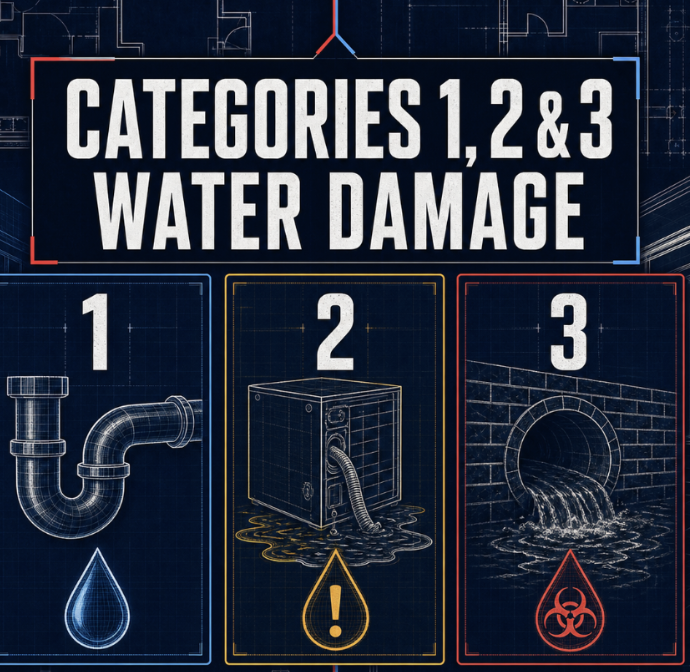
Categories 1, 2 and 3 Water Damage Explained
Water damage is classified as Category 1, Category 2, or Category 3 according to the water’s source and contamination level—not the amount of water in the property. Category 1 originates from a sanitary source. Category 2 contains significant contamination that may cause illness or discomfort. Category 3 is grossly contaminated and can contain harmful pathogens, chemicals, sewage, or other hazardous substances.
The terms clean water, gray water, and black water are commonly used to describe these categories, but professional restorers generally use the numbered Category 1, 2, and 3 framework. A category can change when water sits for an extended period, travels through contaminated materials, or mixes with another water source.
Do not touch water that may contain sewage, exterior floodwater, chemicals, or electrical hazards. For professional water damage cleanup in Houston, call PuroClean of Central Southwest Houston at (832) 856-5900.
Last reviewed: August 24, 2026
Water damage categories at a glance
- Category 1: Water originating from a sanitary source
- Category 2: Water containing significant contamination
- Category 3: Grossly contaminated water that may contain pathogens, sewage, chemicals, or other hazards
- Clean water: Common informal term for Category 1
- Gray water: Common informal term for Category 2
- Black water: Common informal term for Category 3
- Important: Category describes contamination; class describes the extent of wet materials and evaporation requirements
What Are Water Damage Categories?
Water categories provide a professional framework for evaluating contamination and planning appropriate safety, removal, cleaning, and drying procedures. They do not function as a simple description of water color.
A professional assessment may consider:
- The original water source
- Materials and contaminants contacted by the water
- How long the water remained in the property
- Temperature and environmental conditions
- Microbial or chemical concerns
- Whether water moved between floors or rooms
- Occupant health and exposure risks
The ANSI/IICRC S500 is the principal professional standard addressing water damage restoration. It covers subjects including microbiology, health effects, building science, psychrometry, drying technology, equipment, instruments, and restoration procedures.[1]
Water Category vs. Water-Damage Class
Category and class are not interchangeable.
- Water category describes the degree of contamination.
- Water-damage class describes the extent of affected materials and the expected difficulty of removing moisture.
A small sewage backup may be Category 3 even when it affects a limited area. A large sanitary supply-line release may be Category 1 while affecting several rooms and requiring extensive drying.
| Classification | What It Describes | Primary Effect on Restoration |
|---|---|---|
| Category | Water source and contamination | Safety controls, cleaning, containment, removal, and salvageability |
| Class | Amount and location of absorbed water | Equipment, drying strategy, monitoring, and expected drying difficulty |
Both classifications may be used when developing a professional restoration plan. Neither should be determined solely from a photograph or the apparent color of the water.
Category 1, 2, and 3 Water Damage Comparison
| Water Category | General Description | Common Examples | General Response |
|---|---|---|---|
| Category 1 | Water originating from a sanitary source | Recent supply-line release, clean fixture overflow, certain rainwater intrusion before contamination | Stop the source, extract water, inspect hidden areas, dry materials, and monitor moisture |
| Category 2 | Water containing significant contamination that may cause illness or discomfort | Certain appliance discharges, some toilet-bowl overflows without feces, water that has contacted contaminants | Use appropriate protection, evaluate porous materials, remove water, clean, sanitize, and dry |
| Category 3 | Grossly contaminated water containing harmful agents | Sewage, toilet backflow with feces, rising floodwater, river or surface water, storm surge | Keep occupants away, establish containment and protection, remove affected porous materials, clean retained surfaces, and dry |
This table provides general examples rather than a property-specific classification. Actual conditions, source, exposure, and affected materials must be evaluated onsite.
What Is Category 1 Water Damage?
Category 1 water originates from a sanitary source and does not initially pose substantial risk from dermal exposure, ingestion, or inhalation. It is often informally called clean water.
Common Category 1 sources
- A recent broken water-supply line
- A burst pipe carrying potable water
- A recent sink or bathtub overflow without contaminants
- A failed water-heater tank
- Rainwater entering before contacting contaminants
- Melting ice or snow from a sanitary source
Category 1 does not mean the property is safe from electrical, structural, slip, or mold-related hazards. A clean-water release can still saturate drywall, flooring, insulation, cabinets, ceilings, and electrical systems.
Category 1 cleanup process
A professional Category 1 response may include:
- Stopping the water source
- Inspecting electrical and structural conditions
- Extracting standing water
- Mapping visible and concealed moisture
- Moving or protecting contents
- Removing materials that cannot be dried
- Installing air movers and dehumidifiers
- Monitoring moisture until drying goals are reached
Prompt action may preserve more materials. EPA guidance recommends drying water-damaged areas and items within approximately 24 to 48 hours when possible to reduce the likelihood of mold growth.[2]
PuroClean provides professional emergency water extraction in Houston and water extraction and dehumidification.
Can Category 1 water become contaminated?
Yes. Water from a sanitary source can deteriorate after contacting dirty flooring, soil, waste, chemicals, or contaminated building materials. Time and environmental conditions can also increase contamination concerns.
A supply-line leak that remains trapped beneath flooring for an extended period should not automatically be treated the same as water extracted immediately after release.
What Is Category 2 Water Damage?
Category 2 water contains significant contamination and may cause illness or discomfort if contacted or consumed. It is commonly called gray water, although the numbered classification is more precise.
Possible Category 2 sources
- Certain washing-machine discharges
- Certain dishwasher discharges
- Some toilet-bowl overflows without fecal matter
- Aquarium water
- Water that has passed through contaminated materials
- Category 1 water that has deteriorated
Not every appliance discharge receives the same classification. The water’s contents, source, exposure, and materials contacted must be considered. Water containing feces, sewage, or substantial hazardous contamination should not be treated as Category 2.
Category 2 cleanup process
Category 2 restoration may require:
- Appropriate personal protective equipment
- Containment of affected areas
- Water extraction
- Evaluation and removal of affected porous materials
- Cleaning and sanitization of retained surfaces
- Controlled structural drying
- Contents evaluation
- Documentation of removal and cleaning
Carpet, padding, drywall, insulation, and composite materials exposed to Category 2 water may be less salvageable than the same materials affected by a recent Category 1 loss.
Can Category 2 become Category 3?
Yes. Category 2 water can deteriorate when it remains stagnant, moves through contaminated areas, or experiences environmental conditions that increase microbial activity. The category should be reassessed when conditions change.
How Water Category Can Affect Restoration Cost
Water category can materially affect restoration cost because contaminated losses may require additional containment, protective equipment, cleaning, disposal, and removal of porous materials. For broader pricing context, Damage Restoration Hero publishes average damage restoration costs by service type. These figures are general consumer-price benchmarks rather than a quote for a specific Houston loss.[7]
What Is Category 3 Water Damage?
Category 3 water is grossly contaminated and can contain pathogenic, toxic, or otherwise harmful agents. It is commonly called black water, although the water does not need to appear black.
Common Category 3 sources
- Sewage and wastewater backups
- Toilet backflow containing feces
- Rising river, bayou, lake, or surface water
- Storm surge and seawater
- Exterior floodwater entering a building
- Water containing harmful chemicals or biological contaminants
- Category 2 water that has substantially deteriorated
An EPA report describing professional flood-cleanup guidance notes that the IICRC framework categorizes water according to contamination, from potable Category 1 water to grossly contaminated Category 3 water. The report identifies seawater, groundwater, surface water, rising rivers and streams, and certain hurricane or tropical-storm intrusion as Category 3 sources.[3]
Why Category 3 water is dangerous
Category 3 water may contain:
- Bacteria and viruses
- Human or animal waste
- Industrial or household chemicals
- Pesticides and petroleum products
- Sharp debris
- Other biological and environmental contaminants
The CDC warns that floodwater can contain sewage, downed power lines, hazardous waste, germs, chemicals, debris, and displaced animals.[4]
Keep children, pets, employees, tenants, and customers away from Category 3 water. Do not use household fans or ordinary vacuums in the affected area.
Category 3 cleanup process
A professional Category 3 response may include:
- Safety assessment and restricted access
- Electrical and structural hazard evaluation
- Personal protective equipment
- Containment and controlled work zones
- Contaminated-water extraction
- Removal of affected porous materials
- Cleaning and decontamination of retained structural surfaces
- Air filtration and controlled drying
- Contents evaluation and disposal documentation
- Moisture monitoring and reconstruction planning
Houston properties affected by exterior flooding may require specialized flood damage cleanup in Houston.
Clean Water, Gray Water, and Black Water
The terms clean water, gray water, and black water are widely understood by consumers, but they can create misunderstandings.
- Clean water generally refers to Category 1.
- Gray water generally refers to Category 2.
- Black water generally refers to Category 3.
These terms do not describe the water’s visible color. Clear-looking water can contain harmful contamination, and dark-looking water is not classified solely by appearance.
The terms also differ from municipal water-reuse definitions of graywater and blackwater. For property restoration, the professional category framework should guide safety and cleanup decisions.
Can the Category of Water Damage Change?
Yes. A water category can deteriorate as conditions change. Important factors include:
- Time since the release
- Temperature and humidity
- Contact with soil, waste, chemicals, or contaminated materials
- Movement through floors, ceilings, wall cavities, or HVAC systems
- Microbial growth
- Cross-contamination during cleanup
Category 1 water does not automatically change category after a fixed number of hours. Time is one factor among several. A qualified restorer should evaluate the actual source, environment, materials, and exposure conditions.
Prompt extraction and drying can reduce deterioration and limit how far moisture spreads. Professional moisture mapping in Houston can help identify concealed areas where water may have remained longer than the visible surface water.
Who Determines the Water-Damage Category?
A trained restoration professional evaluates the water source, contaminants, exposure time, affected materials, environmental conditions, and movement through the building. Additional specialists may be necessary when industrial chemicals, regulated materials, sewage, mold, or other unusual hazards are present.
Property owners should avoid assigning a category based only on:
- Water color
- Odor
- A photograph
- The size of the affected area
- Whether the water originally came from inside or outside
“`html
How Does Water Category Affect Material Salvageability?
The category of water is one of several factors used to determine whether a material can be cleaned and dried or should be removed. Material composition, porosity, saturation, damage, exposure time, and accessibility also affect the decision.
| Material | Category 1 Consideration | Category 2 Consideration | Category 3 Consideration |
|---|---|---|---|
| Carpet | May be recoverable after prompt extraction and drying | Requires evaluation based on contamination and condition | Commonly removed because it is porous and difficult to decontaminate fully |
| Carpet padding | May require removal to dry the carpet and subfloor effectively | Often removed | Commonly removed and discarded |
| Drywall | May be dried when structurally sound and promptly addressed | May require partial or complete removal depending on contamination | Affected porous sections are commonly removed |
| Insulation | Salvageability depends on type, saturation, and access | Frequently removed when contaminated | Commonly removed because contamination can remain within the material |
| Solid wood framing | Often dried in place when structurally sound | May be cleaned, treated, and dried when appropriate | May be retained after professional cleaning and decontamination when structurally sound |
| Tile, metal, and other nonporous surfaces | Often cleanable and dryable | Often retainable after appropriate cleaning | May be retained when accessible and capable of effective decontamination |
| Upholstery and mattresses | Require specialized evaluation and rapid drying | Salvageability may be limited | Commonly considered unsalvageable after direct exposure |
This table provides general tendencies rather than automatic disposal rules. High-value, historically important, or irreplaceable contents may require evaluation by a qualified conservation or specialty-restoration professional.
How Does Cleanup Change by Water Category?
The overall restoration sequence remains similar, but worker protection, containment, cleaning, demolition, and disposal become more extensive as contamination increases.
| Restoration Step | Category 1 | Category 2 | Category 3 |
|---|---|---|---|
| Site access | Controlled according to electrical and structural hazards | Restricted according to contamination and exposure concerns | Strictly restricted to appropriately protected personnel |
| Extraction | Prompt removal using appropriate extraction equipment | Extraction with contamination controls | Controlled contaminated-water removal and appropriate waste handling |
| Porous materials | More materials may be eligible for drying and retention | Salvageability is more limited and material-specific | Many directly affected porous materials require removal |
| Cleaning | Cleaning according to affected materials and conditions | Additional cleaning and sanitization procedures | Detailed decontamination of retained structural surfaces |
| Containment | May be limited depending on the work | May be needed to prevent cross-contamination | Commonly required to isolate contaminated work areas |
| Drying | May begin after extraction and evaluation | Begins after appropriate removal and cleaning controls | Begins after contaminated materials and surfaces have been properly addressed |
Extraction is not the same as decontamination
Removing visible water does not automatically remove contamination from flooring, walls, framing, cabinets, contents, or concealed cavities. Category 2 and Category 3 losses may require removal and cleaning before structural drying can proceed safely.
Drying equipment should follow contamination control
Air movers can spread contaminated particles when used without proper containment and cleaning procedures. EPA guidance cautions against using fans before determining that water is clean or sanitary.[2]
Reconstruction begins after mitigation
New drywall, insulation, flooring, cabinets, and finishes should not be installed until contaminated materials have been addressed and retained structural components reach appropriate drying goals.
Learn more about the distinction between water mitigation and water restoration.
Category 3 Water Damage Safety Precautions
Do not enter Category 3 water unless you are trained, appropriately equipped, and the area has been evaluated for electrical, structural, chemical, and biological hazards.
Property owners and occupants should:
- Keep children and pets away from the affected area.
- Avoid direct skin contact with sewage and floodwater.
- Do not enter standing water near electrical outlets or appliances.
- Do not use household vacuums or ordinary fans.
- Do not activate an HVAC system that may spread contamination.
- Avoid handling contaminated porous materials without appropriate protection.
- Wash exposed skin with soap and clean water after accidental contact.
- Seek medical attention for concerning wounds, illness, or exposure.
The CDC states that floodwater exposure can result in wound infections, skin rashes, gastrointestinal illness, and other health concerns. It recommends staying out of floodwater whenever possible.[4]
Electrical hazards
Water may conceal energized wiring, appliances, power strips, or downed electrical lines. Do not enter water to reach a breaker panel. Contact an electrician, utility provider, or emergency service when electrical safety is uncertain.
Structural hazards
Wet ceilings, drywall, flooring, and structural components may weaken or collapse. Sagging ceilings, leaning walls, major cracks, or movement require professional evaluation before entry.
Chemical hazards
Floodwater can move household chemicals, fuel, pesticides, industrial substances, and other hazardous materials. Do not handle unidentified containers or chemical releases.
Does the Water Category Affect Insurance Coverage?
The category can affect the restoration scope and cost, but it does not determine whether an insurance claim is covered. Coverage depends on the cause of the loss, policy language, exclusions, endorsements, deductibles, limits, and insurer’s investigation.
Sudden plumbing losses
A sudden and accidental supply-line break may qualify for homeowners coverage, subject to policy terms. The Texas Department of Insurance explains that most homeowners and renters policies cover sudden and accidental water damage, such as a burst pipe, toilet overflow, or broken washing-machine hose.[5]
Gradual deterioration
A sanitary water source does not guarantee coverage. Damage from gradual leakage, seepage, poor maintenance, or long-term deterioration is commonly excluded even when the water originally came from a potable supply line.
Sewer and drain backups
Coverage for a sewer or drain backup may require a specific water-backup endorsement. Limits and deductibles may differ from the main property coverage.
Exterior flooding
Most standard homeowners policies do not cover rising exterior floodwater. Separate flood insurance is generally required.[6]
Claim documentation
Useful documentation may include:
- The apparent water source
- Initial photographs and video
- Water-category assessment
- Affected-area diagrams
- Moisture readings
- Extraction and equipment records
- Material-removal documentation
- Contents inventories
- Cleaning and disposal records
- Mitigation and repair estimates
PuroClean can document restoration conditions and services. The insurance carrier—not the restoration contractor—determines coverage and claim payment.
Houston Water-Damage Category Examples
Burst supply line in a Houston home
A recent potable-water supply-line release may begin as Category 1. The assessment should consider how long the water remained, which materials it contacted, and whether it traveled into contaminated areas.
Washing-machine discharge
A washing-machine release may be Category 1 or Category 2 depending on whether it originated from the clean supply line or contained detergents, soil, or other contaminants from the appliance discharge.
Toilet overflow
The classification depends on the contents and source. A toilet overflow containing urine but no feces may be evaluated differently from sewage or a toilet backflow containing fecal matter.
Roof leak after a storm
Rain entering through a recently created roof opening may begin with lower contamination, but the category can change after contact with roofing materials, attic debris, insulation, animal waste, or contaminated cavities.
Properties with overhead intrusion may require roof-leak water damage restoration in Houston.
Bayou, street, or yard flooding
Rising exterior water should be treated as Category 3 because it can contain sewage, chemicals, microorganisms, soil, and other environmental contaminants.
Sewer backup
Sewage entering through a toilet, floor drain, shower, or other plumbing opening is Category 3 and requires professional contaminated-water cleanup.
Fire-suppression water
Water from sprinklers or firefighting efforts must be evaluated according to its source and everything it contacted, including soot, debris, chemicals, insulation, and damaged building materials.
Water Categories in Commercial Properties
Commercial water losses can spread through large floor areas, multiple suites, shared walls, vertical plumbing systems, inventory, production equipment, and HVAC systems. The water category affects occupant access, containment, business-continuity planning, and material salvageability.
Commercial properties may include:
- Office buildings
- Apartment complexes
- Retail centers
- Restaurants and commercial kitchens
- Hotels
- Healthcare facilities
- Schools and childcare facilities
- Warehouses and industrial properties
- Public buildings
Commercial Category 1 example
A recent overhead supply-line failure in an office may originate as Category 1 but still require extensive moisture mapping because water can travel through ceilings, wall cavities, insulation, and multiple tenant spaces.
Commercial Category 2 example
An appliance or process-water discharge may contain detergents, food residue, or other contaminants requiring additional cleaning and material evaluation.
Commercial Category 3 example
A sewer backup in a restaurant, medical facility, apartment building, or public property can require immediate isolation, controlled access, contaminated-material removal, surface decontamination, and documentation.
Learn more about commercial water damage restoration in Houston.
Frequently Asked Questions
What are the three categories of water damage?
Category 1 originates from a sanitary source. Category 2 contains significant contamination that may cause illness or discomfort. Category 3 is grossly contaminated and may contain sewage, pathogens, chemicals, or other harmful agents.
Is Category 1 water safe to touch?
Category 1 water originates from a sanitary source, but the affected area can still contain electrical, structural, slip, and hidden-moisture hazards. Water may also become contaminated after contacting building materials.
What is gray-water damage?
Gray water is a common informal term for Category 2 water. It contains significant contamination and may cause illness or discomfort after exposure.
What is black-water damage?
Black water is a common informal term for Category 3 water. It is grossly contaminated and may contain sewage, harmful microorganisms, chemicals, or environmental contaminants.
Does Category 3 water have to look black?
No. Category is based on contamination, not visible color. Clear-looking exterior floodwater or sewage-contaminated water may still be Category 3.
Is rainwater Category 1 or Category 3?
It depends on the source and what the water contacted. Rain entering directly through a recent roof opening may be evaluated differently from rising surface water. Exterior floodwater, groundwater, and water from overflowing rivers or streams are generally treated as Category 3.
Is a washing-machine leak Category 1 or Category 2?
A broken clean-water supply line may begin as Category 1. Water discharged from inside the washing machine may contain detergent and soil and may qualify as Category 2.
Is a toilet overflow Category 2 or Category 3?
It depends on the contents. An overflow containing urine but no feces may be evaluated as Category 2, while sewage or water containing fecal matter is Category 3.
Can Category 1 water become Category 2?
Yes. Category 1 water can deteriorate after extended exposure or contact with contaminated materials. There is no universal automatic time at which the category changes; actual conditions must be evaluated.
Can Category 2 water become Category 3?
Yes. Category 2 water may deteriorate after prolonged stagnation, microbial activity, or contact with more heavily contaminated sources and materials.
Can Category 3 water damage be cleaned?
Some nonporous and semi-porous structural surfaces may be retained after appropriate cleaning and decontamination. Many directly affected porous materials require removal because they cannot be reliably decontaminated.
Can carpet be saved after Category 3 water damage?
Carpet and padding directly exposed to Category 3 water are commonly removed because they are porous and difficult to decontaminate fully.
Does water category determine insurance coverage?
No. Category affects restoration procedures, but insurance coverage depends on the cause, policy terms, exclusions, endorsements, deductibles, and insurer’s decision.
Who determines the category of water damage?
A trained restoration professional evaluates the source, contaminants, exposure time, affected materials, and environmental conditions. Specialized hazards may require additional qualified professionals.
How can I request a water-category assessment in Houston?
Call PuroClean of Central Southwest Houston at (832) 856-5900 to discuss the incident and arrange the appropriate response.
Request Water Damage Cleanup in Houston
PuroClean provides emergency extraction, contamination control, structural drying, dehumidification, moisture mapping, cleaning, contents handling, documentation, and restoration services for Houston properties affected by Category 1, Category 2, and Category 3 water.
References
- Institute of Inspection, Cleaning and Restoration Certification. “S500 Standard for Professional Water Damage Restoration.” Overview of professional restoration principles, microbiology, building science, psychrometry, drying technology, equipment, and procedures. ↩
- U.S. Environmental Protection Agency. “Water Damage—Cleanup and Mold Prevention.” Guidance concerning clean-water damage, contaminated water, material drying, personal protection, containment, and responding within approximately 24 to 48 hours. ↩
- U.S. Environmental Protection Agency. “Report on Guidance Documents to Safely Clean, Decontaminate and Reoccupy Flood-Damaged Houses.” Discussion of the IICRC contamination-category framework and Category 3 floodwater sources. ↩
- Centers for Disease Control and Prevention. “Safety Guidelines: Floodwater.” Information concerning sewage, chemicals, germs, debris, electrical hazards, illness, and floodwater precautions. ↩
- Texas Department of Insurance. “When Are Water Damage and Mold Covered by Insurance?” Texas guidance concerning sudden water damage, gradual leaks, mold, mitigation, and insurance coverage. ↩
- National Flood Insurance Program. “Flood Insurance Eligibility.” Guidance explaining that most homeowners insurance does not cover flood damage. ↩
- Damage Restoration Hero. “Average Restoration Job Value.” Consumer-pricing benchmarks for water, fire and mold restoration projects.
Safety and classification disclaimer: The examples in this guide are general. Water category, contamination, material salvageability, safety controls, and cleanup procedures must be determined from the actual source and onsite conditions. Do not enter standing water when sewage, exterior flooding, electrical hazards, chemicals, or structural instability may be present.