


Sammamish is frequently recognized as one of the most picturesque and family-friendly communities in the Pacific Northwest. Stretching across a high glacial plateau between the shores of Lake Sammamish and the Snoqualmie Valley, the city offers beautiful evergreen vistas. However, the very geography that gives the Sammamish Plateau its commanding views introduces a hidden, highly destructive engineering challenge to the utilities running inside your home.
Homes built across the Plateau sit at an average elevation of 500 feet above the surrounding lowlands. To reliably deliver municipal water up this steep incline, local water infrastructure must operate under intense, high-baseline hydrostatic pressures. When this extreme regional water pressure interacts with an aging or poorly maintained residential water heater, it creates a volatile environment.
In fact, residential properties on the Plateau experience significantly more volatile, high-velocity plumbing failures than homes situated at sea level. When a failure occurs, the resulting PuroClean of Sammamish water heater damage requires immediate, sophisticated structural drying to prevent permanent foundation and framing failure. Understanding the physics behind Plateau water pressure can mean the difference between a routine maintenance check and a catastrophic 80-gallon structural explosion.
1. The Physics of the Plateau: Elevation and Hydrostatic Pressure
To understand why water heaters fail so dramatically in this area, you have to look at the municipal water delivery system. Water is heavy, and pushing it up a 500-foot ridge requires immense mechanical force. Municipal water districts utilize high-pressure pumping stations and massive storage tanks to ensure that homes in neighborhoods like Klahanie, Pine Lake, and Sahalee maintain strong water pressure at their fixtures.
For water to reach the top of the Plateau with enough velocity to power your showers and appliances, the baseline street pressure in municipal mains can frequently exceed 100 to 150 psi (pounds per square inch).
The Residential Danger Zone
Standard residential plumbing fixtures, appliances, and water heater tanks are structurally engineered to safely handle a maximum pressure of 80 psi. Ideally, internal home pressure should sit comfortably between 45 and 60 psi.
When municipal water traveling at 120+ psi enters a home without being properly modulated, it places every pipe connection, valve, and storage tank under severe mechanical strain. This constant over-pressurization accelerates metal fatigue, weakens soldered joints, and turns a standard water heater into a literal pressure cooker.
2. The Silent Failure of the Pressure Reducing Valve (PRV)
Because street-level water pressure on the Plateau is far too high for residential use, building codes require every home to be equipped with a Pressure Reducing Valve (PRV). Usually located near your main water shut-off valve, the PRV acts as a mechanical gatekeeper, throttling the high municipal pressure down to a safe, manageable 50 psi before it distributes through your walls.
The critical vulnerability for Sammamish homeowners is that PRVs fail silently over time. The internal rubber diaphragms, springs, and seals inside a PRV typically wear out within 5 to 10 years.
When a PRV fails, it rarely leaks water onto the floor to alert you. Instead, it fails “open,” allowing the full, unrestricted force of the municipal high-pressure main to flood into your internal plumbing system. You might notice a slight increase in shower pressure or a banging sound in your walls (known as water hammer), but otherwise, the dangerous pressure spike goes completely unnoticed until a major component gives way.
3. The Anatomy of a Catastrophic Water Heater Failure
When a failed PRV allows excessive pressure into a home, the water heater bears the brunt of the stress due to a compounding scientific law: thermal expansion.
When water is heated from a cold ground temperature up to standard household temperatures (typically 120°F to 140°F), it physically expands in volume by approximately 2%. In older plumbing systems, this extra volume could expand backward into the municipal supply lines. However, modern plumbing codes require backflow preventers, creating a “closed system.”
Inside a closed system, that 2% volume expansion has nowhere to go. If the home’s plumbing is already sitting at a high baseline pressure due to a failed PRV, the additional pressure generated by heating the water can rapidly push the internal tank pressure past 150 psi.
The Final Line of Defense: The T&P Valve
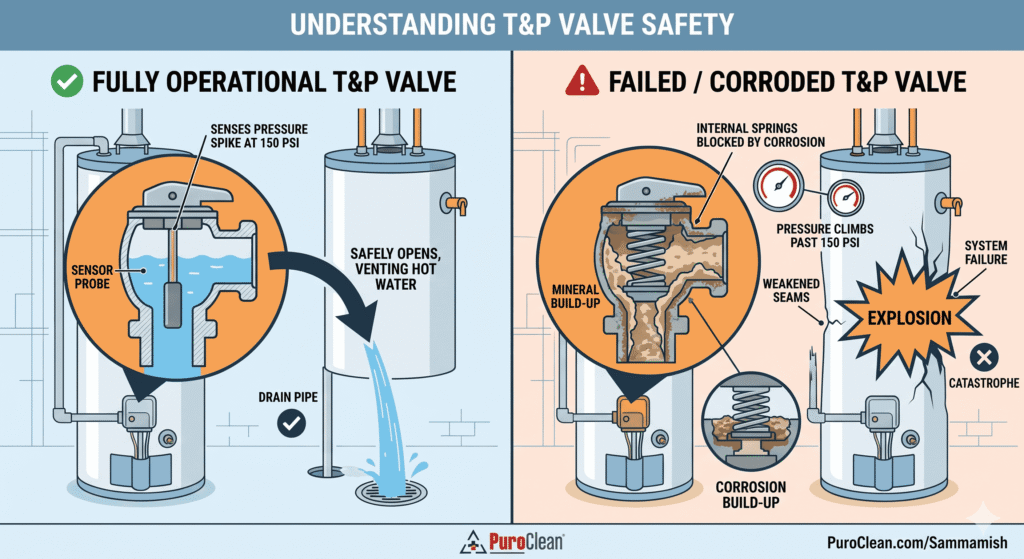
Every water heater is legally required to have a Temperature and Pressure (T&P) Relief Valve. This mechanical safety valve is engineered to spring open and safely discharge water down a drain pipe if internal tank conditions reach 210°F or 150 psi.
| Valve Status | Internal Condition | System Outcome |
| Fully Operational | Senses pressure spike at 150 psi | Safely opens, venting hot water down the drain pipe. |
| Failed / Corroded | Pressure climbs past 150 psi | The steel tank expands, seams rupture, causing an explosive blast. |
Because the ground water source on the Sammamish Plateau contains naturally occurring mineral content, scale accumulation is common. Over years of neglect, mineral deposits can calcify around the internal springs of the T&P valve, locking it shut. When a compromised T&P valve meets a failed PRV and a standard thermal heating cycle, the structural integrity of the steel inner tank is completely overwhelmed. The tank rips open along its welded seams, releasing incredible kinetic energy instantly.
4. The 40-to-80 Gallon Catastrophic Release & Scalding Water Hazard
When a water heater undergoes structural failure under high pressure, it does not slowly drip; it bursts with explosive velocity. Depending on the size of your home, this results in an immediate, high-velocity dump of 40 to 80 gallons of water.
This sudden volume of water creates a unique subset of structural concerns that complicates the process of mitigating PuroClean of Sammamish water heater damage:
- Kinetic Destruction: The sheer physical force of an explosive tank rupture can blow interior utility closet doors off their hinges, shatter nearby drywall, and crack structural studs.
- The Scalding Factor: This water isn’t coming out at room temperature. It is released at boiling or near-boiling temperatures under pressure. Scalding water is vastly more destructive to building materials than cold water. It melts the specialized glues holding engineered hardwood and luxury vinyl plank (LVP) flooring together, causes drywall mud to liquefy instantly, and splits baseboards away from framing studs.
- Rapid Vapor Migration: Superheated water instantly flashes into steam upon release, raising the relative humidity of the entire floor or basement to 100% within minutes. This vapor travels upwards, condensing on cold window panes, ceilings, and inside wall cavities far away from the initial site of the burst, creating widespread mold risks.
5. Why Thermal Expansion Tanks Are Essential
To combat the intense pressure dynamics found across the Plateau, modern plumbing codes strictly mandate the installation of a Thermal Expansion Tank. This small, secondary metal tank (typically 2 to 5 gallons in size) is installed on the cold water supply line directly above your primary water heater.
Inside the expansion tank is a flexible rubber bladder surrounded by pressurized air. When the water inside your primary heater gets hot and expands, the extra volume pushes into the rubber bladder, compressing the air pocket. This cushion safely absorbs the pressure spike, preventing the main tank from expanding and contracting.
However, expansion tanks are not permanent. The internal rubber blues can rupture over time, causing the expansion tank to fill completely with water and lose its cushioning capacity. If your expansion tank feels heavy or sounds solid when tapped at the top, it has likely failed and is no longer protecting your system from high-pressure surges.
6. Managing the Aftermath: Structural Restoration Protocols
When a high-velocity failure occurs, mitigating the resulting PuroClean of Sammamish water heater damage requires a highly scientific approach. Because the water is driven out by high pressure and heat, it migrates deeper into the structural elements of a home than standard ambient floodwaters.
The Concrete Absorption Factor: Many water heaters in Sammamish are located in garages, crawl spaces, or lower-level utility rooms built directly over concrete slabs. Concrete looks solid but is actually a porous sponge. When superheated water is blasted across a slab under pressure, it drives deep into the concrete’s capillary network.
If a contractor simply dries the surface and reinstalls flooring over the top, that trapped moisture will slowly wick upward over the coming weeks, buckling your new floors and cultivating hidden toxic mold colonies.
The Professional Mitigation Workflow
To properly address high-pressure PuroClean of Sammamish water heater damage, certified restoration technicians follow a rigorous containment and desiccant drying protocol:
- Thermal Imaging Analysis: Using advanced infrared technology, technicians map the hidden migration of water behind drywall, under flooring systems, and through structural subfloors without performing invasive tear-outs.
- High-Capacity Desiccant Dehumidification: Because hot water releases massive amounts of vapor, standard refrigerant dehumidifiers are often insufficient. Industrial desiccant units are deployed to create an ultra-low relative humidity environment, pulling deeply embedded moisture out of saturated framing timbers.
- Directed Cavity Drying: If water has traveled down interior wall tracks, specialized pressure systems inject dry air directly into the wall plates, saving the drywall and preventing the necessity of complete demolition.
7. The Homeowner’s Pressure Prevention Checklist
You don’t have to wait for a catastrophic failure to protect your home. If you live on the Sammamish Plateau, adding these simple plumbing checks to your annual maintenance routine can fully safeguard your property:
- Test Your Home’s Water Pressure: Purchase a simple, inexpensive pressure gauge from a local home improvement store and screw it onto an exterior hose bib. If the reading is above 80 psi, your PRV has failed and must be replaced immediately by a licensed plumber.
- Inspect the T&P Valve: Gently lift the lever on your water heater’s T&P valve once a year. Water should briefly discharge down the drain tube. If the lever is stuck, or if it continues to drip after you close it, the valve is corroded and needs to be replaced.
- Check the Expansion Tank Age: If your water heater is more than 6 years old and still has its original expansion tank, have a professional evaluate the internal bladder integrity.
- Know Your Water Heater’s Lifespan: The average lifespan of a traditional tank water heater operating under Plateau pressure conditions is 8 to 12 years. If your system is pushing past a decade of service, proactive replacement is significantly cheaper than emergency structural remediation.
Get Expert Emergency Support
If you experience a sudden system rupture, dealing with the complex aftermath of PuroClean of Sammamish water heater damage requires a rapid, comprehensive response. Our locally owned and operated team understands the structural nuances of King County homes and the specific challenges of regional water pressure. We are available 24/7/365 to deploy advanced extraction, thermal mapping, and industrial drying systems directly to your property.
Available 24/7/365 | (425) 947-1001 | Contact Us Online | Google Business Profile | IICRC Certified | True Emergency Response | Complete Damage Restoration Solutions