 PuroClean of Melbourne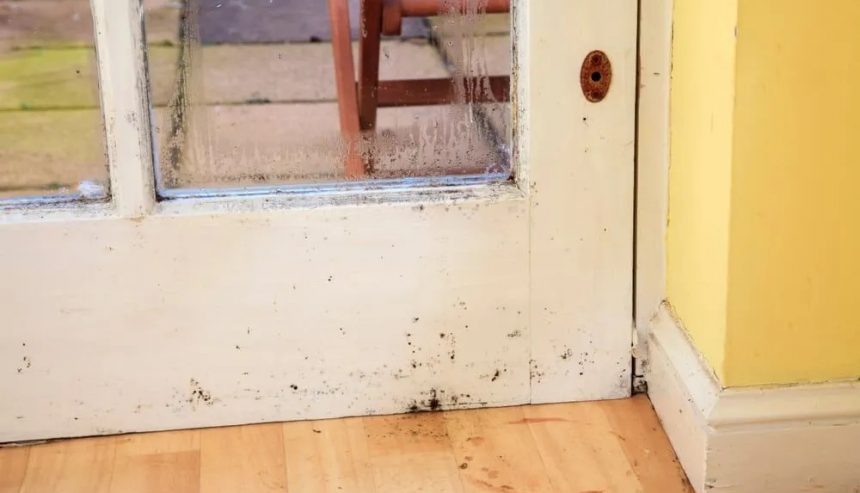
In this article:
Table of Contents
Hardwood floors are one of the most prized features a Melbourne home can have. They are warm, beautiful, and durable but they have one significant vulnerability that Florida homeowners know all too well: moisture. And wherever moisture goes in this climate, mold is never far behind.
Mold Removal in Melbourne, FL – Call (321) 378-2400
Discovering mold on your hardwood floors or wood furniture is a gut-punch moment. Your immediate instinct is to grab the strongest cleaner you own and scrub it away. That instinct, while understandable, is exactly what causes many homeowners to turn a manageable mold problem into an irreversible finish disaster or worse, to sand away the surface contamination while leaving the mold alive and growing in the wood beneath.
At PuroClean of Melbourne, we deal with mold in wood regularly across Brevard County on hardwood floors damaged by flooding, on wood cabinetry compromised by plumbing leaks, on furniture affected by chronic humidity. We know what works, what damages wood permanently, and when a situation has gone beyond what careful DIY treatment can resolve. This guide shares everything you need to know about treating mold in wood the right way protecting both the mold-free future of your floors and the finish that makes them beautiful.
First: Understanding the Difference Between Surface Mold and Deep Mold
The most important distinction in treating mold on hardwood is understanding where the mold actually is — because the location of the mold determines both the treatment method and the likelihood of a successful outcome.
Surface Mold
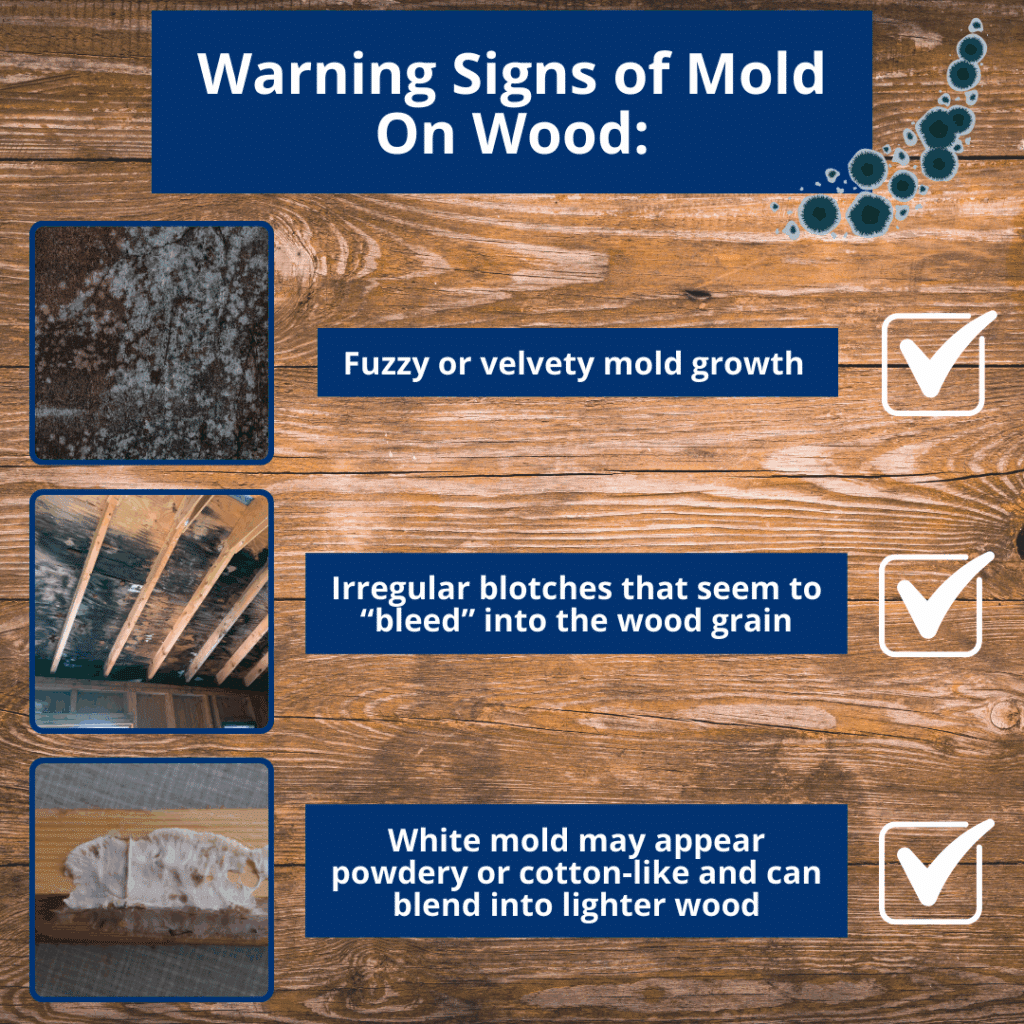
Surface mold grows on top of the wood’s finish or in the very outermost layer of the wood surface. It appears as fuzzy, powdery, or dusty growth — often white, gray, or light green — that looks like it is sitting on top of the material rather than embedded in it. Surface mold is relatively common after brief moisture exposure and, if addressed quickly, can often be removed without damaging the wood finish beneath.
This is the type of mold most homeowners are dealing with when they notice growth following a humidity spike, a brief water intrusion event, or condensation accumulation. It is the most treatable form.
Deep or Penetrating Mold
Deep mold has moved beyond the surface and penetrated into the wood fibers themselves. This happens when wood has been wet for an extended period — typically more than 24 to 48 hours in Florida’s warm climate. At this stage, the mold hyphae (the root-like structures that mold uses to anchor and feed) have grown into the grain of the wood, making it impossible to remove the mold without also removing a layer of the wood itself.
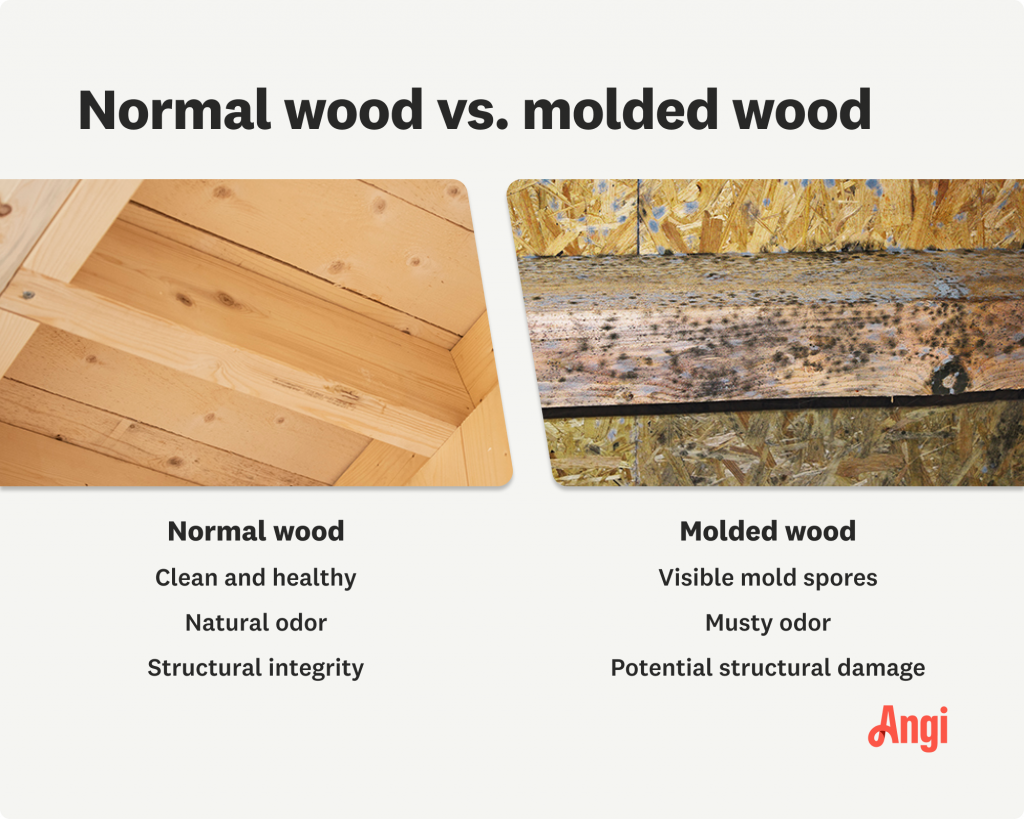
How To Remove Mold From Wood Furniture in 30 Minutes | Angi
Deep mold often presents as dark staining — gray, black, or greenish — that does not wipe away from the surface. The wood may also feel soft or spongy to the touch, and the finish may be lifting, bubbling, or discolored around the affected area. In advanced cases, the wood may have structural damage and wood rot that requires replacement rather than remediation.
Knowing which type you are dealing with before you begin treatment is essential. Attempting surface treatments on deep mold will not solve the problem — it will temporarily improve the appearance while leaving active mold alive in the wood below, where it will continue to grow and spread.
What Causes Mold in Hardwood Floors and Wood in Melbourne Homes
Understanding the cause is important not just for treatment but for prevention — because mold in wood always has a moisture source, and if that source is not addressed, the mold will return no matter how effectively you clean it.
In Melbourne homes, the most common causes of mold in hardwood floors and wood materials include flooding from storm events or plumbing failures, slow plumbing leaks beneath the floor that keep the subfloor and the underside of hardwood boards continuously damp, condensation from inadequate HVAC performance or poor insulation, high indoor humidity that chronically exceeds 60 percent — an ongoing challenge in Brevard County’s coastal climate — and moisture wicking upward from a concrete slab, which is the foundation type under the majority of Melbourne homes.
Slab moisture deserves special mention because it is one of the most common and least recognized causes of mold in hardwood floors in this region. Concrete is porous and absorbs moisture from the soil beneath it. In Melbourne’s water table and soil conditions, moisture migration through slabs is a year-round reality, and hardwood floors installed directly over slabs — without an adequate moisture barrier — are perpetually exposed to the moisture vapor rising from below. This slow, chronic moisture exposure is ideal for mold growth at the underside of the hardwood boards, where it may go undetected until significant colonization has already occurred.
What Not to Use on Hardwood: The Damage Prevention List
Before covering what works, it is worth being very clear about what does not work — and what actively damages hardwood floors and finishes in ways that cannot be reversed.
Bleach is the most commonly misused cleaner in mold situations. Bleach does kill mold on the surface, but it has two serious problems when used on wood. First, bleach is a strong oxidizer that strips and damages wood finishes, discolors the wood, and can cause wood fibers to break down with repeated use. Second — and this is critical — bleach is water-based, and the water in the bleach solution penetrates deeper into porous wood than the active chlorine ingredient. The chlorine kills surface mold while the water feeds the mold deeper in the wood. Bleach is appropriate for non-porous, sealed surfaces. It is not appropriate for wood.
Excessive water in any form — wet mops, saturated rags, steam cleaning applied to mold-affected areas — will drive moisture deeper into the wood and worsen the underlying problem. Wet cleaning of hardwood should be minimal under any circumstances, and it should be near-zero when mold is present.
Abrasive scrubbers including steel wool, scouring pads, and stiff wire brushes scratch and permanently damage wood finishes. Using these on mold-affected hardwood removes the protective finish along with the mold, leaving the bare wood exposed and far more vulnerable to future moisture and mold penetration.
Ammonia-based cleaners damage many types of hardwood finish, particularly polyurethane, and can cause cloudiness, discoloration, and finish delamination. They are not appropriate for mold treatment on finished wood.
Vinegar, while widely recommended online for mold removal, is also problematic for finished hardwood. Undiluted white vinegar is acidic enough to etch and dull many types of wood finish over time. While diluted vinegar is sometimes used in other contexts, it is not the best tool for mold in hardwood and carries real risk of finish damage if used incorrectly.
What Does Work: Step-by-Step Mold Treatment for Hardwood
The following process is appropriate for surface-level mold on finished hardwood floors and wood furniture where the mold has not penetrated deeply into the wood and the finish is still largely intact. If you assess the situation and determine that the mold is deep, the wood is soft, or the affected area is large, skip to the professional remediation section below.
Step 1: Protect Yourself Before You Touch Anything
Before any work begins, put on an N95 or higher-rated respirator mask, nitrile gloves, and safety goggles. Mold releases spores when disturbed, and stirring up an active mold colony without respiratory protection means directly inhaling those spores. Do not skip this step regardless of how small the affected area appears.
What Does Mold Look Like on Wood? How to Spot and Stop It
Turn off the HVAC system while you work to prevent spores from being pulled into the ductwork and distributed through the rest of your home. Open windows in the immediate work area only — not throughout the entire house — to create a one-directional airflow that moves spores out rather than spreading them to other rooms.
Step 2: Remove Loose Surface Mold With a Dry Process First
Using a HEPA vacuum or a soft brush attachment on a HEPA vacuum, gently remove any loose surface mold before applying any liquid. This step removes the bulk of the surface colony and significantly reduces the risk of spreading spores across the rest of the floor when you begin wet treatment. Dispose of the vacuum bag immediately in a sealed plastic bag taken directly outside to the trash.
Do not use a standard household vacuum for this step. Standard vacuums do not have filters capable of capturing mold spores and will redistribute them into the air.
Step 3: Apply a Mold-Specific Cleaner Appropriate for Wood
The best cleaning agents for mold on finished hardwood are those that kill mold without introducing excessive moisture or damaging the finish. The two most appropriate options for this application are undiluted white vinegar applied carefully with a barely-damp cloth (noting that this should only be used if the finish is polyurethane or wax-free, and wiped dry immediately after), or — more reliably — a commercial mold remover specifically formulated for wood and wood finishes, such as products containing quaternary ammonium compounds (quats) or borax-based formulas.
Whatever product you use, apply it to a cloth or applicator pad — never directly to the floor surface — and work in small sections. The cloth should be damp, not wet. Wipe in the direction of the wood grain. After applying the cleaner, follow immediately with a dry cloth to remove all moisture from the surface. The goal is to kill the surface mold with as little liquid exposure to the wood as possible.
For furniture and smaller wood items, this process can be done on a workbench or outdoor surface where you have better control. Lay the item on a moisture-resistant surface and work methodically, ensuring every surface — including undersides and hidden faces — is treated.
Step 4: Allow the Wood to Dry Completely
After cleaning, the wood must dry completely before any assessment of the result or any additional treatment. Use a fan directed at the treated area to accelerate drying, and if you have a dehumidifier, run it in the room to keep humidity levels low during the drying process. In Melbourne’s climate, drying time without mechanical assistance can be frustratingly slow — do not rush this step. Applying finish or sealant over wood that is not fully dry will trap moisture and create exactly the conditions mold needs to regrow.
Allow at least 24 hours of drying time with mechanical assistance, or 48 hours or more in humid conditions, before evaluating the result and considering any finish touch-up.
Step 5: Assess the Result and Address Finish Damage
Once dry, evaluate the treated area carefully. If the mold is gone and the finish is intact, the surface treatment was successful. You may notice slight cloudiness or a dull spot in the finish where treatment occurred — this can often be addressed with a hardwood floor cleaner and polish appropriate for your finish type, or in more significant cases, by spot-refinishing the affected area.
If dark staining remains after the mold has been removed, this indicates that mold pigments have penetrated the finish into the wood fibers. This type of staining may require light sanding of the affected area followed by refinishing to fully address, which is work best left to a professional floor refinisher.
If the mold returns within days or weeks, the surface treatment removed the visible colony but did not reach all of the mold. This is a strong indicator that the mold has penetrated deeper than the surface — and that professional assessment is needed.
When the Mold Is Deep: What Professional Remediation Looks Like
When mold has penetrated into the wood fibers, when the affected area is large, when the wood shows structural softness or rot, when mold is present on the underside of floorboards accessible from a basement or crawl space, or when surface treatment has been attempted and failed, professional mold remediation is the appropriate next step.
Professional remediation of mold in hardwood floors typically involves a thorough moisture assessment to determine the source and extent of moisture intrusion, controlled removal of severely affected flooring in cases where the wood cannot be remediated in place, treatment of the subfloor and structural elements beneath affected boards, drying of the structure using professional-grade air movers and dehumidifiers calibrated to Florida’s climate conditions, and professional refinishing or replacement of the flooring once moisture levels have been returned to safe levels and mold clearance has been confirmed.
In cases where a slab moisture problem is identified as the source, a vapor barrier solution beneath the floor is essential before new or restored flooring is reinstalled. Installing hardwood over a moisture-active slab without an appropriate vapor barrier will result in the same problem recurring regardless of how thoroughly the mold is remediated.
At PuroClean of Melbourne, our certified technicians use moisture meters and thermal imaging to assess the full extent of moisture and mold in hardwood floor systems before determining the appropriate scope of remediation. We work with clients to preserve as much of their original hardwood as possible — we understand how significant these floors are to a home’s value and character — and we are experienced at the intersection of mold remediation and hardwood floor restoration that this specific problem requires.
Preventing Mold in Hardwood: Melbourne-Specific Strategies
Because prevention in Florida’s climate requires consistent effort, here are the most effective strategies for keeping your hardwood floors mold-free year-round.
Maintain indoor humidity between 45 and 55 percent. Hardwood floors actually expand and contract with humidity fluctuations, and the range that is best for the wood structurally is also the range that is least hospitable to mold. Your air conditioning system should be maintaining this range — if it isn’t, your system may be oversized, undersized, or in need of service. A supplemental dehumidifier in rooms where humidity is consistently elevated is a worthwhile investment.
Respond to water on hardwood floors immediately. Any water spill, leak, or flooding event that leaves standing water on hardwood should be addressed within minutes — not hours. The longer water sits on hardwood, the deeper it penetrates. In Florida’s climate, mold can begin to grow in as little as 24 to 48 hours after a wood surface becomes wet. Speed of response is everything.
Have your HVAC drain line flushed regularly. A clogged condensate drain line is one of the most common causes of water damage to floors near air handler units in Melbourne homes. A monthly flush of the drain line with diluted bleach is a simple, inexpensive preventive measure.
If you are considering installing hardwood floors in your Melbourne home, ensure that a proper vapor barrier system is included in the installation over any concrete slab. This is non-negotiable in Florida’s climate and is the single most important installation decision for the long-term performance of hardwood flooring in this region.
Inspect areas around the perimeter of rooms, near exterior walls, and around plumbing fixtures regularly for any early signs of moisture or discoloration. Catching moisture intrusion before mold establishes itself is the most cost-effective form of hardwood floor protection available.
Final Thoughts: The Wood Is Worth Saving — But Only If You Do It Right
Hardwood floors are a significant investment, and in Melbourne’s real estate market, they add genuine value to a home. When mold appears, the instinct to save them is correct — but only if that effort is executed with the right approach, the right products, and an honest assessment of whether the situation is one that DIY treatment can resolve or one that requires professional intervention.
Using the wrong cleaner, applying too much moisture, or treating surface mold that has already gone deep can turn a recoverable situation into one that requires full floor replacement. The guidance in this article is designed to help you make the right call — and to understand clearly when calling PuroClean of Melbourne is the step that saves your floors rather than the one that comes too late to.
If you are dealing with mold on hardwood floors or wood structures in your Melbourne home and you are uncertain about the extent of the problem or the right course of action, call us. Our assessment is always honest, our approach is always preservation-first, and we are available around the clock throughout Brevard County.
PuroClean of Melbourne
Mold, Water & Fire Remediation | Available 24/7
📍 739 North Dr, Melbourne, FL 32934
📞 (321) 378-2400
🌐 puroclean.com/melbourne-fl-puroclean-melbourne
✉️ [email protected]

Connect With Us on Social Media!
Instagram | Facebook | Direction | Check Reviews | Yelp

 PuroClean of Melbourne