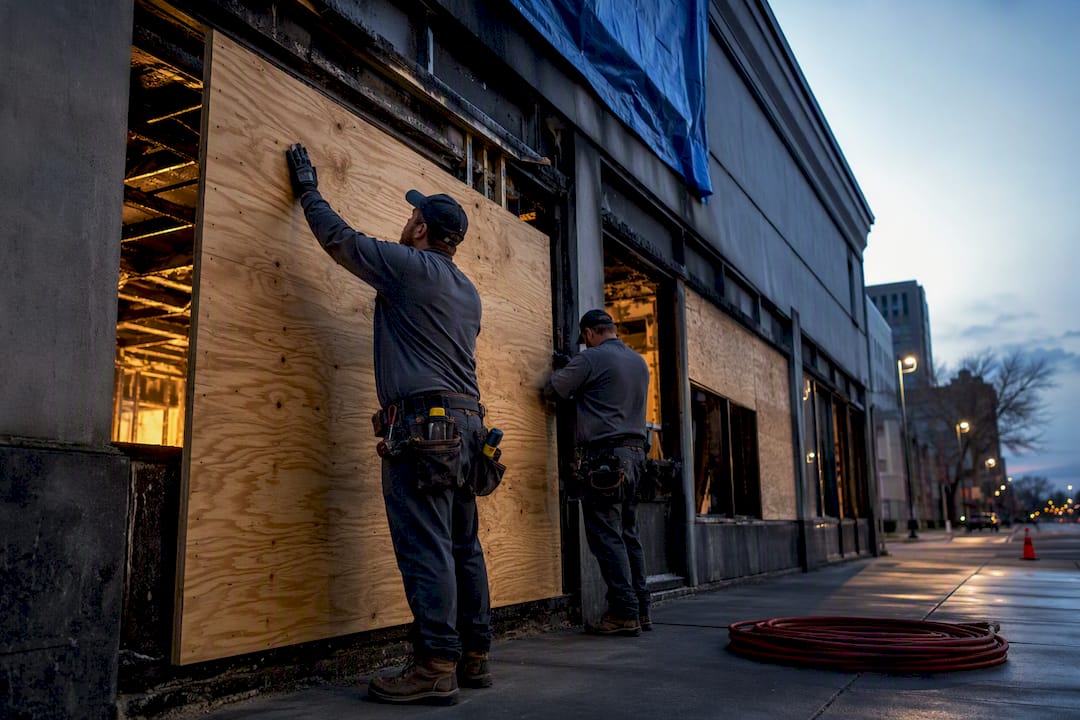
Call a 24/7 emergency fire restoration company like PuroClean of Northeast Sacramento the moment fire officials clear your property. Do not re-enter until you get that clearance, and once inside, shut off the HVAC system, photograph every room before touching anything, and call your insurer to open a claim. Fast mitigation within the first day stops soot corrosion, blocks mold growth, and gives your adjuster a clean documented record instead of a dispute.
Puroclean
Get Fire Damage Help Fast
PuroClean provides emergency fire and smoke restoration for residential and commercial properties throughout the greater Sacramento area.
Table of Contents
- What Should You Do First After a House Fire?
- How Does the Fire Restoration Process Actually Work?
- What Does Emergency Fire Restoration Typically Cost?
- How Long Does Fire Damage Restoration Take?
- Is It Safe to Stay in a House After a Fire?
- How Do You Choose the Right Fire Restoration Company?
- What Does PuroClean Bring to a Local Fire Emergency?
- Regulatory Compliance and Permits for Commercial Fire Restoration
- What Makes Commercial Fire Restoration Different From Residential?
- How Do Restoration Crews Minimize Business Downtime?
- What Equipment Do Commercial Fire Restoration Crews Use?
- How Do You Know the Restoration Job Is Actually Done?
- Why Speed and Standards Beat Guesswork Every Time
- Get Emergency Fire Restoration Help Now
- Sources
- FAQ
What Should You Do First After a House Fire?
The hours right after a fire are the most damaging window you’ll deal with, and also the most fixable one. Restoration professionals stress that smoke residues and corrosive off-gassing keep attacking surfaces for 24 to 72 hours after suppression, which means every hour you wait to act is an hour that soot has to etch itself deeper into metal, glass, and grout. Here’s the order that actually protects your property and your insurance claim.
- Wait for clearance. Do not enter the structure until fire officials or your restoration crew say it’s safe. Structural damage, hidden hot spots, and compromised flooring cause more injuries in the aftermath than the fire itself.
- Account for people and pets first. Nothing else matters until everyone is safe and has somewhere to stay for the next few days.
- Call an emergency fire restoration company and your insurer, in that order. A 24/7 crew can be on-site the same day for board-up and stabilization, and starting your claim early prevents delays later.
- Photograph and video everything before you move a single item. Wide shots of each room, close-ups of damaged belongings, and dated timestamps give your adjuster a scope they can’t argue with.
- Leave the HVAC system off. Running it circulates soot particles through every duct in the building, turning a contained problem into a whole-house one.
- Do not clean soot yourself or shampoo carpets. Wiping soot with a household rag smears it into fabric and drywall, and once that happens, materials that could have been restored often have to be replaced.
- Don’t throw anything away yet, even ruined items. Adjusters need to see the damage in place; discarding items before documentation is one of the most common reasons claims get reduced.
- Schedule board-up, roof tarping, and utility shutoff immediately. Emergency board-up and tarping are standard, billable mitigation services most policies cover, and they’re the difference between a contained loss and a rain-soaked, looted one.
Pro Tip: Take a video walkthrough narrating room by room before crews arrive, even a shaky one on your phone. Adjusters weight timestamped video heavily, and it takes two minutes to record while you’re waiting for the fire restoration team to show up.
How Does the Fire Restoration Process Actually Work?
Restoration crews don’t clean the closest mess first. They follow a strict sequence because fire damage behaves in predictable, chemically active ways, and skipping a step in that sequence tends to turn a repairable surface into a replacement job.
Emergency stabilization comes first. Board-up, roof tarping, and utility shutoff happen before anything else because an open structure invites rain, theft, and animals. This is also when crews confirm the building is structurally safe to work in.
Assessment and documentation follow immediately. Technicians walk the entire structure, photographing damage room by room and, where char patterns suggest hidden burn paths inside walls, performing exploratory demolition. The ANSI/IICRC S700 standard governs this step, and it’s worth knowing about even if you never read the document yourself: it’s the first publicly reviewed American National Standard for fire and smoke restoration, and it makes assessment, HVAC inspection, and documented scope mandatory rather than optional add-ons a contractor can skip to save time.
Contents pack-out and triage happen next. Every item gets sorted into salvage, deep-clean, or total-loss categories. Electronics, textiles, and anything porous usually leave the property for off-site ultrasonic or ozone-chamber cleaning, while structural components stay in place for on-site work.
Soot removal follows a specific order that most homeowners never think about until it’s explained to them:
- Dry methods go first, always. HEPA vacuuming and dry chemical sponges lift loose soot without pushing it deeper into the material. This isn’t a preference; IICRC guidance is explicit that wet cleaning before dry cleaning risks smearing residue permanently into porous surfaces.
- Wet cleaning agents are matched to residue type. Protein residue from a kitchen fire responds to different solvents than the synthetic soot from burned plastics or electronics, and using the wrong one can set a stain rather than lift it.
- Structural drying gets sequenced carefully. When firefighting water is present, crews dry the structure in a way that doesn’t drag wet soot across dry, unaffected areas.
- Odor control comes last, and it isn’t one-size-fits-all. Thermal fogging, ozone treatment, and hydroxyl generators are the three main counteractant tools professionals reach for, and each carries occupancy restrictions. Ozone and thermal fogging generally require the space to be vacated during treatment; hydroxyl generators are milder and can sometimes run while light work continues nearby.
- Painted surfaces get a stain-blocking primer before any repaint. Skip this step and smoke compounds bleed straight through new paint within weeks, bringing the odor back with them, according to Kilz’s technical guidance on post-fire priming.
One detail that surprises most property owners: the S700 standard ties job completion to your verification, not the contractor’s checklist. Final acceptance depends on you confirming that residues and odors are no longer detectable, which is a meaningfully different bar than “the crew says it’s done.” If your nose or your eyes tell you otherwise, the standard backs you up in asking for more work before signing off.
Controlled demolition and reconstruction close out the process, and this is where the timeline stretches. Cabinetry, drywall, and flooring that survived cleaning get repaired; anything beyond salvage gets rebuilt to match the original structure, coordinated with your adjuster’s approved scope.
What Does Emergency Fire Restoration Typically Cost?
Costs swing dramatically depending on how much of the structure burned versus how much just absorbed smoke. Published industry ranges put total fire damage restoration anywhere from roughly $3,000 for a contained, single-room smoke event up to $52,000 for a severe structure fire, with most residential jobs landing in the low- to mid-five-figure range once soot removal, drying, and partial reconstruction are all factored in.
That’s a wide range because fire damage restoration is billed by task, not by a flat number. A typical invoice breaks down something like this:
Homeowners insurance commonly covers emergency mitigation, including board-up, extraction, and soot removal, as part of the dwelling coverage that pays to prevent further loss. Reconstruction typically falls under the same dwelling coverage, though your deductible applies once and policy limits cap the total payout, so a badly underinsured property can still leave you with a gap even after a full claim payout.
Getting reimbursed cleanly comes down to documentation, and adjusters respond to a few specific things:
- A dated photo and video record from before any cleanup started
- A signed, written scope of work, not a verbal estimate
- Line-item invoices that match the signed scope, task by task
- Proof that mitigation began promptly, since delayed action is a common reason insurers push back on secondary damage claims
Pro Tip: Ask your restoration crew for the scope of work in writing before they start, not after. Adjusters trust a signed pre-work scope far more than a summary invoice handed over once the job is finished.
How Long Does Fire Damage Restoration Take?
Mitigation and reconstruction run on very different clocks, and conflating them is the single biggest reason homeowners feel blindsided by timelines.
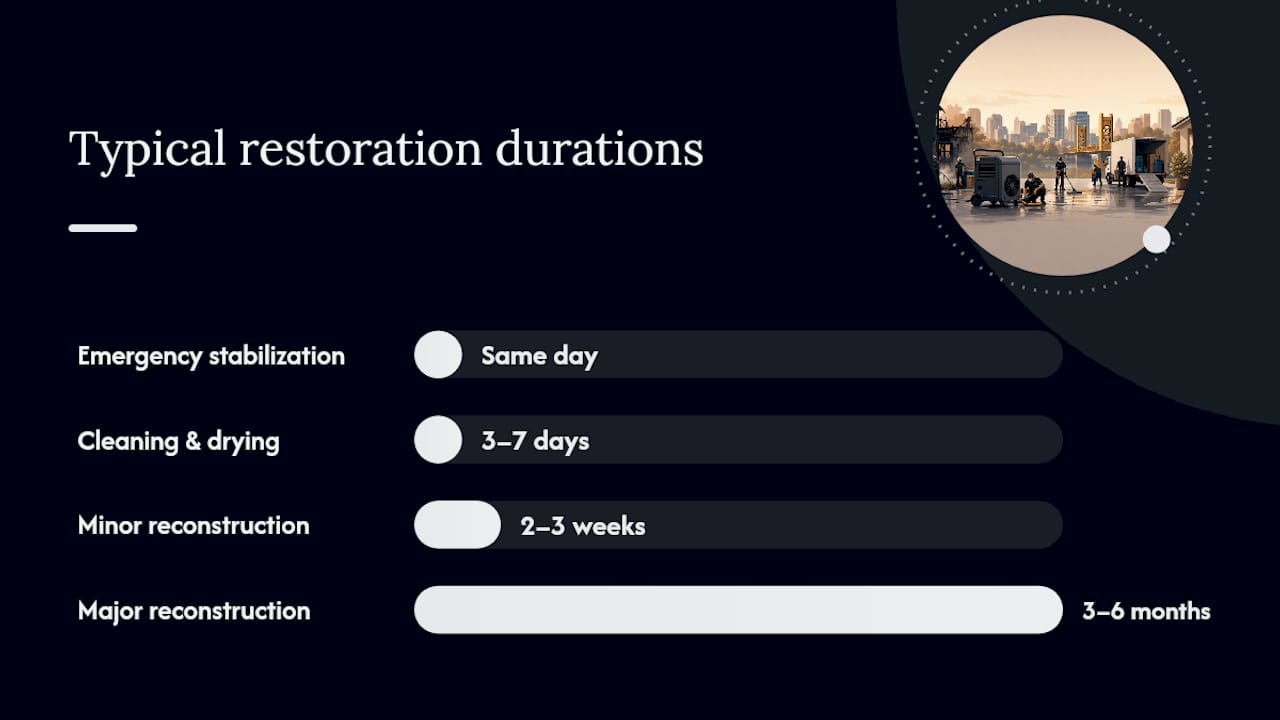
- Emergency stabilization happens same-day. Board-up and tarping are typically done within hours of the first call.
- Cleaning and drying run 3 to 7 days for a moderate loss, covering soot removal, structural drying, and initial odor treatment.
- Reconstruction runs weeks to months, depending entirely on how much rebuilding is required. A room that needs new drywall and paint might close out in two to three weeks; a home needing structural framing repair or a full kitchen rebuild can run three to six months.
Several factors stretch that reconstruction window past what most people expect. Insurance approval delays are the most common one, since adjusters often need to inspect before authorizing rebuild work, and that scheduling alone can eat a week or two. HVAC contamination adds time if ductwork needs professional cleaning or replacement before the system can run safely again. Permit delays hit commercial properties and larger residential rebuilds especially hard, since most jurisdictions require inspection sign-off at multiple construction stages, not just at the end.
If your home is uninhabitable during the drying or rebuild phase, ask your restoration company about contents access early. Many crews can arrange scheduled visits to your pack-out storage for medications, documents, or essentials, even while the main job is still in progress, which saves you from waiting out the entire timeline before retrieving anything you need.
Is It Safe to Stay in a House After a Fire?
Fire residue is more dangerous than it looks, and that danger doesn’t end when the flames do. Soot from burned synthetic materials, plastics, and furniture contains acidic compounds that irritate skin, eyes, and lungs, and firefighting chemical residues add another layer of exposure risk on top of the smoke itself.
Until a professional clears the air quality and surfaces, a few rules protect you:
- Don’t run the HVAC system. Ductwork spreads soot particulates through the entire building, and HVAC inspection is a mandatory step under the S700 standard precisely because smoke migrates through ducts and deposits residue crews can’t see from the register.
- Don’t sleep in a smoke-damaged structure with children, elderly family members, or anyone with asthma or respiratory conditions until it’s professionally cleared.
- Don’t assume a room that “looks fine” is clean. Smoke odor without visible soot can still mean airborne particulates settled on surfaces you can’t see from the doorway.
- Seek medical attention if anyone in the household develops a persistent cough, headaches, or respiratory irritation after returning, even briefly, to a fire-damaged property.
- Ask about environmental testing if the fire involved synthetic materials, electronics, or a large volume of plastics, since those produce more corrosive byproducts than a typical wood or paper fire.
Pro Tip: If anyone in your household has asthma or a chronic respiratory condition, ask your restoration company to complete HVAC inspection and cleaning before anyone moves back in, not after. It’s a small scheduling ask that avoids a bigger health problem.
How Do You Choose the Right Fire Restoration Company?
The contractor you hire determines whether your claim goes smoothly or turns into a six-month argument with your insurer. A few checks separate a legitimate emergency fire restoration company from a truck-and-a-shop-vac operation.
- Confirm genuine 24/7 response, not a voicemail that gets returned Monday. Fire damage doesn’t wait for business hours, and neither should your crew.
- Verify licensing and insurance before signing anything. A company working on your home without its own liability coverage puts your property at legal risk if something goes wrong during the job.
- Ask directly whether they follow ANSI/IICRC S700. It’s the industry benchmark for assessment, HVAC inspection, and cleaning methodology, and a company that doesn’t know the standard by name is a red flag on its own.
- Require a written, photo-backed scope of work before any cleaning starts. Verbal estimates disappear the moment there’s a disagreement over what was included.
- Confirm HVAC inspection is part of the plan, not an upsell. If a contractor skips this step or treats it as optional, they’re skipping a mandatory part of the S700 process.
- Ask how contents pack-out and odor control are handled. A vague answer here usually means a vague invoice later.
- Compare scopes line by line, never lump-sum totals. Two bids that look similar on the bottom line can hide very different levels of actual work.
- Walk away from anyone who starts cleaning before documenting damage. That single habit is the fastest way to lose insurance reimbursement for work already done.
What Does PuroClean Bring to a Local Fire Emergency?
A local fire restoration company answers fire and smoke emergencies around the clock across the greater Sacramento region. The team handles the full arc of fire damage restoration, from board-up and tarping through soot removal, contents pack-out, and structural drying.
A few specifics worth knowing before you call:
- Response coordination may include board-up, tarping, and temporary utility shutoff as day-one services.
- Documentation practices often align with insurance requirements, so photo and scope records match adjuster expectations.
- HVAC inspection is commonly included as part of fire loss assessment rather than as an optional add-on.
- Familiarity with local properties can enable faster on-site assessment and help avoid scheduling surprises during peak wildfire season.
For homeowners weighing service types, PuroClean’s breakdown of the seven types of fire restoration services covers everything from smoke odor removal to full reconstruction coordination in more detail.
Regulatory Compliance and Permits for Commercial Fire Restoration
Commercial fire restoration carries a permitting burden residential jobs rarely see. Most jurisdictions require a building permit before any structural repair begins, and larger commercial losses often trigger a separate fire marshal sign-off confirming the space is safe to re-enter for work at all.
Electrical and mechanical permits usually apply on top of the general building permit, especially when fire damage reached wiring, HVAC equipment, or fire suppression systems. A commercial kitchen fire, for example, often needs health department clearance before food service can resume, layered on top of the standard construction permits.
Americans with Disabilities Act compliance can also come into play during commercial reconstruction. If a rebuild touches entryways, restrooms, or common areas, some jurisdictions require those elements to meet current ADA standards even if the original space predated them, which can add scope the business owner didn’t budget for.
Occupational Safety and Health Administration rules govern how restoration crews handle the site itself, particularly around structural stability, air quality, and hazardous residue exposure for workers. A commercial restoration company familiar with local permitting offices moves through this faster than one encountering your jurisdiction’s process for the first time, which is one more reason to ask contractors directly about their permit-handling experience before hiring.
What Makes Commercial Fire Restoration Different From Residential?
Scale and stakes change the entire job. A single-family home has one owner making decisions; a commercial building often has a landlord, multiple tenants, insurance carriers for each, and sometimes a property management company all needing to sign off on the same scope of work.
Commercial structures also tend to have more complex mechanical systems. Larger HVAC networks, industrial equipment, server rooms, and specialized wiring all need separate assessment beyond the basic smoke and soot evaluation a home requires. A restaurant fire, for instance, involves grease-laden soot that behaves differently than residential smoke residue and often demands different cleaning agents entirely.
Multi-tenant exposure adds another layer of complication. Smoke and soot rarely respect unit boundaries, particularly in buildings sharing HVAC systems or common ductwork, which means a fire in one unit can trigger inspection and cleaning obligations across several tenants who had nothing to do with the original incident.
Inventory and equipment losses also carry different documentation demands than household contents. A business needs itemized commercial equipment valuations, not just a photo of a damaged couch, and that paperwork burden falls on both the business owner and the restoration company handling the claim.
How Do Restoration Crews Minimize Business Downtime?
Every day a commercial property sits closed is lost revenue, and that changes how restoration crews prioritize the work compared to a residential job.
Phased reoccupation is the main tool. Rather than closing an entire building until every corner is finished, crews often clear and restore functional areas first, letting a business reopen part of its space while work continues elsewhere behind containment barriers. A restaurant might get its dining room cleared while the kitchen finishes odor treatment separately.
Off-hours scheduling matters too. Restoration teams coordinate demolition, drying equipment placement, and noisy work around a business’s operating hours where possible, particularly for retail and office tenants trying to maintain some level of customer access during the restoration.
Direct communication with the business owner about realistic reopening dates, updated as the job progresses, does more to manage the downtime pain than any specific technique. A business that knows it’s three weeks from reopening can plan staffing and cash flow around that date; a business getting vague timelines from a contractor cannot.
What Equipment Do Commercial Fire Restoration Crews Use?
Commercial losses call for equipment scaled well past what a residential job needs. Industrial-grade HEPA air scrubbers run continuously across larger square footage, filtering airborne soot particulates while other work continues in adjacent zones.
Desiccant dehumidification systems handle structural drying at commercial scale, pulling moisture from large open floor plans faster than the standard residential units used in a single-family home. Thermal fogging equipment treats odor across large volumes of space in a single pass, useful for warehouses or open-plan offices where room-by-room ozone treatment would take too long.
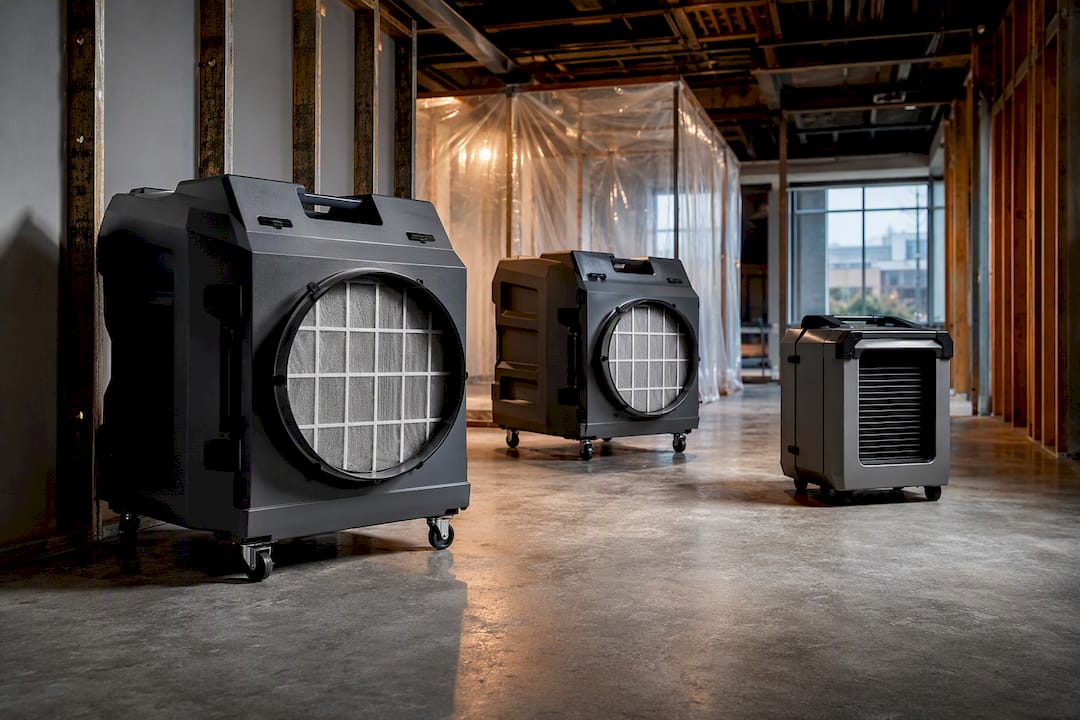
Hydroxyl generators see more use in occupied commercial settings specifically because they don’t require full evacuation the way ozone treatment does, letting some limited business activity continue on other floors during odor remediation. Moisture mapping technology, including thermal imaging cameras, lets crews track drying progress across large structures without opening walls repeatedly to check by hand.
How Do You Know the Restoration Job Is Actually Done?
Completion isn’t a date on a calendar; it’s a verification process. Under the S700 standard, final acceptance depends on the client confirming that residues and odors are no longer detectable, which puts real authority in your hands as the property owner rather than leaving “done” up to the contractor’s judgment alone.
A legitimate final walkthrough includes moisture readings confirming structural materials are back to normal levels, a visual and odor inspection of every treated area, and a review of the HVAC system to confirm cleaning met the standard rather than a cursory once-over. Ask for documentation of these final readings the same way you asked for documentation at the start. A restoration company confident in its work will hand it over without hesitation.
Why Speed and Standards Beat Guesswork Every Time
The gap between a fire loss that recovers cleanly and one that drags into a claims dispute almost always comes down to two things: how fast mitigation started and whether the crew followed a documented standard instead of improvising. The S700 framework exists because soot and smoke residue are chemically active, not passive stains, and treating them like a weekend cleanup project is how salvageable homes turn into full rebuilds.
Get Emergency Fire Restoration Help Now
Puroclean is the alternative to waiting on hold with an insurance hotline while your property keeps absorbing damage. Call PuroClean’s 24/7 emergency line and a crew responds the same day, not the next business day.
On the first call, expect a few direct questions: what burned, whether the fire department has cleared the property, and whether anyone needs somewhere to stay tonight. On the first visit, the crew confirms the site is safe, documents every room with photos before touching anything, begins board-up and tarping immediately, and starts the fire damage restoration process with an HVAC inspection built into the initial scope, not added later as an afterthought.
If you’re weighing next steps for smoke odor specifically, PuroClean’s guide to smoke remediation and odor removal walks through what that phase of the job actually involves. You can also review PuroClean’s coverage area and service locations, including a map of service areas across the greater Sacramento region, before your crew arrives. Call now and get board-up scheduled before the day is over.
Sources
The IICRC publishes the ANSI/IICRC S700 standard itself, the technical baseline for assessment, HVAC inspection, and completion criteria referenced throughout this guide. For cost benchmarking, Angi’s fire damage restoration cost guide breaks down national price ranges in more detail. Restoration Intel’s professional guide covers the technical sequencing behind soot cleaning and odor control, and Kilz publishes manufacturer guidance on stain-blocking primers for post-fire repainting.
- IICRC
- Restoration Intel — Fire Damage Restoration: The Complete Professional Guide
- Angi – How much does fire damage restoration cost?
- Kilz
FAQ
How Much Does Fire Restoration Cost?
Total costs typically range from about $3,000 for a contained smoke event to $52,000 for severe structural fires, with most residential jobs landing in the low- to mid-five-figure range once soot removal, drying, and reconstruction are included.
What Do Restoration Companies Charge Per Hour?
Most fire restoration companies bill by task and line-item scope, such as board-up, soot removal, and drying, rather than a flat hourly rate, which is why a written itemized scope matters more than any single hourly figure.
How Soon Should I Call an Emergency Fire Restoration Company?
Call immediately after fire officials clear the property. Smoke residue keeps corroding surfaces for 24 to 72 hours after suppression, so every hour of delay reduces what’s salvageable.
Will Homeowners Insurance Cover Fire Restoration?
Most homeowners policies cover emergency mitigation and reconstruction after a fire, though your deductible applies once and policy limits cap the total payout, so review your coverage limits with your adjuster early.
Is It Safe to Turn the HVAC Back On After a Fire?
No, not until a professional inspects and clears the system. Running HVAC before inspection spreads soot particulates through ductwork into every room the system serves, turning a localized problem into a whole-building one.