


Which restoration providers deliver the fastest fire and water recovery?
When fire and water damage hits your property, the first call you make shapes everything that follows. Response speed, certifications, and how well a company handles your insurance claim all determine whether you’re back home in weeks or stuck in limbo for months.
Four providers consistently stand out for fire and water restoration services in 2026: Clean Care of New England, Rhode Island Restoration, Clean Works Restoration, and Puroclean. Each brings a different strength to the table.
| Provider | Response Time | Services | Certifications | Insurance Support |
|---|---|---|---|---|
| Clean Care of New England | 24/7 emergency | Water, fire, mold | Licensed and insured | Yes |
| Rhode Island Restoration | 24/7 emergency | Water, fire, reconstruction | Licensed, BBB-rated | Full claims support |
| Clean Works Restoration | 24/7 emergency | Water, fire, mold, rebuild | Licensed and insured | Yes |
| Puroclean | 24/7 emergency | Water, fire, mold, reconstruction | IICRC-certified | Full claims support |
The trust signals that separate reliable providers from risky ones come down to a short list:
- 24/7 emergency availability with a guaranteed response window
- IICRC certifications for water (WRT), fire (FSRT), and mold (AMRT) technicians
- Licensed and insured status verifiable through your state contractor board
- Documented methodology including moisture maps, photo logs, and daily monitoring reports
- Verified customer reviews on Google, BBB, or industry directories
Puroclean’s IICRC firm certification means every technician on your job carries individual credentials you can verify directly through the IICRC’s public directory. That’s a detail worth confirming before you sign any authorization form.
Table of Contents
- How do you choose the right fire and water damage restoration company?
- What does the fire and water damage restoration process actually look like?
- Why does response speed and documentation determine your outcome?
- Puroclean of Northeast Sacramento: ready when it matters most
- Key Takeaways
How do you choose the right fire and water damage restoration company?
The wrong company costs you time, money, and sometimes your insurance claim. The right one treats your loss like a managed project with daily accountability.
Start with credentials. IICRC certification is the industry standard for professional restoration in the United States. A firm-certified company maintains certified technicians and meets ongoing quality standards. Beyond that, verify the contractor’s license through your state board and confirm they carry general liability and workers’ compensation insurance.
Ask these questions before you commit:
- What is your guaranteed response time, and do you have crews available right now?
- Which IICRC certifications do your on-site technicians hold?
- How do you document moisture readings, and will I receive daily progress updates?
- Do you work directly with insurance adjusters, and do you use Xactimate estimating software?
- Can you provide references from recent jobs involving both fire and water damage?
- What is your process when hidden damage is discovered mid-project?
Customer reviews tell you what credentials can’t. Look for patterns in Google and BBB reviews: fast communication, honest timelines, and clean documentation are the details satisfied customers mention most. One or two negative reviews aren’t disqualifying, but repeated complaints about billing surprises or abandoned jobs are.
Pro Tip: Ask specifically whether the company’s technicians hold individual IICRC certifications or whether only the firm is certified. Individual credentials mean the person actually working in your home has been trained and tested, not just the company name on the truck.
Geographic coverage matters too. A company headquartered 90 minutes away may not realistically deliver a four-hour response. Confirm the provider’s actual service area before an emergency, not during one.
What does the fire and water damage restoration process actually look like?
The restoration process follows a defined sequence governed by ANSI/IICRC S500 (water damage) and ANSI/IICRC S700 (fire and smoke damage) standards. Knowing the phases helps you ask better questions and catch shortcuts before they become problems.
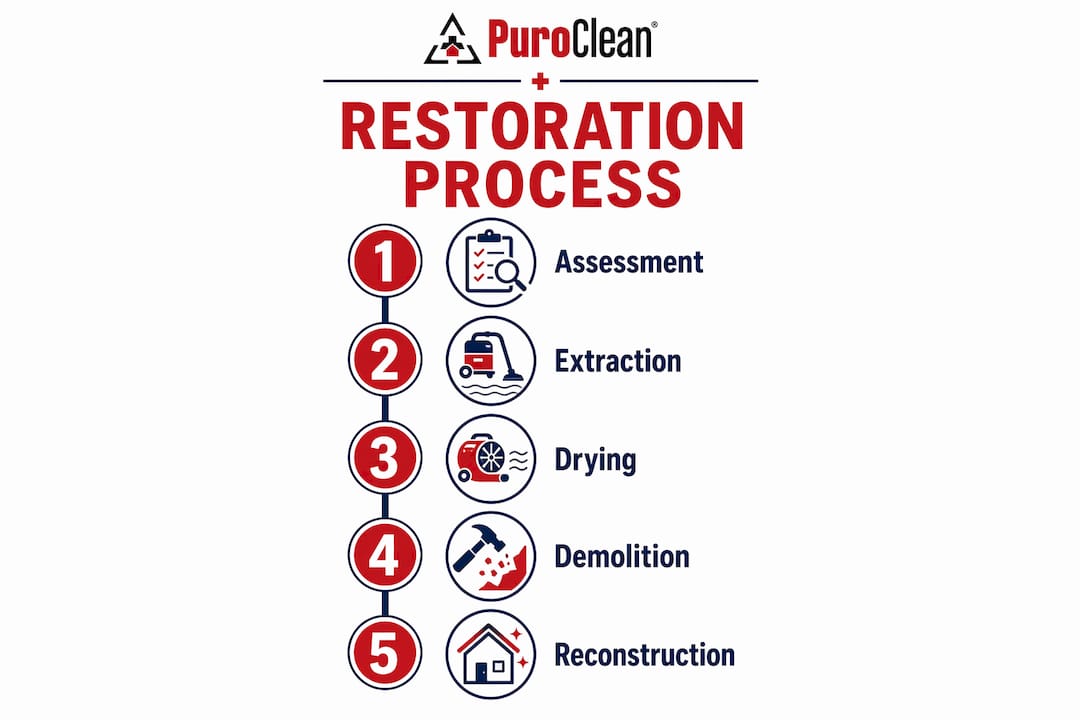
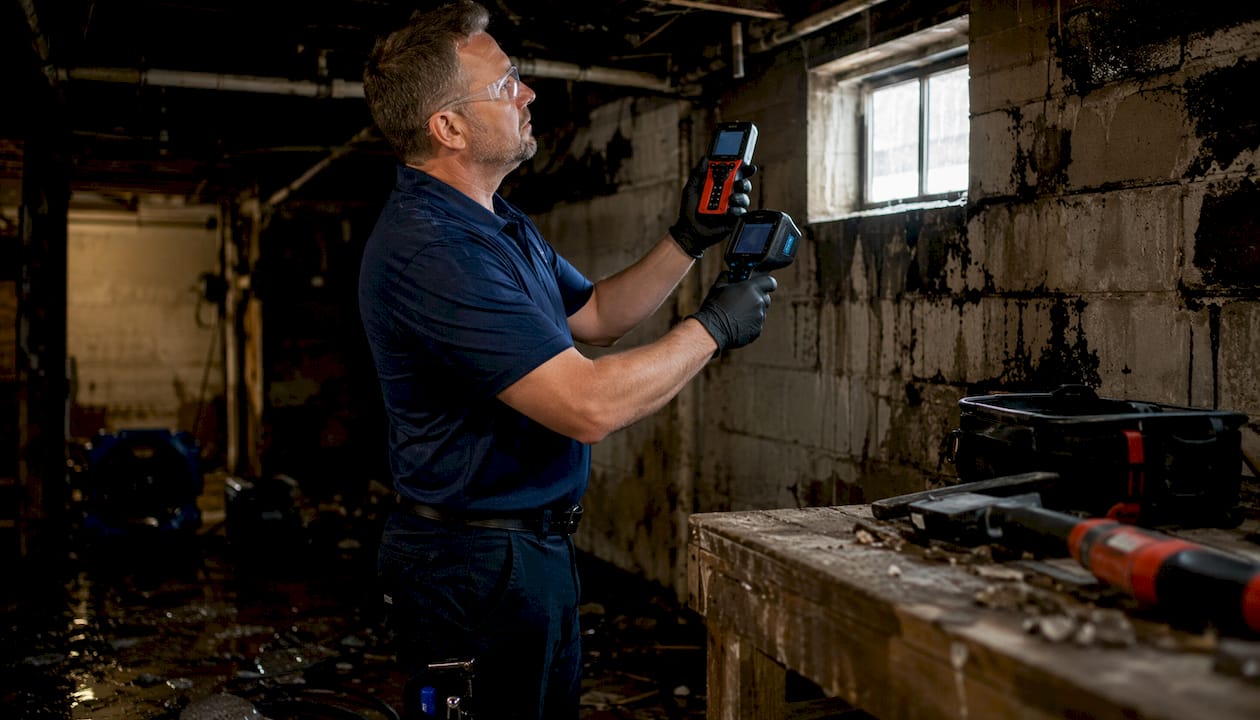
Phase 1: Emergency assessment. Technicians arrive, confirm the damage source is stopped, and map moisture migration using moisture meters and thermal imaging cameras. For fire losses, they evaluate smoke type, soot distribution, and HVAC contamination. Nothing gets touched until the full scope is documented.
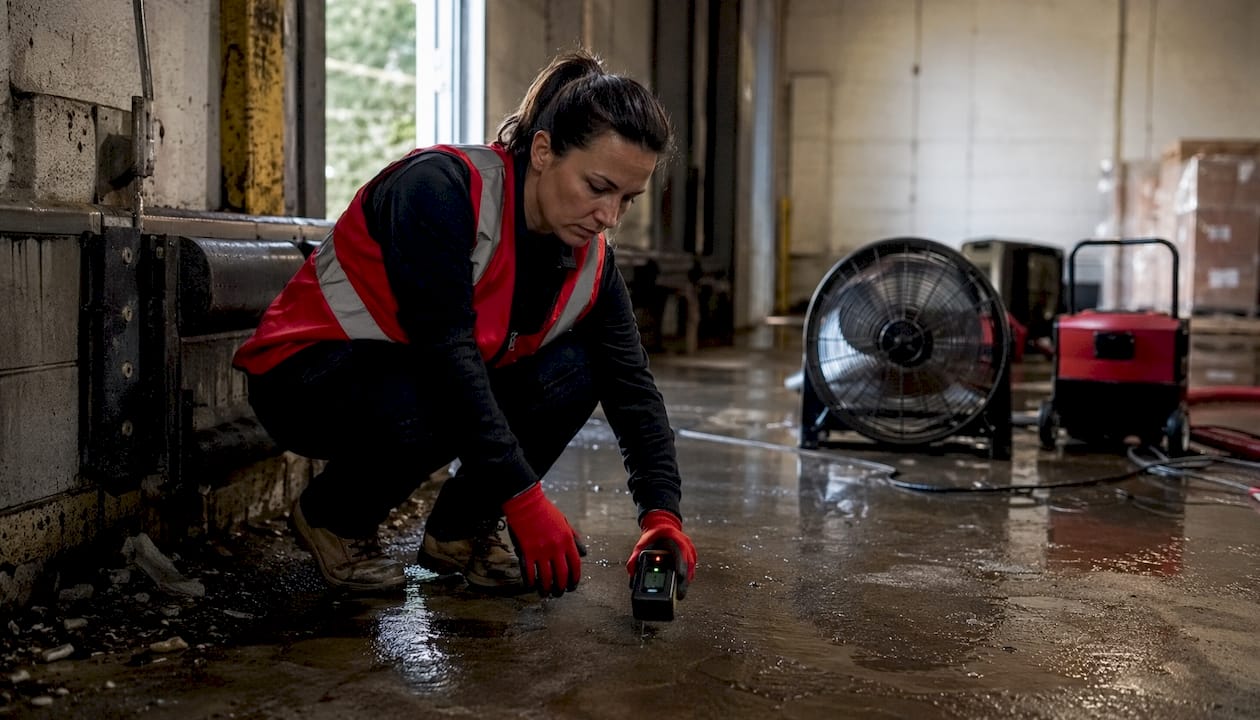
Phase 2: Extraction and stabilization. Industrial pumps and truck-mounted extractors remove standing water. For fire losses, HEPA air scrubbers run continuously to capture airborne soot particles. Boards go on broken windows; tarps cover compromised roofing.
Phase 3: Drying and soot removal. Air movers and LGR dehumidifiers create controlled drying conditions verified by daily moisture monitoring. For fire damage, HEPA vacuuming removes loose soot before any wet cleaning begins. Skipping that sequence causes permanent staining on surfaces that could have been saved.
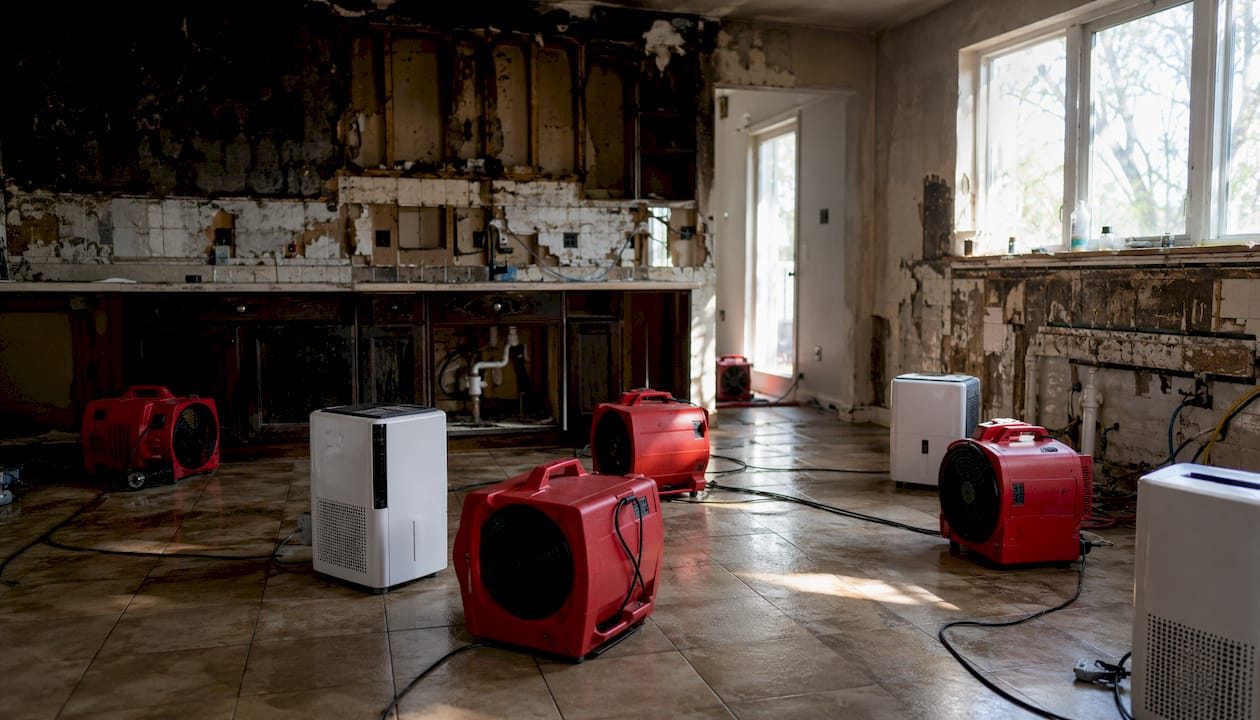
Phase 4: Demolition of unsalvageable materials. Wet drywall that can’t reach drying targets within the project window gets removed. The ANSI/IICRC S500 standard calls for cutting two inches above the highest wet moisture reading, exposing the wall cavity for complete drying.
Phase 5: Reconstruction. Once drying goals are confirmed and documented, rebuild work begins: drywall, insulation, flooring, paint, and fixtures restored to pre-loss condition.
| Phase | Typical Duration |
|---|---|
| Emergency assessment and stabilization | — |
| Water extraction | Same day |
| Structural drying | 3–7 days |
| Reconstruction | 1–2 weeks or longer, depending on extent of damage |
Your role during restoration matters. Keep these responsibilities in mind:
- Clear furniture and personal items from affected areas before crews arrive
- Designate a single point of contact for daily updates
- Photograph all damage before anything is moved or removed
- Keep receipts for all out-of-pocket expenses including temporary housing
Pro Tip: Ask your restoration company for moisture readings in writing at the end of each drying day. If they can’t produce them, that’s a red flag. Verified drying targets, not visual inspection, are what prevent mold from growing inside closed wall cavities after reconstruction.
Why does response speed and documentation determine your outcome?
Speed is not a marketing claim. It’s a physical fact. Microbial growth potential begins within 24–48 hours of a water event, and fire soot becomes acidic within hours of a fire, actively etching glass and corroding metal surfaces. Every hour without professional intervention narrows your options and raises your costs.
Documentation is the other half of a successful recovery. ANSI/IICRC S500 and S700 require moisture maps, photo records, and daily monitoring logs as part of any compliant restoration project. These records do two things: they prove the work was done correctly, and they protect your insurance claim against disputes.
Homeowners who document everything before and during restoration, from pre-loss photos to signed contractor authorizations and expense receipts, consistently experience smoother claims and faster timelines. Insurance adjusters approve scopes faster when the documentation is airtight.
Best practices for homeowners:
- Photograph all damage immediately, before any cleanup begins
- Keep a written timeline of events from the date of loss forward
- Save every receipt for hotel stays, meals, and emergency purchases covered under Additional Living Expense
- Request copies of all moisture logs and photo documentation from your restoration company
- Ask your contractor whether they use Xactimate software to align estimates with your adjuster’s expectations
Insurance communication is often the single biggest source of delay in restoration projects. A company that manages adjuster inspections, scope approvals, and estimate submissions on your behalf can cut weeks off your total project timeline. That’s not a convenience. It’s a material difference in how long you’re displaced from your property.
Puroclean of Northeast Sacramento: ready when it matters most
When fire or water damage hits a property in Northeast Sacramento, Folsom, Rancho Cordova, or Citrus Heights, the clock starts immediately. Puroclean of Northeast Sacramento responds 24/7 for emergencies with IICRC-certified technicians, advanced extraction and drying equipment, and a documented process built around ANSI/IICRC standards.
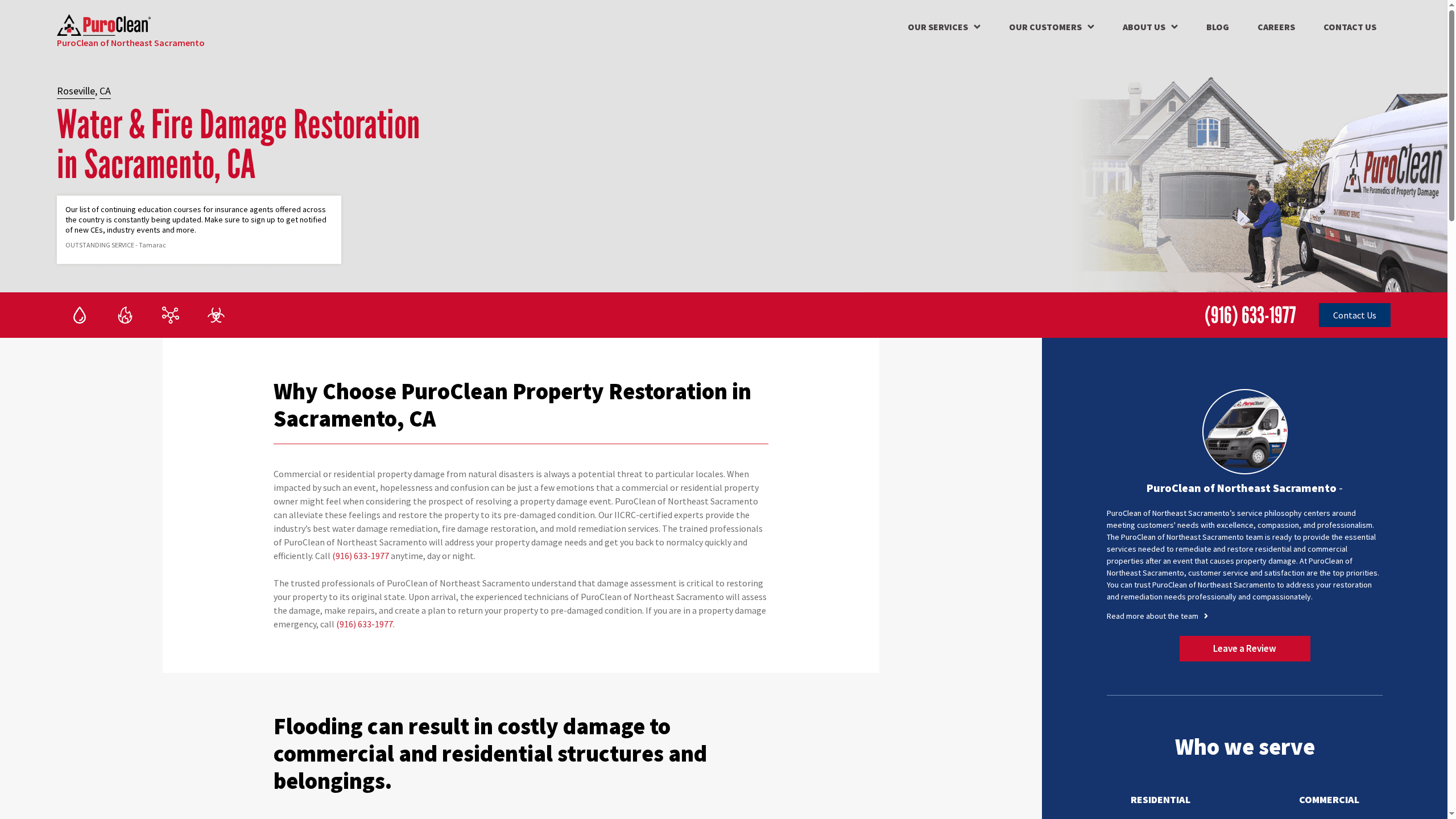
What sets Puroclean apart from a general contractor taking on restoration work is the combination of certified expertise and insurance fluency. Technicians handle moisture mapping, soot removal, and structural drying while simultaneously supporting your claim with the documentation your adjuster needs. For fire damage restoration specifically, that means smoke odor treatment, HEPA-grade cleaning, and reconstruction coordinated under one project team. You get a single point of contact, daily updates, and a restoration timeline you can actually plan around. Call Puroclean of Northeast Sacramento now or visit the local page to request emergency service.
Key Takeaways
Restoration fire and water recovery succeeds when certified technicians respond within hours, follow ANSI/IICRC standards, and document every phase to protect your insurance claim.
| Point | Details |
|---|---|
| Response time is critical | Secondary damage begins within 24–48 hours; losses addressed within 4 hours have significantly better outcomes. |
| Drying takes 3–7 days | Structural drying typically takes 3–7 days; reconstruction on a medium loss adds 1–2 weeks or longer. |
| Documentation protects your claim | Moisture maps, photo records, and daily logs per ANSI/IICRC S500/S700 standards prevent insurance disputes. |
| IICRC certification is the baseline | Verify individual technician credentials at iicrc.org before signing any authorization. |
| Puroclean covers Northeast Sacramento | Puroclean of Northeast Sacramento provides 24/7 IICRC-certified response for fire and water losses across the greater Sacramento area. |
Find Puroclean of Northeast Sacramento on Google Maps
Recommended
- Restoration Process Explanation Guide for Fast Recovery – PuroClean of Northeast Sacramento
- What Is Fire Restoration? Complete Guide for 2025 – PuroClean of Northeast Sacramento
- Role of Restoration After Fire: Complete Guide – PuroClean of Northeast Sacramento
- Fire Damage Restoration Explained: Complete Process Guide – PuroClean of Northeast Sacramento