Restoration certifications guide for Northeast Sacramento
When water floods your home or fire leaves smoke damage behind, the last thing you want is uncertainty about whether your restoration company knows what they’re doing. Choosing the right certified professionals can mean the difference between proper restoration and costly ongoing problems. This guide walks you through key restoration certifications, helping you understand which credentials matter most when selecting a trusted partner for water or fire damage emergencies.
Table of Contents
How To Choose The Right Restoration Certification: Key Criteria
Iicrc Certification Overview
Advanced Certifications From The Restoration Industry Association (Ria)
Why Certification Matters For Insurance And Quality Assurance
Certification Course Accessibility And Cost Factors
Comparing Certification Options: Iicrc Vs. Ria
Situational Recommendations For Choosing The Best Certification
Trust Certified Restoration Experts In Northeast Sacramento
Frequently Asked Questions About Restoration Industry Certifications
Key takeaways
Point
Details
IICRC and RIA certifications verify expertise
Nationally recognized credentials like WRT and FSRT demonstrate proven water and fire restoration knowledge
Certified technicians follow industry standards
ANSI-accredited training ensures consistent quality and proper documentation for insurance claims
Insurance companies prefer certified firms
Certified restoration providers achieve 30% faster claim approvals through standardized practices
Certification requirements vary significantly
Course costs range from $449 to $499 with durations from 2 to 5 days depending on specialization
Match certification to your restoration needs
Water damage requires WRT certified techs while fire damage needs FSRT trained professionals
How to choose the right restoration certification: key criteria
Before diving into specific certifications, you need to understand what separates legitimate credentials from meaningless certificates. The restoration industry has multiple certification bodies, but not all carry equal weight with insurance companies or guarantee quality work.
Start by looking for nationally recognized certifications with proper accreditation. Certification recognition and accreditation indicate industry trust and standards adherence, particularly when backed by organizations like ANSI. These credentials undergo rigorous review processes and require ongoing education to maintain validity.
Here are the essential factors to evaluate:
Verify the certification covers your specific restoration needs, whether water extraction, structural drying, or fire and smoke damage cleanup
Check renewal requirements to ensure technicians maintain current knowledge through continuing education
Review which certifications your insurance company prefers, as this directly impacts claim approval speed
Consider course accessibility including length, format options, and cost when evaluating certification quality
Confirm the certification body maintains a public registry where you can verify credentials
Pro Tip: Always ask restoration companies for their certification numbers and verify them through official registries before signing any contract. Legitimate certified professionals expect this due diligence and provide verification readily.
IICRC certification overview
The Institute of Inspection Cleaning and Restoration Certification (IICRC) represents the most widely recognized credential system in the restoration industry. Insurance companies, property managers, and homeowners trust IICRC certifications because they’re ANSI accredited and require demonstrated competency through standardized testing.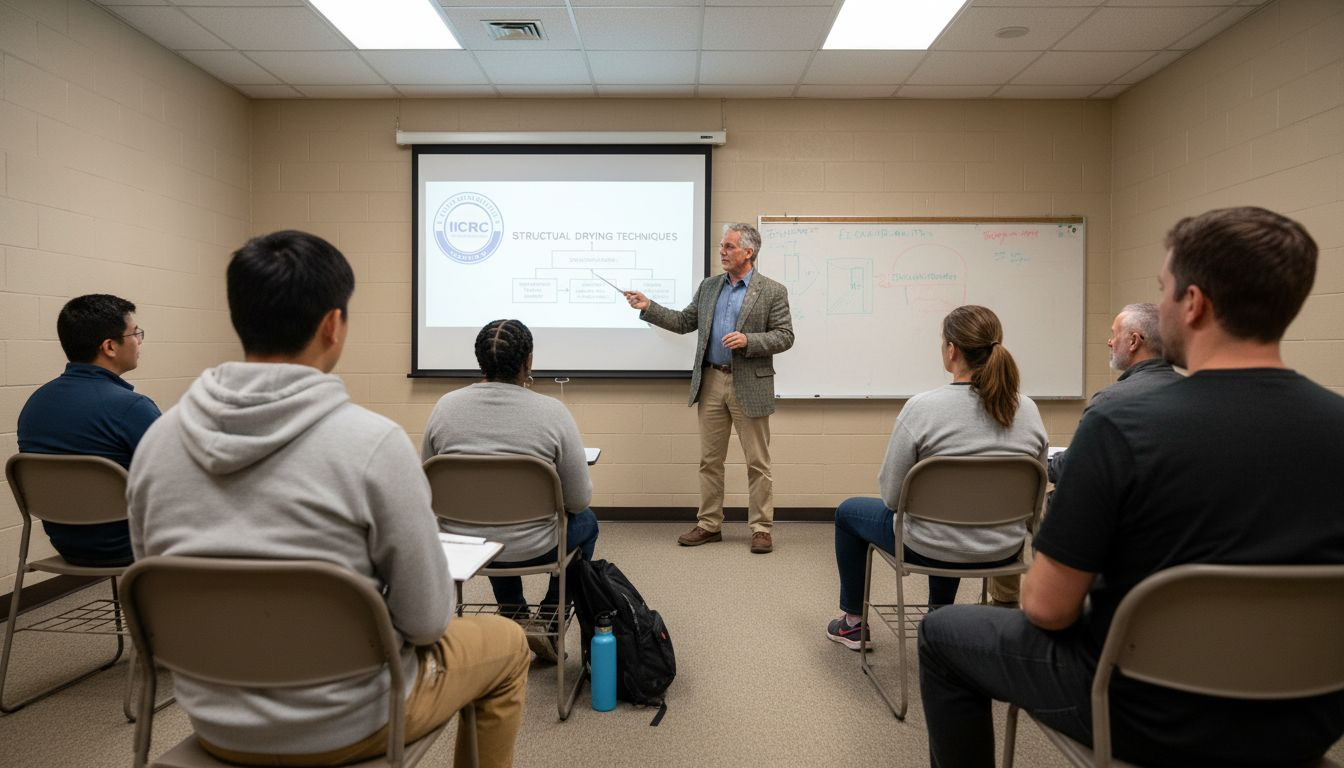
The IICRC Water Damage Restoration Technician (WRT) certification covers water damage identification, drying techniques, and contamination management over 3 to 4 days. This foundational credential teaches technicians how to assess water damage categories, select appropriate equipment, and implement proper drying protocols. For homeowners dealing with burst pipes, slab leaks, or flooding, WRT certification ensures your restoration team understands the science behind moisture removal and structural drying.
The IICRC Fire and Smoke Restoration Technician (FSRT) certification equips technicians with fire damage cleaning, deodorization, and documentation skills in a 2 day course. Fire restoration requires specialized knowledge about soot types, appropriate cleaning methods, and odor control techniques. When you hire restoration services for fire damage, FSRT certified professionals know how to prevent permanent staining and eliminate lingering smoke odors.
Additional valuable IICRC certifications include:
Applied Structural Drying (ASD) for advanced moisture management in complex water damage scenarios
Odor Control Technician (OCT) for specialized deodorization beyond basic fire restoration
FSRT and OCT combo course offering comprehensive fire and odor damage remediation training in 3 days
These certifications are available through both in-person classes and online formats, making them accessible to restoration professionals across the country. The flexibility in training delivery ensures technicians can obtain credentials without sacrificing hands-on learning quality.
Advanced certifications from the restoration industry association (RIA)
While IICRC certifications establish foundational competency, the Restoration Industry Association (RIA) offers advanced designations for experienced professionals seeking specialized expertise. These credentials require significant prerequisites and demonstrate leadership capabilities beyond basic restoration skills.
RIA offers advanced designations including Water Loss Specialist (WLS), Fire Loss Specialist (FLS), and Certified Restorer (CR) requiring specialized training and continuing education with renewal every 3 years. The Water Loss Specialist and Fire Loss Specialist designations build on foundational knowledge, focusing on complex project management, advanced technical skills, and consultation capabilities.
Certified Restorer (CR) designation indicates leadership, management skills, and comprehensive knowledge across restoration disciplines. Professionals holding CR credentials often serve as expert witnesses, insurance consultants, and project managers for large-scale commercial restoration projects. When you hire restoration professionals with RIA certifications, you’re accessing expertise that goes beyond technical skills to include strategic planning and risk management.
Key characteristics of RIA certifications:
Mandatory continuing education requiring 48 hours every 3 years keeps knowledge current with evolving industry standards
Focus on leadership, project management, and consulting capabilities rather than just hands-on technical skills
Best suited for complex restoration projects involving extensive damage, multiple disciplines, or commercial properties
Often required for professionals serving as expert witnesses in legal proceedings or insurance disputes
For most residential water or fire damage situations, IICRC certified technicians provide excellent service. RIA certifications become more relevant when dealing with extensive commercial damage, complex insurance situations, or cases requiring expert testimony.
Why certification matters for insurance and quality assurance
You might wonder whether certification actually makes a practical difference or if it’s just industry paperwork. The answer is clear: certified restoration companies deliver measurably better outcomes and smoother insurance experiences.
Certified restoration companies achieve 30% faster insurance claim approvals due to standardized documentation and adherence to certification standards. Insurance adjusters trust certified professionals because they know the work follows established protocols and includes proper documentation. This trust translates directly into faster claim processing and fewer disputes over restoration scope or costs.
Certified technicians follow ANSI/IICRC S500 standards, improving restoration outcomes and reducing hidden damages. These standards provide scientifically validated approaches to moisture removal, contamination control, and structural drying. When restoration follows these protocols, you significantly reduce the risk of mold growth, structural weakening, or incomplete drying that causes problems months later.
Consider these quality assurance benefits:
Thorough documentation during restoration simplifies restoration and insurance claims communication and reduces delays
Standardized assessment methods ensure no hidden damage gets overlooked during initial evaluations
Consistent restoration protocols mean predictable timelines and outcomes regardless of which certified technician handles your project
Continuing education requirements ensure certified professionals stay current with new equipment, techniques, and safety standards
Certification serves as your guarantee that restoration work meets industry standards, protecting both your property value and your insurance claim eligibility. Uncertified work might look complete but could hide problems that emerge later.
Financially, certification reduces overall restoration costs by preventing incomplete work that requires re-doing. The upfront investment in certified professionals pays dividends through faster recovery, better insurance cooperation, and confidence in restoration quality.
Certification course accessibility and cost factors
Whether you’re evaluating a restoration company’s credentials or considering certification yourself, understanding the investment required provides valuable context. Certification isn’t prohibitively expensive, but it does require meaningful commitment.
IICRC foundational courses cost typically $449 to $499 with duration from 2 to 5 days depending on certification. This price point includes training materials, examination fees, and initial certification issuance. Advanced certifications and combined courses cost more, reflecting the additional content and expertise required.
Course length varies significantly by certification type:
FSRT fire and smoke restoration: 2 days
WRT water damage restoration: 3 to 4 days
Combined certifications or advanced specializations: 4 to 5 days
Online and live streaming options available for most certifications
Renewal requirements add ongoing costs beyond initial certification. Most IICRC certifications require renewal every two years with continuing education credits. RIA advanced designations mandate 48 hours of continuing education every three years. These ongoing requirements ensure certified professionals maintain current knowledge but represent recurring financial and time commitments.
Accessibility has improved significantly with online training options. Many certification courses now offer live streaming formats that provide interactive instruction without requiring travel. This flexibility helps restoration professionals outside major metro areas obtain certifications more easily.
Pro Tip: When evaluating restoration companies, ask when technicians last renewed their certifications. Recent renewals indicate commitment to staying current with industry developments and new restoration technologies.
The investment in certification pays dividends for restoration companies through higher customer trust, better insurance relationships, and justified premium pricing. For homeowners, this investment translates into higher quality service worth the slightly higher cost compared to uncertified alternatives.
Comparing certification options: IICRC vs. RIA
Understanding the differences between IICRC and RIA certifications helps you evaluate which credentials matter most for your specific restoration needs. Both certification bodies serve important roles but target different experience levels and professional focuses.
Factor
IICRC
RIA
Recognition
Widely recognized industry standard, ANSI accredited
Advanced professional designation, specialized recognition
Target audience
Entry to mid level restoration technicians
Experienced professionals and company leaders
Prerequisites
Minimal, some courses require foundational certifications
Requires existing certifications and field experience
Recertification
Every 2 years with continuing education credits
Every 3 years with 48 hours continuing education
Focus areas
Hands-on technical skills and standard operating procedures
Leadership, consulting, project management, expert testimony
Typical cost
$449 to $499 per certification
Higher, reflecting advanced content and prerequisites
Best for
Residential water and fire damage restoration
Complex commercial projects and insurance consulting
IICRC WRT is widely recognized as the industry gold standard for water damage restoration while RIA WLS denotes advanced specialization needing more training and renewals. For most Northeast Sacramento homeowners facing water damage from burst pipes or flooding, IICRC WRT certified technicians provide the expertise needed for effective restoration.
Fire damage scenarios follow similar patterns. IICRC FSRT certification handles typical residential fire and smoke damage effectively. RIA Fire Loss Specialist becomes more relevant for extensive commercial fire damage or cases requiring fire restoration classifications expertise for insurance purposes.
Both certification paths require ongoing education, demonstrating professional commitment to staying current. The key difference lies in scope: IICRC focuses on technical execution while RIA emphasizes strategic management and specialized consulting. For your restoration needs, IICRC certifications typically provide sufficient expertise unless dealing with unusually complex or large scale damage.
Situational recommendations for choosing the best certification
Now that you understand different certification types, here’s how to match credentials to your specific restoration emergency. These recommendations help you quickly identify which certifications matter most when you need immediate help.
For urgent water damage situations:
Prioritize companies with IICRC WRT certified technicians who understand moisture science and proper drying protocols
Verify technicians hold current certifications, not expired credentials from years ago
Ask about Applied Structural Drying (ASD) certification if dealing with extensive flooding or structural water intrusion
Confirm the company follows ANSI/IICRC S500 standards for water damage restoration
For fire and smoke damage:
Ensure technicians hold current IICRC FSRT certification for proper fire damage assessment and cleaning
Look for combined FSRT and OCT certification if smoke odor presents significant concerns
Verify experience with your specific type of fire damage, as techniques vary by soot type and affected materials
For complex or extensive damage:
Consider companies employing RIA Certified Restorer or Water Loss Specialist professionals for project management expertise
Verify the company maintains relationships with insurance companies preferred by your carrier
Ask about experience managing multi-phase restoration projects requiring coordination across multiple specializations
Always verify certifications through official registries before hiring. The IICRC maintains a public database where you can confirm technician credentials. Legitimate restoration companies expect this verification and provide certification numbers readily. When you hire restoration services, this verification step protects you from companies making false certification claims.
Geographic considerations matter too. In Northeast Sacramento, look for certified professionals familiar with local building codes, common property types, and regional insurance carrier preferences. This local expertise combined with proper certification delivers optimal restoration outcomes.
For immediate emergencies, focus on IICRC certifications as your baseline requirement. Companies meeting this standard provide reliable, insurance-approved restoration. Advanced RIA credentials offer additional value for complex situations but aren’t typically necessary for standard residential water or fire damage restoration. Understanding what is emergency restoration helps you evaluate which level of certification your situation requires.
Trust certified restoration experts in Northeast Sacramento
When property damage strikes, you need confidence that restoration work will be done right the first time. Understanding certifications empowers you to make informed decisions, but working with locally trusted certified professionals provides peace of mind during stressful emergencies.
PuroClean of Northeast Sacramento maintains comprehensive IICRC certifications across our restoration team, ensuring every technician follows industry-leading standards for water and fire damage restoration. Our WRT certified professionals bring scientific moisture management expertise to every water damage call, whether you’re dealing with burst pipes, slab leaks, or flooding. When fire strikes, our FSRT certified technicians provide specialized fire damage restoration services including proper cleaning, deodorization, and structural assessment.
We combine certification expertise with 24/7 emergency response, advanced restoration technology, and strong insurance company relationships. Our certified team understands that proper documentation and standardized procedures make your claim process smoother. Whether you need immediate water extraction or comprehensive fire restoration, our credentials and local experience ensure quality outcomes. Contact PuroClean of Northeast Sacramento when you need certified restoration professionals who deliver results backed by industry-recognized expertise.
Frequently asked questions about restoration industry certifications
What is the most recognized certification for water damage restoration?
The IICRC Water Damage Restoration Technician (WRT) certification represents the industry gold standard for water damage professionals. This ANSI-accredited credential demonstrates comprehensive knowledge of moisture science, drying techniques, and contamination management. Insurance companies widely accept WRT certification as proof of qualified expertise.
How do I verify a restoration company’s certification?
Visit the IICRC website and use their certification lookup tool to verify technician credentials by name or certification number. Legitimate restoration companies provide certification numbers readily and expect verification. You can also check the RIA website for advanced designation verification. Always confirm certifications are current and not expired.
Are certified restoration companies more expensive?
Certified companies typically charge slightly higher rates reflecting their training investment and expertise. However, certified professionals often complete restoration faster with better quality, reducing overall project costs. Insurance companies may also provide better coverage when using certified restoration providers, offsetting any rate differences.
Does certification speed up insurance claim approvals?
Yes, certified restoration companies achieve approximately 30% faster claim approvals compared to uncertified alternatives. Insurance adjusters trust standardized documentation and protocols used by certified professionals. This trust translates directly into smoother claim processing with fewer disputes over restoration scope or methodology.
How often do restorers need to renew their certifications?
IICRC certifications require renewal every two years with continuing education credits to maintain current status. RIA advanced designations mandate renewal every three years requiring 48 hours of continuing education. These renewal requirements ensure certified professionals stay updated on new techniques, equipment, and industry standards.
Can I request specific certified technicians for my restoration project?
Most restoration companies assign technicians based on availability during emergencies, but you can request certified professionals when scheduling non-emergency work. For urgent situations, reputable companies ensure at least one certified technician oversees every project regardless of which team members respond initially.
Recommended
Residential mold and property restoration in Roseville, CA
Water, Fire, Mold & Biohazard Removal & Restoration Roseville, CA
Water Damage Restoration in Roseville, CA | Fire and Mold Cleanup
Best fire damage restoration providers – Expert Comparison 2025 – PuroClean of Northeast Sacramento