



A restoration compliance checklist is a structured document that property owners and managers use to confirm every legal health and safety requirement is met before, during, and after restoration work. Without one, you expose yourself to OSHA fines, EPA violations, and personal liability that no insurance policy fully covers. The three regulatory bodies that govern most restoration projects are OSHA, the EPA, and the IICRC. Missing requirements from any one of them can stop a project, trigger penalties, or void a contractor’s license. This guide gives you the exact framework to stay compliant in 2026.
What are the essential regulatory requirements for restoration compliance?
Restoration compliance is governed by three overlapping frameworks: OSHA workplace safety standards, EPA environmental rules, and IICRC industry certification requirements. Each one carries its own documentation burden, and all three must be satisfied simultaneously on most projects.
OSHA’s top violations in restoration
OSHA’s most cited violations in the restoration industry are fall protection (6,827 citations), hazard communication (3,121 citations), and respiratory protection (2,698 citations). These three categories alone account for the majority of enforcement actions against restoration contractors. Each requires a written program. A contractor who performs fall protection work without a documented written plan is already in violation before anyone sets foot on a ladder.
Respiratory protection adds another layer. Fit testing is required annually under OSHA 29 CFR 1910.134 for any worker using a tight-fitting respirator. That testing typically takes 15–20 minutes per worker and must be documented. Property managers who assume contractors handle this automatically are often wrong.
EPA RRP rule requirements
The EPA’s Renovation, Repair, and Painting (RRP) Rule applies to any pre-1978 building where work disturbs more than 6 square feet of interior painted surface or more than 20 square feet of exterior painted surface. Under 40 CFR §745.86, contractors must retain renovation documentation for a minimum of three years. That means signed owner notifications, test results, and cleaning verification records must all be filed and kept accessible.
IICRC certification and licensing
IICRC S500 and S520 standards are now integrated with state licensing requirements and insurance carrier mandates in many jurisdictions. A contractor who holds IICRC certification but lacks the required state license is still non-compliant. Property managers must verify both credentials independently.
| Regulatory body | Key requirement | Documentation needed |
|---|---|---|
| OSHA | Written fall protection, HazCom, and respiratory programs | Signed written plans, training records |
| EPA | RRP rule compliance for pre-1978 buildings | Owner notification, cleaning verification, 3-year retention |
| IICRC | S500/S520 certification | Current certification card, state license copy |

What are the key steps to build and implement a restoration compliance checklist?
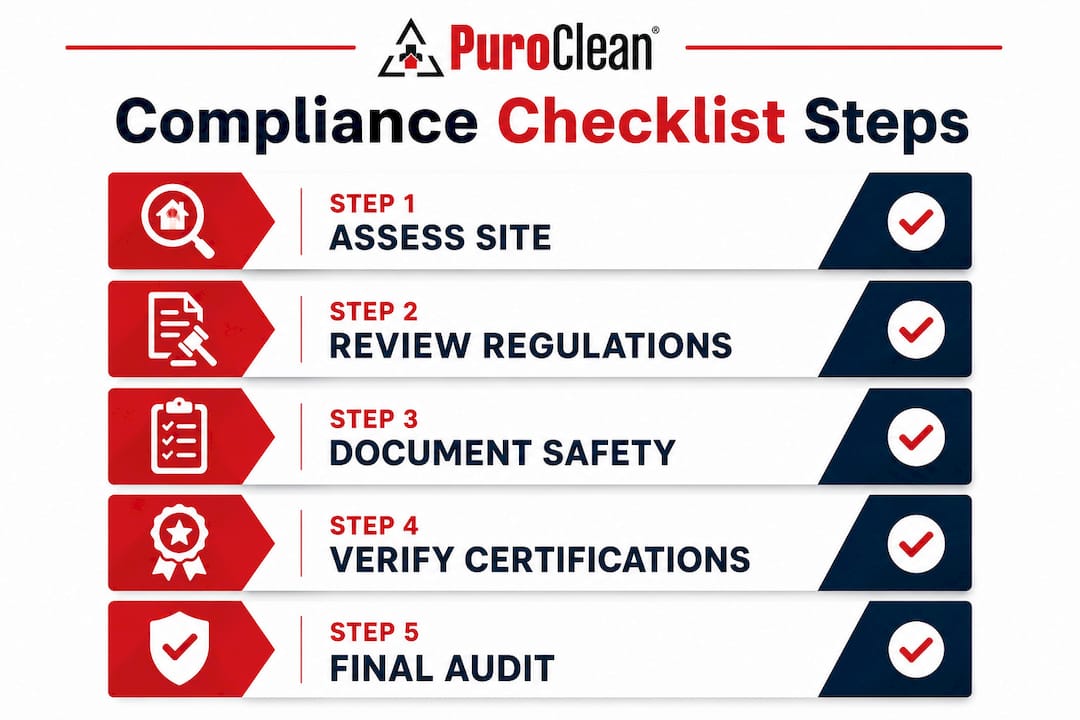
A restoration project checklist works best when it follows the project timeline from site assessment through final documentation. Skipping steps at the start creates gaps that are nearly impossible to close later.
- Conduct a pre-restoration site hazard analysis. Walk the property before any work begins. Identify fall hazards, potential lead paint surfaces, mold presence, and chemical storage areas. Document every finding in writing. This site-specific Job Hazard Analysis (JHA) is one of the first things OSHA inspectors request.
- Verify contractor qualifications and certifications. Collect copies of IICRC certifications, state contractor licenses, and proof of insurance before signing any contract. Choosing a qualified restoration professional is the single most effective way to reduce your compliance exposure from the start.
- Confirm written safety programs exist. Ask for the contractor’s written fall protection program, hazard communication program, and respiratory protection program. OSHA prioritizes written plans over observed performance during inspections. A contractor who performs tasks correctly but lacks written documentation is still a liability for you.
- Check worker training and fit testing records. Verify that all workers using respirators have completed annual fit testing under OSHA 29 CFR 1910.134. Confirm that hazard communication training is current and that records are signed and dated.
- Document PPE requirements and usage. Your checklist must confirm that appropriate personal protective equipment is on site, assigned to specific workers, and logged. Gloves, respirators, Tyvek suits, and eye protection all require documentation when chemical or biological hazards are present.
- Perform and document cleaning verification. For any project covered by the EPA RRP Rule, cleaning verification must be completed using wet disposable cleaning cloths before project sign-off. Failure to document this step creates direct RRP rule violations and legal liability for the property owner.
- Retain all records for the required period. EPA RRP documentation requires a minimum three-year retention period. OSHA training records for respiratory protection must be kept for the duration of employment plus one year. Build a filing system before the project starts, not after.
Pro Tip: Post-remediation documentation packages often exceed 50 pages. Create a dedicated project folder with labeled sections for each regulatory category before work begins. This makes insurance audits and third-party inspections far faster to complete.
How to avoid common compliance mistakes during restoration projects
Most compliance failures are not caused by ignorance of the rules. They happen because property managers assume contractors are handling requirements that actually fall on the property owner’s shoulders.
- Skipping fit testing. Annual respirator fit testing is mandatory, not optional. A contractor who skips this step exposes your property to OSHA enforcement if an inspection occurs during the project.
- Treating HazCom programs as one-time documents. Written hazard communication programs must be updated every time a new chemical, antimicrobial, or sealer is introduced to the jobsite. A program written two years ago and never updated is a compliance violation.
- Failing to verify subcontractor compliance. General contractors often bring in subcontractors for specific tasks. Each subcontractor must meet the same OSHA, EPA, and IICRC requirements as the primary contractor. Property managers who verify only the lead contractor’s credentials create gaps.
- Inadequate record retention. Many property managers discard project files after completion. EPA RRP records must be kept for at least three years. OSHA training records have their own retention schedules. Disposing of records early is itself a violation.
- Ignoring updates to standards. IICRC standards, OSHA regulations, and EPA rules are updated periodically. A restoration project checklist built on 2023 standards may miss 2026 requirements.
Pro Tip: Request a copy of the contractor’s HazCom program at the project kickoff meeting. If they cannot produce it on the spot, that is a red flag worth addressing before work begins.
How to verify and audit restoration compliance to protect your property
Verification is not a one-time event at project close. A compliance audit list should include scheduled checkpoints throughout the project lifecycle.
- Conduct documented site visits during high-risk activities. Industry experts recommend documented inspections for activities like elevated work and chemical application. A written log of your site visits reduces vicarious liability in major loss scenarios.
- Review written safety programs at project start. Do not wait until a problem arises. Confirm that fall protection, respiratory protection, and HazCom programs are current, site-specific, and signed by a responsible party.
- Confirm OSHA and EPA certifications are current. Certifications expire. Check the issue and expiration dates on every document. An expired IICRC certification or lapsed state license invalidates the contractor’s compliance status.
- Verify cleaning verification records before final sign-off. For RRP-covered projects, cleaning verification is a legal requirement. Reviewing restoration and insurance claims documentation shows how often missing verification records delay or deny insurance payouts.
- Maintain a compliance log with periodic reviews. Create a running log that tracks every document collected, every site visit made, and every certification verified. Review it at project milestones, not just at the end.
| Audit checkpoint | What to verify | Timing |
|---|---|---|
| Project kickoff | Written safety programs, certifications, licenses | Before work begins |
| Mid-project inspection | PPE usage, training records, HazCom updates | During active work |
| Project close-out | Cleaning verification, final documentation package | Before sign-off |
Property managers who treat compliance as a contractor-only responsibility consistently face the highest liability exposure. Active oversight of restoration projects is the single most effective way to protect your property and your legal standing. You can find local service coverage details on the Puroclean Northeast Sacramento map.
Key Takeaways
A complete restoration compliance checklist covering OSHA, EPA, and IICRC requirements is the most direct way for property owners and managers to reduce liability and protect project outcomes.
| Point | Details |
|---|---|
| Start with written programs | Confirm contractors have written fall protection, HazCom, and respiratory plans before work begins. |
| Retain EPA records for 3 years | RRP documentation under 40 CFR §745.86 must be kept for a minimum of three years after project completion. |
| Verify fit testing annually | OSHA 29 CFR 1910.134 requires annual respirator fit testing for all workers using tight-fitting respirators. |
| Audit throughout the project | Schedule documented site visits at kickoff, mid-project, and close-out rather than only at the end. |
| Update HazCom programs continuously | Written hazard communication programs must be revised every time a new chemical is introduced to the jobsite. |
Why compliance checklists matter more than most property managers realize
Property managers often treat compliance as a box-checking exercise. After years of watching restoration projects go sideways, I can tell you the paperwork is the project. The physical work can be flawless and the outcome still catastrophic if the documentation is missing.
The shift I have seen in 2026 is that IICRC certification, state licensing, and insurance mandates are converging into a single compliance standard. Insurance carriers are now requiring documented adherence to IICRC S500 and S520 as a condition of claim approval. That means a property manager who hired a contractor without verifying IICRC status may find their claim denied even when the physical restoration work was done correctly.
The most dangerous assumption I see is that a written safety program is a one-time document. HazCom programs, fall protection plans, and respiratory protection programs are living documents. They require updates, employee sign-offs, and periodic reviews. A program written at company formation and never touched again is a liability, not a protection.
My recommendation: treat your restoration compliance checklist as a project management tool, not a legal formality. Review it at every project milestone. Ask hard questions of your contractors. The property managers who do this consistently face fewer enforcement actions, faster insurance resolutions, and better project outcomes.
Puroclean handles the compliance burden for you
Restoration compliance is complex, and the documentation requirements alone can consume hours of a property manager’s time on a single project.
Puroclean of Northeast Sacramento operates under OSHA, EPA, and IICRC standards on every project, from water extraction and structural drying to fire and smoke recovery. Every job comes with the documentation your insurance carrier and local regulators require. Puroclean’s team is available 24/7 for restoration response across Northeast Sacramento, Folsom, Rancho Cordova, and Citrus Heights. When compliance and speed both matter, working with a certified restoration partner removes the guesswork from an already stressful situation.
FAQ
What is a restoration compliance checklist?
A restoration compliance checklist is a structured document that confirms all OSHA, EPA, and IICRC requirements are met before, during, and after a restoration project. It covers written safety programs, worker training records, certifications, and post-project documentation.
How long must EPA RRP documentation be retained?
Under 40 CFR §745.86, renovation documentation for projects disturbing lead-based paint must be retained for a minimum of three years after project completion.
What OSHA standards apply most often to restoration projects?
Fall protection, hazard communication, and respiratory protection are the three most cited OSHA violations in the restoration industry, each requiring a written contractor program.
How do property managers verify contractor compliance?
Property managers should collect written safety programs, current IICRC certifications, state licenses, and training records at project kickoff, then conduct documented site visits throughout the project.
Why does IICRC certification matter for compliance in 2026?
IICRC S500 and S520 certification is now integrated with state licensing requirements and insurance carrier mandates, meaning projects without documented IICRC adherence risk claim denials and licensing issues.
Recommended
- Property Restoration Process Guide: Steps for Success – PuroClean of Northeast Sacramento
- Property Restoration Process Guide: Steps for Success – PuroClean of Northeast Sacramento
- Restoration Process Step by Step: Complete Guide – PuroClean of Northeast Sacramento
- Types of Property Restoration Explained: Complete Guide – PuroClean of Northeast Sacramento