

Decomposition odor is unlike any other smell a property owner will ever encounter. It is pervasive, penetrating, and extraordinarily difficult to eliminate once it has had time to saturate a structure. Whether the source is an undiscovered human or animal death, a biohazard event in an unoccupied property, or the aftermath of a traumatic scene, decomposition odor removal is one of the most technically demanding services in the professional restoration industry. No amount of consumer-grade air freshener, baking soda, or ventilation comes close to addressing the problem at its source – and without proper professional intervention, decomposition odors can persist for months or years, rendering a property uninhabitable and dramatically reducing its value.
This comprehensive guide covers everything property owners, family members, estate administrators, and property managers in the Tacoma area need to know about decomposition odor removal: what decomposition odors are made of, why they are so resistant to standard cleaning, what the professional removal process involves, and why this work must always be handled by trained, certified professionals rather than attempted as a DIY project. If you are dealing with a decomposition odor situation right now, this guide will help you understand exactly what is needed and why acting quickly and decisively is the most important thing you can do.
What Makes Decomposition Odor So Difficult to Remove
To understand why professional decomposition odor removal is necessary, it helps to understand what decomposition odors actually are at a chemical level. The smell of decomposition is not a single compound – it is a complex mixture of dozens of volatile organic compounds produced by the biological breakdown of organic tissue. The primary odor-producing compounds in decomposition include putrescine and cadaverine, which are diamine compounds produced by the bacterial breakdown of amino acids; hydrogen sulfide, which produces a powerful rotten-egg odor; methane and ammonia; and a range of fatty acid derivatives including butyric, propionic, and valeric acids that contribute the distinctive rancid component of decomposition smell.
These compounds are not simply present in the air around a decomposition source. They actively penetrate and adsorb onto virtually every porous surface in the surrounding environment – drywall, wood framing, concrete, insulation, carpet, upholstery, clothing, and personal belongings. Once adsorbed into porous materials, these compounds off-gas slowly over an extended period, continuously re-releasing odor into the indoor air long after the original source has been removed. This is why decomposition odor removal that addresses only the source without treating the affected structure and contents inevitably fails – the building itself has become a reservoir of odor-producing compounds.
Tacoma’s climate compounds the challenge. The region’s naturally elevated humidity levels increase the rate at which volatile compounds migrate into and adsorb onto building materials, and the mild temperatures that persist throughout much of the year mean that off-gassing from contaminated surfaces continues at a steady rate year-round rather than slowing significantly in cold months.
The Serious Health Hazards That Accompany Decomposition Events
Decomposition odor removal is not purely an odor problem. Any property that has been the site of a decomposition event is also a biohazard environment, and the health risks associated with that environment are serious and must be addressed as part of a comprehensive professional response.
Bloodborne Pathogens and Biological Contamination
Human decomposition events involve biological fluids and tissue that may contain bloodborne pathogens including hepatitis B, hepatitis C, and HIV. While these pathogens degrade over time outside a living host, they can remain viable in biological material for varying periods depending on environmental conditions. The Occupational Safety and Health Administration (OSHA) regulates worker exposure to bloodborne pathogens under 29 CFR 1910.1030, and professional decomposition cleanup and odor removal companies must comply with these regulations, including the use of appropriate personal protective equipment, engineering controls, and proper disposal protocols.
Bacterial Contamination
Decomposition is driven by bacterial activity, and the bacteria involved in tissue breakdown are present in extremely high concentrations in affected areas. Surfaces contaminated by decomposition fluids harbor bacterial concentrations that pose direct health risks through skin contact, inhalation of contaminated aerosols, or contact with mucous membranes. Professional decomposition odor removal includes thorough biohazard decontamination of all affected surfaces, not merely odor treatment.
Insect Activity
Decomposition events attract insects, particularly blowflies and their larvae, which can spread biological contamination beyond the immediate area of the decomposition source. Professional cleanup and decomposition odor removal teams address insect activity as part of the remediation scope, coordinating with pest control professionals as needed to ensure complete treatment of all affected areas.
Mold Growth
The biological fluids associated with decomposition events introduce significant moisture into the surrounding structure. In Tacoma’s already humid climate, this moisture creates prime conditions for rapid mold growth on drywall, subfloor, and other porous building materials in the affected area. Professional decomposition odor removal must include assessment and remediation of any mold that has developed as a secondary consequence of the decomposition event.
Why Consumer Products Cannot Achieve True Decomposition Odor Removal
The market is filled with products that claim to eliminate odors – sprays, gels, plug-in deodorizers, ozone-generating consumer devices, enzymatic cleaners, and more. For ordinary household odors, some of these products are effective. For decomposition odor, they are entirely inadequate, and understanding why helps property owners avoid wasting time and money on approaches that will not work.
Consumer odor products work primarily by masking – adding a stronger or more pleasant scent that temporarily overrides the offensive one – or by surface-level chemical interaction with odor molecules on accessible surfaces. Decomposition odors are embedded deep within porous building materials, not sitting on the surface. A spray applied to the surface of a wall cannot reach odor compounds that have penetrated a centimeter or more into drywall or wood. When the masking scent dissipates, the decomposition odor returns unchanged.
Consumer ozone generators, while more effective than sprays, are limited in their output capacity and are not capable of achieving the ozone concentrations needed for structural penetration into heavily contaminated materials. They also pose health risks if used incorrectly in occupied or semi-occupied spaces. Professional-grade ozone treatment is a different category of intervention entirely, deployed under controlled conditions by trained technicians.
Enzymatic cleaners can be effective on biological material at the surface level but cannot penetrate into structural materials deeply enough to address decomposition odor compounds that have migrated well below the surface. They are one component of a professional response, not a standalone solution.
The Professional Decomposition Odor Removal Process
Professional decomposition odor removal follows a systematic, multi-phase approach that addresses the problem at every level – from the immediate source through the contaminated structure and contents. Each phase is essential, and skipping or abbreviating any phase compromises the outcome of the entire process.
Phase One – Immediate Assessment and Scene Evaluation
The first step in any professional decomposition odor removal project is a thorough assessment of the affected area. Technicians evaluate the location and extent of the decomposition event, identify all surfaces and materials that have been contaminated by biological fluids or odor compounds, assess secondary damage including moisture intrusion and potential mold growth, and identify any structural components that will require removal rather than cleaning. This assessment forms the basis for the complete scope of work and ensures that no affected area is overlooked.
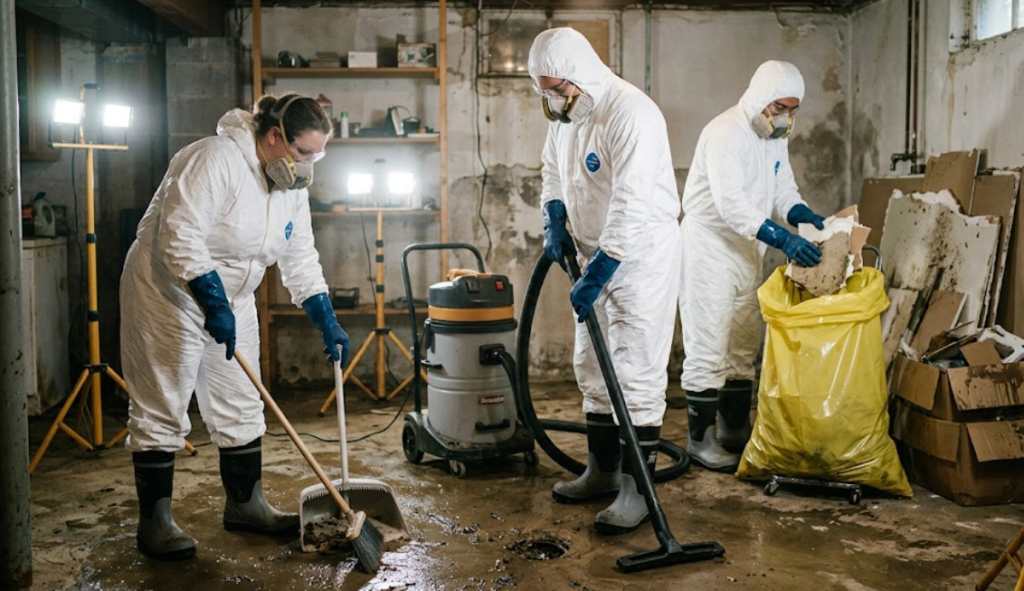
The assessment also includes a safety evaluation – ensuring that the structural integrity of the space is sound, that utility systems in the affected area are safe to work around, and that all team members are equipped with appropriate personal protective equipment before any work begins. OSHA-compliant PPE for decomposition cleanup includes full-body disposable protective suits, gloves, respiratory protection rated for biological aerosols and volatile organic compounds, and eye protection.
Phase Two – Biohazard Removal and Source Remediation
Before any odor treatment can be effective, every trace of biological material must be removed from the property. This includes not only obvious contamination but biological material that may have migrated beneath flooring, into wall cavities, or into subfloor materials. Flooring, drywall, insulation, and other structural materials that have been directly contaminated by biological fluids are removed and disposed of following regulations governing biohazardous waste. This controlled demolition of contaminated materials is one of the most critical steps in decomposition odor removal, because no odor treatment can succeed if biological source material remains embedded in the structure.
All removed materials are packaged in certified biohazard bags and containers and transported to licensed disposal facilities in compliance with Washington State Department of Health regulations governing biohazardous waste. Professional companies maintain the documentation required to demonstrate regulatory compliance throughout the disposal chain.
Phase Three – Chemical Cleaning and Decontamination
With source material removed, the affected area undergoes thorough chemical cleaning and decontamination. Hospital-grade disinfectants and specialized enzymatic cleaning products are applied to all exposed surfaces, including structural framing, concrete, and any remaining building materials in the affected zone. This cleaning addresses biological contamination at the surface level and begins the process of chemically breaking down adsorbed odor compounds on accessible surfaces.
Subfloor concrete that has been exposed to decomposition fluids receives particular attention, as concrete is highly porous and can absorb biological material and odor compounds deeply. Affected concrete may require application of sealing products specifically designed to encapsulate residual odor compounds within the substrate after cleaning.
Phase Four – Advanced Odor Neutralization Technologies
Professional decomposition odor removal employs industrial-grade odor neutralization technologies that operate at a fundamentally different level than any consumer product. The specific technologies used depend on the scope and severity of the situation, and experienced technicians often deploy multiple technologies in combination for the most effective results.
Thermal fogging uses a heated fogging machine to vaporize specialized deodorizing chemicals into a fog of extremely fine particles that penetrate porous materials in the same way that odor-causing compounds did originally – through direct contact, capillary action, and diffusion into the material substrate. This penetration allows the deodorizing agents to reach and react with odor compounds deep within walls, floors, and other structural materials.
Hydroxyl generation uses UV light to produce hydroxyl radicals – the same chemical species produced naturally in the atmosphere by the reaction of sunlight with water vapor – which react with and destroy volatile organic compound molecules on contact. Unlike ozone treatment, hydroxyl generation can be conducted in occupied or partially occupied spaces and leaves no harmful residue. It is particularly effective for ongoing decomposition odor removal in situations where repeated treatments are needed.
High-concentration ozone treatment – conducted under strictly controlled conditions in fully evacuated spaces – produces ozone at concentrations that penetrate deeply into porous materials and react with odor-producing compounds throughout the structure. Ozone treatment rooms must remain unoccupied by people, pets, and plants during treatment and for a period afterward while ozone levels return to safe ambient concentrations. Professional decomposition odor removal companies manage ozone treatment with the safety protocols and monitoring equipment that this technology requires.
Phase Five – HVAC System Treatment
Decomposition odors infiltrate HVAC ductwork and air handling equipment readily. If the HVAC system was operating during or after the decomposition event, odor compounds have almost certainly been distributed through the ductwork to areas of the property beyond the immediate source location. Professional decomposition odor removal includes thorough cleaning and deodorizing treatment of the entire HVAC system – including all ductwork, air handler components, and filter replacement – to prevent the system from continuously re-distributing odor throughout the structure after surface treatment is complete.
Phase Six – Content Evaluation and Treatment
Furniture, clothing, personal belongings, and other contents in the affected area absorb decomposition odors and require individual evaluation and treatment. Some items can be effectively deodorized using professional-grade ozone or hydroxyl treatment in a controlled chamber setting. Others – particularly porous soft goods that were in close proximity to the decomposition source – may be beyond salvage and require disposal. Professional decomposition odor removal companies provide honest assessment of what can and cannot be effectively restored, helping property owners and families make informed decisions about their belongings.
Phase Seven – Post-Treatment Verification
Professional decomposition odor removal concludes with verification that treatment has been effective. This includes air quality assessment, physical inspection of all treated areas, and – where appropriate – third-party testing to confirm that biological contamination has been reduced to safe levels. This verification step provides objective evidence of successful remediation, which is important both for the peace of mind of property owners and occupants and for documentation purposes related to insurance claims or property transactions.
Decomposition Odor Removal and the Emotional Dimension
Decomposition odor removal is almost always associated with a profound loss. Whether the event involves a family member discovered after an unattended death, a property acquired through an estate that contains evidence of a traumatic event, or a rental property where a tenant passed away, the people who need these services are typically navigating grief, shock, and practical overwhelm simultaneously. Professional decomposition odor removal companies that serve the Tacoma community understand this reality and approach every engagement with the compassion and discretion that these circumstances demand.
Experienced teams work efficiently and quietly, communicate clearly about what work is being done and why, and treat every property and every situation with respect. Family members and loved ones are never pressured to be present during cleanup if they prefer not to be. Documentation and communication are handled sensitively, with awareness that the people receiving this service are dealing with far more than a property problem.
What Decomposition Odor Removal Costs and Insurance Coverage
The cost of professional decomposition odor removal in the Tacoma area depends on several factors including the size of the affected area, the duration of the decomposition event and resulting degree of penetration into structural materials, the extent of structural material removal required, and the number of treatment cycles needed to achieve complete odor elimination. Projects range from several thousand dollars for limited-scope situations to significantly higher figures for severe events in larger properties.
Homeowners insurance policies frequently cover decomposition cleanup and odor removal costs when the event occurred inside the insured property. Coverage is typically subject to the policy’s applicable deductible and any specific exclusions. Many policies include coverage for biohazard remediation as part of their standard dwelling coverage or through a specific endorsement. Property owners should contact their insurer promptly after a decomposition event and request documentation of the claim before cleanup begins, as insurers may require specific documentation of conditions prior to remediation.
Professional decomposition odor removal companies experienced in working with insurance companies can provide the detailed written documentation – scope of work, itemized costs, photographs of conditions before and after remediation – that insurance adjusters require for claim processing. This documentation support is one of the significant practical benefits of working with an established, experienced restoration company.
Choosing a Professional Decomposition Odor Removal Company in Tacoma
Decomposition odor removal requires a company with specific training, certification, and equipment that general cleaning or junk removal companies do not possess. When selecting a provider in the Tacoma area, verify the following before making a decision.
Biohazard remediation certification – The company’s technicians should hold certification in biohazard remediation from a recognized industry body. The Institute of Inspection, Cleaning and Restoration Certification (IICRC) and the American Bio Recovery Association (ABRA) both offer relevant certifications that indicate proper training.
OSHA compliance and bloodborne pathogen training – All technicians who work in decomposition environments must have documented bloodborne pathogen training in compliance with OSHA 29 CFR 1910.1030.
Proper licensing and insurance – Verify that the company holds all required Washington State licenses for biohazard remediation work and carries both general liability and pollution liability insurance appropriate for this type of work.
Experience with the full scope of services – Decomposition odor removal is only effective when the company can perform the complete scope of work described in this guide, from biohazard removal through advanced odor neutralization and HVAC treatment. A company that only performs surface cleaning or only one type of odor treatment will not achieve complete results.
Availability and response time – Decomposition events require prompt professional response. Every day of delay allows odor compounds to penetrate deeper into structural materials, increases the complexity and cost of remediation, and extends the period during which the property is uninhabitable. Choose a company that offers 24-hour emergency response and can mobilize quickly.
Conclusion – Trust Only Certified Professionals for Decomposition Odor Removal
Decomposition odor removal is one of the most technically demanding and emotionally sensitive services in the restoration industry. It requires certified professionals, industrial-grade equipment, strict regulatory compliance, and a systematic multi-phase approach that addresses both the biohazard contamination and the deeply penetrating odor compounds that standard cleaning cannot reach. Attempting this work without professional expertise invariably results in incomplete odor elimination, ongoing health risks, and often greater long-term cost than a professional response from the outset.
If you are facing a decomposition odor situation in the Tacoma area, do not wait and do not attempt to address it without professional help. Call PuroClean of Northeast Tacoma at (206) 929-0155 right now.
Our certified biohazard and odor remediation specialists respond with urgency, discretion, and the full range of professional equipment and expertise that complete decomposition odor removal demands. We handle the entire process from biohazard removal through advanced odor neutralization and final verification, work with your insurance company, and treat every situation with the compassion and respect it deserves. Call PuroClean of Northeast Tacoma today – and let the experts restore your property completely.