


Structural Drying Services Tacoma – Complete Expert Guide
Table of Contents
When water damage strikes a Tacoma home or business, the first instinct is to address what is visible – mop up standing water, pull out wet carpet, move damaged furniture. These actions are important, but they address only the surface of a water damage event. The moisture that has penetrated into walls, floors, ceilings, framing lumber, subfloor sheathing, and insulation – the moisture you cannot see – is where the real, lasting damage occurs if it is not addressed properly.
Professional structural drying services in Tacoma are the specialized, scientifically grounded process that removes this hidden moisture from the building assembly itself, preventing the mold growth, structural deterioration, and indoor air quality problems that develop when water damage is treated at the surface but not at the structural level.
In Tacoma’s Pacific Northwest climate, where ambient outdoor humidity makes natural drying of water-damaged structures essentially impossible for much of the year, professional structural drying services are not a premium add-on to water damage restoration – they are the core of what complete restoration actually means.
This guide explains what structural drying services in Tacoma involve, why they require specialized professional expertise and equipment, how the process works from assessment through completion, and what property owners should expect and demand from any restoration company they hire.
What Structural Drying Services in Tacoma Actually Address
The term structural drying refers specifically to the removal of moisture from the building’s structural components – the framing, sheathing, subflooring, concrete slabs, and other materials that form the physical structure of the building. This is distinct from surface drying, which addresses moisture on accessible surfaces, and content drying, which addresses furniture, belongings, and equipment.
When water enters a building – whether from a burst pipe, a roof leak, a sewer backup, or a flooding event – it follows gravity and capillary action into every porous material it contacts. Framing lumber adjacent to a burst pipe absorbs water until its moisture content rises dramatically above the 12 to 19 percent range that represents dry, stable wood.
Drywall paper facing absorbs water and swells. Subfloor sheathing saturates and begins to delaminate. Concrete slabs absorb moisture into their pore structure and retain it for extended periods. All of these materials continue to hold moisture long after standing water has been extracted and visible surfaces appear dry.
Professional structural drying services in Tacoma address this embedded, structural moisture using calibrated drying systems, daily measurement, and documented verification that every monitored structural material has reached target moisture levels before drying is declared complete. This rigorous approach is what separates legitimate professional structural drying from superficial cleanup that leaves a property at ongoing risk.
Why Structural Drying Services in Tacoma Require Professional Expertise
Tacoma’s climate creates drying conditions that are among the most challenging encountered anywhere in the continental United States. Understanding why the Pacific Northwest demands professional structural drying services – rather than allowing natural drying or using consumer equipment – helps property owners make informed decisions about their restoration.
The Outdoor Humidity Problem
Effective structural drying requires creating a vapor pressure differential – a condition in which the air in contact with wet building materials has lower moisture content than the materials themselves, so that moisture evaporates from the structure into the air. In a dry climate, outdoor air provides this condition naturally. In Tacoma, where outdoor relative humidity exceeds 80 to 90 percent for most of the year, outdoor air has higher moisture content than most drying targets for building materials. Bringing outdoor air into a water-damaged Tacoma structure does not dry it – it may actually slow drying or reintroduce moisture into materials that are beginning to dry.
Professional structural drying services in Tacoma address this by sealing the affected structure from outdoor air and using commercial dehumidifiers to create the low-humidity indoor environment needed for effective evaporation from building materials. The building becomes a controlled drying chamber rather than an open space exchanging air with the humid outdoor environment.
The Mold Risk Timeline
The Environmental Protection Agency notes that mold can begin growing on wet surfaces in 24 to 48 hours. In Tacoma’s mild, humid climate, structural wood and drywall that remains above target moisture levels is at continuous risk of mold colonization throughout the drying period. Professional structural drying services deploy sufficient equipment and use calibrated drying configurations that achieve rapid moisture reduction, minimizing the period during which building materials are in the moisture range that supports mold growth. Every day that structural materials remain wet in a Tacoma property is a day of mold risk that professional equipment deployment can reduce.
The Complexity of Structural Moisture Measurement
Determining whether structural drying in Tacoma is complete requires more than visual inspection or the passage of a predetermined number of days. It requires objective moisture measurement using calibrated instruments – pin-type moisture meters, pinless capacitance meters, and psychrometric measurement of ambient conditions – at multiple locations throughout the affected structural assemblies.
Professional structural drying services include daily monitoring with documented readings that track drying progress for each monitored material location. This documentation is the objective evidence of complete drying that insurance companies require and that protects property owners from future liability if moisture-related damage is discovered after the restoration.
The Professional Structural Drying Services Process in Tacoma
Professional structural drying services in Tacoma follow the IICRC S500 Standard for Professional Water Damage Restoration, which establishes science-based protocols for moisture assessment, drying system design, monitoring, and completion verification. Here is what each phase of the process involves.
Phase One – Comprehensive Moisture Assessment and Mapping
Every professional structural drying engagement begins with a thorough assessment of the affected structure. Technicians use pin-type moisture meters to measure the moisture content of wood framing, subfloor, and other wood-based structural materials at multiple points. Pinless capacitance meters scan wall and ceiling surfaces for moisture elevation without requiring probe insertion at every measurement point, allowing rapid survey of large areas. Thermal imaging cameras detect temperature differentials that indicate moisture presence in wall cavities, ceiling assemblies, and other areas that cannot be directly accessed without opening the structure.
These measurements are compiled into a moisture map of the affected area – a documented record of which materials are affected, to what degree, and how moisture has migrated from the initial water intrusion point. This map drives the drying system design and serves as the baseline against which drying progress is measured throughout the project.
Phase Two – Water Extraction
Before structural drying equipment is deployed, all extractable standing and pooled water is removed using truck-mounted extractors and portable units with specialty attachments. Carpet and pad water is extracted using weighted extraction tools that force water upward out of the fiber and pad. Water pooled beneath flooring systems is accessed through targeted openings if necessary. Complete water extraction reduces the initial moisture load on structural materials and significantly reduces the total drying time required, making the overall structural drying services project more efficient and cost-effective.
Phase Three – Controlled Demolition Where Required
Structural drying services in Tacoma sometimes require controlled demolition of finished surfaces to allow drying equipment access to wet structural assemblies. This is most commonly needed in wall and ceiling assemblies where moisture has penetrated behind drywall into framing and insulation. Rather than opening entire walls, experienced restoration professionals use moisture meter readings and thermal imaging to identify the specific locations where cavity access is needed, minimizing the scope of demolition while ensuring complete access to all wet structural materials.
Wet insulation is almost always removed from wall and ceiling cavities before structural drying begins. Insulation holds moisture against framing lumber and dramatically slows structural drying. Its removal typically costs far less than the extended drying time and increased mold risk that result from attempting to dry framing through saturated insulation.
Phase Four – Drying System Design and Deployment
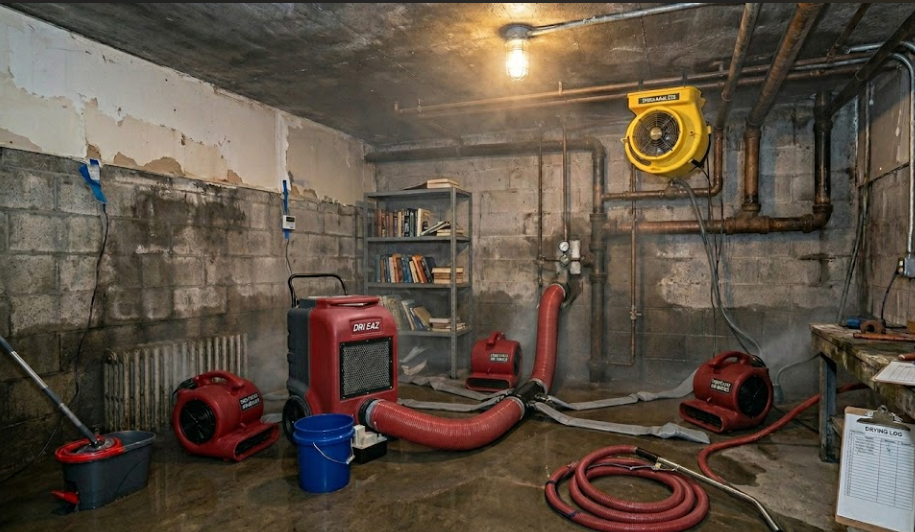
With moisture mapping complete and access to structural materials established, the drying system is designed and deployed. Professional structural drying services in Tacoma use commercial air movers – high-velocity fans engineered to direct large volumes of air across wet surfaces at the velocity needed to maintain effective vapor pressure differentials – in calculated quantities and positions throughout the affected area.
Commercial refrigerant dehumidifiers sized to process the total moisture volume of the affected space are placed to efficiently capture moisture evaporated from structural materials and remove it from the indoor air.
For wall and ceiling cavities, specialty injectidry systems or drying mats direct conditioned air into the cavity space itself, achieving structural drying of framing and sheathing without relying on air exchange through small-diameter holes alone. For concrete slabs and below-grade assemblies, specialty floor drying systems extract moisture upward through the slab surface in a way that ambient air movers cannot replicate. Each of these specialty tools addresses a specific aspect of the structural drying challenge and is deployed based on the assessment findings for each individual property.
Phase Five – Daily Monitoring and Psychrometric Documentation
Professional structural drying services are not a deploy-and-forget operation. Certified technicians visit the property daily to take psychrometric readings – temperature, relative humidity, specific humidity, and dew point – at consistent measurement locations, and to take moisture meter readings at all monitored structural material points. These readings are recorded in a drying log that documents the trajectory of drying progress for each monitored location.
Daily monitoring serves several critical functions. It identifies areas that are drying more slowly than expected, allowing the technician to redirect air movers, add equipment, or open additional access points to address the problem. It confirms that the ambient conditions inside the drying environment are being maintained at the level needed for effective drying. And it creates the documentation record that insurance companies require to process structural drying services claims and that protects the property owner if moisture-related issues arise after the project is closed.
Phase Six – Progressive Equipment Removal and Final Verification
As monitored locations reach their target moisture levels, the drying system is progressively adjusted. Air movers serving areas that have reached target levels are repositioned or removed. Dehumidifier capacity is scaled as the total moisture load decreases.
This progressive approach optimizes the efficiency of the structural drying operation without compromising completeness – equipment is never removed from areas that have not yet reached target levels simply because other areas are dry.
Final completion of structural drying services in Tacoma is declared only when moisture meter readings at all monitored structural material locations confirm achievement of target moisture levels throughout the affected assembly. A final psychrometric reading of the space confirms that ambient conditions are stable. The technician provides a written completion report with all documented readings, which becomes part of the permanent project record.
Structural Drying Services and Insurance Claims in Tacoma
Professional structural drying services are a covered component of water damage claims under standard homeowners and commercial property insurance policies. Equipment rental, daily monitoring, specialty drying systems, and documentation are all recognized claim expenses that insurers expect to see in a properly conducted water damage restoration.
The daily drying logs and moisture reading documentation produced by professional structural drying services are exactly what insurance adjusters look for when reviewing water damage claims – they provide objective evidence that drying was conducted to professional standards rather than simply that equipment was placed in the space.
Property owners should specifically request the complete drying documentation package from their restoration contractor at project completion. This record – typically including the initial moisture map, daily psychrometric readings, daily moisture meter readings by location, and the final completion report – is valuable not only for the current insurance claim but as a permanent record of the property’s water damage history. This documentation can be significant in future real estate transactions or if moisture-related issues arise later that could be attributed to inadequate prior restoration.
How to Evaluate Structural Drying Services Quality in Tacoma
Not all water damage restoration companies in Tacoma provide professional-grade structural drying services. Some companies extract standing water, place a few consumer-grade dehumidifiers, and declare the job done without conducting proper moisture assessment, using adequate commercial equipment, or providing daily monitoring with documented readings. Property owners who receive this level of service are often unaware that drying is incomplete until mold appears or structural damage surfaces weeks later.
When evaluating any structural drying services provider in Tacoma, ask the following questions. Does the company hold IICRC certification in water damage restoration? Can they show you the moisture map they prepared for your property?
What equipment will be deployed and how is the quantity determined? How frequently will technicians visit to monitor drying progress, and will those readings be documented in a drying log? At what objective moisture levels will they declare drying complete, and how will those levels be verified? A company that cannot answer these questions clearly and specifically is not providing professional structural drying services – regardless of what their marketing materials say.
Structural Drying Services for Commercial Properties in Tacoma
Commercial properties present additional complexity for structural drying services that residential properties do not. Larger floor areas require more equipment and more complex drying system configurations. Multi-story construction requires coordinated drying of assemblies at multiple levels. Occupied commercial properties require drying operations to be conducted with minimal disruption to business operations, often requiring after-hours scheduling or phased approaches. Sensitive equipment, stored inventory, and finishes specific to commercial use require careful consideration in developing the drying plan.
Experienced structural drying services companies that serve the Tacoma commercial market understand these complexities and bring the staffing, equipment capacity, and project management capability to handle large-scale commercial structural drying efficiently. Business interruption insurance that activates during periods of forced closure due to water damage can provide critical financial support during commercial structural drying projects, and professional documentation of the drying timeline and scope is essential for substantiating these claims.
Demand Professional Structural Drying Services for Any Tacoma Water Damage
Structural drying services in Tacoma are the technical foundation of any complete water damage restoration. Without thorough, professionally executed, and objectively documented structural drying, no water damage restoration is truly finished – regardless of how clean the surface appears.
In the Pacific Northwest climate, where the humidity that supports mold growth and structural deterioration is present year-round, there is no margin for incomplete drying. The difference between a property that recovers completely and one that continues to deteriorate is almost always found in the quality of the structural drying services that were or were not applied.
If your Tacoma home or commercial property has experienced any form of water damage, do not accept anything less than professional, IICRC-standard structural drying services. Call PuroClean of Northeast Tacoma at (206) 929-0155 right now.
Our certified structural drying specialists conduct comprehensive moisture assessment, deploy professional commercial drying systems, monitor progress with daily documented readings, and provide written completion verification before closing any project. We work directly with your insurance company and stand behind the completeness and quality of their work. Call PuroClean of Northeast Tacoma today and make sure your restoration is truly complete.