


Water Damage Dehumidification Tacoma – Essential Expert Guide
Table of Contents
When water damage strikes a Tacoma home or business, most people focus on the visible problem – the standing water, the soaked carpet, the wet furniture. Extracting that water and removing damaged contents is an important first step, but it is only the beginning of a complete water damage restoration. The step that most property owners underestimate – and that inadequate restoration companies sometimes skip or rush – is water damage dehumidification.
In Tacoma, where ambient humidity levels are among the highest in the continental United States for much of the year, professional dehumidification is not merely a helpful addition to water damage restoration. It is the essential process that determines whether a property truly recovers or whether hidden moisture leads to mold, structural deterioration, and a restoration that ultimately fails.
This comprehensive guide explains what water damage dehumidification in Tacoma actually involves, why it is so critical in the Pacific Northwest climate, how professional dehumidification differs from simply buying a dehumidifier at a hardware store, what the complete drying science looks like in practice, and how to evaluate whether your restoration company is truly completing this critical phase of your water damage recovery.
Why Water Damage Dehumidification in Tacoma Is Uniquely Critical
Every water damage restoration project requires dehumidification, but the stakes and challenges are higher in Tacoma than in most other parts of the country. Understanding the specific factors that make Tacoma’s climate so demanding for water damage dehumidification helps property owners appreciate why this phase of restoration deserves serious attention.
Tacoma’s Baseline Humidity Creates an Exceptionally Difficult Drying Environment
Drying wet building materials requires creating a vapor pressure differential – a condition where the moisture content in the air near a wet surface is lower than the moisture content at the surface itself, so that moisture evaporates from the material into the air and can then be removed by dehumidification. In a dry climate, this differential exists naturally and drying proceeds even without mechanical assistance.
In Tacoma, where outdoor relative humidity regularly exceeds 80 to 90 percent during the fall, winter, and spring months and remains elevated even in summer, no natural drying differential exists. Without aggressive mechanical dehumidification, wet building materials in a Tacoma home simply stay wet – or get wetter if windows are opened to ventilate.
This is a critical point that homeowners in drier climates often fail to appreciate when they relocate to the Pacific Northwest: the standard advice to open windows and air out a water-damaged space is actively counterproductive in Tacoma for most of the year. Bringing in humid outdoor air raises the humidity in the affected space and slows or reverses the drying process. Professional water damage dehumidification in Tacoma works with the building sealed from outside air, using industrial equipment to create the vapor pressure differential that the climate will not provide naturally.
Mold Grows Faster in Tacoma’s Climate Than in Drier Regions
The Environmental Protection Agency notes that mold can begin growing on wet surfaces in 24 to 48 hours. In Tacoma’s mild, humid conditions, that window is at the short end of the range – or shorter. A water damage event that goes without professional dehumidification for 48 to 72 hours in a Tacoma property creates near-certain conditions for mold growth in saturated building materials. The cost of mold remediation – typically starting at several thousand dollars and reaching much higher figures for significant infestations – dwarfs the cost of prompt, professional water damage dehumidification. Acting immediately and aggressively with dehumidification is the most cost-effective mold prevention strategy available.
Tacoma’s Older Housing Stock Absorbs and Retains Moisture
A significant portion of Tacoma’s housing inventory was built before modern moisture management practices were standard. Older homes with minimal wall insulation, single-pane windows, and limited vapor control absorb and retain moisture more readily than newer construction. When water damage occurs in an older Tacoma home, building materials that have accumulated moisture over decades of humid climate exposure require more aggressive and sustained water damage dehumidification to reach the dry baseline that prevents ongoing biological activity and structural deterioration.
The Science Behind Professional Water Damage Dehumidification
Professional water damage dehumidification is grounded in a scientific framework called the psychrometric system – the study of the thermodynamic properties of moist air. Understanding the basic principles helps property owners evaluate the quality of the dehumidification being performed on their property.
Evaporation, Humidity, and Vapor Pressure
Water evaporates from wet surfaces when the partial pressure of water vapor in the adjacent air is lower than the vapor pressure at the surface of the wet material. Air movers – the large fans deployed during water damage restoration – accelerate evaporation by continuously replacing the humid air adjacent to wet surfaces with drier air, maintaining the vapor pressure differential that drives evaporation. Dehumidifiers then extract this moisture from the air, preventing the relative humidity in the space from rising to the point where evaporation slows or stops.
The relationship between temperature, relative humidity, and the drying rate is why professional water damage dehumidification in Tacoma uses controlled conditions rather than simple ventilation. Warmer air holds more moisture and can absorb more evaporation from wet surfaces before reaching saturation – which is why professional drying systems often incorporate controlled heat alongside dehumidification to optimize the drying rate, particularly in Tacoma’s cool climate.
Structural Drying Goals and Moisture Measurement
Professional water damage dehumidification is not complete when the space feels dry or when visible water is gone. It is complete when moisture meters confirm that structural materials – framing lumber, subflooring, drywall, concrete – have reached industry-standard target moisture levels established by the IICRC S500 Standard for Professional Water Damage Restoration. For wood framing, the target is typically a moisture content comparable to unaffected materials of the same type in the same building. For drywall, target moisture levels are similarly referenced to unaffected control areas. Only objective moisture measurement – not visual inspection or the passage of time – determines when water damage dehumidification in Tacoma is truly complete.
How Professional Water Damage Dehumidification Differs From Consumer Equipment
Many Tacoma homeowners who experience water damage wonder whether they can simply purchase or rent a consumer dehumidifier and handle the drying themselves. Understanding the difference between consumer dehumidification and professional water damage dehumidification explains why this approach is inadequate for anything beyond the most minor, surface-level water events.
Equipment Capacity and Performance
A consumer-grade dehumidifier rated at 30 to 70 pints per day operates at a fraction of the capacity of commercial restoration dehumidifiers, which are rated at 100 to 200 or more pints per day and are engineered to maintain high performance across the range of temperature and humidity conditions encountered in water damage environments. Commercial units also operate more effectively at lower temperatures than consumer units – a significant advantage in Tacoma’s cooler climate.
The number and placement of commercial dehumidifiers required for a given water damage situation is calculated using psychrometric principles based on the volume of the space, the extent of wet materials, and the target drying timeline. Substituting consumer equipment without this calculation virtually guarantees inadequate dehumidification.
Drying System Integration
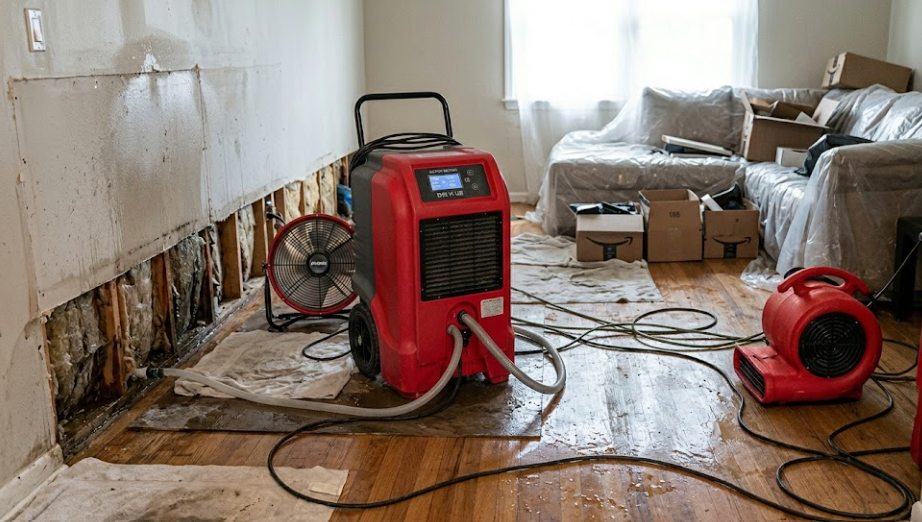
Professional water damage dehumidification is not simply placing dehumidifiers in a room. It is a coordinated drying system in which air movers, dehumidifiers, and sometimes supplemental heat work together in a calculated configuration designed to maintain optimal psychrometric conditions throughout the drying process. Air movers are positioned to maximize airflow across wet surfaces and to direct humid evaporated air toward dehumidifiers.
Dehumidifiers are placed to process the air volume of the affected space efficiently. The system is monitored daily and adjusted based on moisture meter readings and psychrometric measurements that track drying progress. This engineered approach is fundamentally different from placing a consumer dehumidifier in the corner of a wet room.
Drying Hidden and Structural Materials
Consumer dehumidifiers dry the air in an open space. Professional water damage dehumidification systems dry the structural materials within the building assembly – framing, subfloor, wall cavities, and ceiling cavities. Specialty equipment including wall cavity drying attachments, floor mat drying systems for hardwood and structural floors, and directed airflow systems for ceiling assemblies extends the reach of professional drying to areas that ambient air movement cannot effectively reach. In Tacoma, where moisture that penetrates into structural assemblies dries extremely slowly without mechanical intervention, this structural drying capability is essential to complete water damage dehumidification.
The Professional Water Damage Dehumidification Process in Tacoma
Here is what a properly conducted professional water damage dehumidification engagement looks like in a Tacoma property, from initial assessment through final sign-off.
Psychrometric Assessment and Equipment Calculation
Before any equipment is placed, restoration professionals conduct a psychrometric assessment of the affected space – measuring temperature, relative humidity, specific humidity, and dew point conditions – and use moisture meters and thermal imaging to map all areas of elevated moisture. This data drives the calculation of the equipment needed: how many air movers, how many and what size dehumidifiers, whether supplemental heat is warranted, and how specialty drying equipment should be deployed for wall cavities, floors, or ceilings.
Equipment Placement and System Setup
Equipment is placed according to the calculated drying plan. Air movers are directed across all wet floor surfaces and positioned at wall surfaces with elevated moisture. Dehumidifiers are positioned to process the air volume of the affected area efficiently. Specialty cavity drying equipment is deployed at wall and ceiling locations where structural moisture has been identified. The building is sealed from outside air to prevent Tacoma’s humid outdoor air from entering the drying environment and undermining the dehumidification process.
Daily Monitoring and Psychrometric Documentation
Professional water damage dehumidification requires daily monitoring visits. Technicians take psychrometric readings – temperature, relative humidity, and calculated moisture values – at consistent locations throughout the drying area, and take moisture meter readings at all monitored structural material locations. These readings are documented in a drying log that tracks progress over time, identifies any areas drying more slowly than expected, and confirms when individual materials have reached their target moisture levels. This daily documentation is essential for insurance claims and provides the objective evidence of complete drying that protects the property owner if moisture-related issues arise after restoration.
Equipment Adjustment and Progressive Removal
As drying progresses and moisture levels in different areas reach target levels, equipment is adjusted and progressively removed. Areas that dry faster – typically open floor surfaces – have air movers removed while air movers serving slower-drying areas like wall cavities and subflooring remain in place. Dehumidifier capacity may be scaled back as the overall moisture load in the space decreases. This progressive approach optimizes energy use and equipment allocation without compromising the completeness of drying.
Final Moisture Verification and Sign-Off
Water damage dehumidification in Tacoma is complete only when final moisture meter readings across all monitored locations confirm that structural materials have reached target moisture levels. A complete final psychrometric reading of the space confirms that ambient conditions support the continued stability of the dried materials. The restoration professional provides a written drying completion report with all documented readings, which becomes part of the permanent project file for the property owner and their insurance company.
How Long Does Water Damage Dehumidification Take in Tacoma
The duration of professional water damage dehumidification in Tacoma depends on several factors: the volume and type of water that caused the damage, the extent and type of building materials affected, the time elapsed between the water event and the start of professional drying, and the ambient conditions in the affected space. As a general reference, the IICRC S500 standard targets a three-to-five-day drying window for properly executed water damage restoration under optimal conditions. In Tacoma’s challenging climate, achieving this timeline requires adequate equipment and a tightly controlled drying environment.
More severe situations – those involving structural assemblies that have been wet for extended periods, category 2 or 3 water sources, or large volumes of affected material – may require seven to ten days or more of sustained dehumidification before target moisture levels are achieved throughout the structure. Property owners should be cautious of any restoration company that promises completion in an unrealistically short timeframe without objective moisture data to support that claim.
Water Damage Dehumidification and Insurance in Tacoma
Professional water damage dehumidification is a covered component of water damage claims under standard homeowners and commercial property insurance policies in Washington State. Equipment rental, daily monitoring, and documentation are all legitimate claim expenses that insurers expect to see in a properly conducted water damage restoration. Insurance adjusters reviewing water damage claims look for drying logs with psychrometric data and daily moisture readings as evidence that professional drying was conducted – not just that dehumidifiers were placed in the space.
Property owners should request a copy of the drying log and all moisture readings as part of their project documentation. This record demonstrates that dehumidification was completed to professional standards and protects the property owner if moisture-related damage – such as mold growth – is discovered after the restoration is closed.
Conclusion – Professional Water Damage Dehumidification Tacoma Is Non-Negotiable
Water damage dehumidification in Tacoma is not a secondary consideration or an optional add-on to water damage restoration. In the Pacific Northwest climate, it is the central process that determines whether a property truly dries – and stays dry – or whether hidden moisture becomes the foundation of progressive structural damage and mold growth that will require far more costly remediation down the line.
The difference between a property that recovers completely and one that continues to deteriorate after apparent restoration is almost always found in the quality and completeness of the dehumidification phase.
If your Tacoma home or business has suffered any form of water damage, do not settle for anything less than professional, scientifically grounded water damage dehumidification. Call PuroClean of Northeast Tacoma at (206) 929-0155 right now.
Our IICRC-certified water damage restoration specialists deploy professional-grade drying systems, monitor progress with daily psychrometric documentation, and confirm complete drying with objective moisture data before closing any project. We work directly with your insurance company and stand behind the completeness of their work. Call PuroClean of Northeast Tacoma today and make sure your water damage recovery is truly complete.