


Most people never have much reason to think about how a biohazard cleanup crew protects a property until they actually need one. Then the questions come quickly. Is it safe to walk through the room? Why is part of the house being closed off? What are the suits and respirators for? For biohazard cleanup companies in Overland Park, protective measures aren’t one single piece of equipment. They’re a series of decisions made throughout the job to protect people, limit the movement of contamination, and keep the cleanup focused on the areas that actually need attention. At PuroClean, that starts before anything is cleaned or removed.
The First Protective Measure Is Knowing What We’re Walking Into
There isn’t one standard biohazard scene. A medical emergency in a bathroom isn’t the same as an unattended death in a bedroom. An accident in a commercial building presents different challenges from contamination discovered inside a private residence. Even two incidents that sound nearly identical over the phone can look very different once we arrive. So we start by looking. Where is the affected area? What materials are involved? Are there adjoining rooms that need to be considered? How are we going to get equipment into the space? How will affected materials eventually leave the property? Those aren’t exciting questions, but they’re important ones.
Before biohazard cleaning services in Overland Park begin, we want to understand the environment rather than start moving things around and discover halfway through the job that our original plan doesn’t make sense. Sometimes that first walkthrough changes everything.
Keeping People Out Can Be Just as Important as What We Wear
When families picture protective measures, they usually picture the cleanup crew’s clothing. That’s only part of it. One of the simplest protections is limiting who enters the affected area in the first place. After a difficult event, people naturally want access to the property. A family member may want to retrieve a phone or purse. A landlord might need to inspect a room. An employee may think they can quickly grab something from an office before cleanup starts. The problem is that people who aren’t involved in the cleanup don’t always know which surfaces or materials may have been affected.
Reducing unnecessary traffic helps keep the situation contained. In a house, that might be relatively simple. An affected bedroom may be separated from the rest of the home. A commercial or multifamily property can require more planning. There may be shared hallways, neighboring tenants, elevators, common entrances, or employees working elsewhere in the building. The goal isn’t to make the property feel more alarming than it already does. It’s simply to keep people who don’t need to be in the work area out of it.
Personal Protective Equipment Depends on the Job
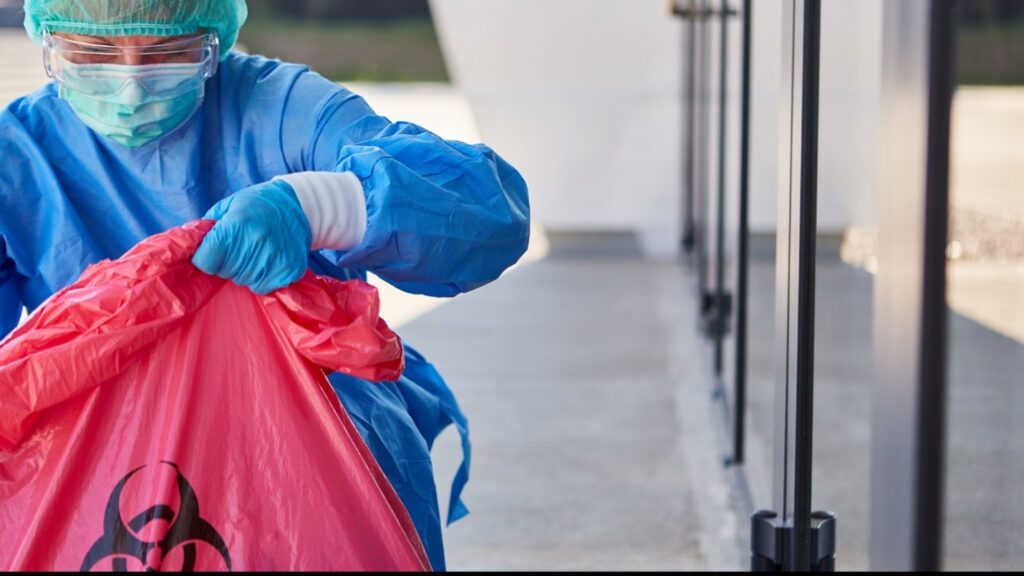
You’ve probably seen restoration crews wearing disposable suits, gloves, masks, respirators, eye protection, or protective footwear. People sometimes assume the same outfit is worn on every biohazard call. It isn’t that simple. Personal protective equipment, commonly called PPE, should match the work being performed and the conditions found at the property. Depending on the situation, that may include protective gloves, disposable protective clothing, eye or face protection, respiratory protection, and footwear protection.
The important part isn’t how dramatic the equipment looks. It’s why it’s being used. Gloves help reduce direct contact with affected materials. Protective clothing can help keep contamination away from a worker’s everyday clothing and skin. Eye and face protection may be appropriate where there’s a possibility of splashes. Respiratory protection can be necessary for certain hazards and work conditions. More equipment isn’t automatically better. The right equipment for the conditions is what matters. That’s part of the professional judgment experienced biohazard cleanup companies in Overland Park bring to a property.
Gloves Aren’t Just Put On Once
Gloves sound straightforward until you think about what happens during an actual cleanup. A technician may handle an affected material and then need another tool. They may move from one part of the work area to another. They may need to leave the controlled area entirely. If the same contaminated gloves touch a clean doorknob, equipment case, phone, or another surface, the gloves haven’t really accomplished what they were supposed to accomplish. So protective practices involve more than simply wearing them.
The crew has to think about when protective equipment is changed, how it is removed, and what is touched while it is being worn. Those little decisions don’t show up in the final photographs. They matter anyway.
Containment Helps Keep the Cleanup From Getting Bigger
People sometimes hear the word “containment” and imagine the entire house wrapped in plastic. That’s usually not the point. Containment is about establishing control over the work area when conditions call for it. The exact setup depends on the property and the nature of the cleanup. We don’t want materials, equipment, or foot traffic unnecessarily carrying contamination from an affected space into an unaffected one.
Think about an upstairs bedroom. The original incident may be limited to that room, but the crew still has to enter and leave. Equipment has to travel through the house. Materials that cannot be restored may eventually have to come out. Without a plan, a small affected area can become a much more complicated project. Good containment isn’t about making the job look impressive. It’s about keeping the cleanup where the cleanup belongs.
We Think About the Path Through the Property
This is something property owners don’t always expect us to ask about. Where’s the best door? Can we reach the affected room without crossing an occupied area? Is there another entrance? What happens if the only path outside passes through the kitchen or living room? The route matters. During biohazard waste cleanup in Overland Park, we have to consider more than the object or building material being removed. We also need to consider what happens between that object leaving its original location and leaving the property.
In a single-family home, the answer may be simple. In an apartment building, office, hotel, or other shared property, it may not be. Sometimes a little planning at the beginning prevents a lot of unnecessary work later.
Clean Areas and Affected Areas Shouldn’t Blur Together
During a longer cleanup, crews need places for equipment and supplies. Those areas shouldn’t be treated casually. A tool used inside an affected space isn’t necessarily something we want placed next to clean supplies without thought. The same goes for protective equipment and materials being prepared for removal.
The work has to have some organization. Where do clean supplies stay? Where is protective equipment put on? Where does used equipment go? How does a technician transition out of the affected area? Professional cleanup involves keeping those distinctions in mind throughout the job. Otherwise, the boundaries start getting fuzzy. And once that happens, it becomes harder to know what has and hasn’t been exposed.
Removing PPE Correctly Matters
Putting protective equipment on gets most of the attention. Taking it off deserves just as much. If the outside of protective clothing or gloves has been exposed during cleanup, a technician doesn’t want to remove that equipment in a way that transfers material onto skin, clothing, or nearby clean surfaces. That’s why removal has to be deliberate.
The same idea applies to disposable protective items after they’re used. They need to be handled as part of the cleanup process rather than tossed casually into the nearest wastebasket. It seems like a small detail. In practice, these are exactly the kinds of small details that separate a controlled cleanup from someone simply wearing protective clothing while cleaning.
Tools and Equipment Need Attention Too
Workers aren’t the only things moving in and out of an affected area. Equipment does too. A tool can become another contact point if nobody thinks about where it has been used. The same is true of equipment that sits on a floor or comes into contact with an affected surface. So the crew has to pay attention to equipment as work progresses. What was used in the affected area? Does it need to be cleaned before it goes somewhere else? Where should it be placed when it’s no longer being used?
A professional crew shouldn’t finish cleaning the room and then carry potentially affected equipment through the rest of the property without considering those questions. Again, most homeowners will never see this part of the process. That’s okay. The best protective measures often aren’t the things that draw attention.
Cleaning and Removal Require Different Decisions
Not every affected material has to be removed. Some surfaces may be candidates for cleaning. Others, particularly certain porous materials, may be more difficult to restore depending on what happened and how deeply they were affected. That distinction matters to protection too. If a surface can be appropriately cleaned where it sits, unnecessary removal may create more movement through the property than needed.
If a material cannot reasonably be restored, leaving it in place simply to avoid removal doesn’t solve the problem either. The crew has to evaluate the material first. That’s why professional biohazard work isn’t supposed to look like demolition for demolition’s sake. We’re trying to address the actual affected environment.
Trauma Cleanup May Require a Different Setup From One Property to the Next
The term “biohazard cleanup” covers a wide range of circumstances. A serious accident or medical event may lead to trauma cleanup in Overland Park, but the protective plan still depends on what we actually find. A small hard-surface area may require one approach. An incident involving carpeting, padding, furniture, and adjacent building materials may require another. The layout changes things too.
A bathroom with tile surfaces presents different practical considerations than a carpeted bedroom filled with personal belongings. That’s why we don’t want to make the entire cleanup plan from a phone call. The information provided before arrival helps us prepare. The property gives us the rest of the answer.
Crime Scene Cleanup Has an Additional First Step
When law enforcement is involved, restoration crews have another boundary to respect. The property has to be released for cleanup. Police officers and investigators have their own responsibilities, and a cleanup company shouldn’t interfere with an active investigation. Once the relevant area has been released, crime scene cleanup in Overland Park can move forward with an assessment of the property and the conditions that remain.
At that point, the focus changes. We’re no longer thinking about evidence collection or the investigation. We’re looking at the physical environment: affected surfaces, belongings, access, containment, cleaning, removal, and how the space can be returned to use. For a family waiting to get back into a home, those two phases can feel like one long event. From a professional standpoint, they’re very different jobs.
Hoarding Conditions Can Change the Protective Plan
Some properties are difficult to move through before a biohazard event ever occurs. Rooms may contain significant accumulation. Walkways may be narrow. Doors may not open completely. Belongings may be stacked against walls or sitting across the floor. Now imagine trying to establish a controlled work area inside that environment. The crew may need to improve access before the primary affected area can even be addressed. In situations where hoarding cleanup services near Overland Park overlap with biohazard work, we have to be especially careful about what gets moved and why.
We don’t want to assume every item in a crowded room is contaminated. We also can’t assume everything is unaffected simply because the primary incident occurred several feet away. The work may have to move more slowly. That’s not necessarily inefficiency. Sometimes slowing down is how you keep the scope from getting bigger than it needs to be.
What About People in the Rest of the Property?
Not every biohazard event requires an entire building to become unusable. That’s another reason assessment matters. If an incident is limited to a specific area, the crew needs to understand whether and how the remainder of the property can continue functioning while work occurs. For a homeowner, that may mean discussing whether family members should stay elsewhere temporarily. For a business, it can involve employee access and keeping customers away from the work area.
For a landlord, there may be questions involving neighboring units or common spaces. There isn’t one answer that fits every building. We’d rather make those decisions based on the actual conditions than tell every caller the same thing.
Protecting Personal Belongings Is Part of the Job
Protection isn’t only about protecting people from contamination. It’s also about avoiding unnecessary damage to the property. If furniture, photographs, documents, electronics, jewelry, or other belongings are near the affected area, we need to understand whether they’re actually involved before moving or discarding them. Sometimes an item can stay exactly where it is. Sometimes it needs to be moved so work can occur. Sometimes it requires cleaning. And sometimes the nature of the exposure means it cannot reasonably be restored.
Those decisions should be made deliberately. If something has sentimental value, tell the crew. A box that looks ordinary to us may contain the only copies of photographs that matter enormously to the family.
Protective Measures Continue Until the Job Is Finished
One mistake people can make is thinking the safety part ends once the obvious material has been removed. It doesn’t. The work area still has to be cleaned appropriately. Equipment has to be managed. Materials being removed from the property have to be handled properly. The crew needs to work through the space without undoing the precautions used earlier in the project. That’s why biohazard cleanup companies in Overland Park rely on a process rather than one protective product. There’s no magic suit. No single cleaner solves every situation. No piece of equipment replaces a thoughtful work plan. The protection comes from all of those decisions working together.
Why PuroClean Takes a Controlled Approach
At PuroClean, we know most property owners aren’t interested in becoming experts in PPE, containment, or biohazard procedures. They shouldn’t have to be. Usually, they want answers to much more immediate questions. Can I go into the room? Should my kids stay somewhere else? Can I retrieve my belongings? What are you going to remove? How will I know when the area is ready to use again? Those are reasonable questions, and answering them clearly is part of the work.
Each PuroClean location is independently owned and operated, with professional training and established restoration procedures supporting the work performed in the field. But procedures still have to be applied to the actual property in front of us. A checklist can’t tell us that the only route from an affected bedroom runs through an occupied living room. The house tells us that. Our job is to notice and plan accordingly.
Frequently Asked Questions About Protective Measures During Biohazard Cleanup
Do cleanup crews always wear full protective suits?
Not necessarily. Protective equipment should be selected based on the hazards and work being performed. Different projects can require different combinations of gloves, protective clothing, eye or face protection, respiratory protection, and other equipment.
Should I enter the affected area if I’m wearing gloves?
Gloves alone don’t necessarily make an affected environment safe to enter. If professional cleanup has been arranged, it’s generally better to ask the cleanup company before entering or retrieving belongings from the affected area.
Does the entire house need to be sealed off?
Not automatically. The extent of the controlled work area depends on the conditions, property layout, and scope of contamination. Some incidents are relatively contained, while others require a broader work area.
How do crews keep contamination from being carried into other rooms?
Limiting access, planning movement through the property, using appropriate protective equipment, managing tools carefully, and establishing controlled work practices can all play a role. The exact measures depend on the job.
Protection Is a Process, Not Just Something a Crew Wears
When people see a biohazard cleanup technician in protective equipment, it’s easy to assume the suit, gloves, or respirator is the safety system. Those things matter. They’re just one part of it. A careful cleanup also involves deciding who enters the area, understanding how people and materials will move through the property, protecting unaffected spaces, handling equipment thoughtfully, and adjusting the plan when new conditions are discovered.
That’s what property owners should expect from professional biohazard cleanup companies in Overland Park. The goal isn’t to make a difficult situation look more dangerous than it is. It’s to understand the risks that are actually present, control what can be controlled, and perform the work without unnecessarily spreading the problem into places that weren’t affected to begin with.
Need help now? Reach out to PuroClean online or call us 24/7 at (913) 353-8300. We help homeowners. We help business owners. We help people get their lives back after disaster strikes. We listen. We act fast. We deliver property restoration after a disaster. We’re here to help you recover from water, fire, mold, and biohazard damage, quickly and with care.
Follow us on Facebook for updates and recovery tips.