


If a pipe bursts or a storm floods your building, someone — an adjuster, a contractor, sometimes both — is going to use the phrase “Category 3 water damage.” It’s the most serious classification in the water damage restoration industry, and it typically means more demolition, more disposal, and a bigger bill. For years, it’s been treated as a given in this industry: if the water came from outside during a storm, it’s automatically Category 3 water damage.
That assumption is no longer accurate — and as of March 2026, it’s officially not the position of the standard that governs the industry.
Table of Contents
What Category 3 Water Damage Actually Means
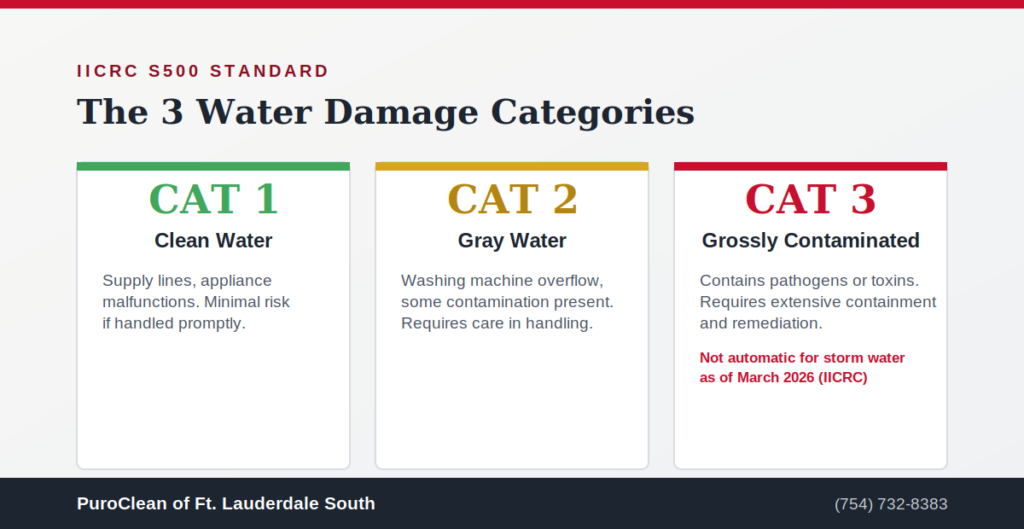
The IICRC S500 standard, the industry’s governing reference for professional water damage restoration, breaks water intrusion into three categories based on contamination level:
- Category 1 — clean water from a source like a supply line or appliance, posing minimal risk if handled promptly.
- Category 2 — “gray water” containing some contamination, such as water from a washing machine overflow or a toilet with urine but no solid waste.
- Category 3 — grossly contaminated water containing pathogens, toxins, or other harmful agents, requiring the most extensive containment and remediation.
The classification isn’t just a label. Category 3 water damage triggers different — and more expensive — procedures: more materials removed rather than dried in place, stricter containment, and more extensive documentation. For a commercial building or condo association, that difference can mean tens of thousands of dollars and weeks of additional downtime.
Category vs. Class: Two Different Numbers That Get Confused Constantly
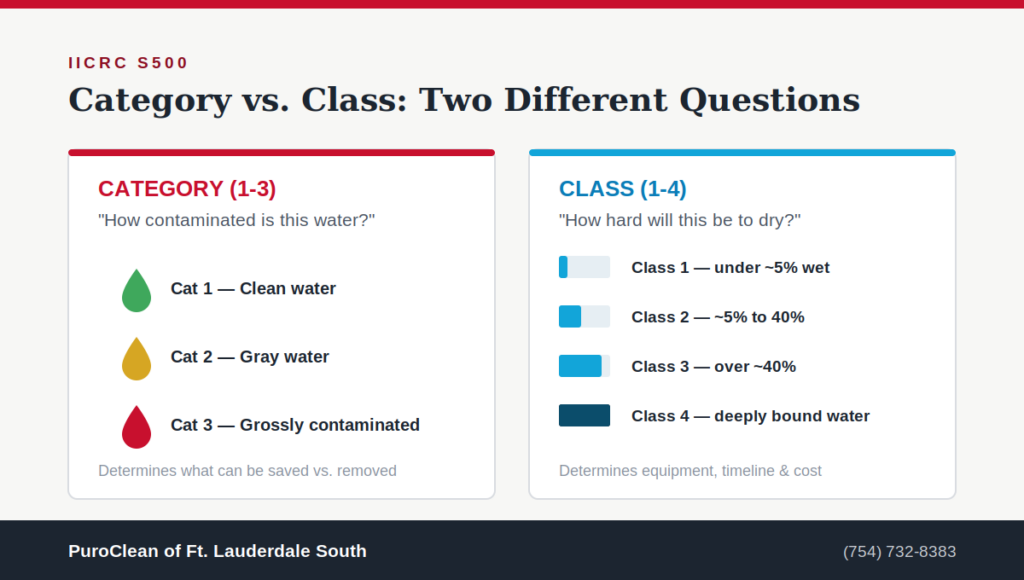
If you’ve been through a water loss, you’ve probably heard a contractor or adjuster say something like “Category 2, Class 3.” Those are two separate systems, and mixing them up is one of the most common sources of confusion for boards and property managers reviewing a scope of work.
Category measures contamination. That’s the 1, 2, 3 scale covered above, and it answers the question: how dirty is this water?
Class measures the drying problem. It’s a 1 through 4 scale that answers a different question entirely: how much material is wet, and how hard will it be to dry?
The class is based on evaporation load, meaning how much wet surface area is involved and how readily those materials give up moisture:
- Class 1 — the smallest drying job, with less than about 5% of porous materials in the space affected.
- Class 2 — a significant portion of the space, roughly 5% to 40% of porous materials wet.
- Class 3 — the largest evaporation load, with more than about 40% of the affected surfaces wet. This is often water that came from overhead and soaked walls, ceilings, and flooring together.
- Class 4 — the specialty category. This is water that has been absorbed deep into dense, low-permeance materials like hardwood, concrete, plaster, or stone. These materials hold moisture tightly and release it slowly, which requires specialized drying methods and a longer timeline.
Two things worth knowing about class that most property owners never hear:
First, a Class 4 loss in a concrete-slab office building with wood flooring is a fundamentally different project than a Class 1 loss in the same building, even if the exact same pipe caused both. The equipment, the timeline, and the cost all change.
Second, the class is properly determined after any demolition or removal work is finished, not at the front door. Until then, the affected area isn’t fully known. A contractor who assigns a class before opening anything up is guessing.
For a board reviewing a proposal, a scope of work that states both the category and the class, backed by moisture readings and photographs, is a sign the contractor is working to standard. A scope that states neither invites questions from the insurer, and questions add days.
The Old Assumption, and Why It Was a Problem
For years, it’s been common practice in restoration and insurance circles to treat any water tied to a storm — wind-driven rain, a roof leak during a hurricane, water pushing in from outside — as automatically Category 3 water damage, on the theory that anything from outdoors is inherently contaminated. That assumption drove restoration scope and insurance payouts, often without anyone actually evaluating conditions at the property itself.
The problem: it isn’t always true. Rain is not sewage. Wind-driven rain entering through a compromised window is not automatically the same thing as floodwater that picked up contamination from surrounding ground or drainage. Treating every storm-related loss identically meant some buildings had materials torn out and replaced that could have been safely dried and saved, adding cost and downtime that the actual conditions didn’t call for.
What the IICRC Clarified in March 2026
In March 2026, the ANSI/IICRC S500 Consensus Body issued a formal position statement addressing exactly this question. The clarification: water from weather events, including top-down water intrusion and wind-driven rain, is not automatically Category 3 water damage simply because of where it came from. Category has to be determined by the conditions actually observed at the specific property, evaluated on-site, not assumed from the fact that a storm caused the loss.
In plain terms, a restoration company responding to a storm loss is now expected to evaluate the specific conditions in front of them, rather than defaulting to the most expensive classification because a hurricane or heavy rain was involved.
Category Isn’t Permanent: How Clean Water Becomes Contaminated
Here’s the part that changes how urgently you should treat a “minor” leak.
Category is not fixed at the moment the water appears. It’s a snapshot of conditions, and those conditions deteriorate. Clean Category 1 water sitting on flooring in a warm building will degrade toward Category 2, and eventually Category 3, as bacteria multiply and the water picks up contamination from the materials it contacts. Industry guidance generally puts that shift within roughly 48 to 72 hours, though Florida’s heat and humidity work against you at the faster end of that range.
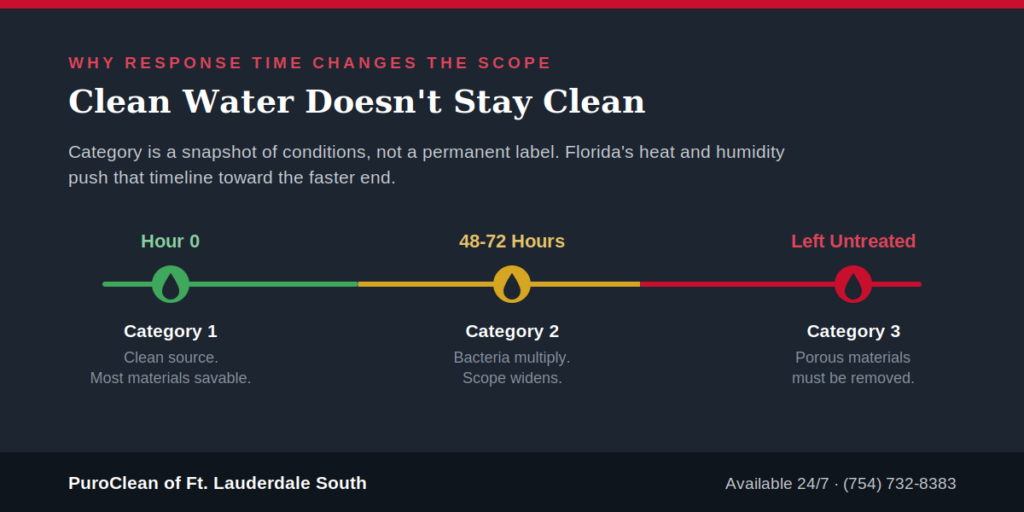
This has real consequences for a building.
A supply line that fails on a Friday afternoon in an unoccupied office suite may start as the least serious classification. By the time someone unlocks the door Monday morning, the same water can require a substantially more aggressive scope, including removal of porous materials that could have been dried and saved two days earlier.
It also means that “we’ll deal with it after the holiday weekend” is a decision with a price attached, even when the water looks clean. The category that gets documented is the one that exists when a restorer arrives, not the one that existed when the leak started.
For property managers, the practical takeaway is straightforward. The window where a water loss is cheapest and least disruptive to resolve is measured in hours, not days, and it closes on its own whether or not anyone has called a contractor yet.
Why This Matters for Fort Lauderdale, Hollywood & Pembroke Pines Buildings
South Florida properties see more storm-related water losses than almost anywhere else in the country, which means this clarification has an outsized impact locally. For property managers and condo boards, it translates into a few concrete things:
- A more accurate scope of work. Materials that can be safely dried don’t have to be automatically demolished just because the loss happened during a storm.
- A stronger position with insurers. A Category 3 water damage classification affects claim value on both sides of the table — an accurate, well-documented category protects a building from being over-scoped just as much as it protects against being under-scoped.
- Less unnecessary downtime. For an office building or a condo common area, the difference between “dry in place” and “demo and rebuild” is often the difference between reopening in days versus weeks.
This is also exactly why documentation matters as much as the classification itself. A restoration company needs to record the actual conditions at the property, not just note “storm-related” and move on to the most extensive scope by default. If your building has dealt with water intrusion before, it’s worth revisiting our guide on what to do in the first hour after a flood — proper documentation from the start is what makes an accurate category possible later.
Where Water Came From Decides Which Policy Pays
Categorization determines the scope of the restoration work. A separate question determines who pays for it, and in Florida the answer often comes down to a distinction that surprises people: did the water come in from above, or did it rise from the ground?
Under Florida law, “flood” has a specific statutory definition. Florida Statutes §627.715 describes it as a general and temporary condition of partial or complete inundation of two or more acres of normally dry land, or of two or more properties, at least one of which is the policyholder’s. In other words, a flood by legal definition involves more than a single building.
That distinction drives coverage:
Rain entering through a wind-damaged roof or window is generally treated as windstorm damage, handled under the property or windstorm policy.
Water rising from the ground, including storm surge, is generally treated as flood, which standard property policies exclude. That requires separate flood coverage through the NFIP or a private carrier.
A burst pipe or failed supply line is usually a covered occurrence under the property policy, and has nothing to do with either of the above.
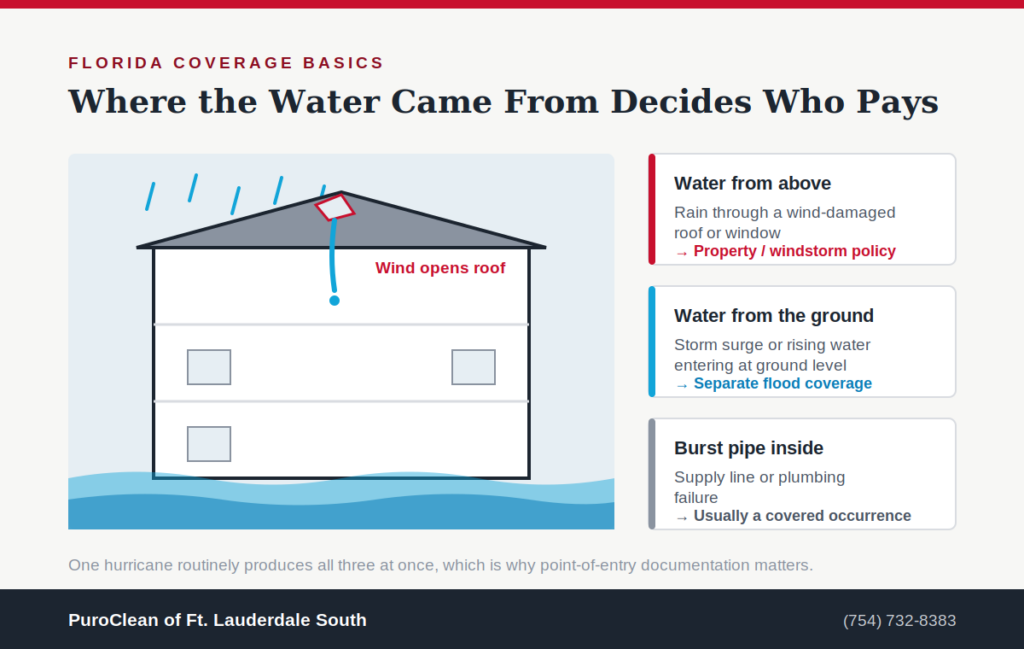
The complication for South Florida buildings is that a single hurricane routinely produces all three at once. Wind opens the roof, rain comes down through the ceiling, and surge pushes in at ground level, all within the same few hours. Two different insurers may each assign their own adjuster, and each will be evaluating which portion of the damage belongs to their policy.
This is where restoration documentation stops being paperwork and starts being evidence. Photographs, moisture readings, and a clear record of where water entered and how far it traveled are what separate one claim from the other. A scope that simply says “storm damage” gives neither carrier what they need, and that ambiguity tends to resolve slowly and in nobody’s favor except the insurers’.
For condo associations, this sits directly alongside the master policy question, since the association’s coverage and the individual unit owner’s coverage are already divided along their own lines. Getting both distinctions documented from day one is far easier than reconstructing them weeks later.
Questions to Ask Your Restoration Company After a Storm Loss
- How are you determining the water category for this specific loss, rather than assuming it based on the storm?
- What conditions did you actually observe on-site that support that classification?
- Can you document those conditions in a way my insurance carrier will accept?
If a contractor can’t answer those clearly, that’s worth knowing before demolition starts, not after.
How PuroClean of Ft. Lauderdale South Handles Categorization
Every loss we respond to, storm-related or not, is evaluated on the actual conditions at your property, documented, and categorized according to current IICRC S500 guidance. That means an accurate scope of work, not an assumption made from the doorway.
Frequently Asked Questions
Is all hurricane water damage Category 3?
No. As of the IICRC’s March 2026 position statement, storm-related water — including wind-driven rain and top-down water intrusion — is not automatically classified as Category 3 water damage. Classification depends on the conditions actually observed at the property.
Why does the water damage category matter for my insurance claim?
The category determines the scope of restoration work required, which directly affects the size and cost of the claim. An inaccurate classification can lead to unnecessary demolition on one end, or insufficient remediation on the other.
Who decides the water damage category after a loss?
The restoration company evaluating the loss should determine the category based on on-site conditions and current IICRC guidance, not assumptions based solely on the cause of the loss.
Does this clarification apply to condo associations too?
Yes. Commercial and residential properties, including condominiums, are both covered under the IICRC S500 standard, and the categorization guidance applies equally to both.
What’s the difference between water damage category and class?
Category describes how contaminated the water is, on a scale of 1 to 3. Class describes how much material is wet and how difficult drying will be, on a scale of 1 to 4. They’re separate systems, and a complete scope of work should state both.
Can Category 1 water become Category 3?
Yes. Clean water degrades as it sits, typically shifting toward Category 2 within roughly 48 to 72 hours, and Florida’s heat and humidity accelerate that process. The category documented is the one present when restoration begins, which is why response time affects both scope and cost.
Does my property insurance or flood insurance cover storm water damage?
It depends on how the water entered. Rain coming through a wind-damaged roof is generally handled as windstorm damage under a property policy, while water rising from the ground, including storm surge, generally falls under separate flood coverage. A single hurricane can produce both, which is why documenting the point of entry matters for the claim.
If Your Building Has Storm or Water Damage
Don’t assume Category 3 water damage is automatic after a storm — and don’t assume a contractor is applying the classification correctly either way. PuroClean of Ft. Lauderdale South evaluates every loss on its actual conditions and documents it to current IICRC S500 guidance.
Call (754) 732-8383 — available 24/7.