The Hidden Realities of Saving Your Hudson Valley Home from the Unexpected
1. Introduction: The Moment Everything Changes
Imagine waking up on a quiet Tuesday in the Spackenkill neighborhood only to hear the unmistakable, sickening sound of rushing water—a pipe has burst in the upstairs bath. Or perhaps, following a relentless Hudson Valley storm, you descend the stairs to find that the Hudson River has practically moved into your basement.
In my years of helping homeowners along the Hudson, I’ve seen it a thousand times: that initial paralyzing shock. The emotional toll of seeing your sanctuary invaded by water or soot is profound. But as a restoration specialist, I often tell my clients that the next few hours are the most important you will ever spend as a homeowner. Property damage is more than a mess; it’s a high-stakes race against time and the unique environmental factors of the Poughkeepsie area. Understanding the science of restoration is the difference between a temporary displacement and the permanent loss of your home’s value.
2. The 48-Hour Ticking Clock: A Health and Safety Deadline
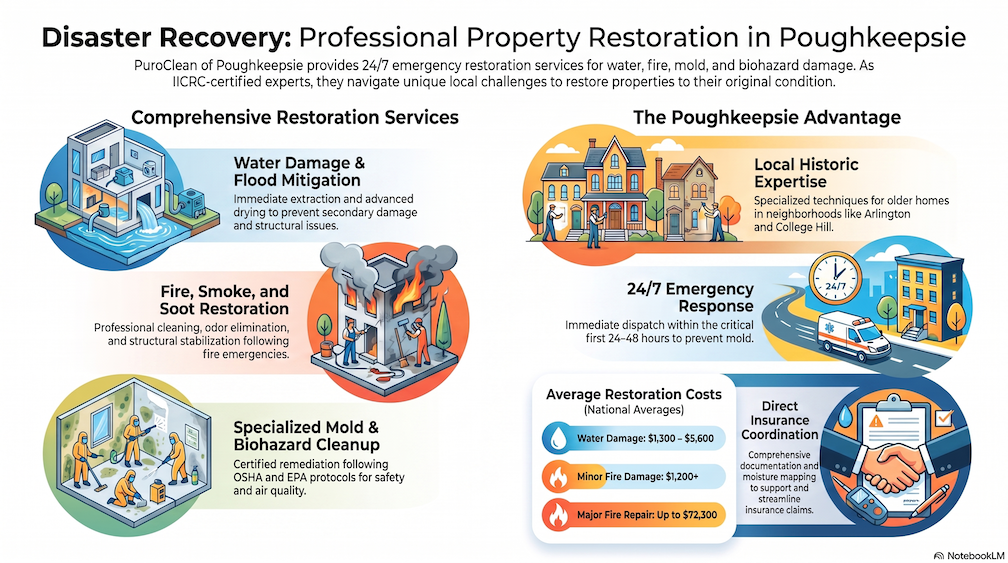
When disaster strikes, the clock doesn’t just start; it sprints. In the restoration industry, the first 24 to 48 hours represent a critical “golden window.” This is when “secondary damage” begins its invisible assault. Moisture doesn’t just sit there—it migrates, wicking into drywall and seeping under floorboards where it initiates microbial growth.
The health risks are not theoretical. If moisture remains unchecked for more than two days, the risk of “microbial infestations,” such as mold and mildew, skyrockets. These contaminants can cause significant respiratory issues and allergic reactions for your family. This is why I always emphasize the absolute urgency of a professional response. As our local protocols dictate:
“Immediately. The first 24–48 hours are critical for preventing mold growth and structural damage.”
3. The Poughkeepsie Paradox: Why History Makes Restoration Harder
Poughkeepsie is defined by its historic character, but from a specialist’s perspective, neighborhoods like Arlington, College Hill, and the South Side present unique structural hurdles. I often find myself in beautiful century-old homes where the “original framing” and “legacy electrical systems” require a level of care that modern construction simply doesn’t.
Restoring these properties is not a standard cleaning job; it is a preservation effort. Historic timber and plaster react differently to water and smoke than modern drywall. We have to use specialized drying techniques to ensure that while the moisture is removed, we aren’t warping the very bones of a house that has stood since the 1920s. In the Hudson Valley, we aren’t just drying a building; we are often protecting a piece of our local heritage.
4. The True Cost of “Wait and See”
I understand the temptation to grab a shop-vac and handle a “minor” flood yourself to save money. However, the financial data suggests that cutting corners early leads to ballooning costs later. According to a Forbes Home report, the financial scale of restoration is vast:
- Water Damage: Average restoration costs typically fall between $1,300 and $5,600.
- Fire Damage: The national average for fire repairs is 12,900**. However, while a minor emergency repair might start at **1,200, a “whole-home” fire restoration—including kitchen rebuilds or roof replacement—can reach as high as $72,300.
Hiring certified professionals is an investment in cost containment. By using industrial extraction, we prevent the “microbial infestations” and structural failures that can easily triple these figures if left to fester.
5. Science Over Scrubbing: High-Tech Healing for Your Home
Modern restoration is a technical discipline, not a mop-and-bucket chore. We use advanced technology to see what the human eye cannot. At PuroClean, we utilize thermal imaging and moisture mapping to find “hidden” water trapped behind beautiful wainscoting or under hardwood floors.
The professional difference lies in the equipment and the standards:
- Industrial Extraction: We utilize both truck-mounted and portable extraction systems depending on the accessibility and scale of the flood.
- Air Quality & Containment: During mold or fire remediation, we don’t just “air it out.” We establish full containment and negative air pressure to ensure that contaminants don’t spread to clean areas of the house. We use HEPA filtration to scrub soot and spores from the air.
- Odor Elimination: For fire damage, we use thermal fogging to neutralize odors at a molecular level, rather than just masking them.
- Strict Protocols: Every job follows IICRC S520 standards for mold and OSHA, EPA, and CDC protocols for biohazards, ensuring your home is truly safe to breathe in again.
6. The “One-Company” Advantage: Navigating Bureaucracy and Heartbreak
Managing a property crisis is a logistical nightmare. You have to coordinate with insurance adjusters to document every lost item and secure permits from the City of Poughkeepsie Building Department or follow specific NYS Department of Environmental Conservation guidance for environmental issues.
This is where having a local team led by experts like Andrew Rankel, Jonathan Beever, and Shawn McDermott makes all the difference. We provide a “one-company” solution, managing the project from the initial 24/7 emergency response and water extraction through to the final “complete reconstruction.” This continuity removes the burden from the homeowner during an already traumatic time.
The emotional relief of this partnership is best expressed by those who have walked this path. As Donna, a local resident, shared after a devastating fire:
“The team was very pleasant and caring. They worked really hard and were very compassionate. I HIGHLY recommend this company.”
7. Conclusion: Beyond the Damage
Living in the Hudson Valley means embracing our environment—but it also means preparing for it. From the intense freeze-thaw cycles that cause ice dams and burst pipes to the flood risks inherent in our riverfront communities, our homes are constantly tested. Resilience requires more than just a quick cleanup; it requires a scientific approach and a deep understanding of our local infrastructure.
As you look around your home or business today, I want you to ask yourself: If the unexpected happened tonight, do I have a plan to stop the clock before that 48-hour window closes? Being prepared isn’t just about insurance; it’s about knowing who to call to ensure your house remains a home, regardless of what the Hudson Valley weather has in store.