


What the Inland Empire’s Logistics Industry Needs When a Suppression System Goes Off
The Inland Empire is the logistics capital of the western United States, and Rancho Cucamonga sits at the heart of it. The I-15 corridor through San Bernardino County carries some of the highest freight volumes in North America, and the warehouse and distribution center development that has followed that traffic has transformed the industrial zones along 4th Street, Arrow Route, and the 15 freeway interchange into one of the most active commercial property markets in Southern California.
These facilities are enormous. A single distribution center in Rancho Cucamonga may cover half a million square feet, house millions of dollars in inventory, employ hundreds of workers across multiple shifts, and operate on a fulfillment timeline where every hour of unplanned downtime translates directly into contractual penalties, customer relationship damage, and operational costs that compound faster than most residential property owners can easily conceptualize.
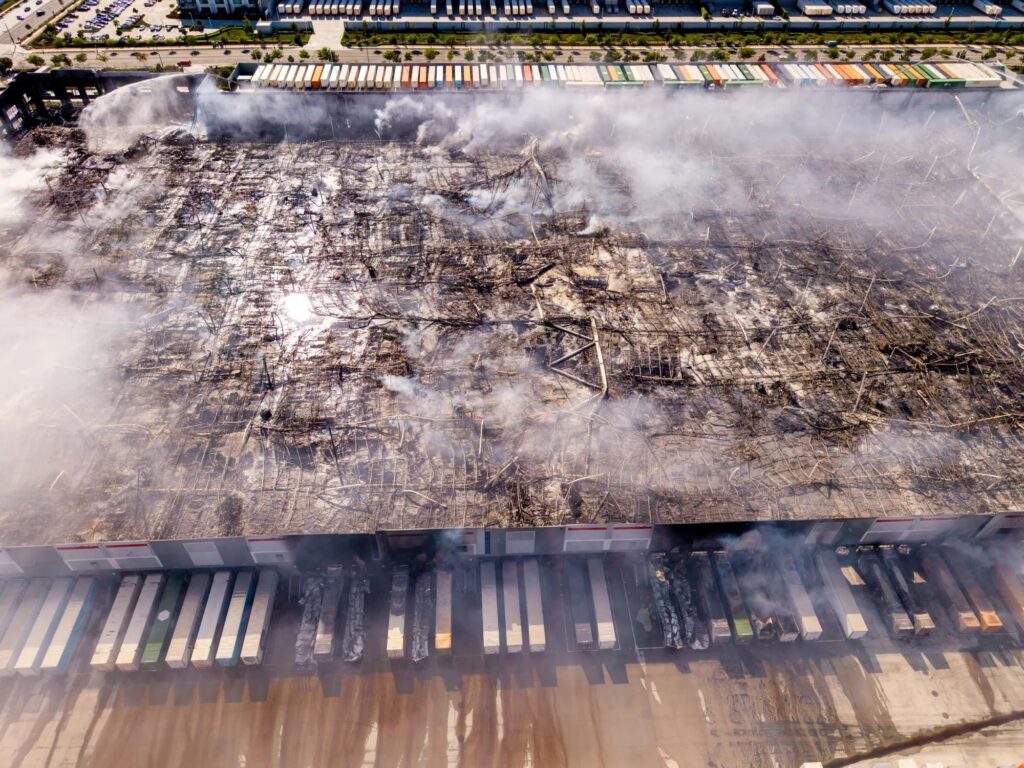
When an emergency water restoration event occurs in one of these facilities, whether from a fire suppression system activation, a roof drainage failure during an atmospheric river event, or a plumbing system failure in the facility’s office or amenity areas, the response cannot be scaled-up residential restoration. It requires a different category of planning, equipment, and coordination entirely.
The Fire Suppression Activation Scenario
The single largest source of emergency water restoration calls in Rancho Cucamonga’s warehouse and distribution center corridor is unplanned fire suppression system activation. These events occur more frequently than the industry publicly acknowledges, triggered by equipment malfunctions, accidental heat source proximity to sprinkler heads, system testing errors, and in some cases deliberate tampering.
A standard commercial fire suppression system delivers water at a rate and volume that produces flooding conditions in a warehouse environment within minutes of activation. A single activated sprinkler zone in a large distribution center can release thousands of gallons of water across the affected area before the system is isolated, saturating concrete flooring, racking systems, inventory, conveyor infrastructure, and the structural components of the building itself.
The water involved in a suppression system activation is not clean water. Commercial suppression systems are charged with water that has been sitting in pressurized pipes throughout the facility, frequently containing rust, scale, biological material from pipe interior surfaces, and in older systems, chemical additives that affect both the contamination category of the event and the decontamination requirements for the restoration.
Emergency water restoration in a Rancho Cucamonga warehouse after a suppression activation is therefore a Category 2 water event at minimum, requiring decontamination protocols in addition to extraction and drying, and affecting inventory and equipment that may have been contaminated beyond salvage regardless of whether visible water damage is present.
The Inventory and Operations Dimension
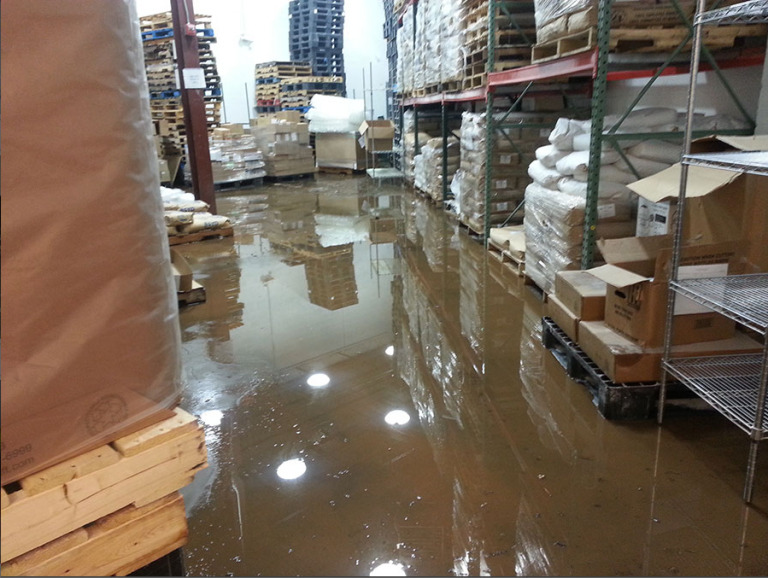
In a residential water restoration event, the primary cost is structural damage to the building and its contents. In a Rancho Cucamonga distribution center, the structural damage may be the smallest component of the total loss.
Inventory affected by suppression water discharge, even inventory that appears physically undamaged, may be unsalvageable from a liability perspective if it has been exposed to Category 2 contaminated water and cannot be certified as uncontaminated to the satisfaction of the retailer or end customer it was destined for. Food, pharmaceutical, cosmetic, and consumer goods inventory frequently falls into this category.
Operational disruption costs accumulate from the moment the suppression system activates. Fulfillment commitments that cannot be met, carrier pickups that arrive to a facility that cannot load, and the downstream inventory positioning impacts across a supply chain that was depending on this facility to perform on schedule create financial consequences that the property damage claim does not capture.
Emergency water restoration sequencing in a distribution center context must account for these operational priorities, identifying which areas of the facility can be restored to operational status first and sequencing the restoration work to enable partial operations to resume as quickly as structurally safe conditions allow.
What Emergency Water Restoration Covers at Scale
Large-scale emergency water restoration in a Rancho Cucamonga warehouse or distribution center requires equipment capacity and coordination that residential and light commercial restoration cannot provide:
- Immediate large-volume extraction using multiple truck-mounted units and high-capacity portable extractors deployed simultaneously across the affected zone
- Suppression system water category assessment to establish decontamination requirements before extraction equipment is positioned
- Inventory triage and documentation conducted concurrently with extraction to support the property and inventory loss components of the insurance claim simultaneously
- Racking system and equipment assessment to identify structural components requiring engineering evaluation before the facility can safely resume operations
- Concrete slab drying using specialized equipment designed for large-format commercial flooring that standard residential drying equipment cannot address efficiently at warehouse scale
- HVAC and climate control system assessment given that suppression water discharge in a climate-controlled fulfillment environment affects the facility’s ability to maintain product-specific temperature and humidity requirements
- Phased restoration sequencing that prioritizes areas enabling partial operational resumption while full restoration continues in the most severely affected zones
- Complete insurance documentation supporting property damage, business interruption, and inventory loss claims with the line-item detail that commercial carriers require
The Business Interruption Claim for a Distribution Center
Commercial property insurance for warehouse and distribution center operations typically includes business interruption coverage that compensates for lost income during the period the facility cannot operate normally. In a Rancho Cucamonga distribution center operating on fulfillment contracts with defined service level agreements, the business interruption calculation is more complex than a simple daily revenue figure.
Contractual penalties for missed fulfillment commitments, expedited freight costs to reroute inventory through alternative facilities, and the long-term customer relationship impact of a service failure during a high-volume period all contribute to a business interruption loss that requires thorough documentation to capture accurately.
Our emergency water restoration file for commercial warehouse properties includes the scope documentation, operational timeline records, and phased restoration progress reports that support a complete business interruption claim alongside the property damage settlement.
Response Time at Industrial Scale
Rancho Cucamonga’s warehouse and distribution center operators understand that emergency response time is measured in minutes and hours, not business days. A suppression activation that occurs at 3am on a Sunday morning still requires immediate professional emergency water restoration response, because the inventory and operational losses accumulating in the flooded facility do not pause until Monday.
PuroClean of Rancho Cucamonga maintains the commercial equipment capacity and the 24-hour dispatch capability to respond to large-scale industrial water events across the Inland Empire corridor at any hour. We understand the operational stakes involved in a distribution center emergency and we move with the urgency those stakes require.
The Inland Empire’s Logistics Industry Deserves a Restoration Partner Built for It
Residential restoration companies scaling up for a warehouse job and commercial companies without Inland Empire experience are equally inadequate responses to an emergency water restoration event in a Rancho Cucamonga distribution center. What these facilities need is a certified local team with the equipment capacity, the commercial documentation expertise, and the operational awareness to match the scale and urgency of what they are dealing with.
That is exactly what PuroClean of Rancho Cucamonga provides. Call (909) 481-4399 the moment a water event affects your facility. We will be there fast, assess the full commercial scope, sequence the restoration to get your operation moving again as quickly as possible, and build the documentation file that supports every component of your insurance claim.