


What Inland Empire Homeowners Need to Know About Fire Claims, Documentation, and Getting Paid Fairly
Most fire damage restoration guides focus on what happens to your home after a fire. Smoke removal, structural repairs, odor elimination. That information matters. But in Rancho Cucamonga’s current insurance environment, an equally important conversation is what happens to your claim after a fire, and what you can do to protect your position when the process does not go smoothly.
California’s insurance market has undergone significant upheaval in recent years. Several major carriers have reduced or eliminated coverage in high wildfire-risk zip codes across the Inland Empire. Homeowners who retained coverage have sometimes found that claims for fire damage restoration are being scrutinized more carefully, undervalued against actual restoration costs, or partially denied on grounds that are not always straightforward to challenge.
This blog is written for Rancho Cucamonga homeowners who want to understand how professional fire damage restoration documentation protects their claim, and what to do when the insurance process becomes an obstacle rather than a resource.
Why Fire Damage Restoration Claims in the Inland Empire Are More Complex Now
San Bernardino County sits within a region that California’s Department of Insurance and major carriers have identified as elevated wildfire risk territory. That designation has changed the claims landscape in ways that directly affect how fire damage restoration jobs in Rancho Cucamonga are handled.
Carriers operating in high-risk zones apply more intensive review to fire claims. Adjusters working these markets are under pressure to manage payouts carefully, which translates into more detailed documentation requirements, more frequent disputes over replacement cost versus actual cash value calculations, and more scrutiny of the line between fire damage and pre-existing conditions.
For a homeowner dealing with fire damage restoration while simultaneously managing displacement, family stress, and an insurance process that feels adversarial, this environment is genuinely difficult to navigate without support.
What Proper Documentation Actually Does for Your Fire Claim
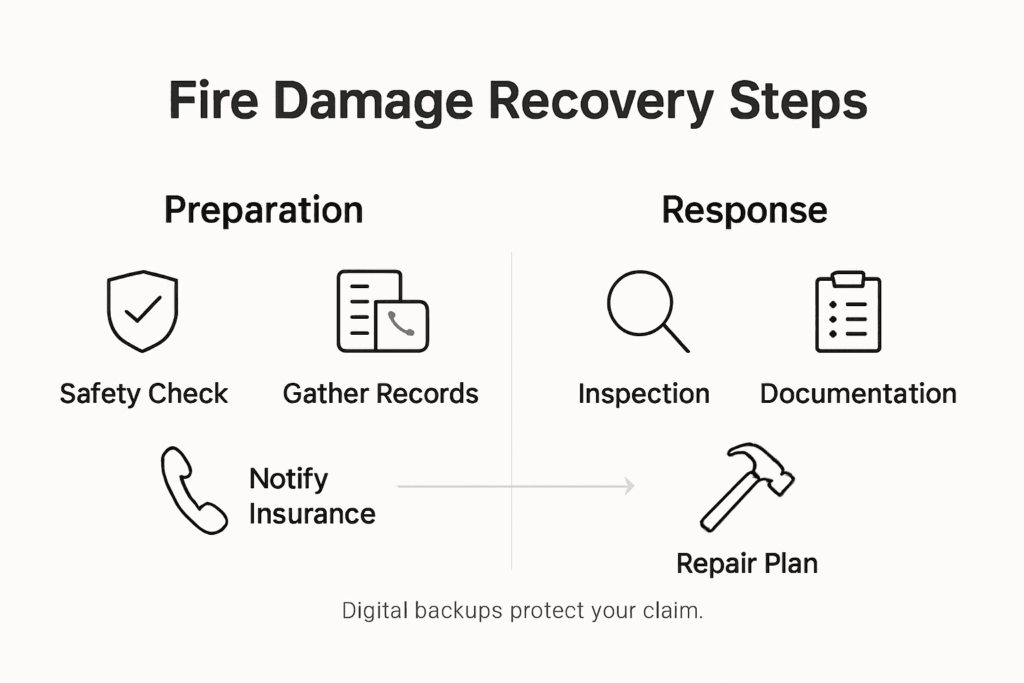
Documentation in a fire damage restoration context is not just photographs of visible damage. A comprehensive restoration file gives your insurance carrier the factual foundation it needs to process your claim accurately and gives you the evidentiary basis to challenge decisions that do not reflect the actual scope of your loss.
What a thorough fire damage restoration file includes:
- Pre-restoration condition documentation of all affected areas before any cleaning, demolition, or stabilization work begins, establishing the baseline from which the claim is measured
- Thermal imaging records showing heat damage and smoke migration beyond the visible fire zone, which frequently extends the documented scope significantly beyond what a visual inspection captures
- Material identification and condition assessment for every affected element, distinguishing between materials that require restoration and those that require replacement, with the basis for each determination documented in writing
- Smoke penetration assessment of structural surfaces including framing, masonry, and subfloor assemblies, relevant to replacement versus encapsulation decisions
- Contents inventory with photographic documentation of every affected item, condition description, and replacement cost basis
- Daily progress logs throughout the restoration process establishing the timeline of work performed
- Clearance documentation confirming the property has been restored to pre-loss condition
Each of these components serves a specific function in the claims process. Missing any of them creates a gap that adjusters can use to reduce the settlement.
The Replacement Cost vs. Actual Cash Value Problem
One of the most common sources of fire damage restoration claim disputes in California involves the distinction between replacement cost value and actual cash value. Standard homeowner’s policies in California typically offer replacement cost coverage for the structure, but the calculation of what replacement actually costs for fire-damaged materials in an older Rancho Cucamonga home is frequently contested.
An adjuster applying generic pricing data to a fire damage restoration scope may calculate replacement costs using builder-grade material pricing that does not reflect what the original materials in your home actually cost to match or replace. In a home with original hardwood flooring, custom cabinetry, or specialty exterior finishes, that gap between the adjuster’s number and the actual restoration cost can be substantial.
Professional fire damage restoration documentation that includes material identification, original specification descriptions where determinable, and replacement cost research specific to the Inland Empire market gives your carrier the information it needs to calculate your settlement accurately. It also gives you the foundation to request a re-evaluation if the initial offer does not reflect actual costs.
What to Do If Your Fire Damage Restoration Claim Is Denied or Underpaid
If you have received a claim denial or a settlement offer that does not cover your actual fire damage restoration costs, several options are available under California law:
Request a written explanation. California Insurance Code requires carriers to provide written explanations for claim denials. If you have not received one, request it in writing. The specific grounds stated in the denial determine which response options are most appropriate.
Engage a public adjuster. Public adjusters are licensed professionals who represent policyholders rather than carriers in the claims process. In complex fire damage restoration claims, a public adjuster can reassess the scope of loss independently and negotiate with the carrier on your behalf.
File a complaint with the California Department of Insurance. The CDI investigates complaints against carriers for unfair claims practices and has specific provisions applicable to fire damage restoration claims in declared disaster areas.
Consult a policyholder attorney. California law provides significant protections for policyholders against bad faith claims handling. An attorney specializing in insurance coverage disputes can evaluate whether the carrier’s conduct rises to the level of actionable bad faith.
Throughout any of these processes, having a complete professional fire damage restoration documentation file from a certified restoration contractor is your most valuable asset. It is the objective record of what actually happened to your property and what restoring it actually requires.
Starting the Restoration Before the Claim Is Resolved
One question we hear regularly from Rancho Cucamonga homeowners after a fire is whether to wait for the insurance process to resolve before beginning fire damage restoration. The answer is almost always no, and California law supports this position.
Homeowners have a legal obligation to mitigate further damage to their property after a loss event. Failing to take reasonable steps to prevent additional damage, including emergency stabilization and beginning the fire damage restoration process, can actually reduce your claim coverage rather than protecting it.
Beginning fire damage restoration promptly, with thorough documentation at every step, demonstrates good faith mitigation effort and creates the professional record that supports your claim regardless of how long the insurance process takes to resolve.
Your Restoration and Your Claim Both Matter
PuroClean of Rancho Cucamonga handles fire damage restoration across Rancho Cucamonga, Ontario, Fontana, Upland, Claremont, and throughout San Bernardino and western Riverside counties, around the clock. Our documentation process is built specifically to support Inland Empire homeowners through the full claims process, not just the physical restoration.
If your home has experienced fire damage and the insurance process is already feeling complicated, call (909) 481-4399. We will assess the full scope of your loss, document it thoroughly, and make sure you have the professional file you need to get your claim resolved fairly. The restoration and the claim are both our concern from day one.