


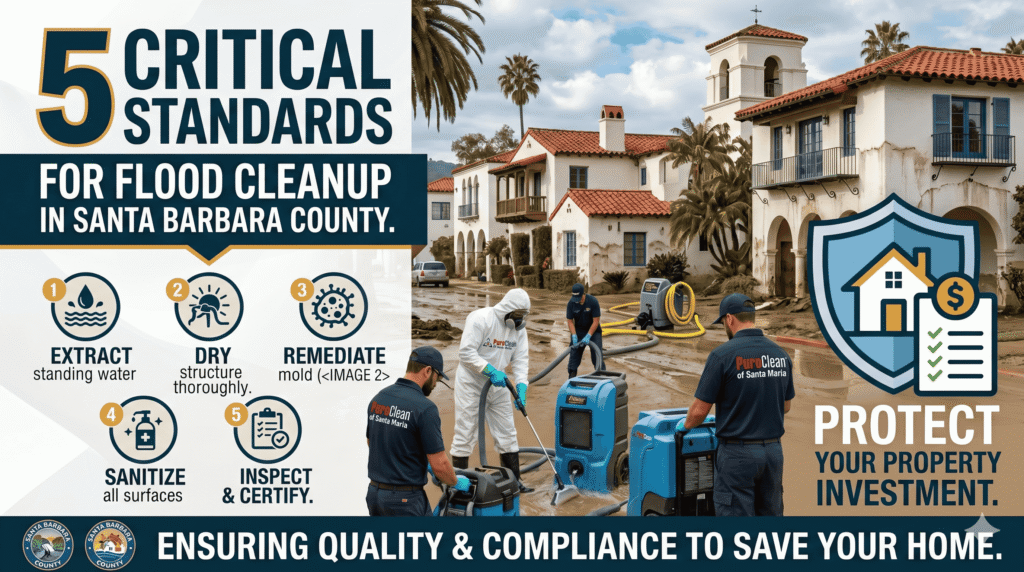
When major coastal storms, seasonal atmospheric rivers, or sudden domestic plumbing failures strike, the clock immediately starts ticking against your property’s structural integrity. In the Central Coast region, water intrusion is never a minor issue. Whether you are managing an estate in Montecito, a commercial space in downtown Santa Barbara, or a family home in the Santa Maria Valley, executing an immediate and precise response is the only way to safeguard your real estate asset.
Relying on an uncertified handyman or attempting a DIY dry-out after a water disaster is a recipe for long-term financial loss. Professional flood cleanup in Santa Barbara County is a highly technical, regulated process that requires deep scientific knowledge of thermodynamics, fluid mechanics, and microbiology.
To help property owners navigate a crisis with confidence, PuroClean of Santa Maria has outlined the five non-negotiable structural and operational standards required to successfully restore a water-damaged property.
Flood Cleanup in Santa Barbara County: Navigating Local Structural Risks
When executing flood cleanup in Santa Barbara County, restoration professionals must account for the unique microclimates and construction styles of our region. A property flooded by coastal brackish water requires an entirely different sanitization protocol than a home affected by a clean water appliance burst inland. Furthermore, the persistent marine layer along the coast keeps relative humidity levels high, drastically hindering the natural evaporation process of building materials.
Without industrial intervention, trapped moisture becomes a breeding ground for wood-decaying fungi and structural instability. Elite restoration teams don’t just clear out standing water; they treat the property as an active ecosystem, utilizing advanced formulas to manipulate indoor air quality, temperature, and airflow. This ensures that every drop of migrated moisture is tracked and eliminated before it can permanently degrade your property investment.
1. Classifying the Water Contamination Level (Category 1, 2, or 3)
The absolute first standard of professional flood cleanup in Santa Barbara County is identifying the sanitary status of the water. According to the IICRC S500 Standard for Professional Water Damage Restoration, water intrusion is categorized into three distinct levels of contamination:
- Category 1 (Clean Water): Originates from a sanitary source, such as a broken water supply line or a malfunctioning faucet.
- Category 2 (Gray Water): Contains a significant degree of chemical, biological, or physical contamination (e.g., discharge from washing machines or sump pump failures).
- Category 3 (Black Water): Highly unsanitary water containing pathogenic, toxigenic, or other harmful agents. This includes all rising outdoor floodwaters, river water, and sewage backups.
Because outdoor storm flooding across Santa Barbara County introduces silt, pesticides, and microbial pathogens into a structure, it is automatically classified as Category 3. Average contractors frequently make the catastrophic mistake of treating storm flooding as clean water, failing to implement mandatory antimicrobial sanitization and porous material removal, which puts the occupants’ health at serious risk.
2. Advanced Micro-Gap Moisture Mapping
Visible dryness is a dangerous illusion. Water follows the path of least resistance, rapidly wicking vertically up porous drywall, slipping underneath luxury vinyl plank (LVP) flooring, and pooling inside insulated wall cavities.
The standard for elite flood cleanup in Santa Barbara County requires comprehensive moisture mapping using diagnostic technology. Professionals do not guess where the water went; they use non-invasive moisture meters, digital hygrometers, and thermal imaging cameras to see through solid structures.
By mapping the exact boundaries of the moisture migration, PuroClean of Santa Maria can pinpoint hidden water pockets behind historical plaster or beneath subfloors. This precision allows technicians to target drying energy exactly where it is needed, bypassing unnecessary, destructive demolition and saving architectural elements that would otherwise be torn out by less experienced crews.
3. Psychrometric Drying and Airflow Engineering
True structural drying is governed by psychrometrics—the science of the physical and thermodynamic properties of air-water vapor mixtures. Simply setting up generic household fans will only move damp air around the room, which actually accelerates the spread of secondary mold growth to unaffected ceilings and furniture.
To meet modern restoration standards, a team must calculate the precise grain removal capacity required for the space. This involves balancing high-velocity axial air movers with commercial Low Grain Refrigerant (LGR) dehumidifiers or desiccant systems.
By continuously calculating GPP (Grains Per Pound) and maintaining a strict vapor pressure differential between the wet structural materials and the ambient air, the water is drawn out of deep wooden framing studs and safely vaporized, ensuring a true, deep-tissue dry-out of the property.
4. Comprehensive Structural Sanitization and Pathogen Control
Because localized flooding often involves Category 3 black water, structural sanitization is a critical safety standard. Once standing water is mechanically extracted, all remaining structural framing, concrete slabs, and non-porous surfaces must undergo rigorous decontamination.
Our technicians apply EPA-registered, hospital-grade disinfectants and antimicrobials to eliminate invisible bacteria, viruses, and fungal spores left behind by floodwaters. This step is completely non-negotiable for ensuring that the indoor air quality is entirely safe for your family or employees to breathe once the physical drying equipment is packed away and removed from the site.
5. Meticulous Insurance Documentation & Compliance
A major, often overlooked component of protecting your property investment is securing proper insurance coverage for the losses incurred. Insurance adjusters require undeniable, empirical proof of dryness and proper mitigation steps before they will approve and pay out large property claims.
The final standard of top-tier flood cleanup in Santa Barbara County is providing a comprehensive, transparent data package. PuroClean of Santa Maria meticulously documents every phase of your project using industry-standard Xactimate estimating software.
We record daily moisture logs, atmospheric conditions, and photographic evidence of the structural progression. This robust documentation package is delivered straight to your insurance carrier, completely eliminating communication bottlenecks and ensuring your claim moves forward smoothly without unnecessary delays or unfair disputes.
Frequently Asked Questions (FAQ)
What is the first thing I should do if my property floods in Santa Barbara County?
If it is safe to do so, immediately shut off the main water valve and turn off the electricity to the affected zones of the property. Once safety is established, call a certified restoration professional immediately to begin emergency extraction within the critical 24-to-48-hour window.
Can mold grow after a professional flood cleanup?
If the cleanup is handled according to strict IICRC standard psychrometric protocols and monitored daily until verified dry, the risk of mold growth is successfully eliminated. Mold only returns if the moisture source was not fully stopped or if structural materials were left above their baseline dry standard.
How long does the professional structural drying process usually take?
On average, a standard structural dry-out takes between 3 to 5 days. However, the exact timeline depends entirely on the class of water intrusion, the types of building materials involved (e.g., concrete vs. drywall), and the outdoor climate conditions at the time.
Why can’t I just use regular household fans to dry out my flooded basement?
Household fans only dry the very surface layer of a material. They lack the high-velocity static pressure required to pull moisture out from deep inside wall cavities, sill plates, and subfloors, and they cannot lower the relative humidity of the room, which leads to secondary mold growth.
Partner with Santa Barbara County’s Trusted Restoration Authority
When a flood threatens your home, business, or historical estate, don’t gamble your real estate investment on uncertified, slow-responding contractors. Put your property in the hands of a locally owned team that treats restoration as an exact, predictable science.
For immediate, 24/7 emergency response and expert flood cleanup in Santa Barbara County, contact PuroClean of Santa Maria today at (805) 975-0800. We deploy immediately to stabilize your property, protect your investments, and restore your peace of mind.
References:
- IICRC: Institute of Inspection Cleaning and Restoration Certification Standards
- EPA: Flood Cleanup and Air Quality Guidelines
- CDC: Reentering a Flooded Home Safely
- FEMA: National Flood Insurance Program (NFIP) Mitigation Standards
Available 24/7/365 | IICRC Certified | (805) 975-0800 | Contact Us Online | Google Business Profile