


Table of Contents
Is white mold dangerous in your bedroom in ways that make it more serious than mold found anywhere else in your home? The answer is yes, and the reason comes down to a single fact that most homeowners never consider: you spend approximately eight hours every night in your bedroom with your eyes closed and your body at its most vulnerable. You are not checking for musty odors. You are not noticing irritation building in your airways. You are breathing whatever is in that room continuously, unconsciously, for a third of your life.
The CDC confirms that exposure to damp and moldy environments may cause a variety of health effects, and the EPA documents that mold spores float continuously through indoor air, entering the respiratory system with every breath. Is white mold dangerous in your bedroom? Eight uninterrupted hours of nightly inhalation exposure make the bedroom the single most consequential location in your home for mold-related health risk, regardless of how small the visible colony appears.
At PuroClean of Santa Maria, we have inspected homes throughout the Santa Maria Valley where persistent bedroom mold was the undiagnosed driver of worsening sleep quality, morning respiratory symptoms, and fatigue that homeowners had been treating as separate problems for months. This guide identifies the seven specific overnight exposure risks that make bedroom mold a health emergency rather than a cosmetic inconvenience.
Is White Mold Dangerous in Your Bedroom? Why Location Changes Everything
In a bathroom, you spend minutes. In a kitchen, you spend an hour or two across a day. In your bedroom, you spend eight hours unconscious, breathing at a slower, deeper rate than during waking activity, with your face centimeters from pillows and mattresses that may be contaminated. Is white mold dangerous in your bedroom more severely than mold elsewhere in your home for this reason alone. Cumulative spore dose, the total number of spores inhaled over time, determines the severity of health effects. Eight uninterrupted hours at elevated spore concentrations represent a cumulative dose that cannot be offset by spending the rest of the day in mold-free areas.
Santa Maria’s coastal climate adds a compounding factor specific to the bedroom. Night temperatures in the Santa Maria Valley drop enough to create condensation on walls, windows, and cold surfaces during the summer fog season. Bedrooms with inadequate insulation, single-pane windows, or exterior-facing walls accumulate nighttime moisture that does not occur in the same way during warmer daytime hours. Is white mold dangerous in your bedroom in Santa Maria’s climate? The nightly moisture cycle provides the conditions for colony growth and spore production precisely during the hours when you are most exposed.
Overnight Risk 1: Eight Hours of Uninterrupted Spore Inhalation
Daytime mold exposure is partly offset by time spent elsewhere, improved ventilation when doors and windows open, and the body’s active immune response during waking hours. Nighttime exposure has no such offset. With bedroom doors typically closed to reduce noise and light, ventilation is reduced. With windows often closed against nighttime temperatures and coastal fog, air exchange drops. The result is an enclosed space where spore concentrations build through the night with no dilution.
The NIH/NIEHS documents that mold exposure causes respiratory symptoms, cognitive issues, and immune effects. All three of these worsen with cumulative dose. A person sleeping eight hours per night in a room with white mold accumulates the single largest daily mold exposure of any activity in their life, delivered continuously during the hours their body is supposed to be recovering.
Overnight Risk 2: Sleep Disruption and Its Cascading Health Consequences
Is white mold dangerous in your bedroom specifically because of what it does to sleep quality? Yes. Mold exposure disrupts sleep through two distinct mechanisms. The first is physical: nasal and airway inflammation from mold allergens causes congestion that forces mouth breathing, reduces oxygen exchange efficiency, and fragments sleep through the night. The second is neurological: research published in PMC found that mold inhalation triggers hippocampal immune activation that alters sleep architecture at the brain level, not merely through congestion.
Poor sleep compounds every other health effect. Growth hormone is released primarily during deep sleep. Immune calibration occurs during sleep. Memory consolidation and neural repair happen during sleep. A person whose bedroom mold is disrupting sleep quality is not simply tired. They are experiencing degraded immune function, impaired cognitive performance, and reduced physical recovery, all of which make the other seven risks on this list more severe than they would be in a well-rested individual.
Overnight Risk 3: Mattress and Pillow Contamination You Cannot See
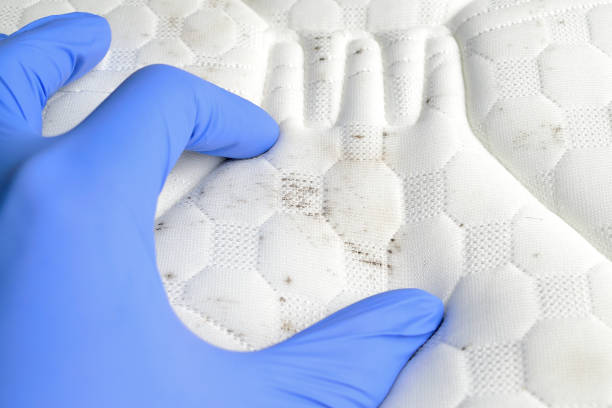
Is white mold dangerous in your bedroom when the growth is on a wall or in a closet rather than directly on your bed? Yes, because mold spores settle on every horizontal surface in a contaminated room, including mattresses and pillows. A pillow that has been in a room with white mold for months contains accumulated spores within its fill material and fabric that are released with every compression of your head during sleep. Your face is centimeters from that surface for eight hours.
Mattresses are particularly susceptible to mold colonization because body heat and perspiration during sleep create a warm, humid micro-environment within the mattress itself. If a bedroom has elevated spore counts due to wall or closet mold, those spores settle into mattress materials and can establish viable colonies within the mattress, independent of the original wall source. The California Department of Public Health notes that porous materials that have gotten wet or become contaminated should be discarded because cleaning cannot eliminate colonization within the material structure.
Overnight Risk 4: Immune Suppression During Sleep When Defenses Are Altered
The immune system does not simply rest during sleep. It shifts into a different operational mode, with certain aspects of immune function becoming more active and others becoming less responsive. Inflammatory cytokine production peaks during early sleep. Adaptive immune memory consolidation occurs during slow-wave sleep. This nighttime immune activity means that mold antigens inhaled during sleep encounter an immune system that is simultaneously in a heightened state of processing and reduced in its capacity to mount immediate defensive responses.
Is white mold dangerous in your bedroom because it exploits this nighttime immune pattern? The research on nocturnal asthma and the well-documented pattern of asthma symptoms being worst between 2 a.m. and 4 a.m. reflects this dynamic. Mold-exposed individuals frequently report that their worst symptoms occur in the early morning hours, not during daytime when mold exposure is lower and immune readiness is higher. The bedroom is where this nighttime vulnerability intersects with the highest exposure window of the day.
Overnight Risk 5: Humidity From Breath Feeding Mold Growth
An average adult exhales approximately 300 milliliters of water vapor per hour during sleep. Over an eight-hour night, that is approximately 2.4 liters of moisture added to the bedroom atmosphere from breathing alone. In a room with a bedroom door kept closed and limited ventilation, this nighttime moisture load is measurable and consequential. It contributes to elevated relative humidity on walls, in closets, and in poorly ventilated corners, creating the moisture conditions that white mold requires to sustain and expand its colonies.
This creates a reinforcing cycle. Mold in the bedroom generates spores that disturb sleep. Disturbed sleep, including mouth breathing from congestion, increases moisture output. Increased moisture feeds further mold growth. The bedroom environment compounds itself in a direction of worsening mold conditions unless the moisture source, including the contribution from the occupied space itself, is addressed through ventilation, dehumidification, and source remediation.
Overnight Risk 6: Closet Mold Spreading Directly Into the Sleep Space
Bedroom closets are among the most common locations for white mold growth in Santa Maria homes. Closets have limited air circulation, collect moisture-laden clothing that is not fully dry when stored, and often share exterior walls that experience nighttime condensation. Is white mold dangerous in your bedroom when the growth is inside a closed closet rather than on an open wall? Yes. Closets share air with the bedroom through gaps around doors, ventilation slots, and the movement of air when the door opens. Clothing stored in a moldy closet carries spores into the sleeping area every time items are retrieved.
The insidious aspect of closet mold is that it is easy to overlook and easy to underestimate. A small white fuzzy patch on the back wall of a closet, behind hanging clothes, may not be visible unless you look for it. But it has been producing spores into your bedroom air for months.
Overnight Risk 7: Children’s Bedrooms Carry the Highest Stakes
Is white mold dangerous in your bedroom more severely when the bedroom belongs to a child? Yes. Children breathe more air relative to their body weight than adults. Their developing lungs, immune systems, and brains are in active growth phases where environmental insults have the potential to alter developmental trajectories. Research cited by the NIEHS confirms that mold exposure can increase asthma risk and worsen its symptoms, particularly in young children, and that early-life mold exposure is linked to childhood asthma development in genetically susceptible children.
A child sleeping eight hours per night in a bedroom with white mold is receiving the most concentrated and prolonged mold exposure of any person in the home. If that mold exposure is occurring during the first years of life when immune programming is most active, the potential for lifelong sensitization and asthma development is at its peak. For parents in Santa Maria, whose homes face year-round moisture conditions, checking children’s bedrooms and closets for white mold is not optional maintenance. It is a health priority.
Is White Mold Dangerous in Your Bedroom — Frequently Asked Questions
Q: Is white mold dangerous in your bedroom if it is only on one wall and small?
Yes. Even small visible colonies in a bedroom are releasing spores into the air you breathe for eight hours every night. The size of the visible colony also frequently underestimates the full extent of colonization within the wall material. Professional inspection determines whether what is visible is the full extent of the problem.
Q: Can I sleep in my bedroom while waiting for mold remediation?
Ideally no, particularly if you have respiratory sensitivities, allergies, asthma, or if the bedroom belongs to a child or elderly person. If temporary relocation is not possible, close the room, improve ventilation with a fan directed toward an open window, and use a HEPA air purifier. These measures reduce but do not eliminate exposure.
Q: Is white mold dangerous in your bedroom if I cannot see or smell it?
Mold can be present within wall cavities, inside mattress materials, in closets, or in HVAC components serving the bedroom without being visible from the room. Morning nasal congestion that clears after leaving the bedroom, worsening allergy symptoms compared to other rooms, and persistent musty odor that seems faint are all indicators worth investigating professionally.
Q: Will washing my bedding regularly protect me from bedroom mold exposure?
Regular washing removes spores that have settled on bedding surfaces, which is worthwhile. But it does not address the ongoing source. The room continues releasing spores between wash cycles, and bedding re-accumulates contamination from the air within hours of being remade. Washing is a supportive measure, not a solution.
Q: How do I know if my poor sleep is mold-related versus another cause?
Track whether sleep quality is worse in your bedroom versus when sleeping elsewhere. If symptoms improve noticeably when you sleep in a different location and worsen when you return to your bedroom, the bedroom environment is a likely contributor. Share this pattern with both your physician and a professional mold inspector.
Protect Your Bedroom: Contact PuroClean of Santa Maria
Is white mold dangerous in your bedroom? The seven overnight exposure risks documented in this guide explain why the bedroom, despite often having smaller visible mold growth than a basement or bathroom, can be the most consequential location in a home for cumulative health impact. Eight hours of nightly exposure at elevated spore concentrations adds up faster than any other activity in daily life.
PuroClean of Santa Maria serves homeowners throughout the Santa Maria Valley, Orcutt, Nipomo, Lompoc, and the Santa Ynez Valley. When mold is found in or near a bedroom, we treat it with the urgency the location demands, including post-remediation air quality verification before anyone returns to sleeping in that space.
Call PuroClean of Santa Maria today.
Available 24/7/365 | IICRC Certified | (805) 975-0800 | Contact Us Online | Google Business Profile
Sources: Centers for Disease Control and Prevention — Mold and Health; EPA — A Brief Guide to Mold, Moisture and Your Home; NIH / NIEHS — Mold; California Department of Public Health — Managing Mold in the Home; PMC — Mold Inhalation and Brain Inflammation.