


Black mold on subfloor systems is a critical structural and health emergency that home remedies cannot fix. As an authority in property restoration, PuroClean of Santa Rosa Beach has stepped in to stop a costly epidemic: coastal homeowners attempting to treat advanced fungal growth with standard household bleach.
Imagine peeling back old bathroom tile or water-damaged bedroom carpeting during a routine renovation, only to find a sprawling, dark silhouette staining the plywood beneath. Your immediate instinct might be to reach for a spray bottle of bleach. However, treating black mold on subfloor materials with retail chemical sprays is a dangerous mistake. What looks like a cheap, ten-dollar fix is actually the opening act of an absolute structural disaster.
The Core Threat: Black Mold on Subfloor Physiology and Why Bleach Fails
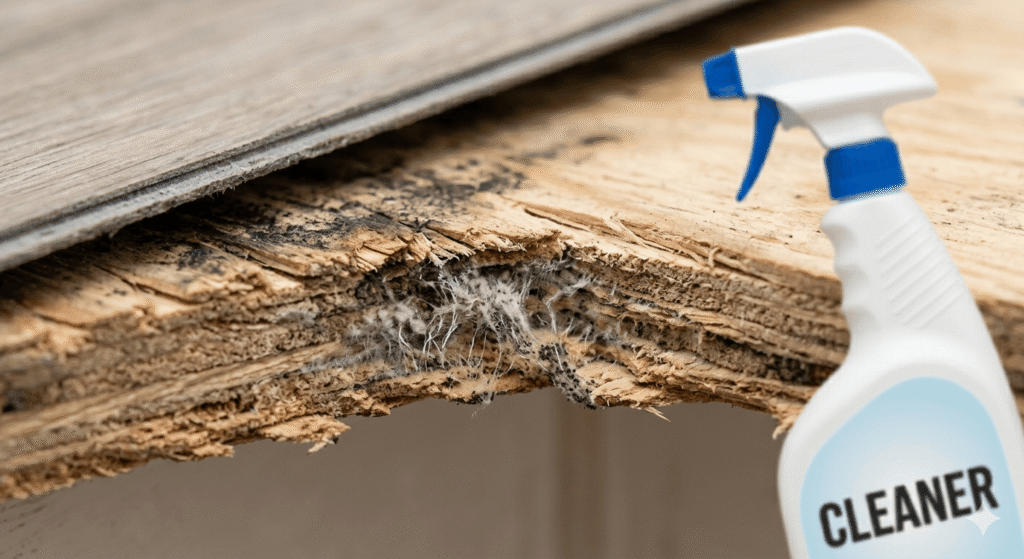
When you discover black mold on subfloor layers, you are dealing with a deeply rooted biological organism, typically Stachybotrys chartarum. Plywood and oriented strand board (OSB) are highly porous materials with a complex, cellular wood structure. They are fundamentally different from non-porous surfaces like bathroom tile or porcelain sinks.
According to the Environmental Protection Agency (EPA) Mold Remediation Guidelines, bleach is explicitly not recommended for treating mold on porous surfaces. Household bleach (sodium hypochlorite) is fundamentally composed of roughly 90% to 95% water. When sprayed onto an infected subfloor, a highly destructive chemical separation occurs:
- The Chlorine Evaporates on the Surface: The chlorine molecule has a high surface tension and cannot penetrate the dense, woven wood grain. It sits strictly on top of the subfloor, bleaching the surface pigment of the mold. This gives you a dangerous optical illusion that the colony is dead.
- The Water Deeply Penetrates the Grain: While the chlorine gas dissipates into the room, the massive water component sinks effortlessly into the subfloor.
Because mold spreads by extending microscopic root networks called hyphae deep within the subfloor’s layers, pumping water into the wood grain does not kill the colony—it feeds it. The hidden roots consume the moisture, causing the plywood layers to delaminate and rot from the inside out while hidden beneath your newly laid flooring.
The Financial Trajectory of a Delayed Response
Failing to properly address black mold on subfloor systems triggers a ticking financial time bomb. Because fungal colonies digest the organic cellulose that provides wood with its load-bearing strength, unmitigated growth eventually causes structural failure.
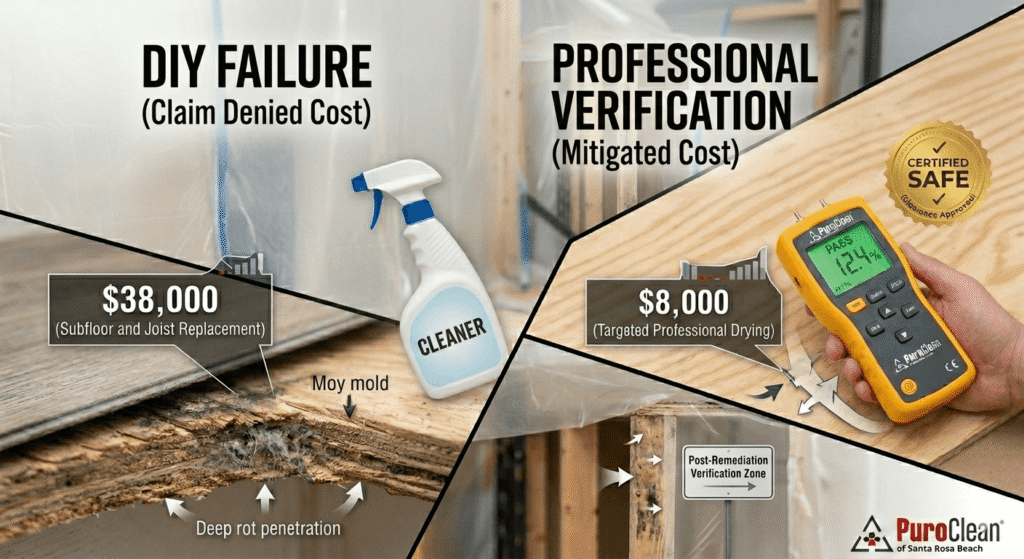
The Institute of Inspection Cleaning and Restoration Certification (IICRC) notes that structural materials left wet or improperly remediated for more than 48 hours face accelerated wood-decay fungi propagation. PuroClean of Santa Rosa Beach consistently documents the stark financial reality of how costs escalate when property owners rely on DIY sprays rather than professional source removal:
Delayed Response (8+ Months Post-Bleach): $38,000 (Includes multi-room demolition, structural floor joist sistering, whole-house spore decontamination, and full reconstruction).
Immediate Professional Intervention: $8,000 (Includes targeted structural drying, negative pressure containment, and HEPA extraction).
| Mitigation Stage | Scope of Work Required | Average Total Cost |
| Immediate Professional Intervention | Targeted structural drying, negative air containment, HEPA air scrubbing, mechanical source removal, and localized sanitization. | $8,000 |
| Delayed Response (8+ Months Post-Bleach) | Multi-room demolition, structural joist shoring/sistering, whole-house HEPA air scrubbing, entire subfloor replacement, and reconstruction. | $38,000 |
By choosing to delay true, professional-grade source removal, a homeowner inherits a $30,000 financial penalty.
In coastal environments like Santa Rosa Beach, where relative humidity levels frequently spike and crawl spaces are subjected to intense vapor drive, this deterioration happens at an accelerated pace. A subfloor masked with bleach might look fine from above for six to eight months. However, underneath that fresh flooring, the wood fibers are actively decomposing.
Eventually, the warning signs become impossible to ignore: the floor begins to squeak excessively, soft spots develop near the walls, a pervasive musty odor fills the home, and occupants experience unexplained respiratory issues. By the time these symptoms manifest, simple drying is no longer an option. You are looking at a full-scale structural reconstruction project.
The 5-Step Professional Protocol for Black Mold on Subfloors
True mold remediation is not defined by the chemicals you spray; it is defined by the physical containment and mechanical removal of the fungal ecology. Professional restoration teams follow strict industry standards—specifically the IICRC S520 reference guide—to ensure that mold is entirely extracted without contaminating the rest of the living space.
When a certified team tackles a contaminated subfloor, they execute a rigorous five-step protocol:
1. Engineered Environmental Containment
Before a single tool is lifted, technicians build a critical barrier around the work zone using heavy-duty, 6-mil fire-retardant plastic sheeting. Using industrial air movers, they establish a negative pressure environment. This ensures that air only flows into the contaminated space, preventing microscopic mold spores from escaping through floor gaps, hallways, or the HVAC ductwork into unaffected rooms during the cleanup process.
2. Precision HEPA Vacuuming
Once containment is secure, the entire area is vacuumed using specialized equipment fitted with High-Efficiency Particulate Air (HEPA) filters. These vacuums are capable of trapping particles down to 0.3 microns with 99.97% efficiency. This initial step safely captures millions of loose, resting surface spores and dust before they can be disturbed and launched airborne.
3. Mechanical Sanding and Source Removal
Because mold hyphae bury themselves inside the wood grain, surface wiping is useless. Technicians use professional wire brushing, media blasting, or mechanical sanding to physically shave away the microscopic top layer of the infected plywood. This removes the root system entirely, grinding down to clean, structurally sound, uninfected wood.
4. EPA-Registered Antimicrobial Treatment
With the physical roots removed, the subfloor is treated with industrial-grade, EPA-registered antimicrobials and fungicidal coatings. Unlike household bleach, these professional formulas are engineered with specialized low surface tension surfactants, allowing them to penetrate deep into the wood cells without adding excess moisture, completely neutralizing any remaining microscopic trace elements.
5. Structural Stabilization and Controlled Drying
Finally, the team deploys commercial low-grain refrigerant (LGR) dehumidifiers and high-velocity axial air movers. Technicians carefully monitor the subfloor’s dry-standard metrics using digital moisture meters, ensuring the wood’s internal moisture content drops safely below 15%. This guarantees that the subfloor is perfectly dry, structurally sound, and completely uninhabitable for future fungal spores before any new flooring is installed.
Safeguarding Real Estate Equity and Insurance Coverage
Ignoring professional remediation parameters can severely damage your home’s financial standing. According to real estate asset preservation standards outlined by organizations like the National Association of Residential Property Managers (NARPM), failure to disclose unmitigated mold issues or presenting amateur repair history can instantly devalue a coastal home by 15% to 20%, or cause transactions to completely collapse during the buyer’s home inspection phase.
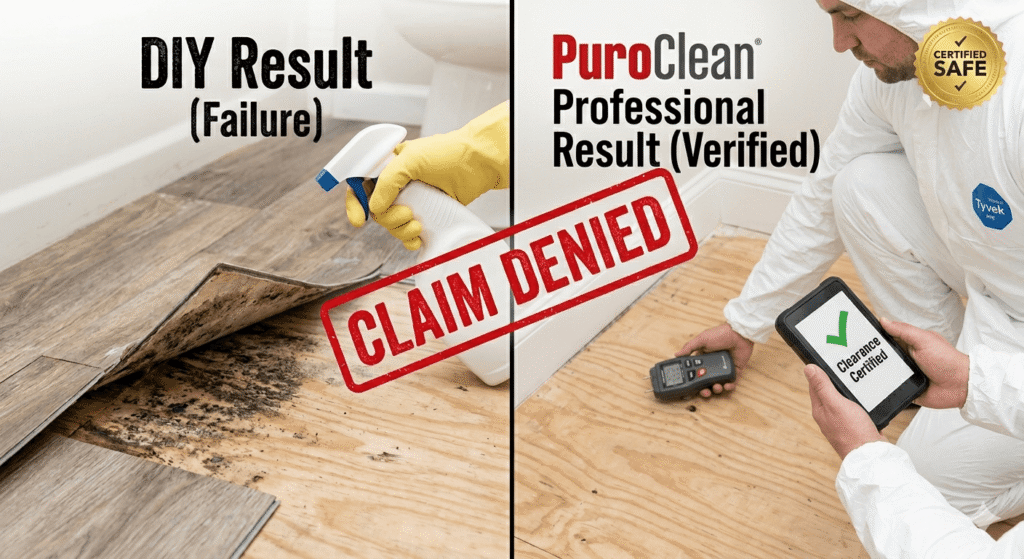
Furthermore, property insurance policies carry rigid rules regarding structural water damage. Most policies cover sudden and accidental water events, but they explicitly exclude damage caused by negligence or lack of proper mitigation. If an adjuster discovers that an active leak was left to fester because you relied on repeated DIY bleach applications, your carrier holds the right to deny your property damage claim entirely.
Partnering with an authorized thought leader like PuroClean of Santa Rosa Beach provides you with a comprehensive digital proof packet—including dry logs, infrared thermal imagery, and independent, third-party air clearance certification—ensuring your home equity is protected and your insurance eligibility remains intact.
Frequently Asked Questions (FAQ)
Can I just paint or seal over black mold on a subfloor?
No. Applying normal paint or standard primers over active mold merely hides the stain. The mold will continue to consume the wood cellulose beneath the sealant layer, eventually causing the paint to bubble, peel, and fail structurally.
What is a safe moisture level for a plywood subfloor?
A structurally sound and safe moisture content level for a plywood subfloor must remain consistently below 15%. Any sustained reading above 16% triggers a high risk for active fungal germination and structural wood rot.
How do professionals know if all the subfloor mold is completely gone?
Eradication is verified through independent, third-party Post-Remediation Verification (PRV) testing. This involves collecting ambient air volume samples and surface tape-lifts within the containment zone to scientifically confirm that spore counts match or fall below safe, natural outdoor baselines.
Take Action to Protect Your Investment
Don’t let a minor renovation discovery spiral into a catastrophic structural and financial disaster. Masking visible mold with store-bought chemical sprays only guarantees that you will spend thousands more correcting deep structural rot down the road.
If you have discovered dark spots, soft subflooring, or a persistent musty smell under your floors, handle it correctly the first time. Contact PuroClean of Santa Rosa Beach today at (850) 399-3380. Our certified, local specialists are standing by 24/7 to provide precision moisture mapping, engineered containment, and verified structural remediation to keep your home safe, dry, and structurally sound for the long haul.
Available 24/7/365 | Contact Us Online | Google Business Profile | IICRC Certified | Insurance Preferred | Complete Mold Remediation Solutions