


If you’re a Santa Rosa Beach homeowner or business owner facing the aftermath of flooding, a hidden pipe burst, or just the relentless coastal humidity, I know exactly the frustration you’re feeling. Standing water is stressful enough, but it’s the lingering worry after the initial cleanup that can be even heavier. You might be staring at a damp closet floor or sniffing a musty smell from the crawl space, wondering: “Did it really dry? Is that stain just dirt, or is it mold?” and, fundamentally, Is Mold on Plywood Dangerous in Subfloors?
The stress is real, and you don’t have to face it alone. This post is designed specifically for you. We are going to solve this mystery, strip away the confusion, and provide a clear, empathetic roadmap. We will explain exactly why that seemingly simple stain could be a structural time bomb and, more importantly, how to protect your property and your family from a truly expensive and hazardous disaster.
The Short Answer: Is Mold on Plywood Dangerous in Subfloors?
Yes, mold on plywood is extremely dangerous for Santa Rosa Beach homeowners because plywood’s layered veneer construction traps moisture between wood sheets. This trapping creates perfect conditions for aggressive mold growth that causes catastrophic delamination—where the layers separate completely, reducing structural capacity by 60-85%. Furthermore, this trapped moisture supports different mold species that can release toxic mycotoxins, trigger serious respiratory illness, remain invisible from above until structural failure occurs, and require specialized remediation.
Let me tell you about a local family who learned just how dangerous mold on plywood becomes.
The Watersound Beach Floor Collapse
A Watersound Beach family discovered the true extent of mold on plywood subfloors when their grand piano crashed through their living room floor. The 990-pound Steinway punched through, with one leg penetrating 14 inches into the crawl space below.
An emergency assessment by our team revealed mold on plywood had caused complete delamination throughout 1,340 square feet. The engineer could literally peel apart the individual veneer layers of the plywood subflooring with his hands.
Forensic analysis estimated growth had been occurring for 6-8 years. Testing identified seven different mold species colonizing the varied micro-environments within the layered plywood, including Stachybotrys (toxic black mold), Chaetomium, Serpula lacrymans (dry rot), Aspergillus, Penicillium, Trichoderma, and Cladosporium.
The consequences were profound:
- Remediation: All 1,340 square feet of plywood required complete replacement, twenty-six floor joists needed sistering or replacement, and all the hardwood flooring had to be removed and then reinstalled. Total cost: $114,000.
- Financial Denial: Insurance denied the claim citing “gradual deterioration.”
- Property Devaluation: When they later sold, their $1.35 million home sold for $1.09 million after 227 days. Comparable properties were selling for $1.38-$1.42 million in 45-75 days.
- Total Financial Impact: $114,000 in remediation, plus $290,000 in reduced sale price, plus $32,000 in holding costs, equaled a total loss of $436,000.
As PuroClean of Santa Rosa Beach’s plywood contamination specialist, I’ve seen mold on plywood cause structural collapses and six-figure disasters throughout the 30A corridor, Panama City Beach, Destin, and Dothan.
Here are the 7 hidden threats every Santa Rosa Beach homeowner must know.
Threat #1: Delamination and Complete Structural Failure
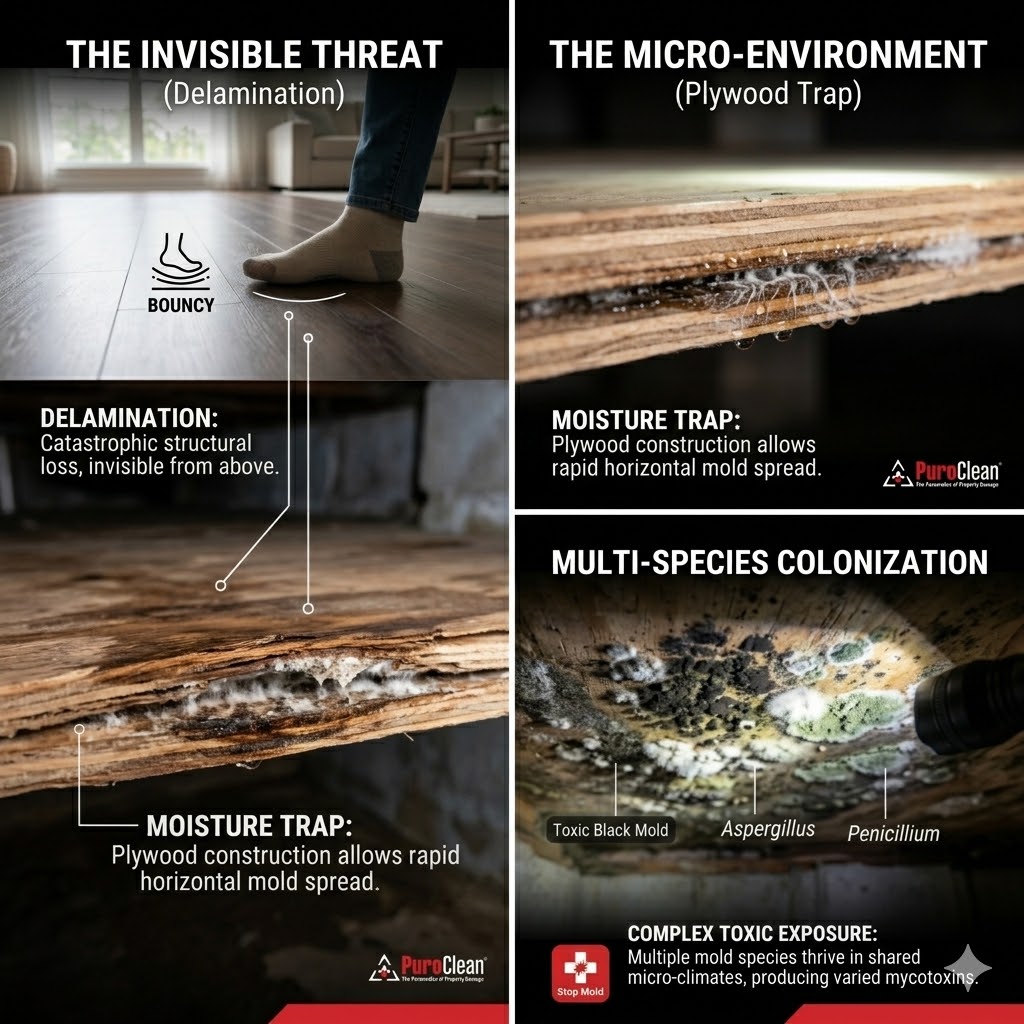
The first catastrophic threat proving that mold is dangerous on plywood subfloors is delamination. This is where individual veneer layers separate completely as mold enzymes dissolve the adhesive bonds. This creates a structurally failed material, despite the floor appearing perfectly intact from above.
Plywood uses 5-7 thin veneer layers bonded with strong adhesive. When mold on plywood begins, it grows between these layers where moisture becomes trapped. The mold secretes enzymes that break down both the wood cellulose and the adhesive compounds.
According to the Forest Products Laboratory, plywood loses 40-60% of structural capacity when delamination affects just 25-35% of the layer bonding. At 50% delamination, the capacity drops a staggering 70-85%.
The true danger: delamination is invisible from above until catastrophic failure occurs. Walking on delaminated plywood might feel slightly bouncy, but not necessarily alarming. Sudden failure only happens when a concentrated load (like a piano leg or a person) exceeds the rapidly diminishing remaining capacity.
Threat #2: Moisture Trapping Between Veneer Layers
The second threat that makes mold on plywood in subfloors dangerous is moisture trapping between the veneer layers. Once water has penetrated past the surface veneer, it cannot easily evaporate, creating sustained, perfect conditions for aggressive mold growth.
Water spreads horizontally between the plywood layers faster than it can evaporate vertically. This creates micro-environments with 90-100% relative humidity, even when the crawl space humidity might have been reduced to 70-75% by a standard dehumidifier.
Mold spores will germinate within 24-48 hours within these trapped moisture zones. This is also why surface cleaning is completely ineffective. Complete material removal is almost always necessary because no surface remediation can reach the active growth inside the plywood sheets.
A Seacrest Beach home provides a perfect example. They had mold on plywood throughout 680 square feet, despite having a crawl space dehumidification system installed two years earlier. The system was maintaining crawl space humidity at 62%, but the trapped moisture between the plywood layers continued to support aggressive growth until the complete subfloor was replaced.
Threat #3: Toxic Mycotoxin Production
The third threat proving Is Mold on Plywood Dangerous in Subfloors is the production of toxic mycotoxins.
The different micro-environments created between the varied plywood layers often host multiple species. This leads to complex exposures. Stachybotrys produces trichothecene mycotoxins, known for causing immune suppression and neurological effects. Aspergillus can produce aflatoxins (which are carcinogenic) and ochratoxins (which cause kidney damage).
According to the Centers for Disease Control (CDC), mycotoxin exposure can cause a wide range of serious issues, including respiratory irritation, immune dysfunction, neurological problems (brain fog, memory issues, concentration difficulty, mood changes), chronic fatigue, and potential organ damage.
Threat #4: Rapid Horizontal Spread Between Layers
The fourth threat demonstrates that mold is dangerous on plywood subfloors is its rapid horizontal spread. Mold grows between plywood layers at 3-4 times the rate of surface growth, allowing contamination to affect entire floor areas within 12-18 months.
The internal contamination typically exceeds any visible surface growth by 300-500%.
An Alys Beach home had visible mold on plywood covering just 40 square feet beneath a bathroom. Initial remediation planning assumed only 80-100 square feet were affected. The actual removal, however, revealed internal contamination spanning 420 square feet—more than 10 times the visible growth area. A planned $12,000 job became a $38,000 project.
Threat #5: Detection Difficulty Until Advanced Damage
The fifth threat proving mold is dangerous on plywood subfloors is detection difficulty. Contamination progresses to advanced delamination entirely hidden from view, which increases the eventual remediation costs 4-8 times.
Only a professional inspection of the crawl space or attic reveals this contamination in its early stages. Surface inspection from inside the living space shows no evidence until advanced structural failure begins.
The 5-7X cost multiplier results entirely from detection delay. Early detection (50-100 sq ft, minimal delamination) might cost $8,000-$15,000. Late detection (800-1,200 sq ft, advanced delamination requiring complete replacement and joist repairs) will likely cost $65,000-$110,000.
Threat #6: Respiratory Illness From Spore Exposure
The sixth threat demonstrating that mold is dangerous on plywood subfloors is the serious respiratory illness caused by billions of spores released from contaminated subflooring.
These spores rise through floor penetrations and cracks into the living spaces. According to the CDC, mold spore inhalation causes allergic rhinitis, asthma development, hypersensitivity pneumonitis, chronic sinusitis, respiratory infections, and immune dysfunction.
Children are particularly vulnerable. Developing lungs exposed to chronic spore inhalation develop asthma at 3-5 times higher rates than unexposed children. After remediation, while symptoms often improve significantly, some damage can be permanent.
Threat #7: Specialized Remediation Complexity
The seventh threat proving mold on plywood is dangerous is specialized remediation requirements. Removing contaminated plywood is 3-5 times more expensive than remediating solid wood.
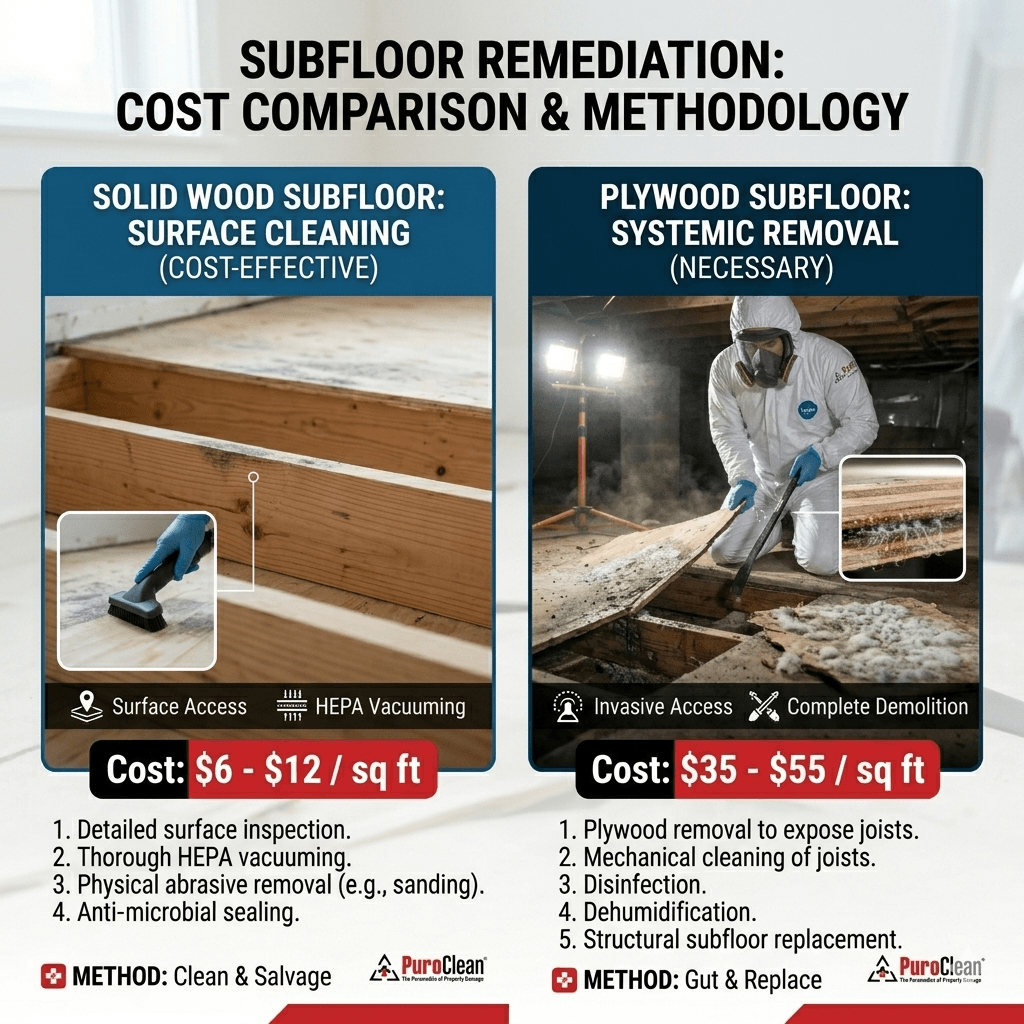
Mold on plywood remediation requires complete material removal (at a cost of $35-$55 per square foot) because surface cleaning ($6-$12 per square foot) cannot reach the mold between the veneer layers.
A Grayton Beach project comparison highlights this perfectly: Mold on plywood over 520 square feet cost $44,000. Solid wood surface mold over the same 520 square feet cost $8,200. The 5.4X cost difference resulted entirely from the material type and the requirement for removal vs. cleaning.
Frequently Asked Questions
What makes mold on plywood in subfloors more dangerous than mold on solid wood? Mold on plywood is more dangerous because plywood’s layered construction traps moisture between veneer sheets, creating sustained growth conditions. The mold penetrates deep between layers where cleaning cannot reach, requiring complete replacement. The enzymatic decomposition dissolves adhesive bonds, causing catastrophic delamination and severe structural failure. Solid wood mold primarily grows on surfaces where it can be cleaned without causing structural separation.
How quickly does plywood in a subfloor delaminate from mold? The delamination timeline is as follows: initial growth occurs 24-48 hours after moisture exceeds 20%. Early delamination (microscopic bond failure) starts within 6-12 months. Visible delamination is evident in 18-36 months. Severe delamination (40-60% capacity loss) occurs within 3-5 years, and catastrophic failure risk becomes critical after 5-8 years. Early detection is essential because even microscopic bond failure reduces structural integrity.
Can delaminated mold on plywood in subfloors be repaired or must it be replaced? Delaminated mold on plywood in subfloors must be completely replaced. No effective repair exists. All enzymatic damage to the adhesive bonds is irreversible, and building codes require structurally sound subflooring. Attempting to repair or clean delaminated plywood will not regain its original strength. This requirement is why remediation costs $35-$55 per square foot versus $6-$12 for solid wood surface mold.
How much does it cost to remove mold from plywood subfloor? Removing mold on plywood costs $35-$55 per square foot. For 700 square feet: $24,500-$38,500. This breakdown includes hardwood removal ($2,800-$5,600), plywood removal ($3,500-$5,600), joist repairs ($4,800-$30,000), new plywood ($4,200-$6,300), hardwood reinstallation ($8,400-$15,400), professional mold remediation ($5,600-$10,500), and verification testing ($800-$2,000). Total project cost with permanent moisture prevention: $40,000-$82,000.
How do I prevent mold from growing on my plywood subfloor? Prevention requires comprehensive moisture control: commercial-grade vapor barrier covering 100% of the crawl space floor, complete crawl space encapsulation ($5,000-$12,000), and a commercial dehumidifier maintaining 50-55% humidity. You must also seal foundation vents, ensure proper exterior drainage ($2,000-$8,000), schedule an annual professional inspection ($400-$800), and immediately repair all plumbing leaks within 24 hours. This initial investment provides a 250-600% ROI compared to the cost of remediation.
PuroClean of Santa Rosa Beach: Plywood Subfloor Specialists
The answer to Is Mold on Plywood Dangerous in Subfloors? is clearly yes. The layered construction that makes plywood a strong subfloor material also makes it uniquely vulnerable to catastrophic structural collapse and complex toxic contamination when moisture is trapped.
Don’t wait for a floor collapse. Early detection is everything. It prevents catastrophic failure and saves you $40,000-$80,000 in additional structural repairs.
Call PuroClean of Santa Rosa Beach at (850) 399-3380 for an emergency plywood assessment and crawl space inspection. We will identify any signs of delamination before structural failure occurs and complete specialized remediation with permanent moisture control to protect your Santa Rosa Beach property.
Available 24/7/365 | Contact Us Online | Google Business Profile | IICRC Certified | Insurance Preferred | Complete Water Damage Remediation Solutions