


There’s a reason so many of us choose to call Santa Rosa Beach home. The sugar-white sand, the emerald water, the slower pace of life along 30A — it’s hard to beat. But that same salty Gulf air that makes our evenings so beautiful is also working against your home, day and night, whether you notice it or not.
High coastal humidity is one of the biggest hidden threats to laminate flooring in our area. Moisture doesn’t need a storm or a burst pipe to cause damage — it just needs time, warmth, and a tight, sealed surface to hide beneath. That combination is exactly what creates laminate floor mold, and by the time you notice the smell or the soft spot underfoot, the problem has often been building for weeks.
This guide walks you through why it happens, what to watch for, and what to do about it — without the scare tactics or the sales pitch. Just straight talk from people who see this constantly on 30A.
Why Coastal Humidity Destroys Laminate
Laminate flooring is a great look for coastal homes, but it wasn’t really designed for our climate. It’s made of layered materials pressed tightly together, with a thin vapor barrier underneath. That barrier is meant to block some moisture — not survive constant coastal saturation.
Here’s what actually happens. Outdoor humidity in Santa Rosa Beach regularly sits well above what inland homes deal with. When that humid air meets a cooler air-conditioned interior, condensation forms — often right at the floor level, where it’s least visible. Add in a slow, easy-to-miss plumbing drip near a kitchen, bathroom, or laundry area, and you’ve got water finding its way under the planks with nowhere to evaporate.
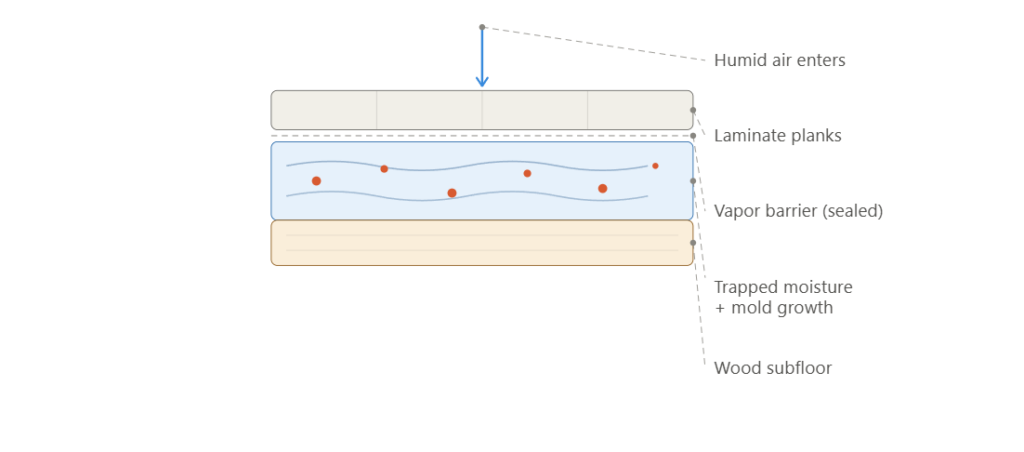
The North American Laminate Flooring Association (NALFA) — the industry’s accrediting body for laminate performance standards — identifies subfloor moisture as the leading cause of premature laminate failure, and specifically recommends a properly sealed vapor barrier for installations in high-humidity environments like ours.
Once moisture is trapped beneath laminate, it has no way to dry out. The flooring that’s supposed to protect your subfloor instead seals moisture in like a lid. Dark, damp, and undisturbed — that’s a textbook breeding ground for fungal growth. This is precisely how laminate floor mold takes hold in coastal homes: quietly, invisibly, and usually faster than homeowners expect.
The U.S. Environmental Protection Agency notes that indoor relative humidity above roughly 60% is likely to cause condensation and encourage mold growth — a threshold that many 30A homes cross regularly during Gulf Coast summers without a dedicated dehumidification strategy.
Vacation rental properties are especially vulnerable. Between guest turnovers, thermostat swings, and periods when the home sits empty with the AC set high, humidity levels inside can fluctuate constantly — giving laminate floor mold even more opportunity to establish itself between cleanings.
The Warning Signs to Look For
Laminate floor mold rarely announces itself with an obvious flood. It shows up in smaller, easy-to-dismiss clues. If you notice any of the following, it’s worth taking seriously:
- Soft, spongy, or springy spots when you walk across the floor, especially near exterior walls, kitchens, or bathrooms
- Buckling, warping, or cupping at the seams where planks meet, even if it’s just a slight lift
- A persistent musty odor that lingers no matter how much you mop, air out the room, or use air fresheners
- Dark or discolored staining creeping out from between the plank joints

Any one of these on its own could be a coincidence. Two or more together are a strong signal that moisture — and likely laminate floor mold — is active underneath the surface, not just on top of it.
Action Steps and Mistakes to Avoid
When homeowners spot staining or smell something off, the instinct is often to reach for bleach and scrub the surface. Unfortunately, that only cleans what you can see. Laminate floor mold problems live underneath the planks, in the subfloor and padding, where surface cleaners can’t reach.
Ignoring buckling planks is another common misstep. It’s tempting to hope a warped section will settle back down once the weather changes, but trapped moisture doesn’t resolve itself — it spreads. The longer affected laminate stays in place, the more moisture and mold spores migrate into the subfloor, adjacent rooms, and your home’s indoor air.
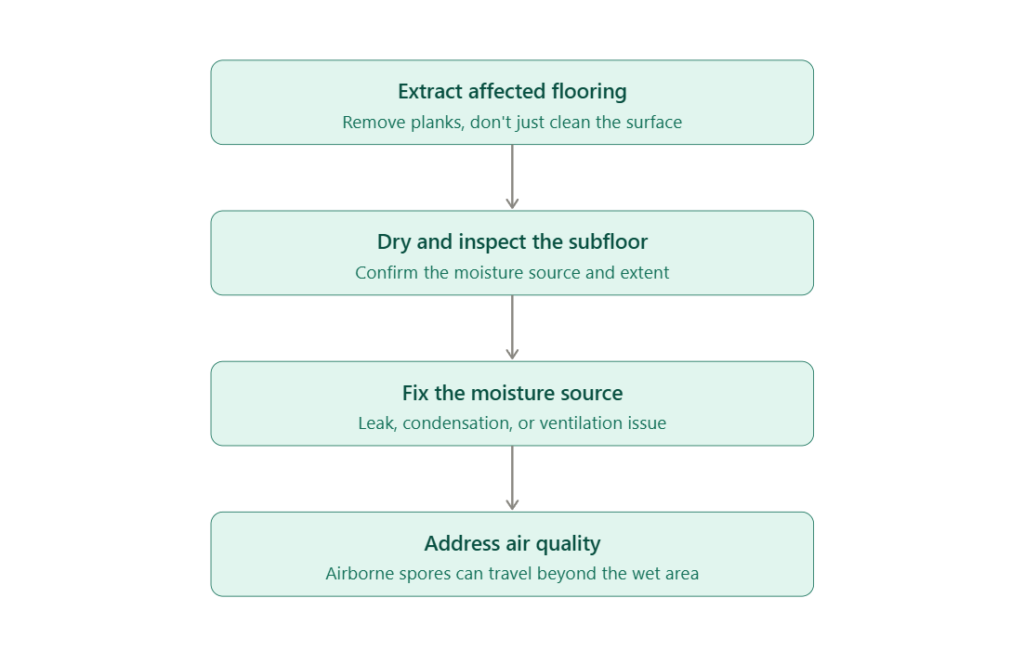
The right approach is methodical:
- Carefully extract the affected flooring rather than covering or bleaching it
- Inspect and dry the subfloor underneath to confirm the true source and extent of the moisture
- Identify and correct the moisture source — whether it’s condensation, a slow leak, or ventilation issues — so the problem doesn’t return
- Address air quality, since airborne spores can travel well beyond the original wet area
Trying to shortcut this process with surface-level fixes almost always costs more in the long run, both in repair costs and in warped laminate floor repair that has to be redone once the real cause is found.
Local Expertise Matters on 30A
Homes along the Santa Rosa Beach and 30A corridor face moisture challenges that differ meaningfully from inland Florida or northern climates. Effective 30A moisture removal accounts for salt air exposure, elevated ambient humidity, and the seasonal rental cycles that many local properties go through. A qualified Santa Rosa Beach mold remediation team should be familiar with these coastal humidity flooring damage patterns specifically — not just general water damage response.
Frequently Asked Questions
Can I just replace the damaged planks myself? You can, but if the subfloor moisture and its source aren’t addressed first, new planks will likely develop the same laminate floor mold issue again.
How fast can mold develop under laminate in coastal humidity? In consistently humid conditions, visible growth can begin within 24–48 hours of trapped moisture, though it’s often not detected until it’s more established. This aligns with EPA guidance recommending that water-damaged areas be dried within 24 to 48 hours to prevent mold growth from taking hold in the first place.
Does a musty smell always mean mold? Not always, but a persistent musty odor combined with any flooring irregularities warrants a professional moisture inspection to rule it out.
Is this covered by insurance? Coverage varies by policy and cause. Documenting the damage promptly and getting a professional assessment helps support any claim you may file.
The Takeaway
Addressing laminate floor mold early protects two things that matter most: your subfloor structure and your family’s or guests’ indoor air quality. What starts as a small soft spot near the baseboard can, if left alone, turn into a full flooring replacement and a lingering air quality issue throughout the home.
If you’re noticing warping, warped laminate floor repair needs, or a musty smell that won’t quit, don’t wait for it to get worse. Reach out for a professional moisture inspection today — catching it early is always faster, simpler, and less costly than remediation after the damage has spread.
Available 24/7/365 | Contact Us Online | Google Business Profile | IICRC Certified | Insurance Preferred | Complete Mold Remediation Solutions