


Mold prevention in Santa Rosa Beach crawl spaces requires comprehensive, year-round moisture control because our distinct coastal climate maintains an unforgiving 70% to 90% relative humidity level continuously. Along the Scenic Highway 30A corridor, historic and modern architectural designs frequently utilize pier-and-beam construction. While beautiful, this building style leaves crawl spaces directly exposed to ambient ground moisture and external air currents.
When seasonal rain patterns, tropical storms, and hurricane season dramatically intensify these moisture challenges, inadequate protection quickly spirals out of control. Property owners routinely face $40,000 to $85,000 in structural remediation costs when subfloor fungal contamination reaches catastrophic levels. Conversely, proactive prevention investments ranging from $12,000 to $25,000 can eliminate wood-destroying mold growth entirely. Securing your subfloor protects your home’s structural integrity, preserves high-end hardwood floors, and safeguards your family’s respiratory health for decades.
A cautionary tale from a Rosemary Beach homeowner illustrates the devastating financial impact of skipping these preventative measures. When he purchased his $875,000 coastal property in 2019, he waived a specialized crawl space inspection, assuming the building’s elevated structure provided natural ventilation. The previous owner had ignored subfloor moisture accumulation, never installing a high-performance vapor barrier or dedicated dehumidification equipment.
Six years later, the homeowner noticed an earthy, musty odor in his main living areas and felt physical “soft spots” developing in his master bedroom hardwood flooring. He contacted us for a professional assessment. Our forensic inspection revealed widespread, catastrophic microbial contamination sprawling across 1,100 square feet of subflooring plywood, advanced wood rot in multiple load-bearing floor joists, and an ambient crawl space humidity level averaging 85% to 90% year-round. A structural engineer verified that the wood decay had been developing silently for six to eight years.
The resulting remediation and structural reconstruction scope was extensive:
| Restoration Phase | Description of Structural Work | Out-of-Pocket Cost |
| Demolition | Complete removal and disposal of contaminated premium hardwood flooring | $14,000 |
| Subfloor Replacement | Stripping and replacing rotted structural plywood subflooring | $28,000 |
| Framing Repairs | Sistering and reinforcing structurally compromised floor joists | $18,000 |
| Mold Remediation | HEPA vacuuming, ice-blasting, and antimicrobial sanitization under containment | $16,000 |
| Encapsulation | Installing a sealed 20-mil crawl space vapor barrier system | $15,000 |
| Climate Control | Commercial-grade crawl space dehumidification system installation | $7,500 |
| Build-Back | Sourcing, installing, acclimating, and finishing new custom hardwood floors | $26,000 |
| TOTAL PROJECT COST | Emergency Structural Remediation & Reconstruction | $124,500 |
To compound the disaster, the homeowner’s insurance claim was completely denied. The adjuster cited standard policy exclusions for “gradual damage, long-term humidity exposure, and maintenance failure.” The entire $124,500 bill had to be paid out of pocket.
When we compared this catastrophic loss to the cost of the preventative measures he had skipped in 2019, the reality was stark. Implementing proper mold prevention in Santa Rosa Beach crawl spaces at the time of purchase would have required a vapor barrier installation ($2,500), complete crawl space encapsulation ($8,000), a commercial dehumidification system ($4,500), exterior drainage modifications ($2,000), and an initial professional moisture assessment ($800). The total prevention investment would have been just $17,800.
By delaying action for six years, the homeowner faced an additional $106,700 in emergency expenses—a massive 600% cost multiplier resulting entirely from skipping preventative moisture controls.
“I thought my crawl space would be fine as long as I didn’t see standing water down there,” he noted during the project wrap-up. “I didn’t realize that Santa Rosa Beach’s baseline humidity alone creates perfect mold conditions without a single plumbing leak. If I’d invested that $18,000 in proper prevention when I bought the home, I would have avoided a six-figure nightmare. Mold prevention isn’t an elective home upgrade; it’s the most cost-effective investment a coastal homeowner can make.”
As PuroClean of Santa Rosa Beach’s premier moisture mitigation specialists, we have spent over a decade helping homeowners protect their coastal properties. This technical guide outlines the exact year-round strategy required to protect pier-and-beam homes from the intense regional moisture challenges that threaten our community.
Mold Prevention in Santa Rosa Beach Crawl Spaces: Why Coastal Foundations Are Ground Zero for Fungal Growth
Understanding why mold prevention in Santa Rosa Beach crawl spaces is a non-negotiable aspect of property maintenance requires a look at the unique environmental forces overlapping along the Gulf Coast.
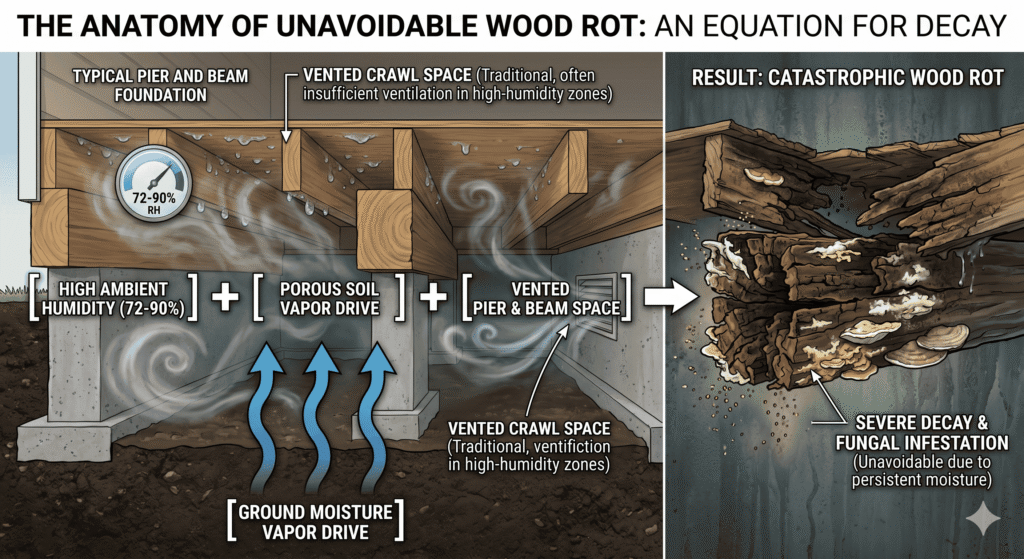
Constant ambient humidity is our primary regional risk factor. Santa Rosa Beach maintains an average annual relative humidity (RH) of 72% to 78%, with seasonal peaks locked between 85% and 90% throughout the summer and autumn months. According to structural drying criteria established by the Institute of Inspection, Cleaning and Restoration Certification (IICRC, https://www.iicrc.org), mold spores transition from dormant to active, aggressive growth when relative humidity remains consistently above 70%. Inland regions experience seasonal drops in humidity that allow structural wood to naturally dry out, but our coastal crawl spaces remain trapped in the danger zone year-round.
Architectural styling further compounds this risk. Pier-and-beam construction—found in approximately 65% to 70% of Santa Rosa Beach homes built before 1990—leaves the foundation crawl space open and vulnerable to the outdoor environment. Unlike a sealed concrete basement or a monolithic slab, open or traditionally vented crawl spaces allow heavy, moisture-laden coastal air to flow freely beneath the home. When this hot, humid air collides with the cooler underside of an air-conditioned subfloor, it reaches its dew point, resulting in micro-condensation along the wooden joists.
The Environmental Protection Agency (EPA, https://www.epa.gov) warns that mold colonies begin to germinate within 24 to 48 hours once organic building materials reach a material moisture content (MC) of 20% or higher. In Santa Rosa Beach crawl spaces lacking proper vapor barriers, structural wood routinely maintains a steady moisture content of 22% to 28% year-round. This provides an ideal environment for wood-decay fungi like Serpula lacrymans to destroy structural framing from the bottom up.
The 5-Phase Year-Round Prevention Strategy
Achieving flawless mold prevention in Santa Rosa Beach crawl spaces requires a comprehensive, multi-layered approach that addresses both soil vapor drive and atmospheric humidity.
Phase 1: High-Performance Vapor Barrier Installation
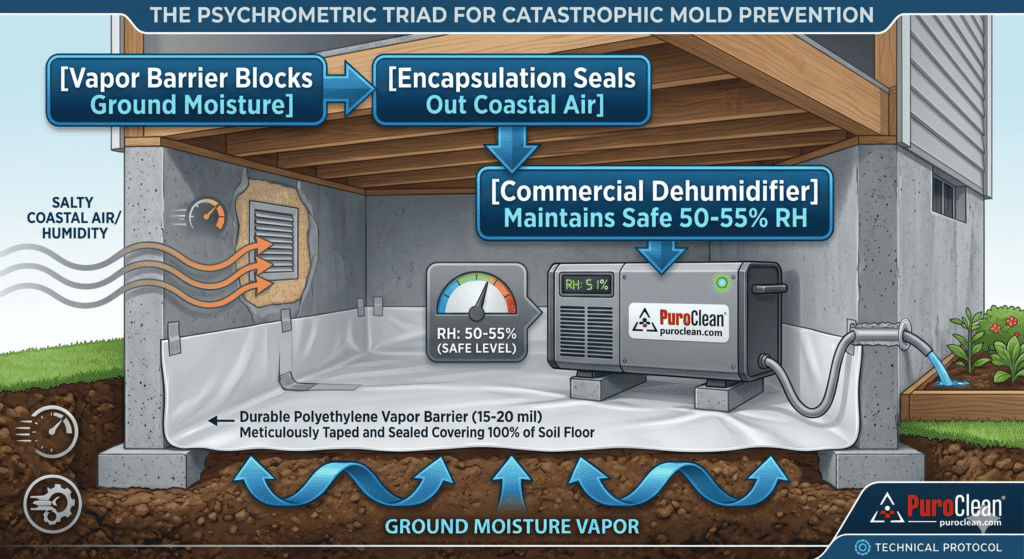
The foundation of all crawl space stabilization begins with stopping ground water transmission. Unsealed coastal soil acts as a continuous moisture pump, sending vapor upward via capillary action. To halt this process, we install a 15-mil to 20-mil reinforced puncture-resistant polyethylene vapor barrier across 100% of the crawl space floor.
This material must be pinned and sealed 12 to 24 inches up the foundation piers and perimeter stem walls. All seams must overlap by a minimum of 12 inches and be permanently bonded using heavy-duty, moisture-resistant acrylic seam tape. This mechanical layer blocks 95% to 98% of ground vapor transmission, immediately reducing the moisture load beneath your subfloor.
Phase 2: Complete Crawl Space Encapsulation
While a floor barrier stops ground moisture, encapsulation isolates the crawl space from volatile outdoor air. This process includes sealing off all traditional foundation vents with moisture-impermeable insulation boards, plugging structural masonry cracks, and fitting crawl space access hatches with commercial weatherstripping. By encapsulating the space, you eliminate the constant influx of humid air from the Gulf, creating a controlled, predictable environment that supports successful mold prevention in Santa Rosa Beach crawl spaces.
Phase 3: Commercial Dehumidification Systems
Once the crawl space is sealed, mechanical humidity control is required to keep relative humidity below the fungal growth threshold. Residential dehumidifiers cannot handle the high grain format of a coastal crawl space. We install heavy-duty, horizontal commercial dehumidifiers designed to operate in low-temperature, tight-clearance environments.
Proper system sizing is critical. An undersized unit will run continuously, burning out its compressor during peak August humidity. An oversized unit will short-cycle, failing to strip deep moisture from the wood grains while wasting energy. A typical 800-square-foot crawl space generally requires a unit capable of removing 70 to 90 pints of water per day (PPD) at AHAM standards, equipped with an integrated condensate pump to automatically drain water away from the foundation.
Phase 4: Exterior Drainage Optimization
Your foundation cannot stay dry if rainwater pools against your stem walls. Santa Rosa Beach receives an average of 56 to 60 inches of rainfall annually—far exceeding the national average of 38 inches. To handle this water volume, exterior grading must slope away from the foundation with a minimum drop of 6 inches over the first 6 horizontal feet. Roof gutters must be kept clean, and downspout extensions must discharge water at least 6 to 10 feet away from the home structure to prevent water from wicking back into the crawl space soil.
Phase 5: Annual Professional Moisture Mapping
Microscopic changes in soil shifting, foundation settling, or minor plumbing leaks can challenge any prevention system. Annual professional inspections utilizing non-destructive testing tools—including pinless wood moisture meters and FLIR thermal imaging cameras—ensure your encapsulation system remains intact. Catching a torn seam or a blocked dehumidifier drain line early prevents minor adjustments from turning into costly remediation projects.
Proactive Seasonal Maintenance Schedules
Managing moisture in a coastal climate requires adjusting system performance to match seasonal weather shifts along the Emerald Coast.
- Spring (March–May): Prepare your system for the upcoming summer surge. Clean your roof gutters, test your crawl space sump pump, inspect the vapor barrier for animal damage, and verify that your dehumidifier’s air filter is clean.
- Summer (June–August): This is peak humidity season, when relative humidity values consistently hit 90%. Your dehumidifier will run frequently to maintain a safe 50% to 55% RH target. Monitor your smart hygrometer closely and inspect your exterior drainage paths after heavy afternoon thunderstorms.
- Fall (September–November): Hurricane season brings increased risks of wind-driven rain and local flooding. Inspect your crawl space immediately following any major storm to ensure storm surges or high winds haven’t torn the perimeter encapsulation seals.
- Winter (December–February): Ambient humidity drops to its lowest level of the year. Use this dry period to schedule your annual professional structural moisture mapping inspection, ensuring your subfloor remains stable ahead of the spring rains.
Frequently Asked Questions
Is mold prevention in crawl spaces really necessary in Santa Rosa Beach?
Yes, implementing dedicated mold prevention in Santa Rosa Beach crawl spaces is absolutely essential for property preservation. Our local climate maintains an average annual humidity level well above the 70% threshold required for aggressive mold colonization. Without active moisture management, 95% of pier-and-beam homes in our area will eventually develop structural wood rot or subfloor mold. Investing $12,000 to $25,000 in proactive encapsulation protects your home from $40,000 to $85,000 in emergency remediation costs, delivering a clear 250% to 600% financial return.
How much does complete crawl space mold prevention cost in Santa Rosa Beach?
A comprehensive encapsulation and moisture control system typically requires an initial investment of $12,000 to $25,000, depending on the square footage and clearance of the crawl space. This includes a heavy-duty vapor barrier ($1,500–$3,500), structural encapsulation seals ($5,000–$12,000), a commercial-grade dehumidifier ($3,500–$7,000), and exterior drainage improvements ($2,000–$5,000). Ongoing operational costs average $40 to $80 per month in electricity for the dehumidifier, alongside an annual professional inspection fee of $400 to $800.
What if I already have mold growing in my crawl space?
If active microbial growth or wood-decay fungi are already present on your joists, you must completely remediate the existing contamination before installing any prevention components. Covering active mold with a plastic barrier traps the moisture inside the wood fibers, accelerating structural wood rot. Professional mold remediation typically costs between $8,000 and $25,000 depending on the severity of the damage. Once the wood is clean and sanitized under IICRC S520 standards, encapsulation can safely proceed.
Will homeowners insurance cover mold prevention in Santa Rosa Beach crawl spaces?
No, insurance carriers do not cover the cost of installing preventative moisture management systems. Insurance companies classify crawl space encapsulation, vapor barrier installation, and dehumidifier maintenance as standard homeowner maintenance responsibilities. However, maintaining clear documentation of your preventative systems can significantly strengthen your position during a future claim, as it demonstrates proactive care and helps prove that any new water damage stemmed from a sudden, accidental plumbing failure rather than long-term neglect.
How long does a 20-mil crawl space vapor barrier last?
When properly installed by certified professionals, a high-quality 15-mil to 20-mil reinforced polyethylene vapor barrier will easily last 15 to 20+ years. These heavy-duty multi-layer materials are specifically engineered to withstand subterranean environments without tearing or degrading. Regular annual inspections help identify minor issues, such as tape lifting or tears from cable technicians, allowing them to be quickly patched before moisture can bypass the system.
Can I install crawl space encapsulation as a DIY project?
While purchasing materials online to save on labor costs might seem appealing, DIY crawl space encapsulation carries significant risks for coastal properties. Improperly sealed seams, inadequate mechanical fastening along stem walls, or incorrect dehumidifier sizing can trap moisture against your subfloor, accelerating wood rot out of sight. Professional installation ensures your crawl space meets local building codes and achieves a permanent air-miser seal, protecting your real estate asset for the long term.
Partner with the 30A Area’s Leading Structural Drying Authority
Do not wait for sagging floors or strong musty odors to reveal a hidden moisture crisis beneath your home. Protecting a premium property on the Emerald Coast requires an accurate assessment of your foundation’s current moisture load. Our certified restoration team specializes in the scientific analysis, thermal diagnostics, and precision encapsulation necessary to keep coastal homes dry and safe year-round.
Choosing PuroClean for your mold prevention in Santa Rosa Beach crawl spaces means securing a custom engineered solution tailored to your home’s specific architecture and soil conditions. We provide clear data logs, certified IICRC expertise, and the long-term reliability required to safeguard your investment against the elements.
Take control of your indoor air quality and protect your subfloor from structural decay. Contact PuroClean of Santa Rosa Beach today at puroclean.com or call our emergency line at (850) 399-3380 to schedule a comprehensive crawl space moisture assessment.
Available 24/7/365 | Contact Us Online | Google Business Profile | IICRC Certified | Insurance Preferred | Complete Mold Remediation Solutions