


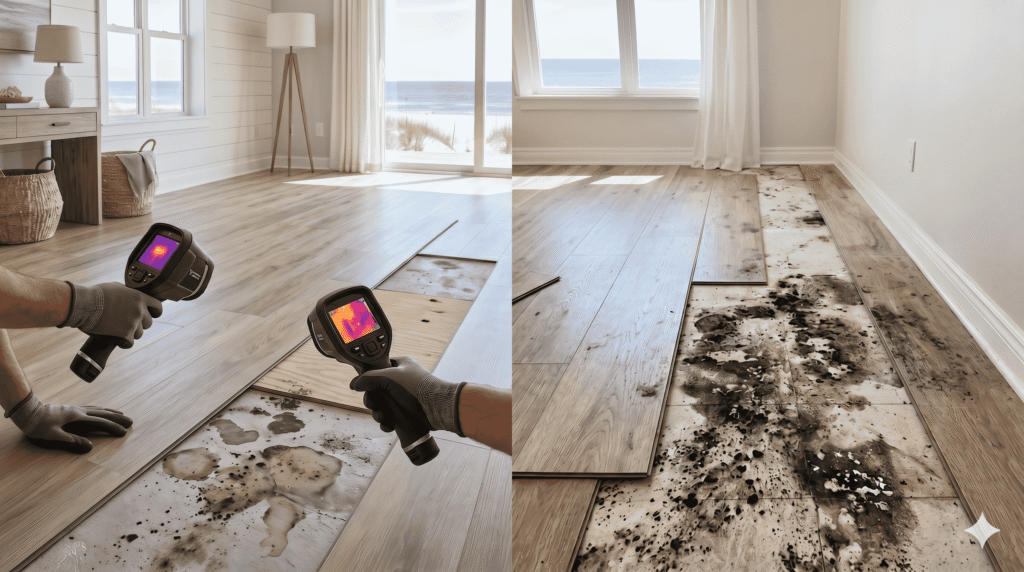
Mold under luxury vinyl plank flooring has become one of the most widespread, expensive, and misunderstood property crises facing coastal homeowners today. As a recognized authority in structural restoration, PuroClean of Santa Rosa Beach is stepping forward to expose a dangerous architectural paradox that is quietly destroying subfloors along the 30A corridor.
In recent years, Luxury Vinyl Plank (LVP) has skyrocketed in popularity, marketed heavily as the ultimate “100% waterproof” flooring solution. It seems like a dream choice for beach houses, coastal rentals, and high-humidity environments. But here is the alarming truth that big-box retailers won’t tell you: while the vinyl plank itself is completely impervious to water, its synthetic backing acts as a flawless, non-porous vapor barrier. When moisture finds its way beneath those tightly locked seams, it cannot evaporate upward. Instead, the “waterproof” flooring seals the liquid directly against your organic plywood or concrete subfloor, creating a dark, stagnant incubation chamber. Before you ever notice a stain on the surface, mold under luxury vinyl plank installations can completely rot your home’s structural foundation.
How Moisture Gets Trapped Beneath LVP Flooring
The manifestation of mold under luxury vinyl plank systems is directly tied to the unique physics of coastal construction and microclimates. Water does not need a catastrophic flood to compromise your flooring; it relies on silent, invisible vectors that homeowners frequently ignore.
According to the World Health Organization (WHO) Guidelines for Indoor Air Quality, sustained dampness in structural assemblies is the primary driver of microbial proliferation and building material decay. In coastal environments, this moisture accumulates beneath LVP via three main pathways:
1. Concrete Slab Sweating and Capillary Action
Groundwater beneath concrete slab-on-grade foundations is under constant hydrostatic pressure. Without a pristine, commercial-grade vapor barrier underneath the slab, moisture is drawn upward through the porous concrete grid via capillary action. When it reaches the surface, it encounters the impermeable bottom of the LVP. The concrete “sweats,” and the moisture is trapped with nowhere to go.
2. Crawl Space Humidity Migration and Vapor Drive
For homes built on crawl spaces, high outdoor humidity creates a massive vapor pressure differential. The hot, humid air outside pushes its way into the cooler, air-conditioned crawl space. From there, the moisture drives upward through the porous plywood subfloor. Once it passes through the wood, it hits the absolute roadblock of the vinyl planks, condenses into liquid water, and saturates the subfloor interface.
3. Pinhole Appliance Leaks and Seam Seepage
While LVP panels repel surface spills, the click-lock seams are rarely completely airtight. Minor ice maker line leaks, dishwasher drips, or tracking in damp sand and saltwater can send tiny amounts of water between the joints. Traditional wood flooring allows this minor moisture to naturally breathe and evaporate over time; LVP seals it in permanently, ensuring a fungal outbreak.
The Critical Warning Signs: Spongy Seams and the Tell-Tale Musty Odor
Because vinyl is completely opaque, discovering mold under luxury vinyl plank finishes requires a high level of vigilance. You cannot rely on visual discoloration because the mold grows entirely underneath the visible surface. Homeowners must look for physical and olfactory cues:
- The Tell-Tale Musty Odor: Fungi release volatile organic compounds (VOCs) as they digest the wood cellulose beneath the floor. If a specific room or hallway develops a heavy, earthy, or damp smell that persists despite deep cleaning, mold is actively colonizing the subfloor grid.
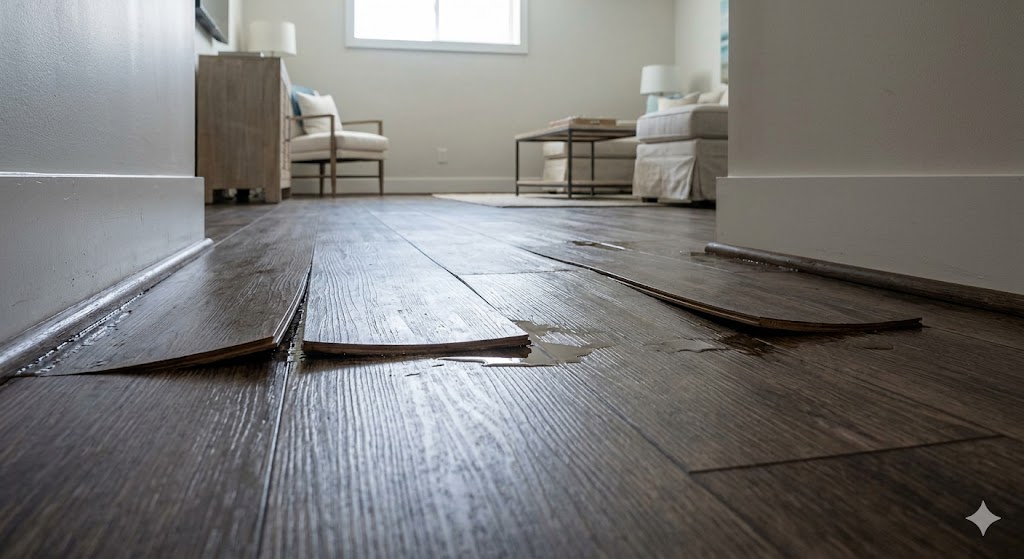
- Spongy, Bouncing, or Squeaking Seams: As plywood subfloors absorb trapped moisture, the wood fibers expand, soften, and begin to delaminate. When you walk across the floor, you may notice a slight “give,” sponginess, or an unusual deflection along the plank seams.
- Cupping, Joint Peaking, or Cushioning: Even though the planks are synthetic, intense vapor pressure from underneath can cause LVP locking mechanisms to warp, lift, or form small peaks at the edges, indicating a severe moisture imbalance below.
The True Cost of Delaying LVP Demolition
When dealing with a hidden moisture crisis, procrastination is an incredibly expensive liability. Many property owners hesitate to tear up a floor that looks visually pristine on top, hoping the moisture will eventually dry out on its own.
The Institute of Inspection Cleaning and Restoration Certification (IICRC) S500 Standard for Professional Water Damage Restoration explicitly states that trapped moisture within multi-layer flooring assemblies cannot be effectively dried through surface air movement alone. Demolition and direct access are legally required to prevent widespread structural degradation.
Consider the severe financial trajectory documented by PuroClean of Santa Rosa Beach:
By attempting to “save” a $4,000 cosmetic vinyl floor layout, you trap the water until it completely destroys the underlying structural framing. What could have been a quick, localized extraction turns into a massive $22,000 deep structural remediation involving structural engineering, joist replacement, and whole-house particulate cleaning.

The Professional Extraction and Structural Drying Solution
Eradicating mold under luxury vinyl plank installations requires a surgical, scientific approach that goes far beyond generic DIY cleaning solutions. PuroClean of Santa Rosa Beach utilizes an advanced, multi-step structural stabilization protocol to safely restore your home’s integrity:
1. Controlled Material Removal and Separation
Technicians establish strict containment zones using negative air pressure machines to prevent invisible mold spores from entering the home’s HVAC system. The affected LVP is carefully uncoupled and removed to expose the true extent of the subfloor dampness.
2. High-Precision Infrared Moisture Mapping
Using advanced FLIR thermal imaging cameras and non-penetrating digital moisture meters, our team maps the exact boundaries of the moisture migration, uncovering hidden water paths behind baseboards and bottom wall plates.
3. HEPA Particulate Extraction
The raw subfloor is thoroughly vacuumed using certified HEPA filtration systems to capture resting fungal spores, dust, and physical debris before any mechanical agitation occurs.
4. Antimicrobial Subfloor Sanitization
The exposed concrete or wood subfloor is treated with industrial-grade, low-surface-tension biocides. These professional formulas penetrate deep into the substrate cells to neutralize fungal root systems without adding destructive residual wetness.
5. Desiccant Dehumidification and Structural Stabilization
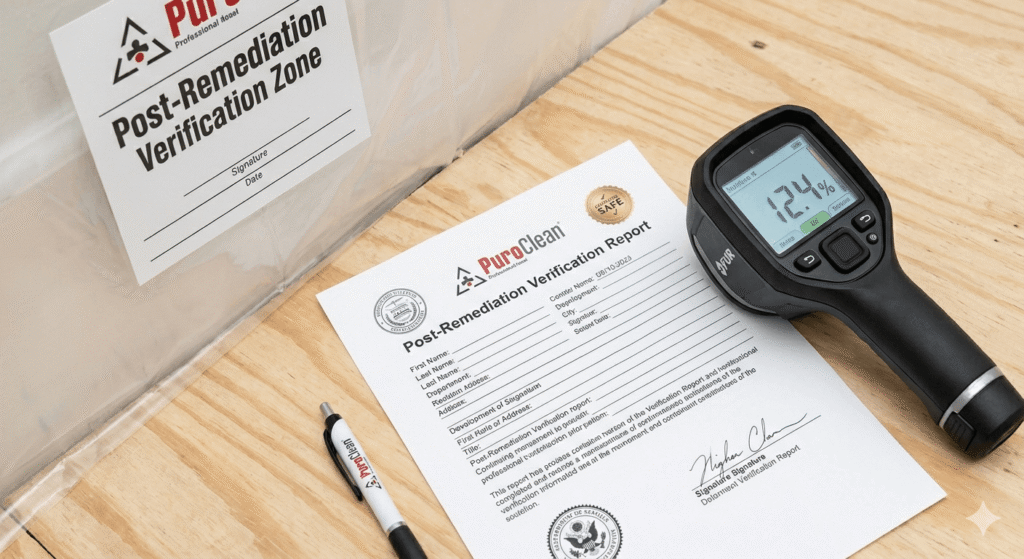
Technicians deploy low-grain refrigerant (LGR) or desiccant dehumidifiers paired with high-velocity axial air movers. We continuously track psychrometric data until the subfloor’s internal moisture content safely drops below 15%, guaranteeing the wood is stable and completely inhospitable to future microbial growth.
Safeguarding Asset Value and Preventing Recurrence
In coastal real estate markets, failure to properly handle a moisture crisis can severely impair your property’s value. Fungal issues that are masked or handled via uncertified DIY methods frequently trigger red flags during real estate transactions. According to property protection studies published by the National Association of Residential Property Managers (NARPM), homes with unverified or uncertified structural moisture damage can suffer an immediate 10% to 15% reduction in market valuation, or see purchase contracts completely collapse at the inspection table.
Furthermore, attempting to handle a complex water loss without certified documentation can void your insurance coverage. Most insurance providers demand proof of rapid, professional mitigation to honor water damage claims. By hiring a certified leader like PuroClean, you receive a comprehensive documentation packet—complete with dry logs, atmospheric charts, and third-party air clearance verification—ensuring your investment remains fully protected.
Frequently Asked Questions (FAQ)
Can I save and reuse Luxury Vinyl Plank flooring after a mold outbreak?
Generally, no. While the top wear layer of LVP is non-porous, many planks feature integrated cork, foam, or felt underlayments that are highly porous. These backing materials absorb mold spores and mycotoxins, making complete sanitization impossible. Reinstalling contaminated planks will quickly trigger a secondary outbreak.
How long does it take for mold to grow under LVP flooring after a leak?
Under ideal conditions—specifically temperature levels above 70°F and relative humidity levels exceeding 60%—mold spores can germinate and begin colonizing a damp subfloor within 24 to 48 hours of a moisture event.
Will a standard underlayment vapor barrier prevent mold under LVP?
A vapor barrier can protect the LVP from moisture rising up from a concrete slab, but it can also trap water that leaks down from above (such as appliance leaks or edge seepage). True prevention requires managing indoor humidity, utilizing professional click-lock seam sealants, and maintaining a dry crawl space environment.
Take Action to Protect Your Coastal Property
Do not let the illusion of “waterproof” flooring compromise the structural integrity of your home. If your floors feel unusually spongy, if you notice localized squeaking, or if you are greeted by a persistent, musty odor, act immediately before a minor moisture issue spirals into a catastrophic structural emergency.
Trust the premier certified experts in the Florida Panhandle. Contact PuroClean of Santa Rosa Beach today at (850) 399-3380 to schedule a professional precision moisture assessment and preserve your home’s safety and value.
Available 24/7/365 | Contact Us Online | Google Business Profile | IICRC Certified | Insurance Preferred | Complete Mold Remediation Solutions