


Discovering a persistent, musty odor in your otherwise beautiful Santa Rosa Beach home is alarming. That distinctive smell is rarely “just old wood”—it is often the first and most definitive warning sign of hidden microbial growth. When your wood floor smells musty, it typically indicates that mold under hardwood floors has already established a significant colony, potentially spreading across 200 to 500+ square feet of subfloor before it becomes visible on the surface.
This is a critical moment for your property and your health. Ignoring this scent allows fungal organisms to thrive in the dark, damp space between your finished flooring and the underlying subfloor. Other common warning signs that mirror this odor include floorboard cupping, unexplained dark discoloration, developing soft spots in the high-traffic areas, and family members noticing respiratory symptoms that worsen only when at home.
Early odor recognition and prompt detection are your best defenses against an overwhelming environmental issue. Acting quickly when you smell that musty wood floor scent can prevent a localized moisture problem from escalating into a complex, $30,000+ remediation project. Understanding the science behind this odor—and, crucially, how to clean plywood subfloor structures properly if they become contaminated—is essential for any coastal Florida homeowner.
Is a musty smell under wood floors dangerous?
Yes, a musty odor emanating from hardwood floors is dangerous as it strongly indicates active mold growth. This scent is caused by Microbial Volatile Organic Compounds (mVOCs), which are gases released by fungi during their growth cycle. Prolonged exposure to these mVOCs and airborne mold spores can cause severe respiratory distress, amplify allergies, and trigger asthma attacks. Furthermore, the mold degrades the wood itself, compromising the structural integrity of both the finished flooring and the plywood subfloor underneath. Professional environmental assessment is required when this odor is present.
Understanding Why Your Wood Floor Smells Musty
When you encounter a musty wood floor smell, you are not smelling the mold itself, but rather the gases it creates. These compounds are highly pervasive and can seep through the smallest cracks and seams in your finished hardwood.
The primary culprit in Santa Rosa Beach is our intense coastal humidity (relative humidity frequently exceeding 70%). This humidity wicks moisture into the building envelope. Combined with common hidden issues like slow plumbing leaks, pinhole leaks in slab-on-grade foundations, or faulty flashing around windows, the subfloor area becomes a perfect incubator. The porous finished wood and the underlying plywood subfloor absorb this moisture, providing the food source mold needs.
8 Definitive Warning Signs of Hidden Mold Under Hardwood Floors
Odor is the master signal, but microbial growth rarely works alone. If your wood floor smells musty, you must proactively look for these eight corresponding physical and environmental clues.
1. Water Floorboard Cupping and Crowning
When the plywood subfloor becomes saturated, it expands and warps, forcing the finished hardwood floorboards out of alignment. “Cupping” occurs when the edges of the boards are higher than the center. “Crowning” is the opposite, where the center of the board humps upward.

2. Unexplained Dark Discoloration and Staining
This is often mistaken for pet stains or dirt. Mold growth behind walls and under floors appears as dark gray, black, or deep green spotting and streaking along the wood grain. This discoloration usually starts in the corners or near water sources.
3. Soft Spots and Spongy Flooring
Fungi feed on cellulose, the structural component of wood. As the subfloor is consumed, it loses its structural integrity. If a section of your floor feels soft, spongy, or “gives” significantly when stepped on, the subfloor is likely severely compromised.
4. Peeling, Flaking, or Bubbling Finish
Water wicking up through the wood forces the protective surface finish (polyurethane or varnish) to detach. This creates visible bubbles or flaking along the seams of the floorboards.
5. Worsening Health Symptoms at Home
Mold affects air quality long before it affects property value. Homeowners may experience:
- Chronic sinus congestion
- Unexplained headaches
- Fatigue
- “Brain fog”
- Persistent, dry cough If these symptoms disappear when you leave the home for a few days, the environment is the source.

6. Increased Pest Activity
Pests like carpenter ants, termites, and wood-boring beetles are drawn to wood that is already soft and compromised by moisture. Fungal growth facilitates this decomposition process.
7. Buckling or Lifting Floorboards
This is an advanced stage of water damage. A sections of the floor actually lifts several inches off the subfloor, often creating a trip hazard. This indicates complete saturation of the subfloor and total structural failure.
8. Elevated Readings on Professional Moisture Meters
The surest way to confirm a problem is with technology. Professional restoration experts use non-invasive moisture meters and thermal imaging to “see” hidden moisture pockets without tearing up the floor.
How to Clean Plywood Subfloor After Discovering Hidden Mold
If hidden mold is confirmed through testing or direct observation, the critical step—and the element that prevents future mold outbreaks—is addressing the contamination on the subfloor itself. This is a task that must adhere strictly to professional guidelines (like the IICRC S520).
Understanding how to clean plywood subfloor structures properly is the difference between a permanent fix and a repeating nightmare. Plywood is incredibly porous; “cleaning” it must involve source removal, not just killing the surface growth.
The professional process involves these non-negotiable steps:
1. Correct the Moisture Source
You cannot clean mold until you stop the water. In Santa Rosa Beach, this often means addressing sub-slab leaks, installing vapor barriers, or managing exterior groundwater.
2. Removal of Contaminated Materials
In cases where mold has caused structural rot (creating soft spots), the plywood cannot be cleaned and must be cut out and replaced. Superficial cleaning will not restore the structural integrity that fungi have destroyed.
3. HEPA Vacuuming and Controlled Demolition
For surfaces that can be salvaged, the process begins with HEPA-filtered vacuuming of the entire area. This safely captures settled spores and visible growth without sending them airborne.
4. Physical Removal: Wire Brushing and Sanding
This is the most critical part of how to clean plywood subfloor effectively. Because mold grows into the porous wood grain, technicians must physically remove the top layer of contaminated cellulose. This involves aggressive wire brushing and/or sanding of the salvaged subfloor until clean wood is revealed.
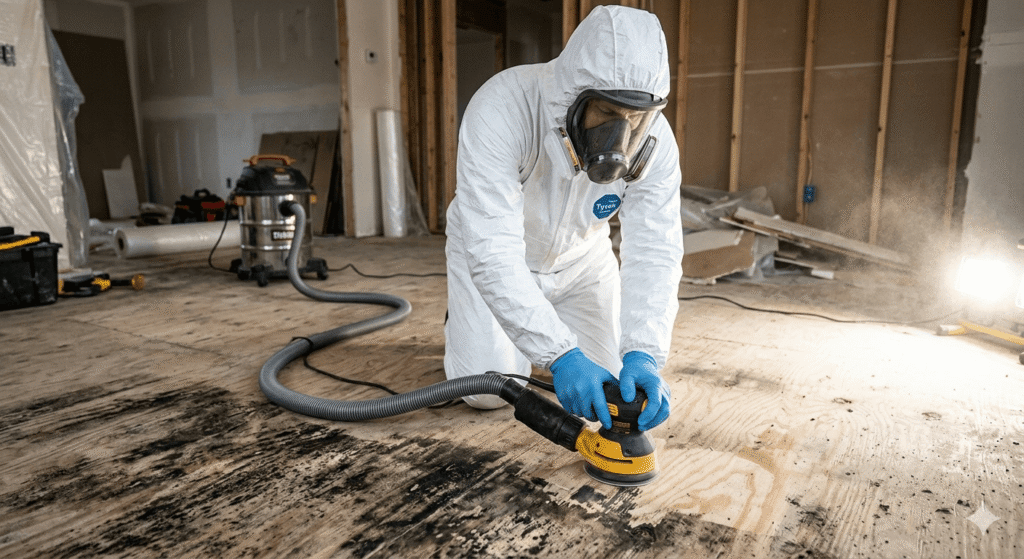
5. Final Sanitization and Air Scrubbing
After the physical removal, the subfloor is again HEPA vacuumed and treated with an EPA-registered antimicrobial agent. Industrial air scrubbers are used during the entire process to maintain negative air pressure, preventing cross-contamination to the rest of the home.
Partner with PuroClean for Local Santa Rosa Beach Support
If your wood floor smells musty, do not try to manage the problem yourself. At PuroClean of Santa Rosa Beach, we understand the specific challenges of Walton County, including our unique soil types and intense coastal humidity.
We are IICRC certified and committed to restoring your home’s safety and value. We proudly serve:
- Santa Rosa Beach
- Miramar Beach
- Destin
- 30A Communities
- Freeport
We are available 24/7 for emergency assessment. Our technicians utilize the latest technology—including thermal imaging, advanced moisture mapping, and EPA-approved air filtration—to find the source of that musty wood floor scent and implement a certified solution.
Contact PuroClean of Santa Rosa Beach today or call us now for a comprehensive mold assessment and professional subfloor cleaning.
Available 24/7/365 | Contact Us Online | Google Business Profile | IICRC Certified | Insurance Preferred | Complete Water Damage Remediation Solutions