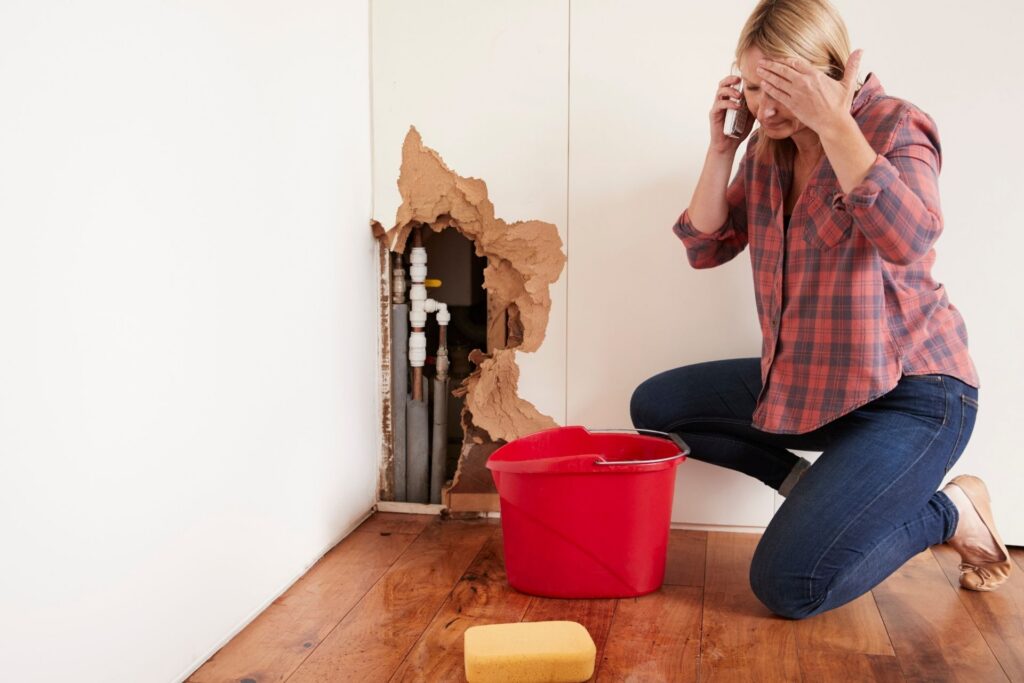
There’s a specific kind of panic that hits when you walk into a room and find a pipe burst with water pouring out of a wall or ceiling, and your brain wants to do about six things at once. Ignore all of them but one. Find your main water valve and shut it off before you do anything else; the plumber calls, the soaked rug you want to save, the insurance photos, all of that comes second. Stopping the flow is what actually limits the damage, so it’s the one thing worth doing on autopilot.
Why Do the First Few Minutes Matter So Much?
Frozen pipes are the most common cause of sudden bursts. As water freezes, it expands, and inside a closed pipe, that expansion creates an ice blockage. According to the Insurance Institute for Business & Home Safety, it’s not the ice itself that splits the pipe open; it’s the pressure that builds up in the trapped liquid water between that blockage and a closed faucet.
That pressure keeps climbing until the pipe fails, often at a spot with little or no ice at all, and once it gives way, water keeps flowing at full force until something stops it. That something needs to be you, not the plumber who’s still twenty minutes away.
Step One: Shut Off the Main Water Valve
Locate your home’s main shutoff valve and turn it off before doing anything else. In most Jacksonville homes, it’s near the water meter, in a crawl space, a utility closet, or where the main line enters the house. If you don’t already know where yours is, this is worth figuring out today, not during an emergency. Every adult in the household should know its location and how to operate it, since a delay of even a few minutes while searching for the valve translates directly into more water on your floors and inside your walls.
Step Two: Cut Power to the Affected Area if It’s Safe
If the burst pipe is anywhere near outlets, switches, or a breaker panel, shut off electricity to that part of the house before you do anything else in the room. Water and electrical current are a dangerous combination, and if you’re not confident which circuits control which areas, shutting off power to the whole house is the safer call. Don’t wade into standing water near an outlet or appliance until power is confirmed off.
Step Three: Start Removing Standing Water
Once the water source is off and the area is safe, begin removing standing water with towels, a wet vac, or buckets. Every minute water sits on flooring or soaks into drywall increases how much needs to be repaired later, so this step is about limiting the spread, not achieving a perfect cleanup. Move furniture, rugs, and belongings out of the affected area if you can do so safely, since porous materials left sitting in water damage faster than almost anything else in the room.
Step Four: Document Everything Before You Clean Further
Take photos and video of the damage before you move too much or start drying things out. Insurance claims move faster and more smoothly with clear documentation of what happened and what was affected, including close-ups of damaged belongings, flooring, and walls. This is also the point where it’s worth noting the approximate time you discovered the burst, since that timeline can matter for your claim.
Step Five: Call a Plumber and a Restoration Company
A plumber needs to repair the actual pipe, but that’s only half the problem. Even after the leak is fixed, the water that’s already inside your walls, flooring, and insulation needs to be professionally extracted and dried, not just mopped up and left to air out. This isn’t a step to delay while you handle other things; the two calls can happen back to back.
Why Can This Be a Problem in Coastal NC Homes?
Burst pipes are common enough that insurers track them closely. About one in 60 insured homes files a water damage or freezing claim each year, with an average claim cost of $13,954, according to the Insurance Information Institute. That average includes everything from a small supply line leak to a full burst, which means a genuine burst pipe, the kind causing serious water damage, often costs well more than that $13,954 figure suggests.
In a Jacksonville home, older plumbing and the occasional hard freeze during winter make this an even more realistic scenario than homeowners often expect, which is exactly why knowing the sequence ahead of time matters more than figuring it out in the moment.
We’re Ready When You Need Us
At PuroClean of South Onslow, we respond to burst pipes and water damage across Jacksonville, Hampstead, and the surrounding Onslow County area around the clock. Contact our team the moment you discover a burst pipe, or call us directly at (910) 787-1881, and we’ll get extraction and drying underway fast.
Frequently Asked Questions
Where is the main water shutoff valve usually located?
Most commonly near the water meter, in a crawl space, basement, utility room, or where the main line enters the home. Every household member should know its location in advance.
Should I try to fix the pipe myself before calling a plumber?
No. Shutting off the water is the right immediate step, but pipe repair should be left to a licensed plumber to avoid further damage or an improper fix that fails again.
Is it safe to walk through standing water after a pipe bursts?
Only after confirming electricity is off to the affected area. Water and live electrical circuits together pose a serious shock risk.
How quickly does mold start growing after a pipe bursts?
Mold can begin developing within 24 to 48 hours in wet materials that aren’t fully dried, which is why fast professional extraction matters even after the leak itself is fixed.
Will homeowners insurance cover burst pipe damage?
Most standard policies cover sudden, accidental water damage like a burst pipe, though coverage details vary. Reviewing your policy or asking your agent before an emergency happens is worth the time.
Can I use a regular wet vac to remove the water myself?
For small amounts, yes, but a wet vac won’t pull moisture out of drywall, subflooring, or insulation the way professional extraction equipment can, which is why a full restoration assessment still matters even after visible water is gone.