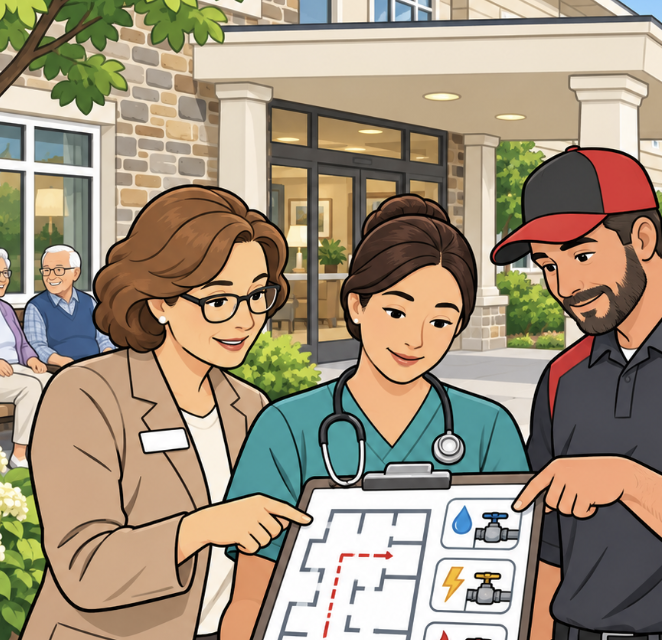
When water damages a senior living facility, protect residents first, isolate the affected zone, stop the source when safe, and activate the facility’s emergency and continuity procedures. Notify nursing, administration, facilities, risk management, infection prevention, and the restoration team. Document the source, affected rooms, resident moves, utilities, equipment, medications, records, and operational restrictions.
A response plan must account for more than wet materials. Residents may rely on oxygen, mobility devices, medication schedules, memory-care routines, dietary services, accessible bathrooms, and climate control. Restoration should be organized around continuity of care and clear authority.
Immediate Priorities
CMS emergency-preparedness guidance identifies risk assessment, communication, policies and procedures, and training and testing as four core planning elements for participating healthcare providers.[1] The facility’s existing plan—not the restoration contractor—governs resident care and regulatory decisions.
Classify the Water Source
A recent potable-water pipe break is different from sewage, groundwater, used appliance water, sprinkler discharge, or water that has remained in contaminated materials. Source, contact, and time affect protective equipment, containment, cleaning, and material removal.
Do not allow residents or unprotected staff to walk through affected corridors. If sewage or unknown water is present, isolate the area and avoid uncontrolled fans that could spread contaminants.
Build a Zone-Based Restoration Plan
Senior living facilities rarely operate as one open space. Map the loss by resident rooms, bathrooms, nursing stations, dining areas, kitchens, therapy rooms, memory-care units, corridors, mechanical spaces, and the floor below.
For each zone, record:
Resident Relocation and Continuity of Care
Facility leadership decides whether residents shelter in place, move within the building, or transfer. The decision should account for care level, cognition, mobility, oxygen, medications, infection precautions, transportation, family communication, receiving capacity, and the condition of utilities and life-safety systems.
CMS guidance expects emergency planning to be coordinated within the facility, across healthcare providers, and with public health and emergency-management partners.[1] Restoration contractors support the building response but do not direct clinical care.
Water Extraction, Cleaning and Drying
Once the zone is safe and the source is controlled, professional work may include standing-water extraction, moisture mapping, contents protection, selective removal, cleaning, air movement, dehumidification, and repeat monitoring.
Water can remain beneath resilient flooring, inside drywall, behind casework, above ceilings, or in insulation. Surface appearance is not a drying standard. The EPA recommends drying water-damaged areas and items within 24 to 48 hours when possible.[2]
In occupied care environments, equipment placement should preserve egress and accessibility. Cords, hoses, noise, heat, and airflow require coordination with facility leadership. Containment and pressure relationships may be needed to protect unaffected areas.
Medical Equipment, Records and Contents
Facility staff and manufacturers should determine whether resident-care equipment, medication storage, packaged supplies, wheelchairs, mattresses, lifts, electronics, and records can remain in service. Do not return wet or compromised equipment to use based only on a dry exterior.
Separate wet contents from dry contents and record their original location, condition, movement, and disposition. Protect resident privacy throughout photography and documentation.
Communication During Restoration
Use one authorized facility lead and one restoration lead. Establish a predictable update schedule covering:
Documentation and Return to Service
A restoration record may include photos, moisture readings, equipment logs, material-removal details, cleaning records, daily updates, and remaining repair needs. The facility and applicable authorities decide when an area can return to resident use. Environmental consultants, code officials, infection prevention, the insurer, or other stakeholders may also have a role.
CDC healthcare recovery guidance recommends multidisciplinary evaluation of water-damaged healthcare facilities and emphasizes extracting water, removing damaged materials, drying salvageable materials, and assessing utilities, equipment, supplies, and records.[3]
Local Senior Living Restoration Support
PuroClean of Springfield provides senior living facility restoration throughout Springfield and Delaware County, including Media, Swarthmore, Wallingford, Broomall, Newtown Square, Drexel Hill, Havertown, Ridley Park, Folsom, Morton, Prospect Park, and Chester.
Frequently Asked Questions
Can the facility remain occupied during drying?
Possibly, depending on the source, affected systems, containment, access, noise, equipment, resident needs, and facility authority. Work can be phased by zone, but resident safety and continuity of care control the decision.
Who repairs the broken pipe?
A plumber or appropriate trade repairs the source. The restoration company addresses the water-damaged materials and coordinates the transition to reconstruction.
How long does drying take?
Many projects require several days, but the timeline depends on materials, depth of moisture, access, source, and environmental conditions. Repeat readings determine completion.
Who decides when resident rooms reopen?
The facility and applicable authorities make that decision. PuroClean supplies restoration documentation and current-condition reporting.
Request Senior Living Facility Restoration
For water extraction, drying, cleaning, documentation, and phased recovery planning in a Delaware County senior living facility, call PuroClean of Springfield at (610) 541-8606.