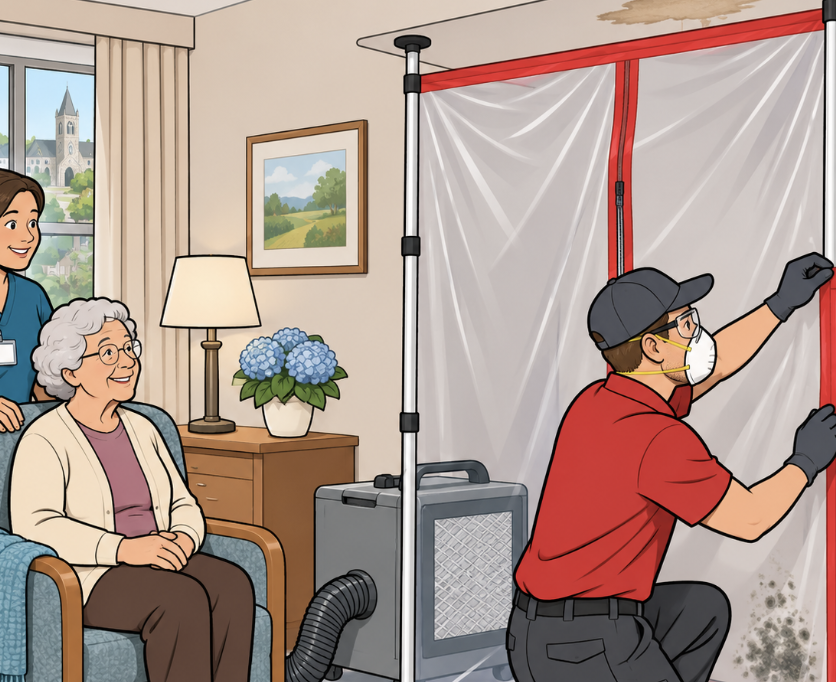
If mold is found after a water leak in an assisted living facility, restrict access, correct the moisture source, notify facility leadership and infection-prevention personnel, and evaluate the full affected area. Do not paint over visible growth or use uncontained demolition in an occupied care environment.
Residents may have respiratory conditions, limited mobility, or other vulnerabilities. The remediation plan should be coordinated with clinical operations, building systems, resident relocation needs, and any environmental consultant or authority involved.
First Actions
Why Mold Appears After a Leak
Water can remain behind baseboards, beneath flooring, above ceilings, inside drywall, or in insulation after the visible surface dries. EPA guidance recommends drying water-damaged materials within 24 to 48 hours when possible.[1] A hidden or delayed loss may already require remediation rather than ordinary drying.
Assess the Scope, Not Just the Visible Spot
Visible growth may be the edge of a larger damp area. Inspection should consider the water path, material porosity, odors, prior repairs, HVAC operation, and moisture readings. Testing is not automatically required in every project, but an independent environmental professional may be appropriate when the facility, insurer, regulator, or project conditions require a written protocol or clearance.
Containment in an Occupied Facility
Containment, pressure control, protected access, covered debris routes, and HVAC coordination may be necessary to prevent dust and spores from reaching occupied areas. Work zones should preserve egress and accessibility and should not interfere with medication, meals, emergency response, or essential services.
Clean, Remove and Dry
Nonporous materials may be cleaned when structurally sound. Porous materials such as drywall, insulation, ceiling tile, carpet backing, and particleboard may require removal when growth or damage cannot be fully addressed. CDC healthcare recovery guidance emphasizes physical removal of mold, drying remaining materials, moisture measurement, and replacement of damaged materials.[2]
Painting or applying disinfectant over visible mold does not remove contaminated porous material. The moisture source must be corrected or the problem can return.
Resident Rooms and Contents
Facility leadership decides whether residents move and when rooms return to service. Mattresses, upholstered furniture, mobility equipment, curtains, records, and personal belongings require item-specific evaluation. Protect privacy while photographing and tracking contents.
Documentation and Reopening
Records may include source-repair confirmation, photos, moisture readings, containment notes, removed materials, cleaning methods, equipment logs, daily updates, and completion conditions. PuroClean provides restoration documentation; the facility and applicable authorities make occupancy decisions.
Assisted Living Mold Remediation in Delaware County
PuroClean of Springfield supports senior living and assisted living restoration throughout Springfield, Media, Swarthmore, Wallingford, Broomall, Newtown Square, Drexel Hill, Havertown, Ridley Park, and surrounding Delaware County communities.
Frequently Asked Questions
Can residents stay in another part of the building?
Possibly. The facility evaluates resident needs, affected systems, containment, access, and clinical risk. Restoration can be phased by zone when conditions allow.
Is bleach enough?
No single product replaces source control, removal of unsalvageable material, physical cleaning, drying, and verification. Never mix cleaning chemicals.
Who determines clearance?
That depends on the facility and project. An independent consultant may establish criteria or perform post-remediation verification when required.
Request Assisted Living Mold Remediation
Call PuroClean of Springfield at (610) 541-8606 for containment, removal, cleaning, drying, and documentation after a water leak.