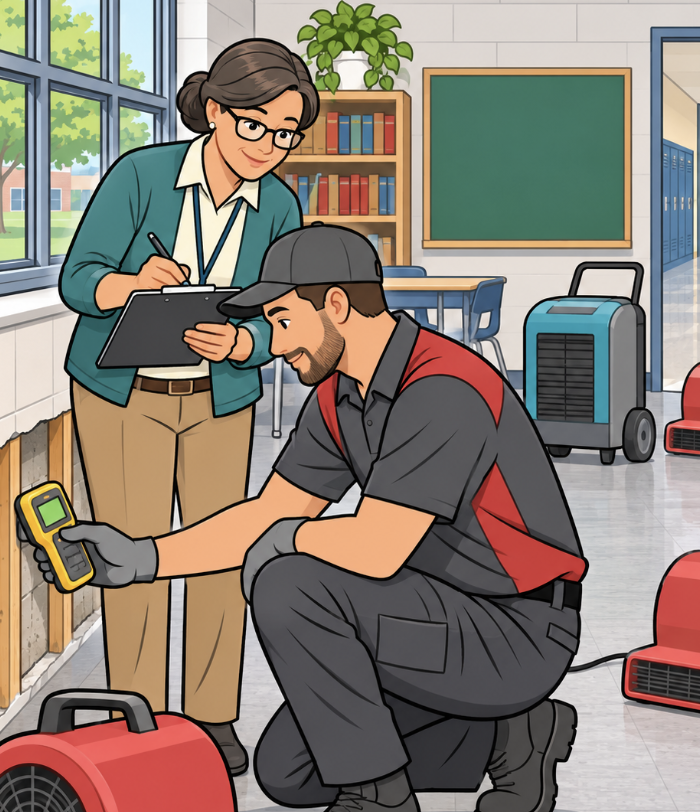
After water damage in a school building, the priority is to make the affected areas safe, remove standing water, thoroughly dry wet materials, and verify that the building is ready for students and staff to return. School reopening should be based on documented conditions, functioning building systems, and appropriate safety assessments, not simply how quickly the floors appear dry.
A flooded classroom can disrupt an entire school day. Water from a broken pipe, roof leak, sprinkler discharge, or storm can travel beneath flooring, behind walls, and into electrical and mechanical systems. Even after visible water is removed, hidden moisture may remain in materials that students and teachers use every day.
For school administrators and facilities directors in Springfield, PA, and surrounding Delaware County communities, restoring a school involves more than drying the building. It also means protecting indoor air quality, maintaining essential services, coordinating contractors, and making informed decisions about when classrooms can reopen.
This guide explains the school water damage restoration process, what a professional drying plan should include, how drying completion is verified, and what administrators should check before resuming normal operations.
Call PuroClean of Springfield: (610) 541-8606
Quick Answer: When Can a School Reopen After Water Damage?
A school can reopen when the areas intended for occupancy are safe, essential building systems are functioning, and unresolved water damage or restoration work does not create unacceptable risks for students, staff, or visitors.
Some schools can reopen unaffected classrooms while restoration continues elsewhere. Other incidents require an entire building or campus to remain closed until critical systems are repaired and safety concerns are resolved.
Before reopening affected areas, administrators should confirm that:
- The source of water has been stopped, repaired, or safely isolated.
- Standing water has been removed and affected materials have been evaluated.
- Moisture measurements support completion of the necessary drying work.
- Damaged ceilings, flooring, walls, and structural components do not present safety hazards.
- Electrical, plumbing, heating, ventilation, fire protection, and sanitation systems required for occupancy are functional.
- Contamination and mold concerns have been appropriately evaluated and addressed.
- Any required professional inspections, agency approvals, or clearances have been completed.
- School leadership has established safe access, occupancy, and communication arrangements.
There is no universal drying period that makes every school safe to reopen. A small clean-water leak affecting one room may be manageable with limited disruption, while a multi-floor water loss can require extensive mitigation, repairs, and inspections.
Why School Water Damage Requires a Different Restoration Approach
Water damage in a school is different from a typical residential water loss. Schools contain classrooms, computer labs, libraries, kitchens, gymnasiums, administrative offices, and mechanical systems that serve hundreds or thousands of occupants.
A leak in one part of the building may affect several important functions even if the damaged area is relatively small.
For example, water from an overhead pipe could saturate ceiling tiles in a hallway, enter nearby classrooms, reach a network closet, and damage flooring below. The visible damage may be concentrated in one corridor, but the operational impact could extend to multiple classrooms.
Administrators also need to consider the needs of students with disabilities, younger children, school health services, food preparation, and the accessibility of temporary classroom arrangements.
Effective school restoration therefore requires coordination among the facilities team, school leadership, restoration professionals, plumbing and electrical contractors, and other specialists as needed.
1. Begin With a Building-Wide Water Damage Assessment
Before deciding how to dry a school, determine exactly which materials and spaces have been affected.
Water does not always remain where it first appears. It can spread through wall assemblies, run beneath floor coverings, enter ceiling cavities, and travel through openings between floors.
A professional assessment should identify the water source, the known or estimated duration of exposure, the affected materials, and whether the water may have become contaminated.
Inspect Beyond the Visible Water
Consider a second-floor supply line that leaks over a weekend. On Monday morning, facilities staff discover wet carpet in one classroom and stained ceiling tiles on the first floor.
The obvious cleanup areas are the two rooms. But a complete assessment should also consider the floor assembly between them, adjacent wall cavities, nearby electrical components, and connected spaces where water may have traveled.
Moisture meters, thermal imaging used alongside direct measurements, and targeted inspections can help identify suspected moisture. Thermal cameras alone do not prove a material is wet or dry.
Identify the Water Source Before Selecting Drying Methods
Water from a recently broken potable-water pipe may require a different response from sewage, drain backups, or water that has contacted contaminated building materials.
The source, exposure time, and conditions encountered during water migration all matter. A leak that initially involved clean water can become more complicated after prolonged contact with materials or unsanitary environments.
Do not begin high-velocity air movement over potentially contaminated materials until qualified personnel have evaluated the conditions and selected the appropriate containment and cleaning procedures.
For guidance on the immediate response to a broken water line, see our guide to what to do after a pipe bursts in a school building.
2. How Professional Drying Works in a School Building
Professional structural drying is a controlled process. The objective is to remove excess water and moisture from affected materials while protecting occupants, equipment, and the rest of the building.
A drying plan should account for the type of material, the amount of water present, the moisture trapped inside assemblies, indoor environmental conditions, and whether the space can safely accommodate drying equipment.
Step 1: Remove Standing Water
Once immediate electrical and structural concerns have been addressed, restoration personnel use extraction equipment to remove accessible standing water from affected floors and materials.
Water extraction is particularly important in carpeted classrooms, corridors, libraries, and administrative offices, where moisture can penetrate backing, padding, and underlying floor assemblies.
Removing the visible water is only the beginning. Wet materials may continue releasing moisture into the surrounding air long after the floor surface looks dry.
Step 2: Establish Appropriate Drying Zones
Large school buildings often benefit from dividing the affected spaces into manageable work zones.
For example, one zone might include two damaged classrooms and a connecting hallway. Another might cover an affected lower-level storage area. Separate zones make it easier to monitor equipment, document drying progress, and limit unnecessary disruption to unaffected school activities.
Depending on the loss, restoration professionals may use temporary barriers, controlled access, and appropriate ventilation arrangements to separate work areas from occupied spaces.
Containment requirements become especially important when contaminated materials or mold remediation are involved. Barriers must not block required emergency exits, accessible routes, or fire protection systems.
Step 3: Control Humidity and Air Movement
Air movers and commercial dehumidifiers serve different purposes during structural drying.
Air movement can help moisture evaporate from exposed wet surfaces when conditions permit. Dehumidification removes moisture from the air, supporting further evaporation and helping control humidity within the drying area.
These systems must be selected and positioned according to the materials, contamination concerns, electrical conditions, and layout of the affected space.
A room full of fans is not necessarily a properly designed drying system. Excessive or poorly directed airflow may create problems, particularly when contamination or fragile materials are present.
Step 4: Monitor Moisture Rather Than Guessing
Professional drying requires repeated measurements.
Technicians can document readings from the affected walls, flooring, trim, and other materials and compare them with appropriate reference conditions and drying goals.
Measurements may include material moisture content, indoor relative humidity, and temperature. The tools and readings appropriate for gypsum board will not necessarily be the same as those used for wood flooring or concrete.
The goal is to establish that the affected materials have reached suitable drying conditions, not to rely on one universal moisture percentage for every surface in the school.
Facilities directors should ask for documentation that identifies which materials were monitored, where measurements were taken, and what criteria were used to determine drying completion.
Step 5: Evaluate Materials That Cannot Be Safely Dried
Some water-damaged materials can be restored. Others may require removal and replacement because of contamination, deterioration, loss of structural integrity, or an inability to dry adequately.
The EPA’s guidance for schools and commercial buildings recommends replacing water-damaged absorbent ceiling tiles and certain types of wet insulation. Drywall may sometimes be dried in place if it remains sound, has no obvious swelling, and has intact seams, but that decision depends on actual conditions.
The objective is not to preserve every material at any cost. It is to reach a safe and durable result without leaving concealed moisture problems behind.
3. How Long Does It Take to Dry a School After Water Damage?
School drying time depends on how much water entered the building, which materials became wet, how long they were exposed, and whether hidden moisture or contamination is present. A localized clean-water incident may require much less work than a large water loss affecting walls, multiple floors, and critical building systems.
Administrators should separate three different timelines: emergency stabilization, structural drying, and rebuilding or reopening.
The First 24 Hours: Stabilization and Assessment
During the initial response, the focus is on occupant safety, controlling the water source, isolating hazards, documenting the loss, and beginning extraction and moisture assessment as conditions permit.
Facilities leadership should also determine whether the damage affects essential school functions, including accessible restrooms, drinking water, food service, electrical power, and fire protection.
The First 24–48 Hours: Mold Prevention Is a Priority
The U.S. Environmental Protection Agency recommends cleaning and drying wet building materials within approximately 24–48 hours when possible to reduce mold risk.
That 24–48-hour period is not a guaranteed drying time or a mandatory reopening deadline. Some materials take longer to dry, and water damage that occurred before discovery may already require additional investigation.
Even materials addressed promptly need appropriate assessment. A room that is visually dry may still have wet insulation, subflooring, or other concealed materials.
Subsequent Days: Verification, Repairs, and Reoccupation
As drying continues, the restoration team should provide updated measurements and identify any unexpected conditions that affect the work.
After drying, some spaces may still require replacement flooring, ceiling repairs, electrical work, sanitation, or other reconstruction before they can return to service.
A school may be able to resume instruction in unaffected rooms while this work continues elsewhere. However, students should not return to active work areas or spaces with unresolved hazards merely because scheduled classes need to resume.
Call PuroClean of Springfield: (610) 541-8606
4. Which School Materials Require the Most Attention?
Different building materials respond differently to water. Understanding those differences helps facilities directors set priorities and ask the right questions during restoration.
Classroom Carpet and Subflooring
Carpet may look dry on top while retaining water in the backing, padding, or subfloor. The restoration assessment should address all affected layers and whether they can be cleaned and dried appropriately.
Contaminated or deteriorated carpet may require replacement. A clean-looking carpet surface is not evidence that the underlying assembly is ready for students.
Drywall and Insulation
Gypsum board can absorb moisture through its edges and paper facing. Walls may also conceal wet insulation or moisture that has migrated through openings around pipes and electrical penetrations.
Swollen or damaged wallboard, contaminated materials, and insulation that cannot be adequately dried may require removal.
Where opening walls is necessary, the school should review its building-material hazard information before demolition begins.
Suspended Ceilings
Wet suspended ceiling tiles may sag, crumble, or fall. They can also conceal water in overhead insulation, piping, and equipment.
Damaged ceiling tiles should not simply be left in place because the visible dripping has stopped. Qualified personnel should evaluate the overhead assembly and confirm that damaged materials have been properly addressed.
Gymnasium and Hardwood Flooring
Water entering a gymnasium floor can affect wood boards and the supporting structure beneath them. Changes in moisture can produce swelling, cupping, buckling, or other dimensional movement.
These floors may require specialized evaluation and controlled drying. Excess heat or overly aggressive drying can damage wood, and an apparently improved surface may still conceal moisture below.
School leadership should not resume athletic activities until qualified professionals have assessed the floor’s condition and any necessary repairs.
Libraries, Textbooks, and Student Records
Paper can absorb moisture quickly. Important records, library collections, historical documents, and educational materials may need careful prioritization.
Some valuable books and records may be candidates for specialized conservation or freeze-drying, depending on the extent of damage. Other materials may be impractical or unsafe to restore.
School staff should document affected collections and coordinate any specialized handling rather than placing damp materials back onto shelves.
Computer Labs and Network Equipment
Water entering a computer lab or technology closet creates both electrical and operational concerns.
Do not turn affected computers, networking equipment, electrical devices, or power supplies back on until appropriately qualified personnel determine that doing so is safe.
A damaged network cabinet may affect attendance systems, communications, instructional technology, or building controls well beyond the room where the leak occurred.
5. Indoor Air Quality, Mold, and Hidden Moisture
Protecting indoor air quality is an important part of school water damage recovery.
Persistent moisture can encourage mold growth, damage building materials, and contribute to musty odors or uncomfortable indoor conditions. These concerns deserve particular attention in classrooms and other spaces that students and staff occupy for extended periods.
The EPA emphasizes identifying and correcting the underlying moisture problem rather than relying on cleaning alone.
What Should Happen if Mold Is Suspected?
If facilities staff discover visible mold, persistent musty odors, or evidence that materials have remained wet for an extended period, the school should arrange an appropriate professional assessment.
The response may require containment, protective equipment, removal of damaged materials, and measures to prevent contamination from spreading into unaffected rooms.
Simply spraying a cleaning product over wet drywall or painting over a stained surface does not correct hidden moisture or establish that mold concerns have been resolved.
Does Every School Need Mold Air Testing Before Reopening?
No. Mold air testing is not automatically required after every water loss.
According to the EPA, visual inspections, moisture control, material condition, and the absence of continuing mold-related problems are important parts of evaluating remediation effectiveness. Air sampling may be useful in particular situations, but it is not a universal substitute for a thorough inspection.
Where contamination, occupant complaints, or complex indoor environmental concerns exist, school leadership should consult appropriately qualified environmental and health professionals about whether testing or independent verification is warranted.
Check the HVAC System
Water can affect HVAC equipment, duct insulation, air-handling components, and surrounding mechanical spaces.
If contaminated materials are involved, operating the HVAC system without an appropriate evaluation could contribute to the spread of contaminants into other occupied areas.
Facilities personnel should coordinate with qualified HVAC and environmental professionals when the system has been affected or when there is concern about airborne contamination.
6. Special Considerations for Older School Buildings in Delaware County
Schools in Springfield and surrounding Delaware County communities have different construction histories, building systems, and renovation schedules. A water loss in an older facility may require additional investigation before damaged walls, ceilings, or flooring are disturbed.
For covered school buildings, federal asbestos regulations under the Asbestos Hazard Emergency Response Act require asbestos management plans and procedures for managing asbestos-containing materials.
Before demolition or invasive drying work, facilities directors should consult the school’s asbestos management plan and determine whether any other hazardous building materials require evaluation.
A restoration response should not introduce avoidable exposure risks while attempting to correct water damage.
Why This Matters for Springfield Schools
The Springfield School District serves Springfield and Morton, with educational facilities ranging from the Springfield Literacy Center and Sabold and Scenic Hills elementary schools to E.T. Richardson Middle School and Springfield High School.
The district’s mix of elementary, middle, and high school buildings illustrates why reopening plans need to reflect each facility’s layout, age, equipment, and student population.
A water loss involving an elementary classroom may create different access and relocation needs than one involving a high school science laboratory, technology room, or athletic facility.
These principles also apply to private schools, childcare and early learning facilities, and other educational properties throughout Media, Wallingford, Swarthmore, Upper Darby, and nearby communities.
7. Can a School Reopen in Phases While Restoration Continues?
Yes, phased reopening may be appropriate when unaffected areas can operate safely and the restoration work can be properly separated from students and staff. It is not suitable for every incident.
Rather than treating the entire school as one undifferentiated space, administrators can evaluate the operational status of individual building zones.
Zone A: Unaffected and Ready for Occupancy
These areas have no identified damage or related safety concerns and retain the building services required for their intended use.
Before classes resume, confirm that occupants can reach the rooms through safe, accessible routes without passing through restoration zones.
Zone B: Drying or Repairs in Progress
These areas may be undergoing water extraction, dehumidification, material removal, electrical work, or reconstruction.
Restrict access to authorized personnel, protect required egress routes, and ensure that noise, dust, equipment, and construction activities will not create unsafe conditions in occupied spaces.
Appropriate barriers and separate contractor access may help limit disruption when the building layout allows.
Zone C: Not Cleared for Use
These areas have unresolved hazards, contamination concerns, damaged building systems, or incomplete evaluation.
They should remain restricted until the responsible professionals and authorities have addressed the outstanding conditions.
Examples include a room beneath a visibly damaged ceiling, a corridor affected by electrical hazards, or a cafeteria without required water and sanitation services.
Questions to Ask Before Reopening Any Zone
- Can students and staff enter and exit safely without crossing restoration work areas?
- Are fire alarms, sprinklers, emergency lighting, and necessary exits functioning?
- Are accessible routes and required accommodations maintained?
- Are ventilation, drinking water, restrooms, and handwashing facilities sufficient for the intended occupancy?
- Have wet materials, contamination concerns, and indoor air quality issues been appropriately addressed?
- Is restoration equipment safely positioned and isolated from students?
- Have required inspections, permits, or clearances been obtained?
- Is there a clear plan for communicating room changes and remaining restrictions?
The final occupancy decision belongs to school leadership and the responsible building and safety authorities, supported by findings from the appropriate professionals.
8. What Documentation Should School Administrators Request?
A complete drying process should leave behind more than an invoice and a statement that the equipment has been removed.
Documentation gives facilities directors a clearer understanding of the loss and supports conversations with administrators, insurers, maintenance teams, and future contractors.
Ask for These Restoration Records
- Initial assessment: The date, reported cause, affected rooms, apparent water migration, and observed conditions.
- Photographs: Images showing the incident area before mitigation when safe, during the work, and after completion.
- Moisture map: Identified wet materials, measurement locations, and affected building zones.
- Drying records: Relevant moisture readings, environmental measurements, equipment deployment, and documented progress.
- Material disposition: A record of what was dried, cleaned, removed, replaced, or referred for specialized evaluation.
- Outstanding issues: Any remaining plumbing, electrical, HVAC, environmental, or reconstruction work.
- Completion summary: The scope of restoration performed, criteria used to evaluate drying, and any limitations or recommendations.
Schools should also maintain their own incident records documenting decisions about room closures, class relocations, parent notifications, and the reopening process.
For institutions with multiple buildings, keeping these records organized may help identify repeat plumbing problems and support future preventive maintenance decisions.
9. Communicating Water Damage and Reopening Decisions to Families
Parents and staff may have questions about why a classroom is closed, whether the school is safe, and when normal schedules will resume.
Clear communication can prevent confusion, particularly when only part of a school is affected.
School administrators should explain what is known, which spaces are restricted, what actions are underway, and when the next update is expected. Avoid making promises about reopening dates before critical assessments are complete.
Example Parent Communication
Our school experienced a water-related building incident affecting a limited portion of the facility. The affected area has been restricted, and our facilities team is coordinating the necessary repairs, cleanup, and drying. We are evaluating building conditions before reopening those spaces. Classes in unaffected areas will continue only where school leadership has confirmed safe access and appropriate building services. We will provide another update as more information becomes available.
This type of message acknowledges the incident without creating unnecessary alarm or asserting that safety evaluations are complete before they actually are.
For complex losses, designate one person to coordinate updates among facilities staff, contractors, school leadership, employees, and families.
10. Preventing Repeat Water Damage After the School Reopens
Reopening should not mark the end of the school’s response.
Once normal operations resume, the facilities team should evaluate what caused the incident and whether similar vulnerabilities exist elsewhere.
In southeastern Pennsylvania, freezing weather, winter building shutdowns, roof and drainage problems, aging plumbing, and equipment failures can all contribute to school water damage.
Some issues become more difficult to detect during weekends, holidays, or summer breaks when parts of a building are unoccupied.
Practical Prevention Measures
- Review plumbing vulnerabilities. Identify aging, exposed, or frequently repaired piping.
- Inspect roof and drainage systems. Address known leakage, blocked drainage, and vulnerable building penetrations.
- Monitor mechanical rooms and unused spaces. Verify appropriate temperature and leak detection measures.
- Maintain water shutoff procedures. Make sure trained facilities personnel know which valves serve each building area.
- Plan for school holidays. Establish inspection and emergency contact procedures during extended closures.
- Evaluate moisture-prone locations. Investigate repeated dampness around restrooms, kitchens, basements, and HVAC equipment.
- Review the emergency response plan. Document lessons learned and improve coordination among district leadership, vendors, and maintenance personnel.
Preventive maintenance cannot eliminate every unexpected water loss. It can, however, reduce the chance that a small leak becomes a larger disruption because no one notices it or knows how to respond.
Frequently Asked Questions About School Water Damage Restoration
How long does it take to dry a flooded classroom?
There is no single drying time for every classroom. The duration depends on the water source, amount of water, affected materials, hidden moisture, and environmental conditions. Professional measurements should help determine when the necessary drying work is complete.
Can students attend school while dehumidifiers are running?
Sometimes classes can continue in unaffected areas, provided the equipment and work zones are safely isolated and required building systems, access routes, and environmental conditions are appropriate. Students should not occupy active restoration areas with unresolved hazards.
Does water damage automatically mean a school has mold?
No. Water damage does not automatically mean mold has developed. However, moisture can support mold growth if affected materials are not adequately cleaned and dried. The EPA recommends responding promptly, ideally drying wet materials within 24–48 hours when possible.
How do restoration professionals know a school is dry?
Professionals can use material moisture measurements, environmental readings, inspections, and documented drying goals appropriate to the building materials. A surface that looks or feels dry is not sufficient evidence that concealed assemblies have dried.
Does every school need air quality testing after a water loss?
No. The need for testing depends on the nature of the incident, suspected contamination, potential mold concerns, occupant conditions, and advice from qualified environmental professionals. Testing does not replace proper moisture assessment and visual inspection.
Can school carpet be saved after flooding?
Some carpet may be restorable after a limited clean-water incident if the carpet, backing, padding, and subfloor can be appropriately cleaned and dried. Contamination, prolonged exposure, deterioration, or trapped moisture may require removal and replacement.
Who decides when a school is safe to reopen?
The responsible school officials make operational reopening decisions with input from qualified facilities, restoration, environmental, engineering, health, and safety professionals as appropriate. Required inspections or approvals from authorities must also be completed where applicable. A restoration contractor does not independently certify every aspect of a school’s occupancy safety.
What should be included in a school water damage restoration report?
A useful report typically includes affected areas, initial conditions, photographs, moisture mapping, drying measurements, work performed, material removal, outstanding repairs, and documentation supporting completion of the restoration scope.
School Water Damage Restoration in Springfield and Delaware County, PA
For school administrators, a water emergency creates two related challenges: restoring the building and protecting the continuity of education.
Prompt extraction, thoughtful drying, accurate moisture documentation, and clear communication help school leaders make informed decisions. Just as importantly, a phased recovery strategy can help minimize unnecessary disruption without overlooking safety concerns.
PuroClean of Springfield’s commercial water damage restoration services include water mitigation, structural drying, moisture assessment, and restoration documentation for commercial and institutional properties.
For immediate water removal, visit our Springfield water extraction service page.
The local PuroClean team serves Springfield and surrounding communities, including Morton, Media, Swarthmore, Wallingford, Upper Darby, Drexel Hill, and nearby Delaware County markets.
If your school, educational facility, or commercial building has experienced water damage, contact PuroClean of Springfield to discuss the incident, affected areas, and appropriate next steps.
Call PuroClean of Springfield: (610) 541-8606
Sources and Further Reading
- U.S. EPA: Water Damage Cleanup and Mold Prevention in Schools and Commercial Buildings
- U.S. EPA: Planning and Evaluating School Mold Remediation
- U.S. EPA: Evaluating Remediation Completion
- OSHA: Flood Response and Recovery Safety
- U.S. EPA: Asbestos and School Buildings
- Springfield School District: District Overview