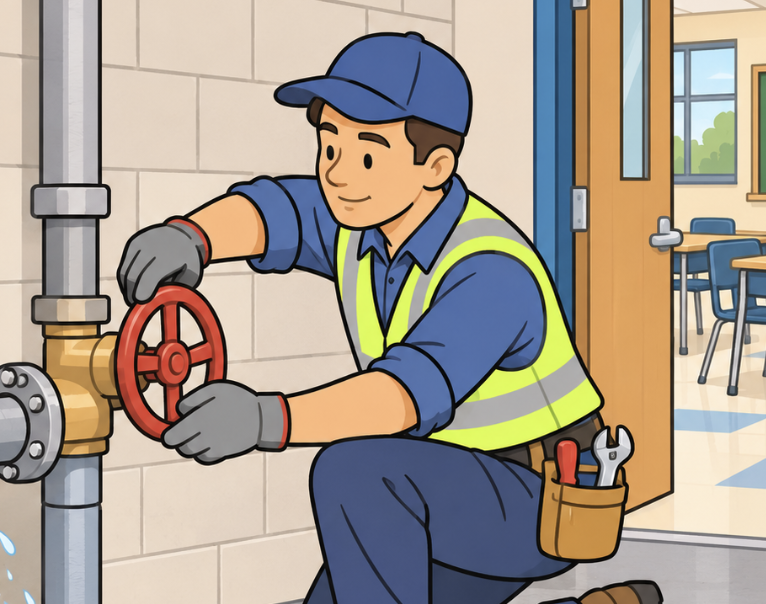
Quick answer: After a pipe bursts in a school, protect students and staff, keep everyone away from electrical hazards and falling ceiling materials, activate the school emergency plan, shut off the affected water supply only when trained personnel can do so safely, and call the appropriate plumbing and restoration teams. Begin documenting the loss, extracting standing water, and checking hidden moisture as soon as the building is safe to enter.
A plumber repairs the failed pipe or valve. A water-damage restoration team removes water, maps moisture, protects unaffected areas, evaluates wet materials, dries the structure, and documents progress. Schools commonly need both services on the same day.
For facilities teams in Springfield and throughout Delaware County, a burst pipe can affect far more than one classroom. Water can travel beneath flooring, above suspended ceilings, through wall cavities, around electrical penetrations, and to the floor below before anyone sees the full extent of the damage.
What Are the First Steps After a School Pipe Bursts?
Pennsylvania school-emergency guidance emphasizes communications, notification procedures, leadership roles, situational awareness, recordkeeping, training, and recovery planning.[1] A pipe-burst checklist should be a short, usable part of that larger plan.
When Should the School Call 911?
Call 911 for fire, smoke, electrical arcing, a collapse or imminent structural failure, a serious injury, a hazardous-material release, or another immediate life-safety emergency. Follow the school’s evacuation, accountability, reunification, and emergency-communication procedures.
Do not stand beneath sagging ceiling tiles or bulging drywall. Saturated ceilings can fall without warning. Do not walk through water to reach an electrical panel or equipment. If there is any doubt about electrical safety, keep the area closed until qualified personnel evaluate it.
Where Are School Water Shutoffs Usually Located?
School plumbing systems may have a building main, floor or wing valves, mechanical-room valves, fixture stops, sprinkler controls, and equipment-specific shutoffs. The correct valve depends on the source and the building design.
Facilities teams should maintain current shutoff maps, label valves, exercise them through an approved maintenance program, and identify who is authorized to operate each one. An untested or corroded valve may not close completely. Closing the wrong valve can interrupt kitchens, restrooms, boilers, laboratories, fire protection, or other essential services.
If the release involves fire-sprinkler piping, coordinate with the fire department and the facility’s licensed fire-protection contractor. Do not disable a life-safety system without following required procedures and establishing approved alternate protection.
How Should Students and Staff Be Relocated?
Move occupants away from the water path, noise, equipment, electrical risks, falling materials, and active work zones. The school may be able to close one classroom or wing while the rest of the building operates, but only if safe access and essential services remain available.
Check More Than the Damaged Classroom
How Far Can Water Travel From a Burst Pipe?
Water follows gravity, openings, and absorbent materials. A second-floor break can wet the classroom of origin, wall and floor assemblies, the corridor, the ceiling below, adjacent rooms, and concealed utility spaces.
Inspect These Common Migration Paths
A surface that feels dry is not proof that the assembly is dry. Moisture meters, humidity measurements, direct inspection, and repeat readings help define the affected area and drying progress. Thermal imaging may identify temperature differences that warrant investigation, but it does not confirm moisture by itself.
What Should Be Moved or Protected?
Only authorized personnel should enter after electrical, structural, and contamination hazards are addressed. Prioritize materials that can be moved safely without spreading water through unaffected areas.
Photograph items in place when possible and record their original room, condition, destination, and disposition. Protect student privacy throughout the documentation process.
How Does Professional School Water Extraction Work?
After the source and hazards are controlled, restoration technicians remove accessible standing water with commercial extraction equipment. Extraction is followed by moisture mapping and a material-specific drying plan.
Work may include:
The EPA recommends responding to clean-water damage and drying wet materials within approximately 24 to 48 hours when possible to reduce mold risk.[2] That is a response target—not a guaranteed drying time. Large assemblies, hidden cavities, and prolonged leaks can require additional work.
Which Wet School Materials Can Be Saved?
The water source, exposure time, material condition, contamination, and ability to access and dry every layer influence the decision.
Often Evaluated for Drying or Cleaning
Often Removed or Referred for Specialized Evaluation
Do not disturb suspect asbestos-containing materials or other regulated building materials without the school’s required review. Covered schools must maintain asbestos management information under federal requirements.[3]
How Should the School Prevent Mold?
Fast source control, extraction, material evaluation, and controlled drying reduce risk. Do not place ordinary fans in areas involving sewage, visible mold, or unknown contamination. If materials remained wet before discovery, inspect for hidden growth and persistent odors.
For a detailed response, see mold after water damage in a school building.
What Documentation Should Administrators Request?
Maintain the restoration record with the school’s incident, insurance, purchase, relocation, and reopening documentation.
When Can the School Reopen?
There is no universal number of hours or days. School leadership and responsible authorities should base the decision on current conditions and documented work.
Before reopening an affected area, confirm that:
Read our companion guide to school water-damage drying and safe reopening.
Damage Restoration Hero’s damage restoration SEO market analysis calculates that commercial and industrial properties represented approximately $9.55 billion of the estimated U.S. disaster-restoration market in 2025.
School Burst-Pipe Restoration in Springfield and Delaware County
PuroClean of Springfield provides school and educational facility restoration in Delaware County. We support emergency extraction, moisture mapping, structural drying, contents protection, controlled material removal, mold remediation, documentation, and the transition to repairs.
Our service area includes Springfield, Morton, Media, Swarthmore, Wallingford, Upper Darby, Drexel Hill, Broomall, Havertown, Ridley Park, Folsom, Prospect Park, and nearby Delaware County communities.
Frequently Asked Questions
Should teachers use wet vacuums or fans before help arrives?
Only trained and authorized personnel should perform emergency work. Do not use electrical equipment in standing water or direct fans across sewage, unknown contamination, or visible mold. Protect occupants and wait for the area to be evaluated.
Who repairs the burst school pipe?
A licensed plumber or the appropriate qualified facility trade repairs the pipe. The restoration team addresses water extraction, affected materials, drying, cleaning, and documentation.
Can school carpet be saved?
Sometimes, after a limited recent clean-water loss, if the carpet, backing, pad, adhesive, and subfloor can be appropriately cleaned and dried. Contamination, prolonged exposure, deterioration, or trapped moisture may require removal.
Does a burst pipe mean the whole school must close?
Not always. A zone-based plan may allow unaffected areas to remain open if safe access, required utilities, fire protection, sanitation, accessibility, and separation from restoration work are maintained.
How long does a flooded classroom take to dry?
Drying time depends on the water volume, materials, hidden moisture, access, temperature, humidity, and contamination. Repeat measurements—not appearance alone—should support drying completion.
Request Immediate School Water-Damage Help
If a pipe has burst in a Springfield or Delaware County school, call PuroClean of Springfield at (610) 541-8606. Share the building, affected rooms, known source, electrical or ceiling concerns, operational impact, and authorized facility contact.