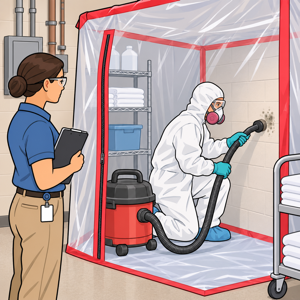
Quick answer: Mold remediation in a hospital or healthcare facility begins by protecting patients and staff, correcting the moisture source, defining the affected area, completing the facility’s infection-control risk assessment, and establishing approved containment. Mold-damaged materials are removed or physically cleaned under controlled conditions, remaining assemblies are dried, and the facility’s designated professionals review documentation and verification before the space returns to clinical use.
Healthcare mold remediation is not simply a cleaning project. Work may affect vulnerable patients, ventilation and pressure relationships, medical equipment, sterile supplies, clinical workflows, and occupied departments. The restoration contractor performs the approved remediation scope; facility leadership, infection prevention, engineering, environmental consultants, equipment specialists, and regulatory authorities retain their respective decisions.
What Should a Healthcare Facility Do When Mold Is Found?
Do not place ordinary fans in a mold-affected area or disturb suspect materials without controls. Unplanned air movement, cutting, or demolition can spread dust and spores beyond the visible area.
Why Mold Requires Special Controls in Healthcare Settings
Mold is common in the environment, but healthcare facilities must consider patients whose medical conditions or treatments may increase susceptibility to environmental organisms. The level of concern depends on the department, occupants, size and duration of the moisture problem, HVAC pathways, and work activities.
CDC healthcare environmental guidance recommends minimizing dust and moisture intrusion into high-risk patient-care areas and involving infection-control personnel in construction and repair activities.[1] A project beside an office does not automatically require the same controls as one adjacent to oncology, transplantation, intensive care, neonatal care, sterile processing, or a protective environment.
Where Does Mold Hide After a Healthcare Water Loss?
Visible growth may be only one part of the problem. Investigate the water path and building systems, including:
Use moisture history, direct inspection, material readings, environmental conditions, and building-system knowledge. Thermal imaging can help identify areas for further investigation but does not establish the presence or absence of mold.
Does Every Healthcare Facility Need Mold Testing?
No single test is automatically required for every project. Visible growth and a known moisture source can often support remediation without pre-remediation air sampling. Testing may be useful when growth is suspected but not visible, the source or extent is uncertain, the facility needs a consultant-defined protocol, sensitive departments are involved, or independent verification is required.
Air samples provide information about the conditions at the time and place collected; they do not certify an entire facility. There is no universal federal indoor mold-spore limit that acts as a simple pass-or-fail number for all healthcare spaces. The facility’s consultant should define the purpose, methods, interpretation, and decision criteria before samples are collected.
How Is Healthcare Mold Containment Designed?
Containment should be based on the project risk assessment, not a one-size-fits-all plastic barrier. Depending on the scope and location, controls may include:
Read our detailed guide to healthcare water-damage containment.
What Happens During Healthcare Mold Remediation?
1. Correct the Source and Stabilize Conditions
Repair leaks, correct condensation or humidity, restore drainage, and address wet materials. Remediation will fail if the moisture source continues.
2. Establish the Approved Work Zone
Install barriers, air control, access procedures, surface protection, and debris routes. Confirm egress, fire protection, accessibility, utilities, and clinical operations before work begins.
3. Remove Mold-Damaged Porous Materials
Heavily affected ceiling tiles, gypsum board, insulation, composite casework, and other porous materials may require controlled removal. Bag or wrap debris within the work zone and transport it by the approved route.
4. Physically Clean Remaining Materials
HEPA vacuuming and appropriate damp cleaning may be used on remaining sound materials under the approved protocol. The CDC’s recovery guidance emphasizes that mold remediation requires physical removal rather than relying on disinfectant alone.[2]
5. Dry and Monitor
Confirm that remaining assemblies meet project dry goals. Track humidity, temperature, material moisture, equipment, and progress. Persistent moisture can require additional access or material removal.
6. Complete Detailed Cleaning
Clean the work zone, equipment, containment surfaces, and approved transition areas. Facility environmental services may have separate terminal-cleaning responsibilities before clinical use.
7. Perform Required Verification
Verification may include visual inspection, moisture documentation, pressure and containment records, consultant assessment, or sampling when defined by the project plan. Establish criteria before remediation starts.
What About HVAC Mold?
If water or visible growth affects air-handler components, duct insulation, filters, drain pans, supply or return pathways, coordinate with facilities engineering, infection prevention, mechanical specialists, and the environmental consultant.
Do not run a contaminated system merely to dry it. The CDC recommends isolating HVAC remediation from cleaned areas, assessing wet insulation, cleaning or replacing affected components, and testing systems before return to service after extensive damage.[2]
How Are Medical Equipment and Supplies Handled?
Mold, humidity, water, and cleaning activities can affect device function, packaging, sterility, and corrosion. Quarantine exposed equipment and supplies under facility procedures.
When Can the Remediated Area Return to Clinical Use?
Containment removal, building completion, and clinical reoccupancy are separate decisions. Before return to service, the facility may need to confirm:
CDC guidance recommends continued inspection after major water-damage recovery and appropriate surveillance for unusual infection patterns when warranted by the facility’s assessment.[2]
Healthcare Mold Remediation in Delaware County
PuroClean of Springfield provides healthcare facility mold remediation and restoration in Delaware County. We coordinate source-related drying, containment, controlled material removal, HEPA-filtered cleaning, moisture verification, documentation, and phased recovery with the facility’s authorized team.
We serve hospitals, outpatient centers, physician practices, dental facilities, rehabilitation centers, laboratories, urgent care centers, and other healthcare properties in Springfield, Media, Swarthmore, Wallingford, Upper Darby, Drexel Hill, Broomall, Havertown, Ridley Park, Morton, Folsom, Prospect Park, and nearby communities.
Frequently Asked Questions
Does visible mold always require air testing?
No. The need for sampling depends on the project purpose, hidden conditions, facility protocol, sensitive occupants, consultant recommendations, and verification requirements. Testing does not replace moisture assessment and physical inspection.
Can mold be treated with disinfectant and left in place?
Disinfectant alone is not remediation. Growth must be physically removed, damaged materials addressed, and the moisture source corrected. The work plan determines which materials can be cleaned and which require removal.
Must a hospital close during mold remediation?
Not always. A facility may operate unaffected zones when shared systems, access, patient risk, and containment allow it. Clinical and facility leadership make that decision.
Who performs clearance testing?
When independent testing or clearance is required, the facility should use its designated qualified environmental consultant. PuroClean performs remediation and provides project documentation.
How long does healthcare mold remediation take?
The timeline depends on source repair, affected area, access, materials, containment, HVAC involvement, verification, and reconstruction. A fixed number of days cannot be promised before the scope is defined.
Request Healthcare Mold Remediation
If a Springfield or Delaware County healthcare facility has visible mold, persistent odors, or water damage that may extend into concealed assemblies, call PuroClean of Springfield at (610) 541-8606.