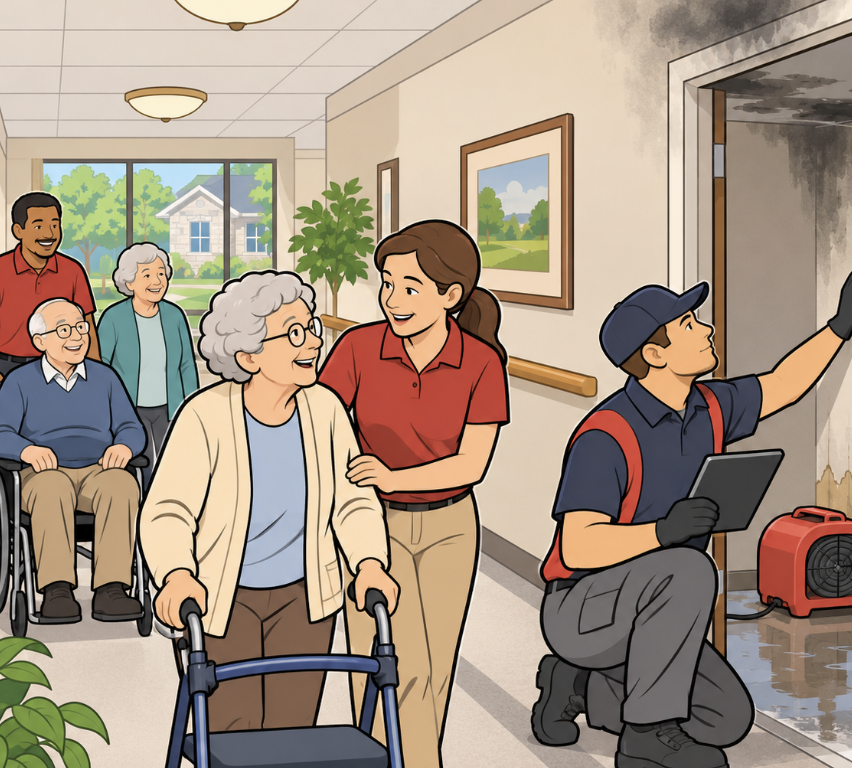
A senior living emergency restoration plan should identify who has authority, how residents will be protected or relocated, which utilities and services are essential, who will respond after hours, and how water, fire, mold, sewage, or storm damage will be isolated and documented. The plan should connect the facility’s clinical and emergency procedures with practical building-recovery steps.
CMS describes four core emergency-preparedness elements: risk assessment and planning, communication, policies and procedures, and training and testing.[1] A restoration plan supports those elements; it does not replace the facility’s regulatory emergency plan.
1. Define Authority Before an Emergency
Name primary and alternate people authorized to activate vendors, approve emergency stabilization, communicate with leadership, and coordinate resident-care decisions. Include after-hours numbers and succession if the first contact is unavailable.
2. Complete a Facility Risk Review
Map hazards relevant to Delaware County and the building: frozen pipes, roof leaks, sprinkler discharge, sump failure, severe storms, power loss, fire, sewage, mold, and equipment failure. Note resident rooms below roofs or plumbing, low-level spaces, older supply lines, kitchens, laundries, mechanical rooms, and areas with sensitive occupants or equipment.
3. Record Utilities and Building Systems
Keep a protected off-site or cloud copy. Plans locked inside an inaccessible office are not useful.
4. Plan for Residents and Continuity of Care
Coordinate with clinical leadership on mobility, cognition, oxygen, medications, dietary needs, infection precautions, transportation, family notification, and receiving locations. The Pennsylvania Department of Aging emphasizes planning for medications, medical equipment, transportation, backup providers, and support networks for older adults.[2]
5. Prequalify Restoration and Repair Contacts
List restoration, plumbing, electrical, roofing, HVAC, elevator, fire-protection, security, environmental, and reconstruction contacts. Confirm service area, after-hours access, insurance requirements, purchase-order rules, and who can authorize work.
6. Establish Restoration Zones and Routes
Pre-identify resident relocation areas, clean access routes, debris exits, equipment staging, waste locations, and loading access. Preserve fire egress, accessibility, medication movement, meal service, and emergency response.
7. Protect Records, Equipment and Supplies
Identify priority records, servers, medication storage, resident-care equipment, mattresses, wheelchairs, lifts, food supplies, and packaged medical materials. Record manufacturer and service contacts. Create a chain-of-custody method for contents moved during an incident.
8. Define Communication
Prepare contact trees and message templates for staff, residents, families, physicians, pharmacies, emergency management, regulators, insurers, and vendors. Use one facility spokesperson and a predictable update schedule.
9. Document the Loss
The incident file should include time discovered, source, photos, resident moves, utilities, affected rooms, moisture readings, equipment records, removed materials, invoices, and reopening decisions. Protect resident privacy in all records.
10. Train, Test and Update
Walk staff through shutoffs, reporting, zone control, vendor access, and documentation. Test the plan with tabletop scenarios such as a second-floor pipe break during winter or a kitchen fire during meal service. CMS expects emergency plans and training to be reviewed and updated at least annually.[1]
Local Planning Support
PuroClean of Springfield provides senior living facility restoration across Springfield and Delaware County. A pre-loss conversation can clarify access, building priorities, contacts, and documentation before an emergency.
Frequently Asked Questions
Does the restoration company write the facility’s emergency plan?
No. Facility leadership owns the emergency and clinical plan. A restoration company can support the property-damage, vendor-access, documentation, and recovery sections.
How often should the plan be updated?
Review it at least annually and whenever leadership, vendors, floor plans, utilities, resident needs, or regulations change.
Should the plan include evacuation?
Yes, within the facility’s broader emergency procedures. Restoration planning should support shelter-in-place, internal relocation, and evacuation without directing clinical decisions.
Build the Relationship Before the Loss
Call PuroClean of Springfield at (610) 541-8606 to discuss emergency restoration planning for a Delaware County senior living facility.