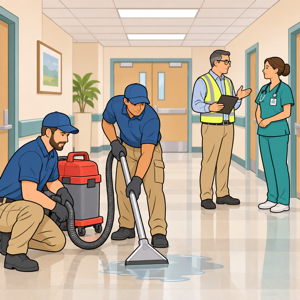
Quick answer: When water damages a hospital or healthcare facility, protect patients and staff, activate the facility’s emergency structure, isolate the affected zone, stop the source when safe, and bring facilities engineering, infection prevention, clinical leadership, environmental services, risk management, security, and restoration personnel into one coordinated response. Standing water should be extracted and hidden moisture assessed as soon as the area is safe and authorized for entry.
A hospital water loss is not simply a wet-building problem. Water can interrupt patient care, contaminate supplies, affect medical equipment, disable electrical or life-safety systems, disrupt HVAC pressure relationships, and move through several departments before it becomes visible. The facility’s clinical and emergency policies control patient movement and care decisions; the restoration team supports building stabilization, cleaning, drying, remediation, and documentation.
What Are the First Five Actions After Hospital Emergency Water Damage?
The Centers for Disease Control and Prevention describes healthcare-facility recovery after major emergency water damage event as a multidisciplinary effort involving engineering, remediation, infection control, and equipment specialists.[1] The exact team and response scale depend on the department, water source, patients, building systems, and extent of the loss.
Activate Hospital Incident Command and Establish One Source of Truth
The incident should have a designated facility lead who can coordinate clinical, operational, technical, and communication decisions. Restoration contractors need one authorized point of contact for access, safety requirements, work-zone boundaries, scope approvals, and daily status.
CMS emergency-preparedness guidance identifies risk assessment and planning, policies and procedures, communication, and training and testing as four core elements for covered healthcare providers.[2] A water loss may activate all four. The facility should document which plan was activated, who holds authority, which departments are affected, and how operational changes will be communicated.
Information to Gather During the First Call
Classify the Water Source and Its Travel Path
A new potable-water pipe break differs from sewage, drain water, roof runoff, floodwater, fire-sprinkler discharge, HVAC condensate, or water that has remained in contaminated materials. Source and contact determine cleaning, containment, protective equipment, material removal, and whether ordinary air movement is appropriate.
Do not assume water remains in the room where it appeared. It can move beneath flooring, through wall cavities, above ceilings, along pipe penetrations, into elevator shafts, around casework, and to lower floors. A water release above an operating room, laboratory, pharmacy, imaging suite, or electrical room may have consequences far beyond the visible stain.
Build a Water-Migration Map
Document the known source and every location with visible water, staining, elevated moisture, affected contents, damaged finishes, or reported odors. Use direct inspection and appropriate moisture instruments. Thermal imaging can help identify areas for further assessment but does not prove that a surface is wet or dry.
Protect Critical Utilities and Patient-Care Systems
Facility engineering and qualified vendors should evaluate affected electrical distribution, emergency power, medical gases, steam, domestic water, sewage, HVAC, fire alarms, sprinklers, nurse-call systems, elevators, communications, and building controls. Restoration personnel should not energize, move, clean, or return specialized equipment to service without authorization.
The CDC’s healthcare water-system guidance recommends an Emergency Water Supply Plan so essential functions can continue during total or partial water interruption.[3] Even when the incident is a local pipe break, the facility should consider whether potable water, sanitation, hand hygiene, sterilization, food service, dialysis, laboratories, laundry, and climate control remain reliable.
Separate Patient and Restoration Traffic
Establish approved access, equipment staging, waste routes, and worker entry procedures. Restoration hoses, cords, air movers, dehumidifiers, barriers, and carts must not obstruct required egress, medical transport, emergency access, or accessibility.
When unaffected areas remain operational, the facility may require physical barriers, HEPA-filtered air control, pressure monitoring, covered debris carts, surface protection, worker check-in, dedicated elevators, or off-hours work. Infection prevention and facilities leadership determine the controls; the restoration team implements the approved work-zone plan.
For a deeper discussion, see our guide to healthcare water-damage containment.
Begin Water Extraction and Structural Drying
Once hazards are controlled and the facility authorizes entry, remove accessible standing water. Extraction reduces the volume that can migrate and evaporate into the building. It does not complete the drying process.
Professional drying may include:
The CDC recommends extracting standing water and sewage, removing heavily contaminated or damaged porous materials, cleaning nonporous materials, drying remaining structure, and evaluating utilities, medical equipment, furniture, records, and supplies.[1]
Evaluate Medical Equipment, Supplies, and Records
Water exposure can affect electrical safety, calibration, sterility, packaging, corrosion, insulation, and manufacturer warranties. The exterior of a device may look dry while internal components remain compromised.
Restoration contractors can document visible exposure and surrounding property conditions, but they do not recertify clinical devices or determine whether medications, sterile supplies, or regulated records remain usable.
Address HVAC and Infection-Control Concerns
Water in air handlers, insulation, ductwork, ceiling plenums, or mechanical rooms can affect spaces beyond the original leak. Facility engineering and infection prevention should determine whether systems remain in operation, require isolation, or need specialized inspection and cleaning.
Before invasive work begins, the facility may require a general construction infection-control risk assessment and a water-management construction risk assessment. The CDC’s reopening guidance specifically calls for these evaluations in extensive healthcare-facility recovery.[1]
Do not place ordinary fans in areas with sewage, visible mold, unknown contamination, or unassessed dust. Airflow should support the approved containment and pressure plan.
Document the Loss by Zone
A useful hospital restoration record is organized by department, room, and phase. It may include:
Provide a consistent daily update stating which zones are restricted, active, ready for facility review, or returned to service. Avoid ambiguous descriptions such as “mostly dry” or “almost complete.”
When Can a Hospital Department Reopen?
Reoccupancy is a facility and regulatory decision, not a promise made by the restoration contractor. The responsible team may need to confirm structural safety, utilities, ventilation, infection-control requirements, equipment function, sanitation, fire and life-safety systems, accessibility, environmental conditions, and applicable inspections.
The CDC notes that certification and licensing requirements vary by jurisdiction and that reopening should comply with state and local requirements, building and fire inspections, and other applicable regulations.[1] In Pennsylvania, healthcare-facility building and safety oversight can include structural, electrical, plumbing, HVAC, fire alarm, sprinkler, and smoke-detection considerations.[4]
Emergency Hospital Water-Damage Restoration in Delaware County
PuroClean of Springfield provides hospital and healthcare facility restoration in Delaware County. We support emergency extraction, moisture mapping, structural drying, controlled material removal, cleaning, mold remediation, documentation, and phased recovery for hospitals, outpatient centers, physician practices, dental offices, rehabilitation facilities, laboratories, urgent care centers, and other healthcare properties.
Our response area includes Springfield, Media, Swarthmore, Wallingford, Upper Darby, Drexel Hill, Broomall, Havertown, Ridley Park, Morton, Folsom, Prospect Park, and nearby communities. PuroClean follows the facility’s approved access, safety, infection-prevention, and operational requirements.
Frequently Asked Questions
Can unaffected hospital departments remain open?
Possibly. Facility leadership must consider shared utilities, HVAC, access, infection-control risk, emergency egress, patient populations, and the ability to isolate restoration work. A zone-based recovery plan may allow unaffected departments to continue operating.
How quickly should hospital water extraction begin?
As soon as the source is controlled, hazards are addressed, and the facility authorizes entry. Fast extraction limits migration, but controlled cleaning, drying, monitoring, and system evaluation still need to follow.
Who decides whether medical equipment can be reused?
The facility’s biomedical engineering team, manufacturer, or another authorized qualified specialist should evaluate equipment. Restoration personnel document exposure and property conditions but do not recertify clinical devices.
Does every water loss require mold testing?
No. Testing decisions depend on the moisture history, visible growth, patient population, facility protocol, consultant recommendations, and regulatory or project requirements. Testing does not replace moisture assessment and physical inspection.
Can PuroClean work with the facility’s insurer or third-party administrator?
Yes, when authorized. We can provide photographs, readings, scope information, estimates, equipment records, and progress documentation while keeping facility leadership informed.
Request Healthcare Water-Damage Response
For a water emergency in a Springfield or Delaware County healthcare facility, call PuroClean of Springfield at (610) 541-8606. Provide the affected department, water source, known hazards, operational impact, and authorized facility contact so the response can be organized around your requirements.