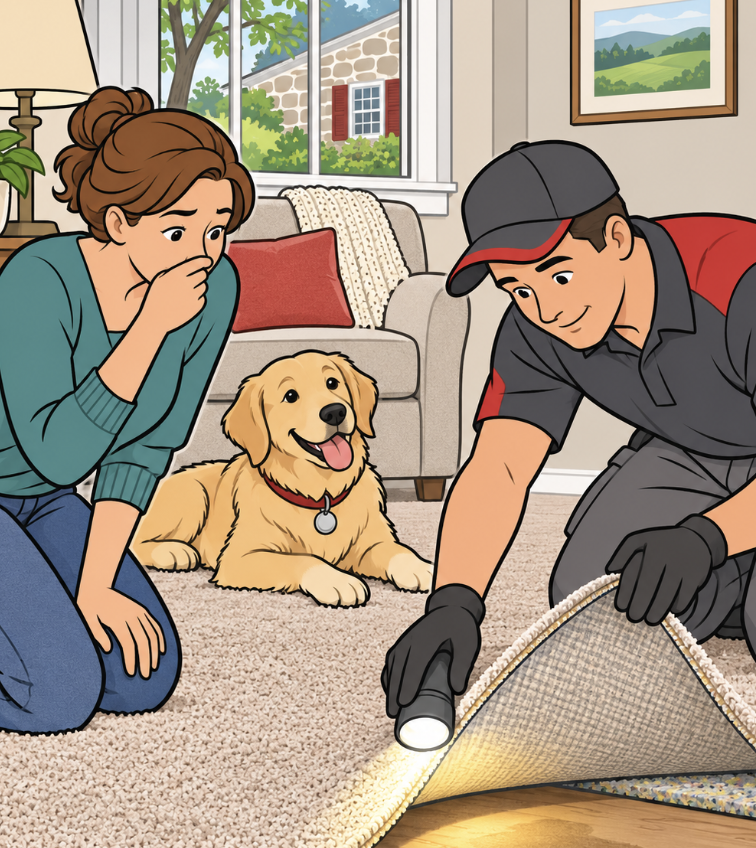
Pet urine odor often returns after carpet cleaning because the cleaning reached the carpet fibers but not the full contamination below them. Urine can pass through the backing into padding, tack strips, subfloor, baseboards, furniture, or wall edges. Humidity and re-wetting can make odor more noticeable again, and fragrance may only mask it temporarily.
The durable solution is to find every affected material, treat the source at the correct depth, and replace porous materials that cannot be cleaned effectively. Repeatedly shampooing the surface without checking underneath can spread moisture while leaving the odor source in place.
Five Reasons the Odor Comes Back
1. Urine Reached the Carpet Padding
Carpet fibers may release a stain while the absorbent pad remains contaminated. Each step compresses the carpet and pad, moving air through the material and releasing odor.
2. The Subfloor Absorbed Repeated Accidents
Wood and wood-based subfloors are porous. Repeated pet accidents can enter seams, fastener holes, and wall edges. Surface carpet cleaning cannot reach contamination inside the floor assembly.
3. The Wrong Area Was Treated
The strongest odor is not always directly above the source. Airflow, furniture, heating systems, and multiple accident sites can make the odor difficult to locate by smell alone.
4. The Product Masked Rather Than Removed the Source
Fragrance can temporarily cover odor. Deodorization works best when the treatment reaches the odor-producing material. EPA indoor-air guidance describes source control as usually the most effective way to improve indoor air.[1]
5. Humidity or Cleaning Re-Wetted the Residue
Odor may seem stronger during humid weather or after wet cleaning. Added moisture can move residue within porous materials and release odor compounds that were less noticeable when dry.
Where Pet Urine Hides
- Carpet backing and padding
- Tack strips and floor edges
- Plywood, oriented strand board, or wood plank subfloors
- Hardwood seams and unfinished edges
- Baseboards, lower drywall, and door trim
- Upholstery, mattress foam, and furniture frames
- Concrete pores and cracks
- Heating vents or floor registers near an accident
A pet may also return to the same location, adding new contamination after a prior cleaning. Medical or behavioral causes should be discussed with a veterinarian when accidents are sudden, frequent, or unusual.
How Professionals Find the Source
Professional inspection starts with the history: where accidents were noticed, how often they occurred, which rooms smell, and what cleaning has already been attempted. The technician then evaluates surfaces, edges, furniture, and connected areas.
Inspection tools may help locate suspected contamination, but no single tool is perfect. Ultraviolet light can reveal some residues, while moisture or contamination-detection tools can support the assessment. Visual findings, odor, material condition, and targeted inspection must be considered together.
In Springfield homes with older hardwood, carpet over wood, finished basements, or multiple flooring layers, small test areas may be needed to determine how far contamination traveled.
Why More Carpet Shampoo May Make Things Worse
Over-wetting can push residue deeper, spread it sideways, leave detergent behind, or keep the carpet pad damp. A rental machine may improve appearance while failing to extract enough solution from the lower layers.
EPA guidance notes that carpet can hold dust and other material and that maintenance should include effective vacuuming and periodic extraction cleaning.[2] Pet urine remediation, however, may require more than routine carpet maintenance because the source can be beneath the carpet.
The Professional Pet Odor Removal Process
- Inspect and map affected areas. The technician identifies known and suspected accident sites and checks carpet, padding, floor edges, furniture, and adjacent materials.
- Choose material-specific treatment. Carpet, upholstery, hardwood, concrete, and subfloor require different methods and product compatibility checks.
- Reach the contamination depth. Treatment must contact the source rather than only the visible stain.
- Extract and dry. Recoverable cleaning solution and residue are extracted, and the materials are dried appropriately.
- Remove what cannot be restored. Heavily affected padding, tack strip, fiberboard, or other porous materials may require replacement.
- Reinspect after drying. Odor is evaluated without relying on heavy fragrance.
Can the Carpet Be Saved?
Sometimes. A recent, limited accident may be treatable when the carpet is colorfast, structurally sound, and accessible. Repeated saturation, delamination, widespread contamination, or affected padding and subfloor can make replacement more practical.
The decision should consider:
- Number and age of accident sites
- Carpet and pad construction
- Whether urine reached the subfloor or walls
- Prior cleaners and treatments
- Colorfastness, staining, and material condition
- Odor response after treatment and drying
Safety and Cleaning Products
Follow product labels and never mix household cleaners. Keep pets and children out of the work area until products are used, extracted, and dried as directed. If an animal is ill or there is concern about exposure to infected urine, contact a veterinarian and healthcare professional. The CDC advises avoiding direct contact with urine from animals suspected of leptospirosis and using protective clothing when contact is unavoidable.[3]
Pet Odor Removal in Springfield and Delaware County
PuroClean of Springfield provides pet odor and urine removal in Springfield as part of its biohazard cleanup services. The team serves Springfield, Wallingford, Swarthmore, Media, Drexel Hill, Havertown, Broomall, Newtown Square, Ridley Park, Folsom, Morton, Prospect Park, Chester, and nearby Delaware County communities.
Frequently Asked Questions
Why does the room smell worse on humid days?
Humidity can make odor from residues in porous materials more noticeable. It may also slow drying and affect how air moves through carpet and padding.
Will baking soda remove old urine odor?
It may absorb some surface odor, but it cannot reliably reach widespread contamination in padding, subfloor, walls, or furniture. It can also leave residue in carpet.
Does an enzyme cleaner always work?
No product works in every material or situation. It must reach the source, be compatible with the surface, remain for the required contact time, and be used according to its label.
Should I replace the carpet before treating the subfloor?
No. If the subfloor is affected, installing new carpet over it can allow odor to return. Inspect and address the full assembly first.
Stop Masking the Odor and Find the Source
If pet urine odor keeps returning after carpet cleaning, call PuroClean of Springfield at (610) 541-8606 for a material-by-material assessment and treatment plan.