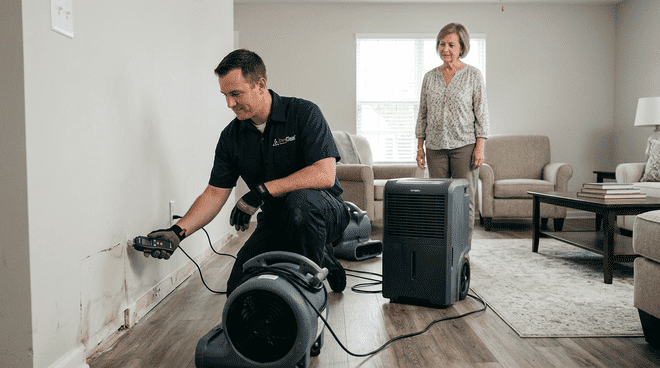
The rebuild is the part of a water loss everyone pictures, and the drying is the part that decides how big the rebuild has to be. Drywall, carpet pad, and subfloor that are dried properly and in time can often stay; the same materials left damp turn into a tear-out, and sometimes a mold job. That’s why the first day matters more than the last week. This is the whole sequence, from the first phone call to the final coat of paint, and what you control at each step.
TL;DR
- If water is near outlets, appliances, or the electrical panel, stay out; FEMA warns never to touch wet electrical equipment.
- Shut off the water at the main valve, then call for emergency water extraction and drying the same day.
- Photograph every wet room and damaged item before anything is moved, torn out, or thrown away.
- EPA says drying wet materials within 24 to 48 hours usually prevents mold; that window drives every early decision.
- River or surface flooding usually needs a separate flood policy; FEMA says most homeowners insurance doesn’t cover flood damage.
- Rebuild only after moisture readings confirm the structure is dry; new drywall over damp framing traps the problem.
Why water damage repair is three jobs, not one
Water damage repair in Fredericksburg, VA, is really three jobs done in order: getting the water out, drying the structure, and rebuilding what couldn’t be saved. The first two are mitigation, and their aim is to stop the damage spreading and save as much of the building as possible. The third is reconstruction, and its size depends on how well the first two went. PuroClean of Stafford handles both sides, with our reconstruction services picking up once the structure has been dried and documented.
The type of water matters as much as the amount. The IICRC’s S500 standard sorts water into three categories by contamination: Category 1 comes from a clean source such as a supply line, Category 2 carries significant contamination, such as washing machine overflow, and Category 3 is grossly contaminated, including sewage and rising water from rivers or streams.
That last category is the local catch. Floodwater from the Rappahannock counts as Category 3, so porous materials it soaks, such as carpet, pad, and the lower part of drywall, are usually removed rather than dried.
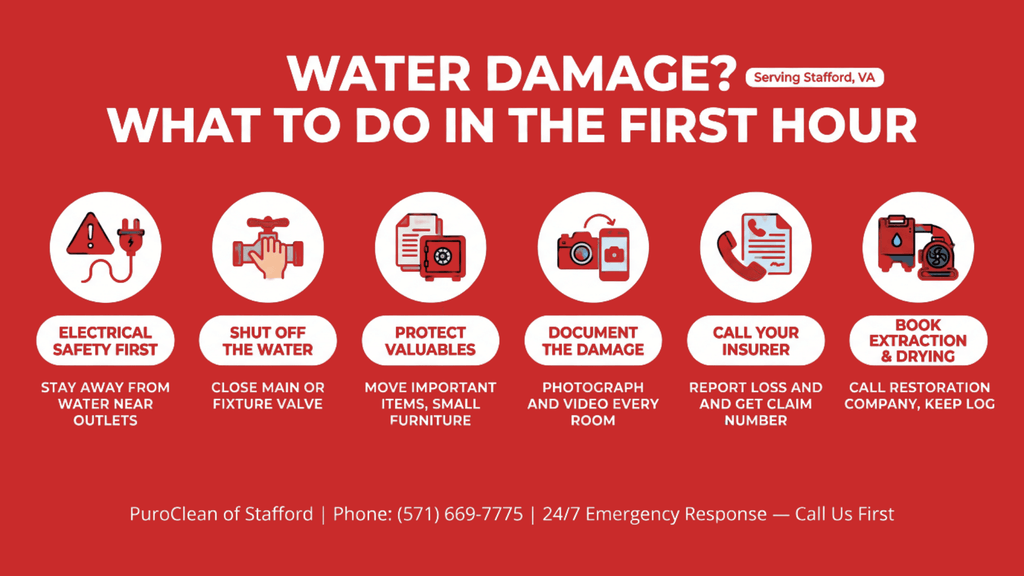
Do these things in the first hour
Make the house safe, stop the water and start the paper trail; everything else can wait for the crew.
- Stay out of rooms where water is near outlets, cords, or the panel, and only switch off a breaker you can reach without standing in water.
- Shut off the main water valve, or the valve on the leaking fixture or appliance.
- Move documents, valuables, and small furniture out of wet rooms if you can do it safely.
- Photograph and video every affected room, ceiling, and item before anything is moved or removed.
- Call your insurance company to report the loss and get a claim number.
- Call a restoration company for extraction and drying, and keep a written log of every call.
If a storm has opened the roof or a window, that gap needs covering before drying can work, and we install tarps and board-ups after storms for that reason. Winter pipe bursts, summer storms, and Rappahannock runoff are the usual sources of water losses across our Fredericksburg service area.
Get the water out and the structure dry
Water removal in Fredericksburg, VA, starts with extraction and ends with a meter reading, not a feeling: the job is done when materials reach their drying goal.
Extraction comes before air movement
Pumping and extracting standing water from carpet, pad, and hard floors removes it far faster than any fan can evaporate it, so the first hours of a job are about pulling out bulk water. Every gallon left behind has to be dried out of the building later.
Drying is measured, not guessed
Our IICRC-certified technicians use thermal imaging and moisture meters to find water behind walls and under floors, then set dehumidifiers and air movers and track humidity, temperature, and moisture content every day until materials reach their drying goals. Household fans without dehumidification mostly move damp air from room to room.
Humid weather shortens the window
EPA’s mold and moisture guidance]] says wet materials dried within 24 to 48 hours usually won’t grow mold, and it recommends keeping indoor humidity below 60 percent. In a wet house during a Virginia summer, that usually means dehumidifiers, not open windows.
If growth has already started, mold removal and remediation becomes part of the job, under its own containment.
Keep the records your insurer will ask for
Documentation decides how smoothly a claim goes, so start it before the first wet item leaves the house.
- Photos and video of every affected room, taken before and during the work.
- A list of damaged belongings, with rough age and where they were bought if you know.
- Receipts for emergency costs, such as supplies, a hotel, or a plumber.
- The daily moisture readings and drying logs from the restoration company.
- A small sample of damaged carpet or flooring, if the adjuster hasn’t seen it yet.
Flood damage is the distinction to understand. FEMA’s flood insurance overview notes that most homeowners insurance doesn’t cover flood damage and that, as of 2026, a new flood policy typically has a 30-day waiting period, so flood coverage has to be in place before the water arrives.
If you’re not sure whether your street sits in a mapped flood zone, Fredericksburg’s flood insurance page explains the city’s 2023 flood map update and how to look up a property through FEMA. On our side, we write line-item estimates in Xactimate, document affected areas and materials, and can bill your insurance carrier directly when the loss is covered.
Rebuild in the right order
The last stage of water damage repair in Fredericksburg, VA, starts only after the structure is dry and the scope is agreed upon, and it works from the inside of the wall outward.
- Confirm final moisture readings and keep the drying records.
- Agree on the written repair scope with your insurer and contractor.
- Replace insulation and drywall, then tape, finish, and prime.
- Install flooring, trim, and cabinets.
- Paint, then walk through the finished rooms before signing off.
Permits are the local wrinkle. Fredericksburg is an independent city, so permits and inspections for work inside city limits go through the city rather than Stafford or Spotsylvania County; ask whether your repair needs one before the walls close. Our teams will explain where reconstruction is needed and what can stay.
Drying it yourself, a contractor and a restoration company compared
| Option | Works when | Breaks when | What it costs you |
|---|---|---|---|
| Towels, fans and a shop vacuum | A small clean-water spill, caught within hours | Water reached drywall, carpet pad or subfloor | Moisture nobody measured |
| A general contractor alone | Materials are already dry and clean | Materials are still wet, or the water was contaminated | Rebuilding over damp framing |
| A restoration company, then your own builder | You already have a builder you trust | Drying records never reach the builder | Two schedules and two points of contact |
| One company for drying and rebuild | You want one schedule and one set of records | You’d rather choose your own builder | Less choice over who does the finish work |
What goes wrong most often
- The carpet is pulled up, but the pad and subfloor stay wet, and the musty smell returns a week later.
- New drywall goes up before the framing is dry, and mold starts behind the finished wall.
- Damaged items go to the curb before anyone photographs them, and the contents claim stalls.
- Fans run for days without dehumidifiers, and moisture spreads into rooms that were dry.
- Drying waits for an adjuster’s visit, and EPA’s 24-to-48-hour window closes; ask your insurer whether you can start right away.
Final Verdict
A small clean-water spill caught within a few hours is a towel-and-fan job; watch the spot for odor or staining over the following days. Once water has reached walls, carpet pad or subfloor, or came from a drain, a toilet or the river, start professional water removal in Fredericksburg, VA, the same day. And if the rebuild is what worries you, plan water damage repair in Fredericksburg, VA, from the first call, because the drying sets the size of the rebuild. You can see how drying, mold work, and rebuilding fit together across all of our residential services.
If you can’t tell which situation you’re in, that uncertainty is what an inspection is for. Call PuroClean of Stafford at (571) 669-7775 or request an on-site inspection.
FAQs
Q: How long does water damage restoration take?
A: It depends on how much water there was, what it soaked into, and whether anything has to be rebuilt. Drying alone usually takes several days of monitored equipment, and reconstruction adds time on top of that. The honest answer comes after the first moisture readings; ask for a written plan that shows the drying goals and how progress will be checked each day.
Q: Does homeowners insurance cover water damage in Virginia?
A: It depends on your policy, the cause of the water, and your insurer’s decision. One rule worth knowing: FEMA says most homeowners insurance doesn’t cover flood damage, which needs a separate flood policy. Read the water and flood sections of your policy, report the loss promptly, and ask your agent what documentation they need before work starts.
Q: Can wet drywall be saved?
A: Sometimes. Drywall soaked by clean water and dried quickly with professional equipment can often stay, as long as it hasn’t swollen, sagged, or started to grow mold. Drywall soaked by contaminated water, including river flooding, is usually removed. Moisture readings decide, not appearance: a wall can look dry on the surface while the back of the board and the framing are still wet.
Q: Will I have to move out during repairs?
A: Not always. Many water losses can be dried with the family still at home, using the unaffected rooms. Moving out becomes more likely when the kitchen or the only bathroom is out of service, when the water was contaminated, or when reconstruction is extensive. Ask your insurer whether your policy includes additional living expenses before you book a hotel.
Q: How do I know if mold has started after water damage?
A: A musty smell, new staining, or spots on drywall, baseboards or the back of furniture are the usual signs. EPA notes that wet materials dried within 24 to 48 hours usually won’t grow mold, so the longer things stayed wet, the closer you should look. If you see growth over a large area, have it assessed before anyone disturbs it.