

Table of Contents
When law enforcement releases a property following a methamphetamine lab investigation or a fentanyl contamination event, what’s left behind isn’t just odor or cosmetic mess — it’s complex chemical and particulate contamination that poses real health risks, long after the visible signs are gone. Fentanyl decontamination gone wrong can be fatal, and the liability is on the property owner to ensure adequate fentanyl cleanup and decontamination was performed.
Whether you’re a homeowner, property manager, or a high-ranking detective tasked with coordinating scene handoffs, it’s crucial to understand the real science behind what makes some cleanup services effective — and why most general “cleaning” is insufficient.
This article will explain:
- The nuances of clandestine drug lab and fentanyl residue contamination
- Why physician-guided protocols are critical
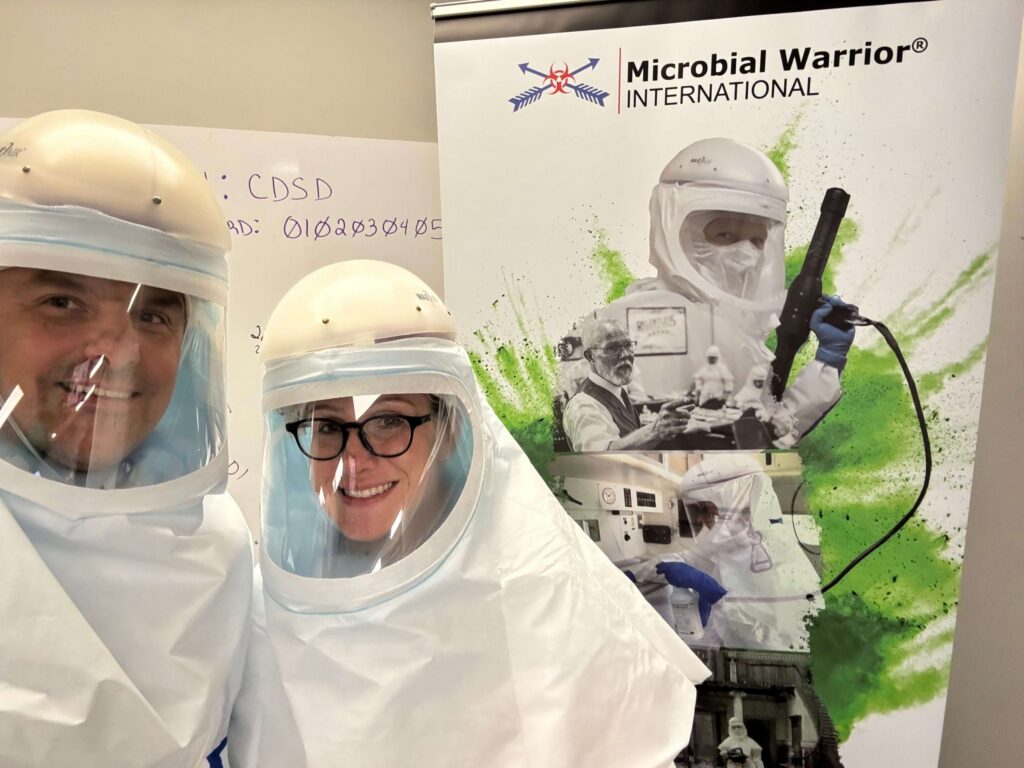
- How the Microbial Warrior methodology elevates remediation
- What Tucson property owners should demand from their cleanup provider
- The difference between cosmetic cleaning and hazard mitigation
Part I — What Makes Meth Labs and Fentanyl Scenes Different
Meth Lab Residue is Not Ordinary Dirt
Methamphetamine laboratories are chemical process environments. According to the U.S. EPA Voluntary Guidelines for Methamphetamine and Fentanyl Cleanup, residues from meth labs are often:
- Sticky, semi-volatile chemical mixtures
- Absorbed into building materials
- Distributed via HVAC systems and airflows
- Persistent on walls, floors, cabinets, and porous surfaces
These aren’t just particles — they’re chemical residues and byproducts that can continue to off-gas over time or transfer on contact, posing risk long after seizure and visible “cleanup” is over.
The EPA explicitly states that “Visible cleanliness does not equate to safety.” — which means odor or sight cannot be relied upon.
Fentanyl Contamination Requires Even Greater Precision
Fentanyl and its analogs (e.g., carfentanil, furanylfentanyl, acetylfentanyl) are measured in micrograms, not grams. Exposure risk assessments for these substances must be informed by:
- Toxicology thresholds
- Surface adhesion factors
- Particle size behavior
- Secondary contamination vectors
This is why standard household PPE and cleaning products are not adequate and can even make the situation worse by aerosolizing residues or increasing absorption if there is alcohol present in the cleaning agent.
Part II — The Case for Physician-Guided Cleanup Protocols
Credentials Matter — This Isn’t Housekeeping
Most restoration companies handle:
- Water damage
- Fire soot
- Basic biohazard cleanup
But clandestine drug labs and fentanyl scenes straddle the line between toxicology, exposure science, and environmental remediation. A physician-guided protocol brings:
- Validated exposure assumptions
- Clinical risk thresholds
- Medical understanding of systemic absorption
- Appropriate respiratory and dermal protection standards
Without medical oversight, fentanyl and meth lab cleanup protocols are just “best guesses.” With physician guidance, they become risk-based decisions aligned with health science.
In practice, physician involvement ensures:
- Proper PPE for the specific contaminant profile
- Conservative assumptions about exposure pathways
- Safety margins grounded in toxicology
- Documentation that holds up under scrutiny
This is the difference between surface cleaning and hazard mitigation.
Part III — Why Microbial Warrior Protocols Elevate Meth & Fentanyl Cleanup
General “restoration cleaning” focuses on:
- Appearance
- Odor removal
- Stain reduction
Whereas Microbial Warrior protocols focus on containment and contamination control, which is exactly what matters in meth and fentanyl scenarios.
The process follows four core phases:
1. Contain
Isolate the contaminated environment to prevent cross-contamination.
This includes:
- Establishing controlled access zones
- Airflow containment
- Sealing off HVAC pathways
- Preventing particulate spread
This is the first and most crucial step. Improper containment spreads contamination.
2. Control
Active exposure control to reduce the potential for aerosolization and contact transfer.
This includes:
- Multi-layered PPE with appropriate respiratory protection
- Air scrubbers with HEPA filtration
- Sequenced work plans to minimize disturbance
- Exposure tracking logs
Control is about limiting risk vectors before cleanup begins.
3. Neutralize
Targeted decontamination designed to break down hazardous residues rather than just move them around.
Neutralization requires:
- Chemistry-specific agents (not generic cleaners)
- Surface-testing and verification
- Adjusted methods for porous vs. non-porous materials
Neutralization is fundamentally different from wiping and hoping.
4. Remove
When residues are too embedded or materials are compromised, removal is the only safe option.
This includes:
- Documented decision making about salvage vs. disposal
- Safe removal of porous materials
- Controlled waste handling
Cutting corners here is a common cause of re-contamination.
Part IV — How This Applies in Tucson
In Tucson, we deal with:
- Older construction with porous materials
- Central AC systems that can redistribute contaminants
- Multi-unit housing where contamination can cross units
- Harsh desert conditions that affect residue behavior
These local conditions mean half-measures are not just ineffective — they’re dangerous.
Part V — What Agencies and Detectives Should Expect
High-ranking law enforcement and task force leaders evaluating cleanup teams should expect:
Scientific Rigor
Cleanup protocols should be based on recognized guidelines:
- EPA voluntary cleanup guidelines (meth & fentanyl)
- Arizona Department of Health Services references
- Toxicology-informed exposure principles
Professional Credentials
Look for teams with:
- Physician oversight
- Advanced contamination control training
- Documentation standards that support liability and compliance
These are not optional; they’re evidence of true expertise.
Documentation
Good cleanup answers:
- What was remediated
- How it was remediated
- What was removed
- What was tested and verified
Law enforcement and property stakeholders should never accept undocumented or poorly documented work.
Part VI — Why PuroClean of Tucson Is the Most Credible Crew in the Region
We are the most credentialed and medically informed decontamination team in Southern Arizona because we combine:
- Physician-guided remediation protocols
- Microbial Warrior containment and hazard control methodology
- Local expertise in Tucson environmental conditions
- Industry-leading documentation standards
- Capable of decontaminating residential and commercial buildings as well as vehicles and aircrafts.
This is not rhetoric — it’s operating practice.