 PuroClean of Northeast Tucson
Why Midsize and Super-Midsize Aircraft Require Medical-Grade Remediation — Not Standard Detailing
Serving Tucson, Southern Arizona & Regional FBOs
Tucson is a strategic hub for business aviation. With consistent year-round weather, proximity to the Southwest corridor, military and aerospace activity, and efficient access to Phoenix and Southern California, mid-range and super-midsize business jets operate heavily through Tucson-area airports and FBOs.
These aircraft are flown hard, turned quickly, and often carry multiple unrelated passenger groups in short succession. While they may not have the physical scale of ultra-long-range jets, mid-range jets present a higher contamination risk per flight hour—and they are frequently misunderstood by operators who rely on routine detailing instead of true remediation.
This article explains:
- The types of mid-range and super-midsize jets commonly operating in Tucson
- The specific finishes and materials used in these aircraft
- The unique contamination and biohazard risks they face
- What separates physician-owned, OSHA-40-certified, Microbial Warrior remediation from standard aircraft detailing
The goal is clarity: mid-range business jets require expert-level cleaning and decontamination, and the wrong approach quietly creates health, liability, and asset risk.
What Is Considered a Mid-Range or Super-Midsize Business Jet?
Mid-range business jets typically fly missions between 2 and 6 hours, while super-midsize aircraft routinely operate 6 to 8+ hour legs. In Tucson, these aircraft are commonly used for:
- Regional and cross-country business travel
- Charter and Part 135 operations
- Owner-operated corporate aircraft
- Repositioning flights to Phoenix, Los Angeles, San Diego, and Texas
Common Mid-Range & Super-Midsize Jets We Service in Tucson
- Cessna Citation XLS / Citation XLS+
- Cessna Citation Latitude
- Cessna Citation Longitude
- Embraer Praetor 500
- Embraer Praetor 600
- Hawker 800XP / Hawker 900XP
- Learjet 60
These aircraft frequently operate through Tucson International Airport, Ryan Airfield, and regional Southern Arizona airports, often supported by national FBO networks.
Why Mid-Range Jets in Tucson Are a High-Risk Cleaning Environment
Mid-range jets occupy a critical middle ground in private aviation:
- They fly more legs per week than long-range jets
- They experience higher passenger turnover
- They are often cleaned under tight time constraints
- They see more frequent lavatory use per flight hour
This combination creates elevated risk for:
- Bodily fluid exposure
- Microbial buildup in soft materials
- Cross-contamination between flights
- Odors embedding into cabin substrates
Because these cabins are smaller and more interconnected, contamination spreads faster and is harder to isolate than in large-cabin aircraft.
The Materials That Define Mid-Range Jet Cabins
Aviation-Grade Leather Seating
Mid-range jets use thin, aviation-certified leathers, engineered to meet fire, smoke, and toxicity standards while minimizing weight.
Key characteristics:
- More porous than automotive leather
- Backed by multi-density foam systems
- Sensitive to moisture and chemical imbalance
Improper cleaning can:
- Drive biological contaminants into foam
- Strip protective coatings
- Cause permanent discoloration or stiffness
Our remediation approach uses controlled moisture, leather-specific chemistry, and medical-grade disinfectiondesigned to eliminate pathogens without damaging finish integrity.
Synthetic Suede & Alcantara-Style Surfaces
Common in:
- Headliners
- Sidewalls
- Seat inserts
These materials:
- Trap contamination invisibly
- Are easily damaged by aggressive agitation
- Collapse or discolor with improper disinfectants
We use low-contact, low-moisture techniques that neutralize contamination without altering fiber structure or appearance.
Veneers, Laminates & Lightweight Composites
Mid-range jets often include:
- Wood veneer tables
- Composite cabinetry
- Laminated sidewalls
These materials rely on aviation-specific adhesives that are highly sensitive to:
- Moisture intrusion
- Heat
- Solvent exposure
Standard detailing frequently causes edge lifting, bubbling, or clouding. Our process accounts for adhesive chemistry and cabin pressurization dynamics.
Carpet & Floor Systems
Aircraft carpet systems are:
- Thin
- Layered over insulation
- Installed above wiring, ducting, and structure
Bodily fluids can migrate:
- Through carpet fibers
- Into backing and insulation
- Along seams and fasteners
Surface-only extraction is medically inadequate. We assess whether sub-surface treatment or selective material removal is required.
Common Contamination Scenarios in Tucson-Based Mid-Range Private Jets
We are most often called after:
- In-flight medical incidents
- Vomiting or gastrointestinal illness
- Lavatory contamination
- Blood exposure from minor injuries
- Post-medical transport repositioning
- Persistent odors with no visible source
Because Tucson aircraft often reposition quickly to other markets, missed contamination becomes a downstream problem for crews, passengers, and operators.
What Sets Us Apart From Standard Aircraft Detailers
Physician-Owned = Clinically Informed Remediation
We are physician-owned, which changes how we think about aircraft interiors.
Our decisions are guided by:
- Infection transmission pathways
- Cross-contamination modeling
- Pathogen survival characteristics
- Long-term exposure risk
This matters in mid-range private jets, where high utilization and limited cabin volume amplify health risk.
OSHA 40-Hour HAZWOPER Certification
Our technicians hold OSHA 40-hour Hazardous Waste Operations certification, qualifying them to remediate environments involving:
- Bloodborne pathogens
- Infectious biological material
- Regulated biohazard waste
Aircraft detailers do not carry this certification and are not trained or legally equipped to perform true biohazard remediation.
Microbial Warrior Certification
Microbial Warrior certification reflects advanced training in:
- Microbial behavior in confined environments
- Proper containment strategies
- Source removal methodologies
- Verification of decontamination
Mid-range jet cabins—with shared airflow and tight layouts—are ideal environments for microbial persistence if mishandled.
Our Mid-Range Jet Cleaning & Decontamination Process
1. Aircraft-Specific Assessment
We evaluate:
- Aircraft model and layout
- Materials present
- Type and extent of contamination
- Migration pathways
No assumptions. No generic protocols.
2. Controlled Containment & Safety
We deploy:
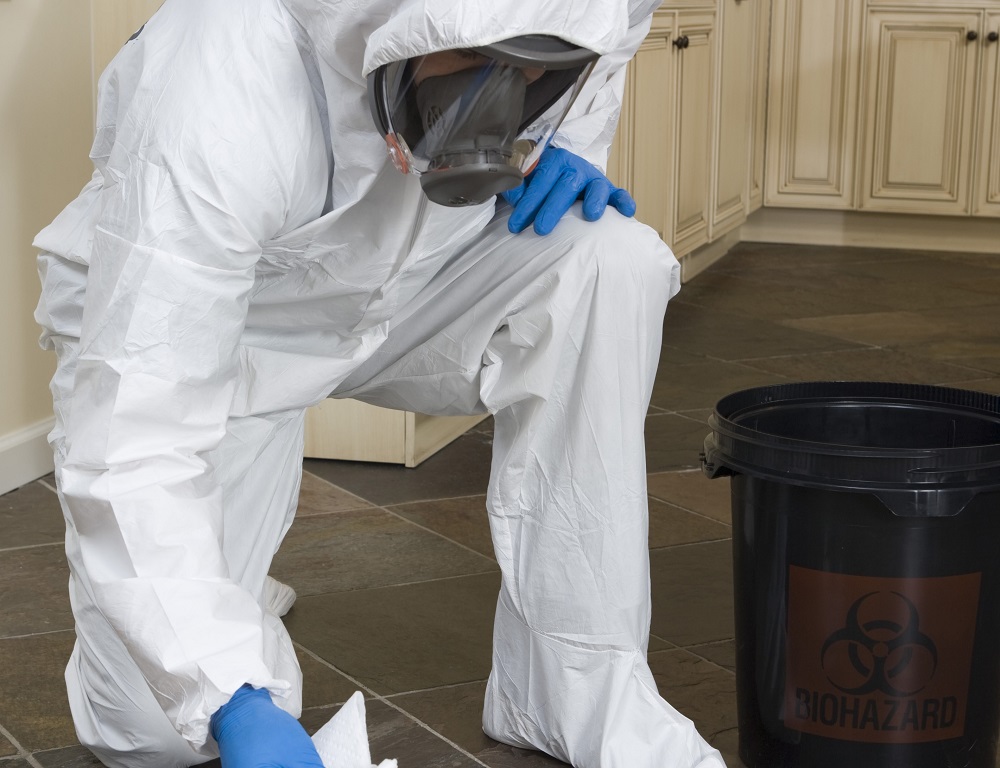
- OSHA-compliant PPE
- Targeted work zones
- HEPA filtration when appropriate
This prevents cross-contamination into:
- Cockpit areas
- Avionics bays
- Hangars and FBO facilities
3. Biohazard Removal & Material-Specific Cleaning
We remove biological contamination while:
- Preserving leather finishes
- Protecting veneers and composites
- Avoiding moisture intrusion near sensitive systems
4. Aviation-Safe, Medical-Grade Disinfection
We use EPA-registered disinfectants selected for:
- Proven pathogen efficacy
- Residue-free application
- Compatibility with aircraft materials
5. Odor Neutralization at the Source
Odors are eliminated by:
- Removing embedded biological material
- Treating porous substrates
- Addressing airflow pathways
Masking agents are never used.
6. Verification & Documentation
We provide:
- Final inspection
- Optional documentation for operators, managers, or insurance
Supporting Tucson & Southern Arizona Aviation Operations
We regularly support mid-range jets operating through Southern Arizona, coordinating with FBOs and aviation professionals to ensure minimal downtime, discretion, and proper return to service.
The Bottom Line: Mid-Range Jets Require More Expertise, Not Less
Mid-range and super-midsize business jets:
- Fly more frequently
- Turn faster
- Carry more unrelated passengers
- Experience higher biological exposure per flight hour
They demand expert-level remediation, not cosmetic detailing.
Being physician-owned, OSHA-40-certified, and Microbial Warrior certified places us among the most qualified aviation biohazard remediation providers serving Tucson and Southern Arizona.
For owners, operators, and FBOs, the distinction is clear:
Detailing improves appearance.
Remediation protects people, aircraft, and operations.
That difference matters — especially in mid-range aviation.
Call us today 520-524-6306
Email: [email protected]

 PuroClean of Northeast Tucson