


A wet hardwood floor can go from salvageable to permanently damaged faster than most property owners expect. If you are searching for how to dry hardwood floors, the first thing to know is this: speed matters, but so does technique. Drying too slowly can lead to cupping, buckling, and mold growth. Drying too aggressively can also stress the wood and make damage worse.
Hardwood is a natural material, and it reacts to moisture unevenly. Water can sit on the surface, soak into the finish, travel between boards, and seep into the subfloor below. That is why a floor that looks only slightly wet may still be holding moisture deep in the system. The goal is not just to make the surface look dry. The goal is to return the flooring and the materials beneath it to an acceptable moisture level.
How to dry hardwood floors after water damage
The first step is always to stop the source of the water. A supply line leak, appliance overflow, roof intrusion, storm entry, or plumbing backup must be controlled before drying begins. If water is still entering the space, every drying effort becomes temporary.
Once the source is stopped, remove standing water as quickly as possible. A wet vacuum or professional extraction equipment is far more effective than towels or mops alone. Surface water needs to come off fast so it cannot continue soaking into the wood. If the floor was exposed to contaminated water, such as sewage or floodwater, that changes the equation completely. In those cases, safety and sanitation become the priority, and some materials may not be restorable.
After extraction, the room needs controlled airflow and dehumidification. This is where many do-it-yourself efforts fall short. A few box fans may help evaporation at the surface, but they do not reliably manage the deeper moisture trapped inside the flooring system. Professional drying typically uses air movers, low-grain refrigerant or desiccant dehumidifiers, and moisture monitoring tools to track progress. The equipment is chosen based on the amount of water, the size of the affected area, indoor temperature, and the construction of the floor assembly.
Why hardwood floors are tricky to dry
Hardwood does not dry evenly. Boards may absorb moisture along the edges first, which can cause cupping, where the sides rise higher than the center. In other cases, after overcorrection or delayed drying, the opposite pattern can develop. The subfloor may also stay wet long after the top layer feels normal to the touch.
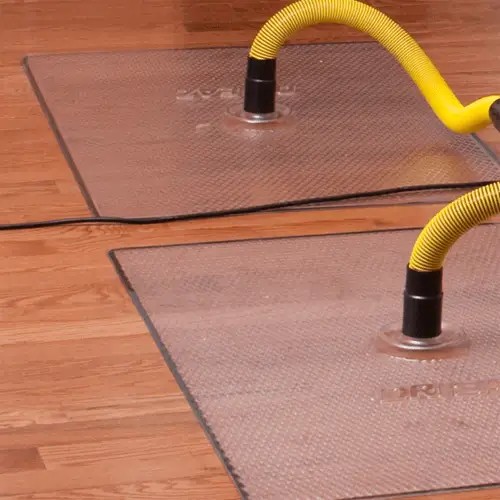
That is why visual inspection is not enough. Moisture meters and thermal imaging help identify where water has migrated. In some situations, drying mats or specialty floor drying systems are used to pull moisture from below or across the floor surface in a more balanced way. This is especially important in high-value hardwood installations where replacement costs are significant.
There is also a timing issue. Hardwood often looks worse before it looks better. During the drying process, some distortion may appear more noticeable as moisture shifts. That does not always mean the floor is beyond saving. What matters is whether the boards stabilize once proper drying is complete.
What not to do
If you want the best chance of saving a wood floor, avoid shortcuts that can lock in damage. Do not leave wet rugs, furniture, or boxes sitting on the floor. Do not use a home heater to blast hot air directly at the boards. Excess heat can dry the top too fast while moisture remains below, increasing stress in the wood.
It is also wise not to sand the floor too early. Sanding before moisture levels have normalized can ruin a floor that might otherwise recover. Many restoration professionals wait until drying is complete and readings are stable before assessing whether refinishing is appropriate.
How long does it take to dry hardwood floors?
It depends on the water source, the wood species, the finish, how long the floor stayed wet, and whether the subfloor was affected. Some minor losses dry in a few days. More serious events can take a week or longer under controlled drying conditions.
The important point is that drying should be measured, not guessed. A floor may seem dry on day two and still hold elevated moisture underneath. Stopping too soon is one of the main reasons floors continue to warp or develop secondary issues later.
In commercial settings, the timeline can be affected by floor size, occupancy needs, and whether drying has to happen while the business remains partially open. In residential settings, cabinets, walls, trim, and adjacent rooms can also influence the scope because moisture rarely stays confined to one obvious area.
Signs the floor may need professional drying
Some water incidents are small and visible, such as a cup spilled on a sealed floor. Others are more serious from the start. If you notice boards lifting, cupping, staining, musty odor, swelling near walls, or water that sat for more than a brief period, the floor should be assessed carefully.
The same is true if water reached from underneath, such as from a crawl space issue, basement humidity, or a leak that traveled under the flooring before appearing on top. Hidden moisture is where many costly mistakes begin.
A professional restoration team can determine whether the floor is likely to respond to in-place drying or whether sections need to be removed. That distinction matters because unnecessary demolition increases cost, but delayed removal in the wrong situation can increase damage. Good decisions come from moisture mapping, not assumptions.
Can warped hardwood floors be saved?
Sometimes yes, sometimes no. Mild to moderate cupping can often improve when drying is handled correctly and the wood is allowed to stabilize. Buckling, severe delamination in engineered products, black water contamination, or prolonged saturation may point toward partial or full replacement.
This is where experience matters. An overly optimistic approach can waste valuable time. An overly aggressive approach can tear out flooring that could have been restored. The right path depends on the severity of the moisture intrusion, the floor construction, and the condition of surrounding materials.
The role of subfloors and hidden moisture
When people think about hardwood water damage, they usually focus on the visible planks. But the subfloor can be the real problem. If moisture remains trapped underneath, the hardwood above cannot truly normalize. That is why professional drying plans often include checking below the surface and inside nearby structural materials.
In some cases, drying from above is enough. In others, technicians may need to access the underside from a basement or crawl space, adjust airflow patterns, or use specialty systems designed for dense flooring assemblies. The strategy should fit the building, not just the symptom.
This matters even more in homes and commercial properties with repeated humidity issues, prior water losses, or tightly enclosed spaces. Moisture that lingers unnoticed can lead to microbial growth, material breakdown, and indoor air quality concerns.
When to call for help right away
If the water came from a dishwasher line, washing machine hose, ice maker line, toilet overflow, storm intrusion, pipe break, or any source that affected more than a very small area, quick professional assessment is the safer move. The same applies if the water loss happened overnight, while the property was vacant, or in a business where interruption carries financial consequences.
Emergency response is not just about removing water. It is about documenting conditions, identifying affected materials, controlling humidity, and creating a drying plan that protects what can still be saved. For property owners in East Bridgeport, Shelton, and Milford, this kind of response can make the difference between a focused restoration and a major rebuild.
At PuroClean of East Bridgeport, controlled structural drying, moisture detection, and clear communication are central to that process. In a stressful situation, people need more than equipment. They need to know what is happening, what can be restored, and what the next step should be.
After drying, what comes next?
Once moisture readings return to acceptable levels, the floor can be re-evaluated for cosmetic and structural recovery. Some floors settle back with minimal visible change. Others may need board replacement, sanding, refinishing, or repairs to adjacent trim and baseboards.
This is also the point to address the root cause if it was not already corrected. A restored floor will not stay restored if there is still a slow leak, poor drainage, or a humidity imbalance in the building. Drying is one phase of recovery, not the whole job.
If you remember one thing, let it be this: hardwood floors can often be saved, but they rarely forgive delay. Acting quickly, using the right drying method, and verifying moisture levels before making repair decisions gives you the best chance of protecting both the floor and the property around it.

