 PuroClean of Sammamish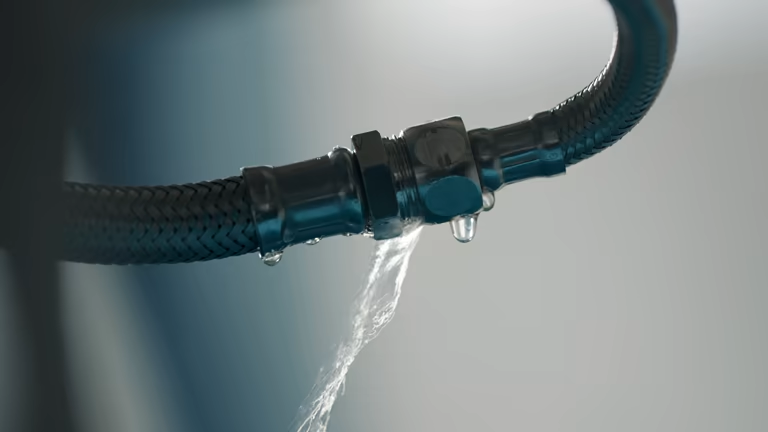
Last September, a Sahalee homeowner left for a Saturday morning at Costco. Before leaving, they started a load of laundry in the second-floor laundry room, the way they had done hundreds of times before. The washing machine was 6 years old. The supply hose was original to the machine.
They returned 3 hours later to find water cascading down their staircase.
The rubber supply hose had failed at the wall connection. Water flowed at full supply line pressure, approximately 4 gallons per minute, for the entire 3 hours they were gone. It saturated the laundry room subfloor, cascaded through the floor assembly into the first-floor ceiling, destroyed the primary bedroom below, migrated through interior walls to adjacent rooms, and reached the hardwood flooring on the main level.
Total damage: $60,000. From a $14 rubber hose.
The tragedy? A $28 braided stainless steel hose replacement, available at any hardware store, has a rated lifespan of 10 to 15 years and would have made this failure statistically nearly impossible. PuroClean of Sammamish appliance flood damage teams respond to this exact scenario multiple times every year across Sammamish Plateau properties. The hose is always rubber. The machine is always unattended. The damage is always catastrophic.
This is not a freak accident. It is a predictable mechanical failure following a well-documented timeline, occurring in a location — the second-floor laundry room — that transforms a contained appliance problem into a multi-floor structural disaster. PuroClean of Sammamish appliance flood damage data shows second-floor laundry room failures average 340% higher restoration costs than equivalent ground-floor events. According to the Insurance Information Institute, washing machine failures represent one of the top five sources of homeowner water damage claims, with average losses exceeding $10,000 per incident nationally. On Sammamish Plateau properties with second-floor laundry configurations and premium finishes, that national average dramatically understates actual exposure.
Understanding the mechanics of how PuroClean of Sammamish appliance flood damage events unfold — from the moment a hose fails to the moment water reaches your main floor hardwood — is the knowledge that separates homeowners who prevent $60,000 losses from those who experience them.
Why Second-Floor Laundry Rooms Are the Single Highest Water Damage Risk in Sammamish Plateau Homes
The second-floor laundry room became a standard feature of Sammamish Plateau new construction during the building boom of 2005 to 2018. Builders offered it as a premium convenience feature: laundry adjacent to bedrooms rather than relegated to a basement or main floor utility space. Buyers paid for the upgrade enthusiastically. What neither buyers nor builders discussed was the physics of what happens when the appliances in that room fail.
Water follows gravity without exception. A laundry room on the second floor sits directly above the most expensive and most difficult-to-restore spaces in the home: primary bedroom suites, home offices, formal living spaces, and in many Sahalee and Trossachs properties, the main floor great room with cathedral ceilings and open floor plans. Every gallon that exits a failed supply line on the second floor becomes a gallon that must travel through the subfloor assembly, ceiling cavity, and finished ceiling of the floor below before it is visible to any occupant.
According to the American Society of Home Inspectors, floor assemblies in standard platform-frame construction absorb and distribute water laterally as it migrates downward, meaning a failure directly above one room creates water damage in adjacent rooms that appear to have no connection to the source. A supply line failure above the second-floor laundry room in a Sahalee property reaches the primary bedroom, the hallway, and portions of two additional rooms before any visible evidence appears on first-floor ceilings. By the time that evidence is visible, the structural framing between floors has already absorbed significant moisture.
This lateral migration is what separates second-floor appliance failures from basement or ground-floor events. A ground-floor washing machine failure floods the laundry room floor. A second-floor failure floods the laundry room floor, the subfloor assembly, the ceiling cavity below, the room below, and potentially the floor below that. The same 4-gallon-per-minute flow rate creates 3 to 4 times the affected square footage when it originates on the second floor.
The Rubber Supply Hose: A Ticking Clock Behind Every Washing Machine
The standard rubber washing machine supply hose that ships with most machines or is installed by appliance delivery teams costs $8 to $14. It is constructed from reinforced rubber with threaded metal end fittings. It carries hot and cold water at full household supply pressure, typically 40 to 80 PSI, every time the machine fills. It flexes slightly with each fill cycle as pressure surges through it.
According to the Rubber Manufacturers Association guidelines cited by the IICRC, rubber washing machine hoses have a functional lifespan of 3 to 5 years before degradation creates meaningful failure risk. The rubber compound begins oxidizing from the moment of installation, accelerated by the heat of hot water cycles. The end fittings create stress concentration points where the rigid metal meets flexible rubber. Over hundreds of fill cycles, micro-cracks develop at these stress points invisibly, with no external indication of developing failure.
The failure mode is sudden and complete. Rubber hoses do not develop slow drips that alert homeowners to a problem before catastrophic failure. They develop internal stress fractures that hold until a fill cycle creates a pressure surge the weakened section cannot resist. Then they fail completely, at full supply pressure, with no warning.
The Sahalee homeowner’s 6-year-old hose was statistically past its recommended replacement window by 1 to 3 years. It had completed an estimated 600 to 800 fill cycles. It showed no external cracking, no discoloration, and no visible swelling at the fittings — the three signs most homeowner inspection guides suggest watching for. It failed anyway, because the failure originated internally at a stress fracture that no external inspection could have detected.
Case Study: Sahalee Second-Floor Laundry — $60,000 Supply Line Failure
The September Sahalee failure described in the opening of this blog represents the complete damage cascade PuroClean of Sammamish appliance flood damage teams document in second-floor laundry events. Thermal imaging conducted during the restoration revealed moisture in the subfloor assembly across 180 square feet of laundry room and adjacent hallway. Moisture had penetrated the floor cavity and distributed laterally into three ceiling sections on the floor below, covering 340 square feet of primary bedroom and bathroom ceiling. Wall cavities on two shared walls showed moisture intrusion to a height of 18 inches from the floor level below. Main floor hardwood flooring in the room adjacent to the primary bedroom showed moisture readings requiring full replacement across 220 square feet. Structural drying required 14 days of commercial equipment deployment. Total restoration: $60,000.
How Water Cascades Through a Sammamish Plateau Home: A Floor-by-Floor Timeline
Understanding the timeline of a second-floor supply line failure explains why response speed is the single most important factor in total damage cost. PuroClean of Sammamish appliance flood damage teams have reconstructed hundreds of these timelines from moisture mapping data. The pattern is consistent.
Minutes 0 to 15: Water exits the failed hose at full supply pressure. The laundry room floor drain, if present, accepts some volume but is overwhelmed within minutes by 4-gallon-per-minute flow. Water begins pooling on the laundry room floor. At the floor perimeter, water finds gaps at base plates, around plumbing penetrations, and under door thresholds. It begins entering the floor assembly.
Minutes 15 to 45: The subfloor assembly above the first-floor ceiling begins absorbing water. OSB or plywood subfloor panels absorb moisture laterally. Water finds the path of least resistance through seams, fastener holes, and plumbing penetrations. First-floor ceiling drywall begins absorbing moisture from above. No visible evidence exists on the first floor yet.
Minutes 45 to 120: First-floor ceiling drywall reaches saturation threshold. Water appears as discoloration or dripping at the lowest points of the ceiling cavity, typically at light fixtures, air register openings, or drywall seams. Wall cavities on shared walls begin receiving water from the saturated floor assembly above. Hardwood flooring on the main level begins absorbing moisture from below through subfloor layers.
Hours 2 to 6: If the failure is undetected, water has now reached every floor assembly and wall cavity in the vertical path from second floor to main floor. Structural framing members have absorbed moisture beyond surface levels. According to IICRC S500 standards, wood framing exposed to sustained moisture for more than 72 hours requires structural assessment before drying protocols can begin, adding engineering costs to restoration timelines.
Hours 6 to 24: Mold growth conditions are established in saturated wall cavities and subfloor assemblies. Every additional hour of undetected flow adds restoration scope and cost. A 3-hour failure creates a $60,000 restoration. A 24-hour failure on the same property would approach $120,000 to $150,000.
Braided Stainless Steel Hoses: The $28 Investment That Prevents $60,000 Losses
The braided stainless steel washing machine supply hose is not a premium upgrade. It is the correct hose for any washing machine installation and has been for the better part of two decades. The cost difference between a rubber hose and a braided steel hose is $14 to $20 per hose, or $28 to $40 for the pair required for hot and cold supply connections.
According to the International Association of Certified Home Inspectors, braided stainless steel hoses carry a manufacturer-rated lifespan of 10 to 15 years. The stainless steel braid encases a rubber or polymer inner tube, preventing the outer stress fractures that cause rubber hose failures. End fittings are reinforced at the stress concentration points where rubber hoses consistently fail. Braided steel hoses can fail, but they do so at a dramatically lower rate and typically with visible warning signs — corrosion at fittings, fraying of the outer braid — that rubber hoses do not provide.
The replacement process takes 15 minutes with a pair of pliers. Water off, old hoses off, new hoses hand-tight plus a quarter turn with pliers, water on, check for drips. That is the complete procedure. It requires no plumbing knowledge, no special tools, and no professional assistance. It is the single highest-return maintenance action a Sammamish homeowner with a second-floor laundry room can perform.
Case Study: Klahanie Proactive Replacement — $0 in Damage
A Klahanie homeowner read about a neighbor’s washing machine water damage event and replaced their 5-year-old rubber hoses with braided steel during a weekend afternoon. Three months later, during a routine inspection, they noticed minor corrosion beginning at one of the old hose’s removed end fittings that had transferred to the supply valve. The valve was replaced for $45. No failure occurred. No water damage occurred. The $28 hose replacement and subsequent valve inspection prevented what would have been a statistically likely failure within the following 12 to 18 months based on hose age and observed valve condition.
Warning Signs Every Sammamish Homeowner Should Check This Weekend
At the hose connections: Rubber hoses showing any surface cracking, discoloration toward brown or yellow, or swelling at the end fittings are past replacement threshold. Any hose over 5 years old regardless of visual condition should be replaced immediately. Braided steel hoses showing fraying of the outer braid or corrosion at end fittings require replacement regardless of age.
At the supply valves: The shut-off valves behind the washing machine should close completely and reopen smoothly. Valves that have not been operated in years may be frozen open from mineral deposits, making emergency shut-off impossible. Test both valves now, before a failure makes testing irrelevant.
At the machine itself: Washing machines that vibrate excessively during spin cycles accelerate hose fitting stress. Check that the machine is level on all four feet. Excessive vibration is both a hose failure accelerant and a machine longevity issue addressable with a 10-minute leveling adjustment.
In the ceiling below: Any water staining, soft spots in drywall, or paint bubbling on the ceiling directly below a second-floor laundry room indicates an active or previous moisture intrusion event requiring immediate professional moisture assessment. What appears as a minor cosmetic issue frequently indicates active moisture in the floor assembly above.
Prevention Framework: What to Do Before the Next Laundry Cycle Runs
This weekend: Replace rubber supply hoses with braided stainless steel on every washing machine in the home. Test shut-off valves behind each machine. Place a water sensor on the laundry room floor near the machine. Connect the sensor to your smartphone.
Annual maintenance: Inspect braided steel hose fittings for corrosion. Test supply valves for smooth operation. Check the floor below the second-floor laundry room for any ceiling discoloration. Clean the washing machine drain pump filter to reduce pump stress.
Every 10 years: Replace braided steel hoses at the manufacturer-rated lifespan regardless of visual condition. Replace supply shut-off valves if they show any resistance to operation.
Smart home integration: Whole-home water shut-off systems that detect abnormal flow patterns and close the main supply automatically represent the most complete protection available. At $400 to $600 installed, they prevent the specific scenario — machine running while homeowner is absent — that creates every catastrophic second-floor laundry loss PuroClean of Sammamish appliance flood damage teams have ever restored.
Frequently Asked Questions About Appliance Flood Damage in Sammamish
How long do washing machine supply hoses last?
Rubber supply hoses have a functional lifespan of 3 to 5 years according to Rubber Manufacturers Association guidelines. Braided stainless steel hoses carry a manufacturer-rated lifespan of 10 to 15 years. Any rubber hose over 5 years old should be replaced immediately with braided steel regardless of visual condition.
Why does second-floor laundry water damage cost so much more than ground-floor events?
Gravity forces water through multiple floor assemblies, ceiling cavities, and wall systems before it becomes visible. By the time a homeowner sees evidence of a second-floor supply line failure, water has already saturated structural framing across two floor levels. PuroClean of Sammamish appliance flood damage data shows second-floor events average 340% higher restoration costs than equivalent ground-floor failures.
Should I turn off my washing machine supply valves when not in use?
Yes, particularly if you are leaving home for more than a few hours. Closing supply valves when the machine is not in use eliminates supply pressure from the hose connections entirely, removing the mechanism that causes catastrophic failures. The valves take 3 seconds to close and reopen. That 3-second habit prevents the scenario responsible for the majority of PuroClean of Sammamish appliance flood damage restoration projects.
Does homeowners insurance cover washing machine flood damage?
Most homeowner policies cover sudden and accidental appliance failures including supply line bursts. According to the Washington State Office of the Insurance Commissioner, gradual leaks the homeowner could reasonably have detected may be excluded. Document the failed hose immediately and contact PuroClean of Sammamish appliance flood damage specialists before any cleanup begins to preserve the evidence record supporting your claim.
How quickly does water damage spread through a second-floor assembly?
Within 15 to 45 minutes of a supply line failure, water begins entering the floor assembly and migrating laterally. First-floor ceiling evidence typically appears within 45 to 120 minutes. Wall cavity moisture intrusion begins within 2 hours. Mold growth conditions establish within 24 to 48 hours in saturated assemblies according to IICRC S500 standards. Every hour of undetected flow compounds total restoration cost.
What is the first thing I should do if I discover a washing machine flood?
Locate the supply shut-off valves behind the machine and close both immediately. If valves are inaccessible or non-functional, shut off the main household water supply. Do not run the machine again. Photograph everything before moving anything. Call PuroClean of Sammamish appliance flood damage emergency line at (425) 947-1001 immediately. Do not attempt to dry the space with household fans. Second-floor assembly moisture requires commercial drying equipment to reach structural framing layers that household equipment cannot access.
When Appliance Flood Damage Strikes Your Sammamish Home, PuroClean Responds 24/7
PuroClean of Sammamish appliance flood damage teams respond within 60 to 90 minutes to washing machine failures and second-floor laundry events across Sahalee, Klahanie, Trossachs, Issaquah Highlands, and Pine Lake. We bring thermal imaging to map moisture through floor assemblies invisible to the eye, moisture meters calibrated for OSB subfloor and structural framing materials, industrial drying equipment positioned to reach floor cavity moisture that household fans cannot access, comprehensive documentation supporting homeowner insurance claims from the first hour of response, and IICRC-certified technicians who understand the specific multi-floor damage cascade created by second-floor supply line failures.
A $28 hose replacement prevents a $60,000 restoration. Call PuroClean of Sammamish at (425) 947-1001 now to schedule a washing machine supply line inspection before the next laundry cycle becomes the one that changes everything.
Available 24/7/365 | (425) 947-1001 | Contact Us Online | Google Business Profile | IICRC Certified | True Emergency Response | Complete Damage Restoration Solutions | Complete Appliance Flood Damage Restoration

 PuroClean of Sammamish