 PuroClean of Sammamish
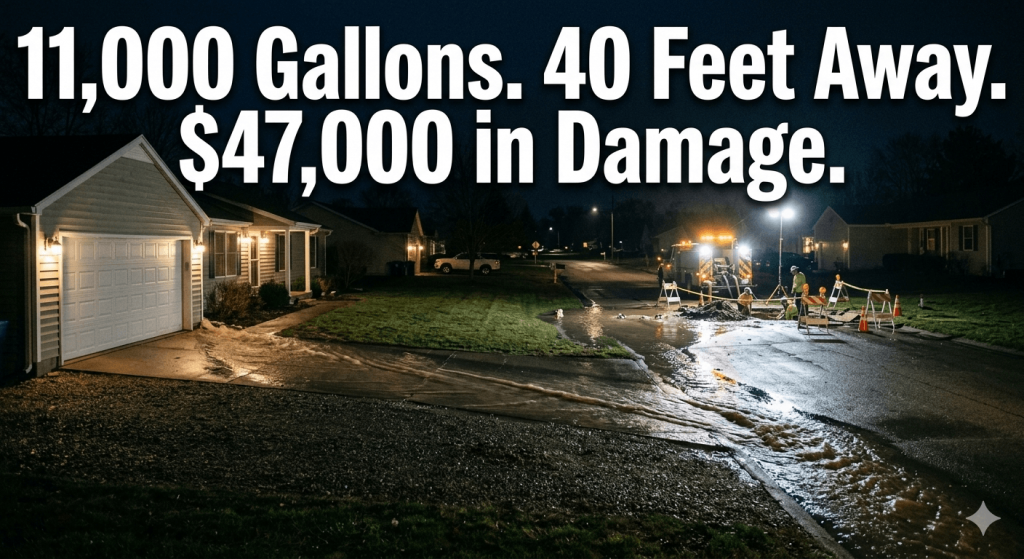
Last January, a Pine Lake homeowner woke at 5:47 AM to water in their garage. Not a dripping appliance. Not a burst pipe. A river moving across their driveway and under the garage door from the street.
A Sammamish Plateau Water and Sewer District main had failed overnight beneath the roadway 40 feet from their property line. Approximately 11,000 gallons had discharged before the district crew isolated the break. A significant portion of that volume had followed the natural grade of the Plateau directly toward the homeowner’s foundation.
By the time district crews arrived and flow stopped, the garage had 6 inches of standing water. The finished basement below had received water through every foundation gap the flowing water could find.
Total property damage: $47,000.
What followed was more confusing than the flood itself. The homeowner called their insurance company. Their insurance company called the City. The City referred them to the district’s risk management office. The district’s risk management office requested documentation the homeowner had not collected. Weeks passed. The restoration could not wait weeks.
PuroClean of Sammamish water main damage restoration began on day one while the liability question remained entirely unresolved. Because it always does. And because the documentation we generate from hour one of every project is precisely what determines whether a homeowner recovers their losses from the responsible party or absorbs them personally.
This guide explains the liability framework, the documentation requirements, and the emergency response sequence that Sammamish homeowners must understand before a water main break makes the education urgent.
Sammamish Water Infrastructure: What Is Actually Underground Beneath Your Street
Before understanding liability, Sammamish homeowners need to understand what is actually buried beneath the streets that adjoin their properties and what agency is responsible for each component.
The Sammamish Plateau Water and Sewer District serves approximately 32,000 residents across the Plateau through a pressurized distribution system of transmission mains, distribution mains, and service connections. According to the Sammamish Plateau Water and Sewer District infrastructure reports, the district’s pipeline infrastructure includes mains ranging from 4-inch distribution lines serving residential streets to 16-inch transmission mains carrying primary supply flow across the Plateau. A portion of this infrastructure dates to original Plateau development in the 1970s and 1980s.
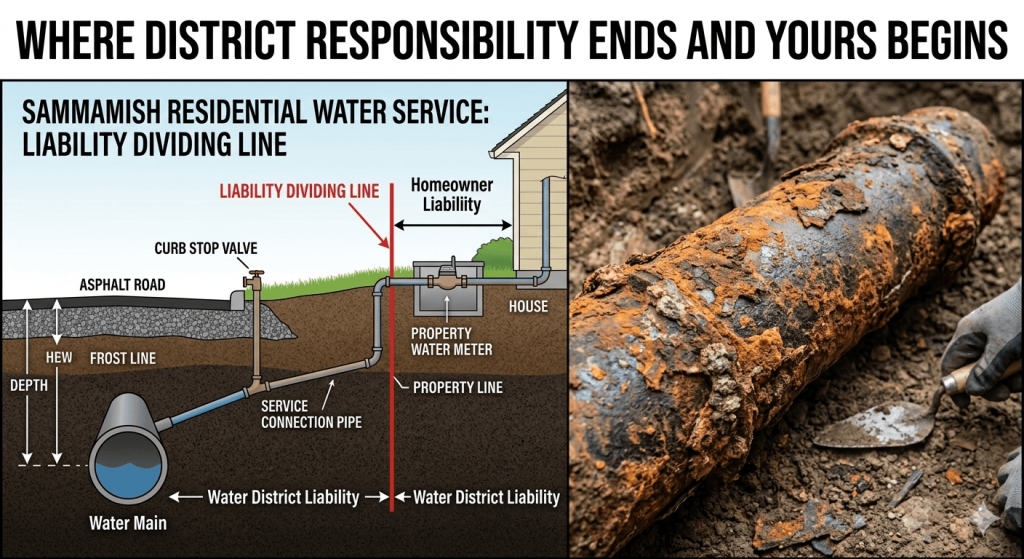
The service line boundary is the critical concept every Sammamish homeowner must understand. The district owns and maintains the water main in the street and the service connection up to the point where the service line meets the property owner’s meter or curb stop. Everything from that boundary into the home is the property owner’s responsibility. When a main fails on the district side of that boundary and water damages private property, the district’s liability exposure begins. When a service line fails between the meter and the home, the homeowner bears the cost.
According to Washington State RCW 86.12.020 governing municipal liability for infrastructure failures, governmental entities in Washington State are not automatically liable for property damage from infrastructure failures. Liability requires demonstrating that the agency had knowledge of the failing condition or acted negligently in its maintenance responsibilities. This distinction is what makes documentation at the moment of the failure so critical to a homeowner’s ultimate recovery.
The infrastructure age factor compounds this liability complexity. Ductile iron and cast iron mains installed during the Plateau’s 1970s and 1980s development have functional lifespans of 50 to 100 years depending on soil conditions, water chemistry, and operating pressure. Sammamish Plateau soils, with their clay content and seasonal moisture cycling, accelerate external corrosion on buried metal mains. A main that has been on the district’s maintenance radar for years represents a different liability posture than one that fails without prior indication.
PuroClean of Sammamish Water Main Damage -The First 60 Minutes: What You Document Determines What You Recover
When a water main break floods Sammamish residential property, the homeowner’s instinct is to focus on moving water and protecting belongings. That instinct is correct for personal safety. It is financially catastrophic for claim recovery if documentation does not happen simultaneously.
PuroClean of Sammamish water main damage restoration teams arrive with documentation protocols that run parallel to extraction operations from the first minute on site. But there is a window of evidence that closes before any restoration team arrives, and that window belongs entirely to the homeowner.
Photograph and video everything before moving anything. The water source direction, the depth of standing water, the entry points into the structure, the street condition showing the main break location, any district or utility crew activity, and the time stamps on every image are the foundation of every successful municipal liability claim. According to Washington State’s tort claims process under RCW 4.96, claims against governmental entities require specific documentation of the damaging event, the property damaged, and the responsible agency’s connection to the cause. Images timestamped to the event itself are irreplaceable evidence.
Record the district’s response. Note the time district crews arrived, the crew member names or badge numbers if visible, any statements made by district representatives about the main condition or failure cause, and the time water flow was stopped. These observations become part of the claim record and may be the only documentation of district knowledge regarding the failing main’s condition.
Do not sign anything from the district without legal review. District risk management representatives sometimes arrive at damage sites offering expedited settlement discussions. Washington State homeowners have 3 years to file tort claims against governmental entities under RCW 4.96. Accepting early settlement offers before full damage scope is documented by professional restoration teams frequently results in inadequate recovery relative to actual restoration costs.
Case Study: Issaquah Highlands — $52,000 Main Break, Documentation Saves the Claim
An Issaquah Highlands homeowner experienced a transmission main failure that discharged water across their lower yard and into their daylight basement. The homeowner photographed the street break location, the water flow direction across their property, standing water depth at three locations, and all visible entry points into the basement before PuroClean of Sammamish water main damage teams arrived. They recorded the names of two district crew members and documented one crew member’s statement that the main section had been flagged in the previous year’s infrastructure assessment. PuroClean’s moisture mapping and damage documentation combined with the homeowner’s event photography created a complete claim record. The district’s risk management office settled for $48,500 of the $52,000 total restoration cost within 90 days of the event. The 10-minute documentation effort the homeowner made before calling anyone else was the foundation of that recovery.
Liability Boundaries: Where City Responsibility Ends and Homeowner Exposure Begins
The liability determination in Sammamish water main damage events follows a framework that most homeowners discover only after the fact, when it is too late to change their documentation approach.
The district bears potential liability when the main failure itself caused the flooding, the district had prior knowledge of the main’s deteriorating condition, the district’s maintenance practices fell below the standard of care for similar infrastructure, or district crew actions during repair operations caused additional damage. According to the Washington State Attorney General’s guidance on governmental tort liability, establishing these elements requires evidence collected at the time of the event — not reconstructed afterward.
The homeowner bears full responsibility when private service line failure caused or contributed to the flooding, the property’s drainage systems were inadequate and would have flooded from normal precipitation events, the homeowner’s landscaping or grading directed flow toward the structure in ways that amplified damage beyond what the main break alone would have caused, or the homeowner failed to mitigate damage promptly after discovering the flooding.
The shared responsibility scenario is the most common and the most contested. When a main break discharges water that combines with normal rain event runoff and overwhelms the homeowner’s drainage system, determining which portion of the damage is attributable to the district versus pre-existing drainage inadequacy requires professional assessment and documentation. PuroClean of Sammamish water main damage restoration teams document the specific entry points and flow patterns that distinguish main break flooding from precipitation-related drainage in these mixed-cause events.
Case Study: Klahanie Street — $34,000 Shared Liability Determination
A Klahanie homeowner experienced flooding from a neighborhood distribution main failure that combined with a heavy January rain event. The district disputed full liability, arguing the homeowner’s inadequate yard drainage had contributed to the basement flooding. PuroClean of Sammamish water main damage documentation included moisture mapping showing flooding entered through foundation gaps at a height inconsistent with normal precipitation drainage and consistent with the lateral flow path from the main break location. The district’s own flow calculations, obtained through a public records request under Washington State RCW 42.56, showed discharge volume sufficient to have caused the flooding independently of precipitation. The district settled for $28,000 of the $34,000 restoration cost. Without the PuroClean documentation distinguishing the flood entry pattern, the shared liability dispute would have been unresolvable.
Your Homeowner’s Insurance: When It Covers Main Break Damage and When It Doesn’t
The relationship between homeowner’s insurance coverage and municipal liability claims in water main damage events creates confusion that costs Sammamish homeowners thousands of dollars annually in unnecessary out-of-pocket exposure.
According to the Washington State Office of the Insurance Commissioner, standard homeowner’s insurance policies cover sudden and accidental water damage from external sources in most configurations. A water main break flooding a basement is typically a covered sudden event under the dwelling coverage portion of a standard policy. Filing a homeowner’s claim triggers professional restoration immediately, preventing mold development and limiting total damage while the slower municipal liability claim process proceeds.
Filing the homeowner’s insurance claim does not waive subrogation rights against the district. Washington State insurance law allows carriers to pursue subrogation claims against liable third parties, including governmental entities, after paying covered claims. Many Sammamish homeowners avoid filing insurance claims in main break events because they fear premium impacts, while simultaneously failing to pursue municipal liability claims because they lack the documentation. The result is absorbing the full restoration cost personally.
The correct sequence is: file the homeowner’s insurance claim immediately to begin professional restoration, pursue the municipal liability claim simultaneously with complete documentation, and allow the insurance carrier’s subrogation process to recover against the district where liability is established. PuroClean of Sammamish water main damage documentation serves both processes simultaneously from the first project hour.
Filing a Claim Against the Sammamish Plateau Water and Sewer District: The Process Sammamish Homeowners Must Know
Washington State RCW 4.96 governs tort claims against governmental entities including special purpose districts like the Sammamish Plateau Water and Sewer District. The process has specific requirements that determine whether a claim is accepted for review.
Claims must be filed with the district’s designated agent within the applicable statute of limitations. Washington State allows 3 years for personal injury and property damage claims against governmental entities. Claims must include: a description of the incident including date, time, and location; a description of the property damaged; the claimant’s contact information; and a description of the damages claimed including estimated or documented costs.
According to Washington State RCW 4.96.020, governmental entities have 60 days to respond to properly filed tort claims before the claimant may file suit. During this period, the district’s risk management team investigates the claim using the documentation available. Claims supported by professional restoration documentation, including moisture mapping, damage assessment reports, and itemized restoration costs, consistently receive more complete responses than undocumented claims.
Public records requests under Washington State RCW 42.56 allow homeowners to obtain the district’s maintenance records for the specific main section that failed, any prior inspection findings or flagged conditions, and the district’s internal incident report for the failure event. These records frequently contain the evidence of prior knowledge that establishes district liability.
Frequently Asked Questions About Water Main Damage in Sammamish
Who is responsible for water main break damage to my Sammamish property?
Responsibility depends on where the failure occurred and whether the district had prior knowledge of the main’s deteriorating condition. The Sammamish Plateau Water and Sewer District owns and maintains mains up to the property meter or curb stop. When district-side main failure causes property flooding, the district bears potential liability under Washington State tort law if negligent maintenance or prior knowledge can be established. Documentation at the time of the event is the determining factor in liability recovery.
What should I do immediately when a water main break floods my property?
Photograph and video everything before moving anything: water source direction, standing water depth, entry points, street break location, and district crew activity. Record arrival times and any crew statements. Call PuroClean of Sammamish water main damage emergency line at (425) 947-1001 immediately to begin professional restoration and documentation. Call your homeowner’s insurance company to open a claim. Do not sign any district settlement documents without legal review. Every hour of delay in professional restoration increases mold risk and total restoration cost.
Does homeowners insurance cover water main break flooding in Washington State?
Most standard homeowner’s policies cover sudden and accidental water damage from external sources, which typically includes water main break flooding. According to the Washington State Office of the Insurance Commissioner, filing a homeowner’s claim does not waive your right to pursue the district for liability. Insurance carriers can pursue subrogation against liable governmental entities after paying covered claims. File your insurance claim immediately to begin restoration, then pursue the municipal liability claim simultaneously.
How do I file a claim against the Sammamish Plateau Water and Sewer District?
File a written tort claim with the district’s designated agent under Washington State RCW 4.96.020. Include the incident date, time, and location; a description of your damaged property; your contact information; and documented restoration costs. The district has 60 days to respond before you may file suit. Support your claim with PuroClean of Sammamish water main damage documentation, including moisture mapping reports and itemized restoration costs. Submit a public records request under RCW 42.56 for the district’s maintenance records on the failed main section.
How long do I have to file a claim against the district for water main damage?
Washington State allows 3 years to file tort claims against governmental entities under RCW 4.96. However, waiting significantly weakens claims because evidence degrades, crew memories fade, and district maintenance records become harder to connect to the specific failure event. File your claim within 30 to 60 days of the event with complete documentation. The 3-year limit is a legal deadline, not a recommended timeline.
Can I get the district’s maintenance records for the main that failed?
Yes. Washington State RCW 42.56 — the Public Records Act — requires governmental entities including special purpose water districts to provide inspection reports, maintenance logs, and internal incident reports upon written request. Submit your request to the district’s public records officer within 30 days of the event. These records frequently contain evidence of prior flagged conditions that establish district knowledge and support liability claims. PuroClean of Sammamish water main damage clients receive guidance on public records request procedures as part of our documentation support service.
When Water Main Damage Floods Your Sammamish Property, PuroClean Responds 24/7
Understanding the liability framework, documentation requirements, and claims process for PuroClean of Sammamish water main damage events gives Plateau homeowners the knowledge to protect their recovery from the first hour of an event that nobody planned for. But when 11,000 gallons of municipal discharge is moving through your garage at 5:47 AM, what matters is professional response from a team that knows exactly what to document, how to document it, and how to begin restoration before liability is resolved.
PuroClean of Sammamish provides 24/7 emergency water main damage restoration across Sahalee, Klahanie, Trossachs, Issaquah Highlands, and Pine Lake. We bring industrial water extraction systems scaled for municipal discharge volumes that dwarf typical residential appliance failures, thermal imaging mapping moisture migration through foundation walls and floor assemblies from the entry points outward, moisture mapping documentation formatted for insurance adjusters and district risk management claims simultaneously, public records request guidance specific to Sammamish Plateau Water and Sewer District procedures, and IICRC-certified technicians who understand that water main damage documentation is as important as water main damage restoration.
The Pine Lake homeowner who absorbed $47,000 in damages did not know what to document in the first 60 minutes. Now you do. Call PuroClean of Sammamish at (425) 947-1001 the moment municipal water reaches your property. The documentation window that determines your recovery opens at the same moment the water does.
Available 24/7/365 | (425) 947-1001 | Contact Us Online | Google Business Profile | IICRC Certified | True Emergency Response | Complete Water Main Damage Restoration


 PuroClean of Sammamish